
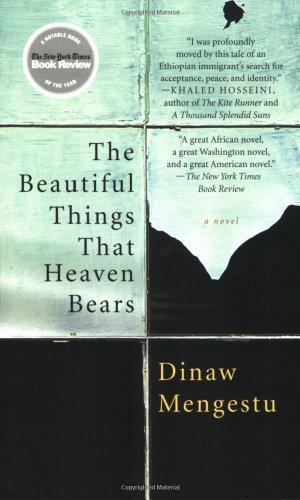
The Beautiful Things That Heaven Bears by Dinaw Mengestu

the beautiful things that heaven bears

The Beautiful Things That Heaven Bears

Dinaw Mengestu (Adult Fiction)

Seventeen years ago, Sepha Stephanos fled his home and the revolution in Ethiopia for the United States.  He shares an apartment with his uncle, attends college, and pursues the American dream.  Years later, Sepha owns and operates a grocery store in a poor and crime-ridden part of Washington, D.C.  As dilapidated buildings are bought and renovated and later occupied by affluent professionals, the neighborhood begins to experience a rebirth while Sepha experiences his own sense of awakening when he befriends his white neighbor Judith and her biracial daughter.  But as racial tensions rise within the neighborhood, Sepha soon finds that family and stability are once again threatened by forces beyond his control.

Mengestu is a talented writer whose words dance across the page and read like a finely-crafted poem.  When describing Judith’s house, he writes, “Its elaborately tiled roof, flaking like dried skin, was echoed in the shutters that still clung out of stubbornness to the delicately molded windows arched like a pair of cartoon eyes on both sides of the house.”  Unfortunately, the beauty of Mengestu’s prose isn’t enough to overcome an unsympathetic protagonist, as well as a tedious storyline that offers a wonderful description of the streets, sights, and sounds of the District of Columbia, but little else.  Had this novel been a memoir, I would understand and almost excuse the depressing and despondent nature of this book.  But since this is a work of fiction, it’s not clear why Mengestu made Sepha so unlikeable and unrelatable.  For example, Sepha has been in America for 17 years, but has managed to make only two friends (both fellow African immigrants).  Also, this same individual—who can wax Dante, Dickinson, and Dostoevsky with the best of them—is at an utter loss as to why his business is doing so poorly when he keeps inconsistent store hours (he opens the store when the mood strikes him) and stocks expired food on dusty shelves that sit atop dirty floors.

The Beautiful Things That Heaven Bears began like Sepha’s expectations when he came to America: full of hope and promise.  But as Sepha once said to his friend Kenneth, “Once you walk out on your life, it’s difficult to come back to it.”  That was almost the feeling I had with this book.  The constant self-pitying and overabundance of defeatism that can be found on just about every page made it difficult to come back to this book and to Sepha…and he deserves much better than that.

Rating: 3/5

*Book cover image attributed to www.textbookstar.com


A Million Shades of Gray by Cynthia Kadohata (J)

a million shades of gray

A Million Shades of Gray    

Cynthia Kadohata (Juvenile Fiction)

Even at eleven years old, Y’Tin Eban knew what his future would look like:  he would work with his elephant, Lady, until she died; he would travel to Ban Me Thuot then to Thailand and finally to America; and he would open an elephant-training school in Vietnam.  But it’s 1975 and the American soldiers have been gone from Vietnam for two years now.  Y’Tin and his tribe live in Central Highlands in South Vietnam and every day, soldiers from the north are advancing closer and closer to his village.  The Americans called it the Vietnam War.  His father called it the American War.  And now, this war was coming to Y’Tin’s remote part of the country and everything that his future once promised is about to change forever.

It’s never easy to discuss the horror and ugliness of war, especially when that discussion involves a younger audience (this book is targeted for readers ages ten and older).  Cynthia Kadohata is able to portray a country savagely torn apart by Civil War with remarkable honesty and sensitivity.  Because she is dealing with younger readers, she avoids graphic details and opts for subtle clues and visuals that guide readers to the desired conclusion.  For example, she describes a scene where captive male villagers are forced to dig a very long and deep pit on the outskirts of the village.  Older readers know immediately that this is a mass grave and the outlook is bleak for the villagers.  However, the younger reader shares the same learning curve as Y’Tin and both share in the eventual realization of what is actually taking place at the same time.

Several reviewers found this book to be too “anti-American” given the repeated mentions by the villagers of the Americans’ broken promise to return should assistance be needed.  But Kadohata foregoes popularity points by choosing to give us a story based on the villagers’ perspective.  They are a community that is scared, helpless, and feels very much abandoned and alone.  It’s an honest representation of the many thousands who were facing certain annihilation by their own government.  While this book deals mainly with war and its effects, at the heart is a young boy—rapidly thrown into manhood—and his relationship with his elephant, Lady.  The mutual trust they have for one another and the formidable bond they share serve as the singular bright spot in what is often a rather dark and grim story.

The book’s title, A Million Shades of Grey, refers to the colors of the jungle right before sunrise, as well as the color of an elephant’s hide.  In life, we often view things—view choices—as being a matter of “black or white”.  Kadohata reminds us that things aren’t always that simple and that every day we face or own “million shades of gray”.  At one time, Y’Tin said that you don’t love and you don’t make promises during times of war.  But it took his village’s smallest but strongest elephant to show him otherwise…that even during war, it is possible to have both.

Rating: 4/5

* Book cover image attributed to www.publishersweekly.com 


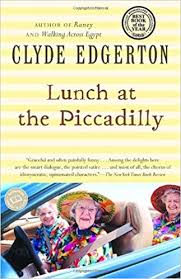
Lunch at the Piccadilly by Clyde Edgerton

lunch at the piccadilly

Lunch at the Piccadilly

Clyde Edgerton (Adult Fiction)

Carl Turnage is watching his beloved Aunt Lil—the last leaf of his family tree—slowly slip through his fingers.  Seeing that she is no longer safe living alone in her apartment and quite unreliable behind the wheel of her car, Carl sends her to a convalescent home to recuperate after suffering from a fall.  There she joins several other residents including Flora Talbert (who owns four colored housecoats and has an obsession with footwear), Clara Cochran (has a glass eye and a penchant for spewing obscenities), Maudie Lowe (the little woman), Beatrice Satterwhite (owns the “Cadillac” of walkers), and L. Ray Flowers (who is quick with a sermon and always looking for a song).  Despite the laidback atmosphere that Rosehaven Convalescence Center offers, Aunt Lil isn’t ready to take it easy just yet.  She wants adventure and she is bound and determined to find it…one way or another.

Lunch at the Piccadilly clocks in at 238 pages (not counting the Epilogue).  After reading ninety-three percent of the book, it inexplicably fell apart.  It was absolutely agonizing to see this witty and charming book careen so horribly and fatally off course.  The last few pages lacked what the entire book simply overflowed with:  heart and soul.  Edgerton’s novel was a poignant, funny (with a few laugh-out-loud moments), and compassionate book with characters dealing with loss of mobility, loss of independence, and loss of memory.  He gives us several women with an insatiable zest for life, but know that the mortality clock is ticking louder and louder with each passing day.  Why this same passion and fervor failed to carry through until the last page is both confusing and disappointing.  However, the ending wasn’t the only problem.  There was also a salacious backstory that kept resurfacing throughout various points of the story.  This past event between two of Rosehaven’s residents really had no purpose, lent no value to the story, and only managed to introduce some unneeded drama and friction.  Also, L. Ray’s need to break out into lengthy religions sermons broke the momentum of the story and was irritating at best.

It truly was heartbreaking and frustrating to see a book with this much promise and value self-destruct so quickly.  I felt a little duped in the emotional commitment I invested in caring about these sassy, snarky, and spirited seniors who are making the best of what little life they have left.  In the end, I felt as if this book was like one of Rosehaven’s residents who stands steadfastly by the front door, waiting for visiting family or friends that will never come.  No matter how many times I might flip back in the book, looking tirelessly for my sense of closure, I realize that that too will never come.

Rating: 3/5

*Book cover image attributed to www.amazon.com


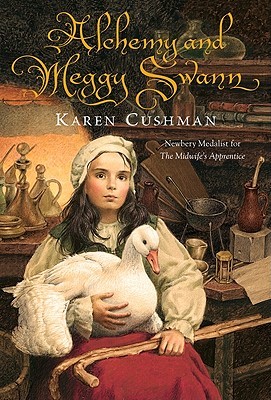
Alchemy and Meggy Swann by Karen Cushman (YA Historical Fiction)

Alchemy and Meggy Swann

Alchemy and Meggy Swann   

Karen Cushman (Young Adult Historical Fiction)

“The meeting of two personalities is like the contact of two chemical substances; if there is any reaction, both are transformed.” – Carl Jung

After the death of her gran, Margaret “Meggy” Swann is carted from Millford Village to London and unceremoniously deposited at the doorstep of her father, Master Ambrose, the local alchemist.  Meggy is none too pleased with her new home: heads mounted on sticks and placed on a bridge, the smell of fish and sewage everywhere, and streets slick and slippery from horse droppings.  Ye toads and vipers!  What kind of place IS this London?  Between a mother who was pleased to see the back of her and a father who assumes she is a beggar upon their first introduction, Meggy has found herself in a rather unenviable position.  She is crippled, penniless, and friendless…unless you count her goose, Louise.  But Meggy is stronger than she thinks and with the help of a cooper, a printer, and a rather smitten player, she’ll not only save a life, but she’ll manage to save a soul as well.

From her first utterance of, “Ye toads and vipers”, I fell in love with Meggy Swann.  She is scrappy, sassy, resourceful, impish, loyal, and brave.  She is disabled (suffering from what we would today recognize as bilateral hip dysplasia), but doesn’t seek sympathy, pity, or charity.  In a time when deformity and illness were viewed as a direct judgment from God, it would have been easy for Meggy to become bitter from the taunts and jeers unmercifully thrown at her by villagers both young and old alike.  While in Millford Village, she was able to stay somewhat isolated and protected within her mother’s alehouse; however, in London her lameness is on full display and it is at this moment when we see Meggy’s pluck and spirit begin to emerge.  No longer will she be the meek victim of unfair slurs and prejudices.  While her father is busy transforming metals in his laboratorium, Meggy is experiencing her own transformation into a strong, proud, and confident young woman who refuses to let her circumstances define or limit her.

This story is set in 1573 London and Cushman successfully transports readers to the Elizabethan Era through her usage of period-appropriate language.  This requires having to adjust to the frequent occurrences of words such as naught (nothing), certes (certainly), mayhap (perhaps), belike (very likely), and sooth (truth), but given the age this book targets (12 years and above), the acclimation should be quick and painless.

There are so many lessons that one could glean from this book, but perhaps the most poignant was one that Meggy learned from a flightless goose: “Even Louise had given the girl something, the knowledge that one did not have to be perfect to be beauteous.”  And that is something worth remembering, be ye toad or viper.

Rating: 5/5

* Book cover image attributed to www.goodreads.com

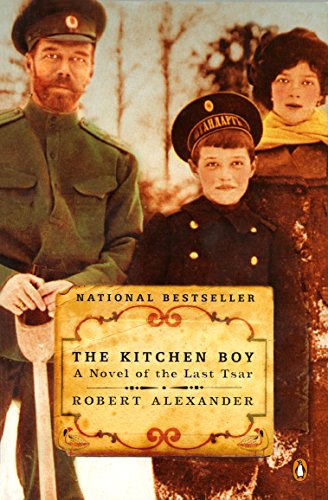
The Kitchen Boy: A Novel of the Last Tsar by Robert Alexander

the kitchen boy

The Kitchen Boy: A Novel of the Last Tsar

Robert Alexander (Adult Fiction)

“My name is Mikhail Semyonov.  No, my real name—the one given to me at birth—was Leonid Sednyov, and I was known as Leonka.  Please forgive my years of lies, but now I tell you the truth.  What I wish to confess is that I was the kitchen boy in the Ipatiev House where the Tsar and Tsarista, Nikolai and Aleksandra, were imprisoned…and I saw them shot.  Trust me, believe me, when I say this: I am the last living witness and I alone know what really happened that awful night…just as I alone know where the bodies of the two missing children are to be found.  You see, I took care of them with my own hands.”

Mikhail (Misha) Semyonov is ninety-four years old.  He’s a man who’s tired of living with the knowledge of what he has caused, what he has seen, and what he has done.  Before he dies, he begins dictating his story into a small black tape recorder that will be given to his granddaughter upon his death.  Misha desires neither understanding nor absolution.  He merely wants the truth to finally be known and perhaps, at last, it will.

It’s one thing to read about the execution of the Romanov family during the late-night/early hours of July 16-17, 1918.  The information gleaned from a history book or online is rather antiseptic—a blurb here, a mention there.  On the contrary, what we get from Robert Alexander is an emotional, personal, and in-depth portrayal of a father, a mother, and their five children.  We get a glimpse of Nikolai Aleksandrovich and Aleksandra Fyodorovna not as Tsar and Tsarista, but as a loving husband and wife and doting parents.  Viewing them in this light makes reading about their horrific and heinous murders all the more gut-wrenching and abhorrent.  They are not merely line items, but flesh and blood who love, hate, fear, and trust.  Because of this humanistic portrayal of the royal family and the two weeks leading up to their execution, we almost forget that this is based on fact, and we futilely hold out hope for a courageous midnight rescue or a perilous, well-planned escape…although history reminds us that neither will happen.

This book held a few surprises for me.  First, the number of secret notes, letters, and diaries that not only survived, but were preserved.  I found this astonishing given the Bolsheviks’ ruthless intent to wholly wipe out the very existence of the Romanovs.  It was also interesting to learn how the Romanovs planned to smuggle their vast family fortune once they acquired liberation (I will not elaborate further should this be new to you as well).  Third, the ending was purely unexpected and opened up a whole new prospect of “What if….”.  Just when you think you’ve reached the end of the story, Alexander gives us one final jolt that depletes the room of oxygen and leaves us wishing that his work of fiction was indeed fact.  What if…

Rating: 5/5

*Book cover image attributed to www.amazon.com


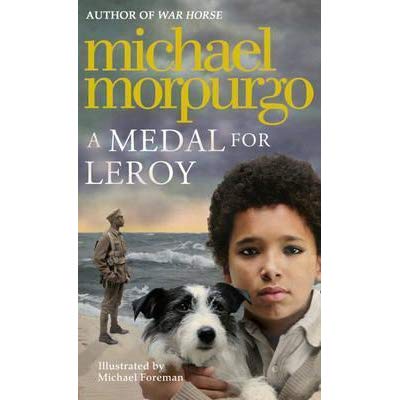
A Medal for Leroy by Michael Morpurgo (J Historical Fiction)

A Medal for Leroy

A Medal for Leroy   

Michael Morpurgo (Juvenile Historical Fiction)

Michael has no father, brothers, or sisters.  Just his mother, Maman, and two aunts:  Auntie Pish and Auntie Snowdrop.  It is 1940s London and right after the war.  Michael’s friends call him “Poodle” because of his frizzy hair and French ancestry.  But Michael doesn’t mind much.  In fact, he likes being different, being special.  Regarding his father, Michael knows only what his mother has told him:  his father’s name was Roy, he was a Spitfire pilot, and he was killed in the war.  But when Michael’s aunt passes away, she leaves behind a clue that will not only shed light on his past, but also finally reveal who he is.

A Medal for Leroy was inspired by the true story of Walter Tull, the first black person to serve as an officer in the British Army.  Like his fictional counterpart in this story (Michael’s grandfather, Leroy), Tull grew up in an orphanage, played soccer, served heroically in battle, and has no known grave.  Both Tull and Leroy deserved a medal for bravery, but were denied because of the color of their skin.  Morpurgo is a master storyteller (author of the spectacular novel War Horse) and provides his characters with a surprising amount of depth given that his book is only 130 pages.  He delicately tackles the ugliness of racial intolerance and inequality while showing young readers the value of having dignity in the face of disgrace and showing love without reservations or conditions.

In a world that still seems divided by so many factors, it is worth looking at the words that Michael’s aunt, who served as a nurse during the First World War, wrote to Michael: “It was while I was with those poor wounded soldiers that I first understood, Michael, that when all’s said and done, it’s what we all want and need most: to love and to be loved.”  Words lovingly passed along to a beloved nephew that would serve us all to remember today and always.

Rating: 4/5

* Book cover image attributed to www.goodreads.com


In the Year of the Boar and Jackie Robinson by Bette Bao Lord (J)

In the Year of the Boar and Jackie Robinson

In the Year of the Boar and Jackie Robinson   

Bette Bao Lord (Juvenile Fiction)

Bandit is confused.  What would make Mother smirk, Grandmother cry, and Grandfather angry?  The House of Wong is certainly unsettled, but why?  Bandit quickly learns that her father will not be returning to Chungking.  Instead, she and her mother will be going to him…to America.  But Bandit isn’t worried because no bad luck will come her way.  This is the year of the Boar and travel, adventure, and double happiness await her.  Soon, Bandit will begin her journey from China to San Francisco to her eventual home in Brooklyn, New York.  She will travel thousands of miles with a new name and new dreams.  But will America be all that Bandit hopes it will be?

In the Year of the Boar and Jackie Robinson is a charming and humorous story largely based on Bette Bao Lord’s own experiences as a newcomer to America.  Bandit (who adopts an American name of Shirley Temple Wong) endures teasing, bullying, and rejection that often comes with simply being different.  Despite her difficulties with fitting in, she is constantly reminded by her mother of the importance of maintaining your self-respect despite struggling through ridicule: “Always be worthy, my daughter, of your good fortune.  Born to an illustrious clan from an ancient civilization of China, you now live in the land of plenty and opportunity.  By your conduct show that you deserve to enjoy the best of both worlds.”  Her mother’s words serve as a valuable reassurance to Bandit that her past life in China need not be forgotten or sacrificed for her present life in America.  She is much richer for having both.

Despite her trials and torments, Bandit makes friends through America’s favorite pastime—baseball—and its formidable hero, Jackie Robinson and realizes that things are not always what they appear to be.  On the day Bandit gains the unlikeliest of allies, she recalls something that her grandfather had told her many times: “Things are not what they seem.  Good can be bad.  Bad can be good.  Sadness can be happiness.  Joy, sorrow.”  In the year of the Boar, Bandit discovers the pride in being yourself and the value of friends who accept you just the way you are.  Double happiness.

Rating: 4/5

* Book cover image attributed to www.harpercollins.com


Balzac and the Little Chinese Seamstress by Dai Sijie

Balzac and the Little Chinese Seamstress

Balzac and the Little Chinese Seamstress

Dai Sijie (Adult Fiction)

It was in early 1971 when two “city youths”—ages 17 and 18—were banished to the mountain known as the Phoenix of the Sky.  Boyhood friends, they were to be re-educated as part of Chairman Mao’s Cultural Revolution in China.  If they were fortunate, they would be reunited with their families after two years.  But they were not the offspring of average parents.  Instead, their parents—professional, respected, educated—were classed as enemies of the people, and their chances of release currently stood at three in a thousand.  So, the two spent their days laboring in the paddy fields, working in the mines, or carrying human and animal waste on their backs.  But one fateful day, their village headman sent them to the district of Yong Jing.  That journey would culminate with the princess of Phoenix Mountain, a miller, and an author named Honoré de Balzac.

Dai Sijie himself was re-educated and spent between 1971 to 1974 in the mountains of Sichuan Province.  His experiences undoubtedly gave this novel its authenticity, depth, and richness.  I knew very little of Mao Zedong’s 10-year movement to preserve Chinese Communism through the cultural eradication of capitalism and tradition.  Needless to say, the results were disastrous: economically, politically, and societally.  Sijie gives us a glimpse of the isolation, fear, and hysteria suffered by those who were sent away through the eyes of our 17-year old narrator (unnamed) and his 18-year friend, Luo.  When the two come across a hidden collection of translated Western classics, their worlds expand as they are introduced to the foreign feelings of lust, jealousy, revenge, and honor.  Matters are further complicated when they share these novels with the local tailor’s daughter, the Little Seamstress.

I truly enjoyed this book and found it as light and airy as a basting stitch.  It read like a well-crafted fable and the scenes were sewn together seamlessly.  It was a delightful read that reinforces the idea that the written word is often just as powerful suppressed as it is unleashed.  Albert Einstein said, “A little knowledge is a dangerous thing.  So is a lot.”  Balzac and the Little Chinese Seamstress reminds us that once a book is opened, so is the mind and when the mind is opened, the heart takes flight.  Perhaps for this reason alone, there are still those in the world who wish books to remain closed.

Rating: 4/5

* Book cover image attributed to www.amazon.com 


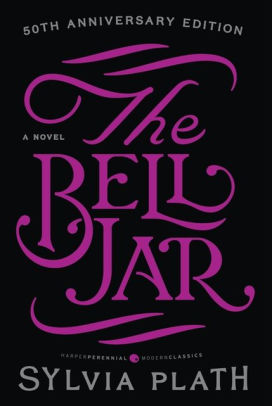
The Bell Jar by Sylvia Plath

The Bell Jar

The Bell Jar

Sylvia Plath (Adult Fiction)

Esther Greenwood knew something was wrong with her that summer, and it wasn’t just the electrocution of the Rosenbergs or all the non-stop talk surrounding it.  She was supposed to be having the time of her life.  She was in New York and living the high life—a far cry from her 19 years living in a small New England town.  It was the summer of 1953 and what Esther knew for certain was that one of her troubles was Doreen.

Published in 1963, The Bell Jar was poet Sylvia Plath’s first and only novel.  Weeks after her book’s publication, Plath committed suicide at the age of 30.  Given that Plath’s personal struggles with money and depression parallels those of her main character, it is understandable why many view The Bell Jar as being semi-autobiographical.  Although this book deals with grave and bleak issues, Plath’s poetic prowess shines through giving readers a story that is poignant yet subtly lighthearted.  Although Plath’s future as a novelist would never be fully realized, she managed to give us a heroine that epitomized the women of her day.  The feminist movement saw its beginnings in 1963 and Plath put Esther right on the front lines—questioning societal views on conformity, conservatism, femininity, marriage, and family.

Much has changed since the release of The Bell Jar, but the increasing number of individuals diagnosed with depression or anxiety, as well as the rise in suicides, continue to make this novel timely and relevant.  Throughout the story, told in first-person narrative, Esther often describes herself as existing inside a bell jar: continually experiencing isolation and detachment from the outside world, always feeling that she is on display and expected to be more than she is or ever will be, and constantly struggling to be “perfect”.  When Esther learned that the famous novelist, Philomena Guinea, would be willing to pay for her treatment and education, Esther could conjure up neither gratitude nor any amount of relief: “I knew I should be grateful to Mrs. Guinea, only I couldn’t feel a thing.  If Mrs. Guinea had given me a ticket to Europe, or a round-the-world cruise, it wouldn’t have made one scrap of difference to me, because wherever I sat—on the deck of a ship or at a street café in Paris or Bangkok—I would be sitting under the same bell jar, stewing in my own sour air.”

Esther Greenwood is a young woman trapped in a life that she is tired of living, yet afraid of leaving.  During her story, I often found myself silently cheering those times when the seal of her bell jar was lifted just enough to allow a bit a fresh air to seep through.  It was during these times that I hoped Esther, and others who suffer under their own bell jar, would be able to momentarily experience a feeling of joy, worth, and hope.

Rating: 5/5

*Book cover image attributed to www.barnesandnoble.com


Top 10 Picks for 2018

The Dusty Jacket’s Top 10 Picks for 2018*

Adult Fiction/Biography

  1. The Kitchen House by Kathleen Grissom (reviewed March 2018)
  2. Little Bee by Chris Cleave (reviewed May 2018)
  3. Whistling Past the Graveyard by Susan Crandall (reviewed June 2018)
  4. The Invisible Wall (Biography) by Harry Bernstein (reviewed June 2018)
  5. A Long Way Gone: Memoirs of a Boy Soldier (Biography) by Ishmael Beah (reviewed July 2018)
  6. The Dressmaker by Kate Alcott (reviewed July 2018)
  7. Snow Flower and the Secret Fan by Lisa See (reviewed August 2018)
  8. The Beggar King and the Secret of Happiness (Biography) by Joel ben Izzy (reviewed September 2018)
  9. The Miracle Life of Edgar Mint by Brady Udall (reviewed November 2018)
  10. The Reader by Bernhard Schlink (reviewed November 2018)

Juvenile/Young Adult

  1. My Side of the Mountain (J) by Jean Craighead George (reviewed March 2018)
  2. The Devil’s Arithmetic (YA) by Jane Yolen (reviewed April 2018)
  3. Sadako and the Thousand Paper Cranes (J Biography) by Eleanor Coerr (reviewed April 2018)
  4. Island of the Blue Dolphins (J) by Scott O’Dell (reviewed April 2018)
  5. Homeless Bird (YA) by Gloria Whelan (reviewed May 2018)
  6. Fever 1793 (YA) by Laurie Halse Anderson (reviewed June 2018)
  7. The Seven Wonders of Sassafras Springs (J) by Betty G. Birney (reviewed August 2018)
  8. The Miraculous Journey of Edward Tulane (J) by Kate DiCamillo (reviewed August 2018)
  9. The Incredible Journey (J) by Sheila Burnford (reviewed November 2018)
  10. The Terrible Thing That Happened to Barnaby Brocket (J) by John Boyne (reviewed November 2018)


*List contains selections reviewed in 2018