
Miss Hickory by Carolyn Sherwin Bailey (J)

Miss Hickory

Miss Hickory

Carolyn Sherwin Bailey (Juvenile Fiction)

Miss Hickory had an apple-wood twig body, hickory nut head, and wore a rather smart checked gingham dress.  She lived a fine and comfortable life under the lilac bush in a corncob house.  Before winter set in, Great-Granny Brown would bring Miss Hickory’s house (and her along with it) into the Old Place and set both on the windowsill to pass the time amiably until springtime.  But this year, Crow had brought some terrible news.  It seems that Great-Granny Brown has closed up the Old Place for the winter and has decided to spend the winter in Boston in some place called the Women’s City Club.  Abandoned, dismayed, and soon-to-be evicted, what is Miss Hickory to do?  Leave it to her old friend Crow to not only offer up a solution, but an adventure to boot!

1947 Newbery Medal Winner, Miss Hickory is NOT to be confused with some run-of-the-mill children’s story.  Oh no!  For author Carolyn Sherwin Bailey advises her readers at the beginning of her story that all of her characters—from Miss Hickory to Crow to Squirrel and even Hen-Pheasant—are very much real and alive (save for one, but I don’t wish to spoil the story).  Bailey gives us a wonderful adventure tale that centers around one very prissy, self-centered, judgmental, and rather pretentious Miss Hickory.  We follow her seasonal exploits in the orchard that sits beside the Old Place.  Readers get to meet many colorful characters such as fearful Ground Hog, spoiled Chipmunk, and worldly Wild-Heifer.  As Miss Hickory encounters each of these wonderful creatures, she grows a bit in experience, character, and self-actualization.

Miss Hickory is a beautifully told story complemented by Ruth Gannett’s exquisite lithographs.  Her drawings give an earthy and rustic feel to a tale celebrating nature and wildlife.  Bailey spent her summers at a home in New Hampshire that adjoined an apple orchard.  Her keen observational skills allow readers to be transported to a world where you can delight in the purple asters, smell the fragrant pine needles, taste the berries and nuts, and feel the crunch of autumn leaves beneath your feet.

SPOILER: Although younger readers may find the ending a bit sad, Miss Hickory is truly a celebration of discovering your personal worth and finding your place in the world (adults may have to help them look for this silver lining).  In the end—although Miss Hickory was a bit “hardheaded”—she discovered that home is more than a structure, it’s a sense of belonging.  And although she was a bit of a nut (sorry!), Miss Hickory shows us that is does pay to listen to your heart rather than your head, that you can’t always judge a book by its cover, and—most importantly—that you should always, ALWAYS be nice to squirrels because making them angry would be just plain…nutty.

Rating: 4/5

*Book cover image attributed to www.discoverbooks.com

**Want more?  Visit our Facebook page at www.facebook.com/thedustyjacket
Fortunately, the Milk by Neil Gaiman (J)

Fortunately the Milk

Fortunately, the Milk   

Neil Gaiman (Juvenile Fiction)

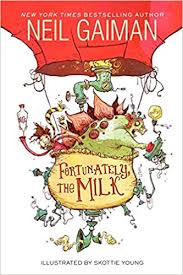
Mom was off to a conference so Dad was in charge.  She had given him loads to remember, but the most important of all was, “Oh, and we’re almost out of milk.  You’ll need to pick some up.”  You couldn’t very well put orange juice on your Toastios.  Or pickle juice.  Or mayonnaise or ketchup.  So Dad went to the corner store for milk (and NOT the fat-free kind because it tastes like water!!!).  After he returned after being gone an unusually long time, he plopped down the milk and told his two children the most unbelievable story they had ever heard.  A story about aliens and dinosaurs and time travel and pirates and ponies and vampires and…  Well, perhaps it’s best if you were to hear it from Dad himself because you wouldn’t believe it if I were to tell it.

From the imagination that is uniquely Neil Gaiman, Fortunately, the Milk is a story filled with charm, wit, and humor.  It’s a quick read that would make for a wonderfully entertaining bedtime story.  Bursting with unforgettable characters (a time-travelling stegosaurus inventor anyone?) and an action-packed race through time (literally), Gaiman gives us a tale where the universe sits precariously on the shoulders of a dad simply trying to get back home with a bottle of milk.

Perhaps the real star of this book is Skottie Young’s outrageously fantastic illustrations.  His pen-and-ink drawings are what you might get if you were to give Tim Burton’s brain a pen and a piece of paper.  They are as whimsical, outlandish, and over-the-top delightful as Gaiman’s story and both combine to give young readers an epic journey through space, time, and around the block to the corner grocer.

So whether you’re into science fiction, fantasy, comedy, or just enjoy reading about boogers and snot (those aliens are really quite disgusting), you’re sure to enjoy this little gem of a book.  Even if you do enjoy pickle juice with your Toastios…weirdo.

Rating: 4/5

*Book cover image attributed to www.amazon.com

**Want more?  Visit our Facebook page at www.facebook.com/thedustyjacket

Dead Boy by Laurel Gale (J)

Dead Boy

Dead Boy

Laurel Gale (Juvenile Fiction)

Being dead stank.  Literally.  With everything rotting, decaying, and decomposing, it really did stink.  And let’s not talk about the maggots and the skin falling off and the hair falling out.  Death was really the pits and eleven-year-old Crow Darlingson should know because Crow is dead.  Well, dead but somehow alive.  If you ask Crow what’s worse than being dead, he would tell you that it’s being alone.  Loneliness really stank.  But along came Melody Plympton, his new neighbor, who somehow accepted his deadness.  Just when things were looking up, Crow and Melody discover a terrifying and mysterious creature hiding in the park.  A monster that also grants wishes.  Could this same creature be the cause of Crow’s unusual existence?  Could Crow somehow wish himself a normal life?  Crow is willing to face whatever tests and dangers the monster throws at him.  After all, once you’re dead, what’s the worst that can happen?

Dead Boy is Laurel Gale’s debut novel and she sure delivers!  She delights and entertains readers with a creepy, ghoulish, sweet, and imaginative story that’s full of heart.  Although it’s labeled as a “horror” story and depicts scenes of maggots falling out of various body parts at inappropriate times (not that there’s an appropriate time), Dead Boy is really a story about a young boy wanting to be accepted and longing for a friend.  Anyone who’s ever wanted a friend who liked and accepted them for just the way they are will empathize with Crow and his unfortunate situation.

What I found refreshing about Crow was his ability to see the positive in any situation and to enjoy what little pleasure life might happen to toss his way.  Here’s a boy with no friends, unable to eat food, incapable of sleep, and whose entire existence is spent indoors surrounded by the safety of air conditioning (he lives in the desert of all places), yet he delights in the simple act of lying beneath the stars and gazing up at the night’s sky.  He’s selfless, understanding, intelligent, loyal, and a true friend in every sense of the word.  He’s probably one of the most unlikely protagonists that I’ve come upon in a long time and I certainly hope he won’t be the last.

Near the end of the book, when the dust has settled after all of his exploits and adventures, Crow realized something important that beautifully sums up the meaning of this book: “Maybe having friends wasn’t as important as having the right friends”.

Rating: 4/5

*Book cover image attributed to www.goodreads.com

**Want more?  Visit our Facebook page at www.facebook.com/thedustyjacket
Shadow of a Bull by Maia Wojciechowska (J)

Shadow of a Bull

Shadow of a Bull    

Maia Wojciechowska (Juvenile Fiction)

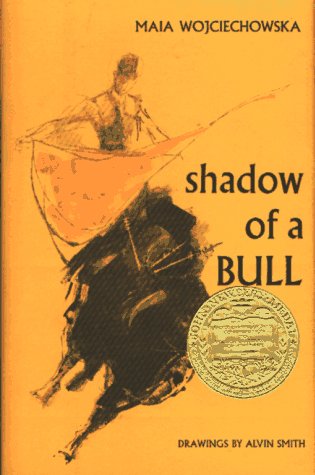
When Manolo was nine he became aware of three important facts in his life.  First: the older he became, the more he looked like his father. Second: he, Manolo Olivar, was a coward.  Third: everyone in the town of Arcangel expected him to grow up to be a famous bullfighter, like his father.

To be a bullfighter was to be revered for a bullfighter was a hero, a magician, and a killer of death.  In Arcangel, death came in the form of a bull and to conquer death brought glory to yourself, your family, and your country.  Manolo was the son of Juan Olivar, the greatest bullfighter in Spain.  Ever since his father’s death, everyone anxiously awaited the day when Manolo would take his father’s place and Spain would once again have a hero.  But unlike his father, Manolo’s future was not prophesied for greatness and he worried that his heart would never allow him to live up to the expectations of his town or the legacy left by his father.

Maia Wojciechowska’s Shadow of a Bull (winner of the 1965 Newberry Award) is a book brimming with valuable lessons and important messages of self-worth, self-confidence, and self-importance.  She encourages the reader to question the idea of heroes and those we choose to idolize—the celebrated sports figure or the wizened town physician—and she shows us the emotional and physical price of sacrificing your own future in order to carry on someone else’s.  She writes of life versus death, bravery versus fear, and a dream versus destiny.  It’s a lot to take in, but Wojciechowska lays out all of these issues as smoothly as a matador works his cape.

Shadow of a Bull is rich in its history and detail regarding the art of bullfighting.  Readers will learn the training involved and will be introduced to several Spanish terms (pronunciation guide and definitions are included at the back of the book).   It’s an effective primer for the sport that may test the patience of a few readers, but proves interesting nonetheless.  Above all else, Wojciechowska doesn’t let us forget that the heart of this book is young Manolo, a boy wishing to bring honor to his family by fulfilling a future that is beyond his desire or control.  He carries the hopes and dreams of an entire country on his very small shoulders and we feel the weight of this burden grow heavier as the day of his testing nears.  It’s a beautifully told coming-of-age story of a boy trying to discover his place in the world.

Walter M. Schirra, Sr.—a fighter pilot during World War I and father of Wally Schirra, the only astronaut to fly in the Mercury, Gemini, and Apollo programs—once said, “You don’t raise heroes, you raise sons.  And if you treat them like sons, they’ll turn out to be heroes, even if it’s just in your own eyes.”  By being true to himself, Manolo found honor beyond the shadow of a bull and was able to become a hero in his own right.

Rating: 5/5

* Book cover image attributed to www.abebooks.com 

**Want more?  Visit our Facebook page at www.facebook.com/thedustyjacket

The Breaker Boys by Pat Hughes (J)

The Breaker Boys

The Breaker Boys

Pat Hughes (Juvenile Fiction)

Nate Tanner was born into privilege.  For several generations, his family has owned coal mines near Hazelton, Pennsylvania allowing Nate to have anything he desired: the best education, the finest clothes, and a bevy of servants to see to his every need.  What Nate didn’t have was a single friend.  Perhaps it was because of his temper or that he was spoiled or that he was always getting into trouble.  Maybe it was all three.  Like his teacher said, when you had so much, what was left to try for?  But then he met Johnny Bartelak, a Polish American boy who sorts coal in one of his family’s breakers.  Theirs was a friendship that started with a simple bike ride, but would slowly be built with lie upon lie.  How could Nate tell Johnny the truth about his family and how could he possibly tell his family about Johnny?  As the miners begin to talk of joining a labor union, Nate must make the ultimate choice between friendship and family.

The Breaker Boys is based on actual events that occurred on September 10, 1897 at the Lattimer mine near Hazelton, Pennsylvania.  Known as the Lattimer Massacre, nineteen striking immigrant coal miners were killed and thirty-nine others were wounded.  The miners were mostly of Polish, Slovak, Lithuanian, and German ethnicity and author Pat Hughes brings their story and struggles to life in this thoughtful and moving story about friendship, honor, forgiveness, and betrayal.  Although Hughes fills her novel with plenty of conflicts—rich versus poor, father versus son, labor versus management, immigrant versus native—the story never feels bogged down or overly preachy and the action and emotions slowly intensify as Nate’s secret becomes closer and closer to being discovered.

Hughes also takes her time in allowing the reader to get to know Nate Tanner—a spoiled, self-indulgent, self-centered, rude, and disrespectful twelve-year-old boy whose mother died while he was quite young and who has still not forgiven his father for marrying the family’s governess.  To her credit, Hughes made Nate very human and avoided giving him an Ebenezer Scrooge or Grinch moment where he sees the error of his ways and experiences a complete moral transformation.  Nate is, after all, a young boy with a lot of growing up to do and so we continue to see moments of selfishness, arrogance, and stubbornness throughout the book, which makes his character all the more relatable and sympathetic.

The Breaker Boys is gripping and insightful and offers readers a glimpse into American history while illustrating the importance of honesty, the value of friendship, and the gift of second chances.  American educator, author, and businessman Stephen Covey said, “Strength lies in differences, not in similarities” and Pat Hughes shows us that despite differences in class, ethnicity, and religion, two young boys found strength and friendship through something as simple as a bike ride.

Rating: 5/5

*Book cover image attributed to www.amazon.com

**Want more?  Visit our Facebook page at www.facebook.com/thedustyjacket

The Stinky Cheese Man and other Fairly Stupid Tales by Jon Scieszka (J)

The Stinky Cheese Man

The Stinky Cheese Man and other Fairly Stupid Tales

Jon Scieskza (Juvenile Fiction)

Meet Jack:  adventurer, trespasser, thief, giant agitator, and—for this particular occasion—narrator of our story.  But this isn’t just any story, but rather several stories.  Stories of a princess, a fibbing frog, a giant, a tortoise and a rather hairy hare, an athletic little girl, an obnoxious chicken, and yes, a stinky cheese man.  These stories will not only entertain, amuse, and delight, but they may—one day—just save your life!  Don’t believe me?  Just ask Jack.

The Stinky Cheese Man and other Fairly Stupid Tales is a wonderful read-out-loud book that will undoubtedly induce a few chuckles, giggles, guffaws and perhaps an eyeroll or two.  But make no mistake that the star of this book is not the stories, but rather the incredible, award-winning artwork of Lane Smith (who collaborated with Jon Scieszka again in creating The True Story of the Three Little Pigs!).  His over-the-top, dark, eclectic, multi-media illustrations earned Smith the 1993 Caldecott Medal Honor award and are the very vibrant and outlandish heart of this outrageously enchanting book.  Lacking any moral lessons whatsoever, unless you count “When in the presence of giants, it’s best to keep your mouth shut” or “Sometimes there is no happy ever after so get over it”, Scieszka encourages us to see the ridiculous side of life, to accept life for what it is, and to remind us that sometimes tales, even fairly stupid ones, can simply be enjoyed without having an ulterior motive.

Danish author Hans Christian Andersen, known for his own fairy tales, once said, “Life itself is the most wonderful fairy tale.”  Indeed, it is.  So, here’s to living life to its fullest, filling it with plenty of laughter and silliness, and creating your own happily ever after because if you don’t, you just might get eaten up by a giant.  The End.

Rating: 4/5

*Book cover image attributed to www.amazon.com

**Want more?  Visit our Facebook page at www.facebook.com/thedustyjacket

 

Top 10 Picks for 2019

Top

Below is our annual Top 10 Picks for 2019.  This year, we’ve added an Honorable Mention list since there were SO many great books for younger readers, we simply couldn’t leave these little gems out.  We hope you find this list is helpful in choosing some books to read in 2020 and look forward to sharing more great dusty jackets in the upcoming year.  Happy reading!

The Dusty Jacket’s Top 10 Picks for 2019*

Adult Fiction/Biography

  1. Anne of Green Gables, My Daughter & Me (Memoir) by Lorilee Craker (reviewed January 2019)
  2. The Bell Jar by Sylvia Plath (reviewed January 2019)
  3. The Kitchen Boy: A Novel of the Last Tsar by Robert Alexander (reviewed January 2019)
  4. Memoirs of an Invisible Friend by Matthew Dicks (reviewed February 2019)
  5. Chosen By a Horse (Memoir) by Susan Richards (reviewed March 2019)
  6. The Dogs of Babel by Carolyn Parkhurst (reviewed April 2019)
  7. The Human Comedy by William Saroyan (reviewed May 2019)
  8. The Art of Racing in the Rain by Garth Stein (reviewed June 2019)
  9. Mr. Timothy by Louis Bayard (reviewed October 2019)
  10. Saints at the River by Ron Rash (reviewed December 2019)

Juvenile/Young Adult

  1. I Don’t Know How the Story Ends (YA Historical Fiction) by J. B. Cheaney (reviewed January 2019)
  2. Alchemy and Meggy Swann (YA Historical Fiction) by Karen Cushman (reviewed January 2019)
  3. Bud, Not Buddy (J) by Christopher Paul Curtis (reviewed March 2019)
  4. An Elephant in the Garden (YA Historical Fiction) by Michael Morpurgo (reviewed March 2019)
  5. The Wheel on the School (J) by Meindert DeJong (reviewed April 2019)
  6. The Lightning Dreamer (YA Historical Fiction) by Margarita Engle (reviewed April 2019)
  7. King of the Wind (J Historical Fiction) by Marguerite Henry (reviewed May 2019)
  8. Return to the Willows (J) by Jacqueline Kelly (reviewed June 2019)
  9. The Hundred Dresses (J) by Eleanor Estes (reviewed August 2019)
  10. The Boy Who Harnessed the Wind (J Biography) by William Kamkwamba (reviewed September 2019)

Honorable Mention

Silent to the Bone (YA) by E. L. Konigsburg (reviewed February 2019)

The Birchbark House (J) by Louise Eldrich (reviewed February 2019)

Abel’s Island (J) by William Steig (reviewed March 2019)

Bed-Knob and Broomstick (J) by Mary Norton (reviewed April 2019)

Bluefish (YA) by Pat Schmatz (reviewed July 2019)

Adam of the Road (J) by Elizabeth Janet Gray (reviewed August 2019)


*List contains selections reviewed in 2019


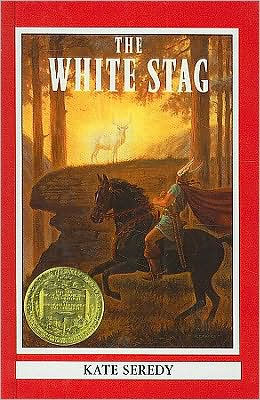
The White Stag by Kate Seredy (J)

The White Stag

The White Stag

Kate Seredy (Juvenile Fiction)

“Hadur, Powerful God, Thou hast indeed turned the sword against me, Thy sword, Hadur, not mine!  But Thou hast given me a scourge in its place and I swear to Thee, I, Bendeguz the White Eagle, that I shall use that scourge, that I shall make it into the most dreadful weapon ever known to men.  Thou hast given me a son, Hadur, he will be that scourge!  My son, Attila the Red Eagle, the Scourge of God!”

And so it was that in the year 408, Attila the Hun was born to Bendeguz the White Eagle and Alleeta, a girl captured during one of the many Hun raids.  Alleeta who would die in childbirth but would give her tribe one of the greatest and most brutal leaders it would ever know.  A leader who would take his people on a journey foretold by his great grandfather Nimrod, Mighty Hunter before the Lord, and started by his grandfather, Hunor of the Hun tribe, and his great uncle, Magyar of the Magyar tribe, and then continued by his father Bendeguz the White Eagle.  Great warriors who would bear the flag of the Red Eagle and follow the mythical White Stag from the headlands of wild Altain-Ula in the west toward the east.  A pilgrimage sweeping from Asia to Europe and leaving countless men, women, and children dead, dying, or enslaved.  A journey that wouldn’t stop until the promised homeland was reached.

Through her poetic prose and beautiful illustrations, Kate Seredy delivers an epic story mixing fantasy, legend, myth, biblical references, and history.  Although Seredy doesn’t fully plunge into the breadth of Attila’s savagery and conquests, she gives her young audience enough information to fully understand that the Huns were a rather nasty and savage lot.  Readers know from the onset that what they are about to delve into is going to be more epic fantasy than straight-from-the-books history: “Those who want to hear the voice of pagan gods in wind and thunder, who want to see fairies dance in the moonlight, who can believe that faith can move mountains, can follow the thread on the pages of this book.  It is a fragile thread; it cannot bear the weight of facts and dates.”

Through her rich illustrations that bring this magnificent tale to life, Seredy immerses her readers with a story of moonmaidens and miracles, life and death, and bravery and barbarism.  But above all of these, she gives us a tale of courage and faith and how the two are tightly woven together.  Because my own words often come up short, I sometimes choose to end my reviews with a quote (some known and others not so much) that manages to encapsulate the feelings and lessons I’m left with after the last page is turned and the book has been reshelved for another.  I found the perfect one from self-help writer Edmond Mbiaka who said, “At every given moment in your life, you have the option to move backwards with fears and doubts or to keep pushing forward with faith and courage.”  Although our own personal moments may never compare to those of the Huns or Magyars, we can find comfort in knowing that we too can reach our own “promised land” if we hold fast, stay true, and never waiver in our convictions and belief.

Rating: 4/5

*Book cover image attributed to www.barnesandnoble.com

**Want more?  Visit our Facebook page at www.facebook.com/thedustyjacket
 

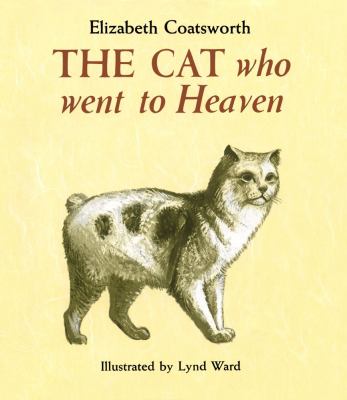
The Cat Who Went to Heaven by Elizabeth Coatsworth (J)

The Cat Who Went to Heaven

The Cat Who Went to Heaven

Elizabeth Coatsworth (Juvenile Fiction)

Once upon a time, far away in Japan, a poor young artist sat alone in his little house, waiting for his dinner.  But on this particular day, dinner was not coming.  Instead, inside the housekeeper’s little bamboo basket was a small white cat with yellow and black spots on her sides.  But the artist could barely provide for the two of them let alone a third!  Fortunately, a tri-colored cat is a very lucky thing to have and so she was kept and named Good Fortune.  True to her name, good fortune followed her and soon the head priest from the temple arrived and commissioned the artist to paint the death of the lord Buddha.  It seemed that the luck of everyone…and everything…in the household was about to change.

Written in 1930 and awarded the Newberry Medal in 1931, The Cat Who Went to Heaven is a short book (just 63 pages) brimming with lessons of mercy, grace, and forgiveness.  Elizabeth Coatsworth’s book has been reprinted twenty-four times, but I suggest selecting the version containing Lynd Ward’s exquisite illustrations.  His drawings bring an added depth and richness to Coatsworth’s beautiful words and will allow readers to fully immerse themselves within this exotic and mystical world.

The Cat Who Went to Heaven is recommended for ages 10 and up, but younger audiences may enjoy it as a bedtime story.  The short chapters followed by a summarizing poem make it an ideal nighttime read.  Most of the book centers around the artist painting various animals which Buddha embodied throughout his life.  Each animal has its own story, and each story has its own moral including honesty, kindness, fidelity, and bravery.  The story is charming and flows like silk, but the ending is abrupt (it even took me a bit by surprise) and may not sit well with more sensitive readers.  Not to spoil the story, but the title IS an indicator as to how this story ends so forewarned is forearmed.

“Forgiveness” is the centerpiece of this book and it was Archbishop Desmond Tutu, Nobel Peace Prize recipient and human rights activist, who once said, “Forgiveness says you are given another chance to make a new beginning.”  Coatsworth wrote her book a year before Archbishop Tutu was born, but she too must have realized the sentiment behind these words because through forgiveness, she has given Good Fortune a very happy beginning, which in turn gives her readers a truly happy ending.

Rating: 4/5

*Book cover image attributed to www.tvtropes.org

**Want more?  Visit our Facebook page at www.facebook.com/thedustyjacket
 

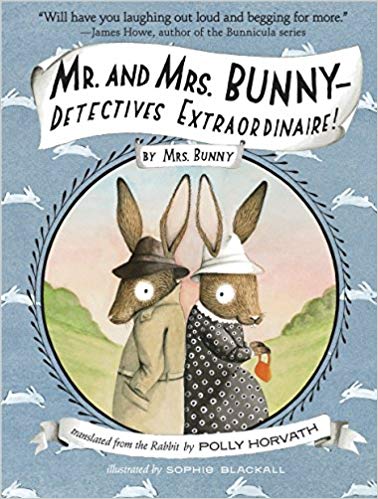
Mr. and Mrs. Bunny–Detectives Extraordinaire by Polly Horvath (J Mystery)

Mr and Mrs Bunny Detectives Extraordinaire

Mr. and Mrs. Bunny–Detectives Extraordinaire 

Polly Horvath (Juvenile Mystery)

The summer solstice has arrived and the residents of Hornby Island are preparing for the festival of Luminara.  While Madeline’s parents are busy making luminaries, she is getting ready for her school’s awards ceremony where Prince Charles himself will be handing out the awards (Madeline is getting three!).  All is pretty much as it should be until Madeline returns home that night to find a mysterious note on her door stating that her parents have been taken in for questioning.  It was signed by “The Enemy” and even included a “mwa-haha”, which is NEVER a good sign.  With her decoder uncle in a sudden and rather inconvenient coma, Madeline is alone and truly in over her head.  She seeks help from Mr. and Mrs. Bunny—Detectives Extraordinaire and although these two don’t seem to know what they’re doing, they DO have rather smart-looking fedoras and that has to count for something.  So, with Mr. and Mrs. Bunny on the case, this mystery is officially afoot!

Although Polly Horvath merely translated this story from Mrs. Bunny’s personal account, she still delivers a funny, quirky, and lighthearted romp that will delight and entertain young readers who enjoy a good mystery.  Filled with fiendish foxes, garlic-bread-eating marmots, exploding chapeaus, and high-speed chases, Mr. and Mrs. Bunny—Detectives Extraordinaire is an action-packed thrill ride where faith is blind, reason is deaf, and hope springs eternal.

Despite its whimsy and charm, Horvath does give readers a few poignant lessons that hopefully won’t get lost amongst all the fur, fluff, and fun.  Through Madeline, we see a girl caught between two worlds: the happy hippies of Hornby and the more mainstream children at her school on Vancouver Island.  Her classmates have already formed an opinion of her based solely on where she lives and nothing Madeline does can alter that prejudice: “[Madeline] didn’t know how to make the other children like her, and she felt she constantly had to defend herself from unspoken accusations about a way of life she hadn’t chosen to begin with.”  Pretty weighty stuff, but this is why Polly Horvath is one of my favorite children’s authors.  She never writes down to her audience and presents real-life problems in a way that young readers can easily relate to and connect with.  She also shows us that family is what you make it for the Bunnys, not all that familiar with humans or children, manage to see and appreciate something in Madeline that her own parents have chosen to either overlook or ignore and end up loving her as their own.  Lastly, she shows us the absolute wonder of simply being noticed and appreciated (see previous comment about Madeline’s parents).  Madeline has the unique gift to understand and communicate with animals.  When she mentions this to Prince Charles, he replies, “I’ve often heard animals speak.  Plants too.  It’s all a matter of noticing, isn’t it?  The richness of our lives depends on what we are willing to notice and what we are willing to believe.”  In this world of clatter and clutter and non-stop input, it’s hard to just stop and notice the beauty that surrounds us every day.  It’s quiet and subtle and often goes unnoticed.  But lucky for us, we have a ten-year-old girl, two clever bunnies (with rather smart-looking fedoras), and the heir apparent to the British throne to remind us that it’s there and it’s well worth the effort.

Rating: 4/5

*Book cover image attributed to www.amazon.com

**Want more?  Visit our Facebook page at www.facebook.com/thedustyjacket