
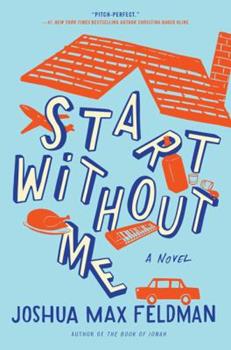
Start Without Me by Joshua Max Feldman (Adult Fiction)

Start Without Me

Joshua Max Feldman (Adult Fiction)

Adam Warshaw is an ex-keyboardist and recovering alcoholic who is muddling along at his job at a bank. Marissa Cavano is a flight attendant who fled an alcoholic mother, married into a wealthy—albeit classist and racist—family, and is currently struggling to save her marriage. Both are heading home for Thanksgiving and their paths are about to intersect in what would be the start of a highly unpredictable and tumultuous day that would send each of their lives in unexpected directions.

They say you can’t judge a book by its cover. Well, you can’t judge it by its BACK cover either. Joshua Max Feldman’s Start Without Me is described as A darkly comic novel. Nope. …the quintessential Thanksgiving novel. Let’s hope not. …a unique solidarity between two strangers as they help each other… More like one constantly saves the other one’s bacon. …Feldman’s novel excels in his crafting of extraordinary dialogue. OK. Nailed that one.

This was an extremely difficult book to get through as Adam’s character is insufferable, unrepentant, oblivious, ungracious, selfish, self-absorbed… The list is long and would take me until Thanksgiving to get through them all. I think the difference between Adam and some other awful main characters that have completely destroyed a book for me (I’m looking at you Kathy Nicolo) is that Adam KNOWS he’s a dumpster fire, the author knows he’s a dumpster fire, and everyone around Adam knows…well, you get the idea.

A friend once told me of a co-worker who said that she HATED a certain restaurant (both shall remain nameless) because she got food poisoning there four times. Four. Times. So, at that point, do you blame the restaurant or do you blame the patron? Who’s the knucklehead? The same with this book. Is it Feldman’s fault that I was totally frustrated by his book or is it mine? I mean, just like the knucklehead co-worker, I kept going back expecting a different outcome only to be confronted with the same mess over and over again. Was I thinking that if I JUST ordered the dessert, I’d be safe?!

The good news is that there are a few bright spots. Feldman really is a master at writing dialogue. It was one of the few things that saved this story and if he had done more of this and less of Adam waxing poetic about his past days in his rock band, I could’ve saved myself a lot of time from having to pet the neighbor’s dog in order to get back into my happy place. The only other glimmer was Marissa, whose backstory is an absolute trainwreck. She is the only character worthy of our sympathy and the only true adult in the room. She extends Adam more grace than he deserves and although she’s been the victim of many bad choices, she’s determined to learn from them and move forward stronger and wiser.

Before this book, Feldman wrote The Book of Jonah. After all of the negative emotions still coursing through my veins after dealing with Adam, it might take me some time before I’m strong enough to tackle this book. In the meantime, you better start without me.

Rating: 3/5

* Book cover image attributed to: http://www.thriftbooks.com

We’re now posting videos of some of our book reviews! Follow us on Facebook at www.facebook.com/thedustyjacket or on Instagram @tdjreviews and join in on the fun!
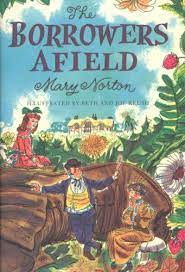
The Borrowers Afield by Mary Norton (J Fantasy)

The Borrowers Afield

Mary Norton (J Fantasy)

It had been a year since Mrs. May told young Kate the story of the borrowers. Since that time, Kate had completely pushed their memory to the farthest corner of her mind until one early spring day when Mrs. May slipped her a letter and said, “This will interest you, Kate, I think.” And indeed it had since that letter had to do with Leighton Buzzard. Leighton Buzzard, as you might recall, was the country town where Great Aunt Sophy’s house was and it was in that house, as you might remember, where underneath the kitchen floorboards lived the Clocks: Pod, Homily, and Arrietty. But whatever happened to those poor Clocks? Last time we saw them, they had been smoked out of their comfortable home and left fleeing for their lives—never to be seen or heard from again. But worry not for there is one soul who knows exactly what happened to our dear friends and it is that very same person that Mrs. May and Kate—quite by chance—are about to meet.

Three years after writing The Borrowers in 1952, Mary Norton picks right up where she left off with The Borrowers Afield where our favorite trio are tirelessly trekking from Firbank to Perkin’s Beck in search of the badger’s set, home to the Hendrearies. In this book, Arrietty finally realizes her dream of living outdoors and becoming a true borrower; Homily begins to toughen up a bit, although required to become a vegetarian; and Pod continues to hold his family together while keeping an even temper and maintaining loving order. Their journey has them finding an unexpected abode, meeting several troublesome insects, and encountering a very helpful yet mysterious stranger.

Norton does not fail to live up to the expectations she established for her readers with her first book in the beloved Borrowers’ series. This next chapter is filled with adventure and ample amounts of danger, disappointment, and discovery. Through their ups and downs, the Clock family begin to not only learn more about themselves and their own capabilities, but they also learn more about one another, which results in a deeper appreciation for one another.

This book stresses family much more than the first as it truly is the Clocks vs the World. In doing so, our little troupe form a tighter bond and realize that if you’re with family, you’re already home. The Borrowers Afield is truly a fun frolic with plenty of action and suspense and every bit worthy of its predecessor.

Rating: 5/5

* Book cover image attributed to: www.amazon.com

We’re now posting videos of some of our book reviews! Follow us on Facebook at www.facebook.com/thedustyjacket or on Instagram @tdjreviews and join in on the fun!
Thimble Summer by Elizabeth Enright (J Newbery Medal)

Thimble Summer

Elizabeth Enright (J Newbery Award)

It was the hottest day in the entire history of the world. At least it felt like it to Garnet Linden as she looked out over her family’s dying crops. Where was the rain? If it didn’t come soon, they would have to harvest their oats for hay and wouldn’t have enough money to pay their mounting bills. On top of all that, her father needed a new barn. Her family not only needed rain, they needed a miracle, but all Garnet had was a small silver thimble that she’d found in the damp, sandy flats of the river. What possible good could that ever do?

Elizabeth Enright’s Thimble Summer received the Newbery Medal in 1939. Her book is a culmination of her grandmother’s childhood stories, her mother’s school days, her own experiences, and various memories of her friends and relatives. All told, Enright gives us a nine-year-old’s memorable summer filled with a high-speed bus ride, runaway chickens, a blue ribbon, a new sibling, and an unexpected sleepover in the town library. Thimble Summer is charming, engaging, and the ideal read for a young reader looking for adventure and suspense without any of the tragedy. It highlights the kindness of strangers and reminds us that family is so much more than blood. Although this story wouldn’t translate well today (as a nine-year old hitchhiking to another town would elicit a call from both local law enforcement and child protective services), readers still have to admire Garnet’s hutzpah when it comes to showing her older brother that she isn’t a total failure while looking good doing it!

In her Newbery Medal acceptance speech, Enright noted the joy she gleaned from writing about children for children since “a child sees everything sharp and radiant; each object with its shadow beside it. Happiness is more truly happiness than it will ever be again, and is caused by such little things.” I think through Garnet Linden, Elizabeth Enright is encouraging all of us to hold onto the magic of delighting in the little things that life has to offer so that we too can experience our very own thimble summer.

Rating: 5/5

* Book cover image attributed to: www.amazon.com

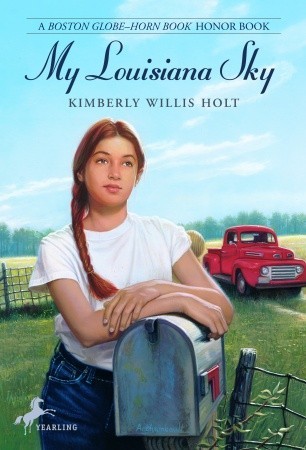
My Louisiana Sky by Kimberly Willis Holt (J Fiction)

My Louisiana Sky

Kimberly Willis Holt (J Fiction)

Tiger Ann Parker was six when she realized that her momma wasn’t like other mothers—acting more like a younger sibling than a parent—and her father was no better, often described as “slow” by the men he worked with at the nursery. Tiger hated to admit it, but she felt embarrassed by her parents and often wished that her mother was more like her stylish and independent Aunt Dorie Kay. If she was, then maybe Tiger could make friends with the girls in her class. Maybe Tiger could finally fit in. Tiger’s wish may be coming true when she’s given the chance to leave her small town of Saitter and begin a new life in Baton Rouge. But is starting over really the answer that Tiger is looking for?

This is the second book by Kimberly Willis Holt that I’ve read, the first being When Zachary Beaver Came to Town, and Holt again delighted me with a cast of unforgettable characters and an immersive story. My Louisiana Sky is another period book, but this one takes place during the 1950s when the country was divided by segregation and people with developmental disorders were often institutionalized. Mirroring Zachary, Holt’s down-home and folksy writing is front and center and instantly draws the reader to her characters and pulls you into their quaint and intimate world. The story is told from twelve-year-old Tiger’s point of view and what really compelled me—apart from its strong themes of acceptance and family—was how the script was flipped a bit. Most books that deal with the subject of developmental disabilities for this age often afflicts either a sibling or a friend of the main character. For Holt to strip Tiger’s familial stability by having not one but both of her parents dealing with varying degrees of mental challenges gives the story an entirely unique perspective and instills an overall sense of aloneness for Tiger. Combine that with her having to deal with the common adolescent fare of self-esteem, body issues, and self-confidence and you can’t really fault Tiger for wanting to leave everything she knows and loves behind for a chance to simply be a twelve-year old girl for a while.

There are so many positive lessons to be learned from this book, but the reader who is fighting against circumstances beyond their control and struggling to be accepted by their peers is going to feel the deep connection to Tiger Ann Parker. Most of us can remember wanting to be part of a clique and recalling the sting when confronted with rejection. We feel Tiger’s anguish when she cries out, “It’s not fair. I didn’t do anything to them,” and appreciate the wisdom of Granny’s words when she tells Tiger, “Perhaps those girls don’t deserve your friendship.” It’s true when they say that it’s not what we have in life, but who we have in our life that matters. For Tiger, all she needed was a best friend who loved baseball, a father who had a talent for listening to the earth, and a mother who loved to dance in between the sheets drying on the clothesline under a bright, blue Louisiana sky.

Rating: 5/5

* Book cover image attributed to: www.goodreads.com

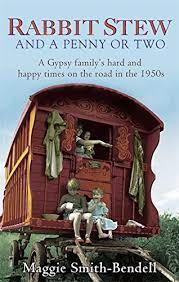
Rabbit Stew and a Penny or Two: A Gypsy family’s hard and happy times in the 1950s by Maggie Smith-Bendell

Rabbit Stew and a Penny or Two: A Gypsy family’s hard and happy times on the road in the 1950s

Maggie Smith-Bendell (Adult Biography)

Many of us were born out on the pea fields. I was born on the pea field at Thurloxton, just up the road towards Bridgwater, so I felt right at home in the peas. Me dad always said that the best pickers were born in the fields, but I knew that was a load of bull to get me to pick faster. He must have thought me daft.

Born the second of eight children, Maggie was a Traveller—where working was a mainstay, where horses were treated better than family, and the seasons determined where you parked your wagon and for how long. It was a life of traditions, culture, and family, but being Romani also meant a way of life met with resistance, discrimination, and abuse. As a child, Maggie flourished in her surroundings. As an adult, she would spend every waking hour fighting to protect and maintain a culture and a people that were under never-ending assault.   

Maggie Smith-Bendell’s biography is a fascinating and rare look into the lives of the Romani Gypsy. Maggie lived within an incredibly tightknit community that valued tradition and thrived on the open road. Their nomadic lifestyle brought plenty of adventure, danger, uncertainty, and joy, but also its share of mistrust and mistreatment from the gorgies (non-Romani people) living in the towns where the Romani came to trade, shop, and sell their goods. Maggie’s words are so mesmerizing and poignant, that we somehow become immersed in her wonderful Gypsy world: smelling the smoke from the family’s campfire; feeling the blackberry brambles tear at our flesh; and weeping as we follow a casket moving slowly to its final resting place. It’s quite an accomplishment given what little formal education she received.

Perhaps the most inspirational part of Maggie’s story was her tireless advocacy work on behalf of the Romani people and her commitment to preserving their culture. Although she could have settled for a quiet, married life raising her children, she chose to dedicate her adult life to fighting for the Romani’s right to own and live upon their own land and to help them acquire homes, an education for their children, and healthcare. Maggie mentions the obstacles, defeats, and setbacks in her work, but she knows that it’s the victories that matter. The chance for another Romani to be able to claim a little piece of this planet as their own. As Maggie put it, “There is no feeling like the peace that comes with having a base to live from, to have a gate of your own to shut at night. The settled community take this security for granted, having known no other way of living. This is right and proper, but for us to share that security is really something else. It’s like catching up with the rest of the world.”

At eighty years of age, Maggie continues to fight for the rights of Gypsies and their way of life. Some have branded her a “land grabber” while she—on her Linkedin page—refers to herself as a “trouble maker”. Regardless of titles, she seems to take it in stride. After all, she knew from quite early on that the world was made up of different kinds of people—those who would accept her people and those who would curse their very existence. Maggie describes an encounter her father had with a police officer and wrote, “Some people did stop to have a word with us, and we enjoyed it when they took the time to speak. Others would pass us by, keeping their eyes on the road or in the hedge, not even glancing at the side of the road where we were stopped. Me dad always said that it took all sorts to make the world. It wouldn’t do for us all to be the same, would it?” Perhaps not all the same, Maggie, but a few more Gypsies might not be so bad.

Rating: 5/5

* Book cover image attributed to: www.amazon.com

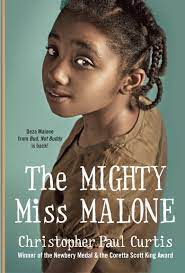
The Mighty Miss Malone by Christopher Paul Curtis (J Historical Fiction)

The Mighty Miss Malone

Christopher Paul Curtis (Juvenile Historical Fiction)

The best-laid schemes o’ mice an’ men/Gang aft a-gley

And leave us nought but grief and pain/For promised joy.

Her teacher told her that it was from a poem by Robert Burns called “To a Mouse”. Deza didn’t quite understand what those words meant—especially the “gang aft a-gley” part—but Mrs. Needham said that it just meant that even the most carefully planned out things could go wrong. Deza knew about this since a lot of the Malone family plans haven’t been quite working out lately. But if there’s one thing that the Malones do well it’s sticking together. After all, their motto was “We are a family on a journey to a place called Wonderful”. Before the Malones could get to Wonderful however, Deza and her family would have to travel through a whole lot of awful first.

Set against the backdrop of the Great Depression, homeless camps, speakeasies, and the much-hyped 1936 boxing match between Joe Louis and Max Schmeling, Curtis gives us yet another story centered around a tough-as-nails, plucky, and absolutely endearing main character. At twelve, Deza Malone is the smartest in her class and destined for something special. With a dictionary in one hand and a thesaurus in the other, she’s more than ready to take on the world one adjective and adverb at a time. Deza is charming, loyal, fiercely protective of her family—especially of her older brother, Jimmie—and principled to a fault. Deza is not a girl who’s afraid to take matters into her own hands in order to set things right…even if it means a little forgery or rule breaking now and then. Struggling to make something of herself while fighting racial prejudice, financial hardship, and social injustice may prove to be formidable challenges for some, but not for the mighty Miss Malone.

The Mighty Miss Malone is the second book by Curtis that I’ve read (the first being Bud, Not Buddy). In both stories, he gives us a main character who rises above their circumstances with grace, dignity, and integrity. His stories are built around the strength of family, the importance of hope, and the resilience of the human spirit. Through Deza Malone, Curtis reminds us that even though plans “gang aft a-gley”, tomorrow is always a brand-new day that brings with it another opportunity to get a little bit closer to a place called Wonderful.

Rating: 5/5

* Book cover image attributed to www.amazon.com

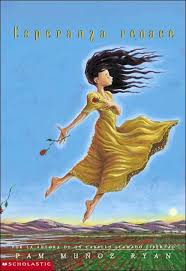
Esperanza Rising by Pam Muñoz Ryan (YA)

Esperanza Rising

Esperanza Rising

Pam Muñoz Ryan (Young Adult Historical Fiction)

Esperanza was the pride and joy of her papa.  The daughter of wealthy ranchers, Sixto and Ramona Ortega, she had everything a twelve-year old could possibly want.  But not far beyond the borders of El Rancho de las Rosas, trouble brewed in Aguascaliente, Mexico.  It was 1930 and the revolution in Mexico had happened over ten years ago, but there were still those who resented the wealth and circumstances of the local landowners.  Soon that hate would spill over into Esperanza’s idyllic and pampered world and would ultimately rob her of everything that she knows and holds dear.

Pam Muñoz Ryan gives us a heartwarming and often heartbreaking riches-to-rags story of a young, spoiled, and arrogant girl who learns the value of humility, empathy, generosity, and kindness.  Inspired by her own grandmother, Esperanza Ortega, Ryan shows us the lavishness and bounty of a prosperous Mexican ranch, as well as the poverty, squalor, and hardship endured by migrant workers living in company farm camps.  She also provides insight into the Mexican Repatriation, which included the deportations of thousands of legalized and native United States citizens to Mexico between 1929 and 1935.  Up until that time, it was the largest involuntary migration in the U.S. with numbers reaching almost a half million.  Ryan also describes the struggles of the workers to compete with cheaper labor from states like Oklahoma, as well as their efforts for a better wage and living conditions through unionization.

In addition to giving readers a story overflowing with moral lessons—Don’t judge a person until you’ve walked a mile in their shoes or Appreciate what you have before you lose it—Ryan also gives us a character who slowly begins to realize that life is more than fancy dresses and porcelain dolls.  Through humiliation, heartache, and despair, Esperanza understands how life is like her father’s beautiful and precious rose garden: “No hay rosa sin espinas.” There is no rose without thorns.  For despite the beauty and splendor that life often provides, there will also be some degree of pain and suffering.  But like her grandmother taught her as she undid Esperanza’s rows of uneven or bunched crochet, “Do not ever be afraid to start over.”  And when Esperanza did, she truly blossomed.

Rating: 5/5

*Book cover image attributed to www.barnesandnoble.com

**Want more?  Visit our Facebook page at www.facebook.com/thedustyjacket

Tuck Everlasting by Natalie Babbitt (J Fantasy)

Tuck Everlasting

Tuck Everlasting

Natalie Babbitt (Juvenile Fantasy)

Winnie did not believe in fairy tales.  She had never longed for a magic wand, did not expect to marry a prince, and was scornful—most of the time—of her grandmother’s elves.  So now she sat, mouth open, wide-eyed, not knowing what to make of this extraordinary story.  It couldn’t—not a bit of it—be true.  And yet…

Ten-year-old Winnie Foster lives with her father, mother, and grandmother in Treegap.  They were the first family in the area and laid proud claim to Treegap wood and the touch-me-not cottage that laid on its outskirts.  She was the only child in the household and, on this particular day, she was bored.  And hot.  And it’s only the first week in August.  After being pecked at by both her mother and grandmother, Winnie ventures outside to seek solitude.  But peace won’t be hers that day for a man in a yellow suit comes up to the iron fence and is looking for a family.  He also has a particular interest in their wood.  Winnie has never ventured outside the fence let alone into the wood.  Maybe she can find some solitude there.  And who knows?  Maybe she’ll find something interesting.

Written in 1975, Tuck Everlasting has sold over 5 million copies and is considered a modern classic in children’s literature.  It’s the story of the Tuck family—father and mother (Angus and Mae), and brothers Miles and Jesse—who drink from a spring in Treegap wood and inadvertently discover immortality.  They’ve been able to keep their secret safe until a chance encounter with Winnie Foster threatens everything they’ve been concealing.  Tuck Everlasting is folkloric in nature and woven with bits of fantasy, drama, and a touch romance.  It’s written for ages 10 and up and its broad-based themes of sacrifice, friendship, loyalty, love, and family ensures a very wide appeal.

Babbitt delivers a detailed and beautifully told story that is rich in symbolism.  Watch for the toad that pops up throughout various points in Winnie’s story.  He’s more than just a convenient friend and marks notable shifts in Winnie’s maturity.  There are also numerous mentions of imprisonment or feeling trapped.  At one point, Winnie recalls a verse from an old poem (Richard Lovelace’s 1642 poem “To Althea, from Prison”) which goes, “Stone walls do not a prison make, / Nor iron bars a cage.”  Winnie feels imprisoned by her mother and grandmother (and the literal iron bars that surround her yard) while the Tucks are prisoners of time itself.  Both are trapped, but Winnie alone has any future chance of escape.

Tuck Everlasting was a quick read packed with moral lessons and questions (Would you want to live forever?).  The only criticism I had was that the ending felt forced and rushed.  Babbitt spent such an inordinate amount of time painting this detailed image of the wood and the Tucks into our minds, that the end fell a little flat.  This was one of those stories that an additional twenty pages might have helped give a more ample and satisfying conclusion rather than a one- to two-page condensed summary that wrapped everything up.  It just left this wonderful journey feeling incomplete and inadequate.

In closing, I will repeat a bit of wisdom that Miles imparted to Winnie, “People got to do something useful if they’re going to take up space in the world.”  During my limited time of taking up space in this world, it is my hope that my reviews and insights provide you with something useful and perhaps even help you discover a book and a story that will stay in your heart forever.

Rating: 4/5

*Book cover image attributed to www.target.com

**Want more?  Visit our Facebook page at www.facebook.com/thedustyjacket


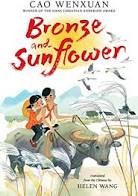
Bronze and Sunflower by Cao Wenxuan (J Historical Fiction)

Bronze and Sunflower

Bronze and Sunflower

Cao Wenxuan (Juvenile Historical Fiction)

Sunflower was lonely.  Her father was a revered sculptor in the city, but he—like so many others—had been sent to work at the Cadre School and now Sunflower has very little to do all day.  To pass the time, she goes down to the river and looks to the other side at the village called Damaidi.  In Damaidi, there is life, there is activity, and most of all, there are children.  She dreams of what it might be like to go over there and play and explore.  Then one day, Sunflower’s dad tragically drowns in the river and she is accepted into the home of Damaidi’s poorest family.  There she meets Baba, Mama, grandmother Nainai, and Bronze, their mute son.  Suddenly, Sunflower is a daughter, a granddaughter, and a sister and life amongst these poor people was about to make her richer than she could ever imagine.

Translated from Mandarin by Helen Wang, Bronze and Sunflower is a masterpiece in storytelling.  It tells the story of a family and a village caught up in China’s Cultural Revolution during the late 1960s and early 1970s.  Wenxuan doesn’t make this period in history the center of his story, but instead chooses to keep it as a backdrop.  He instead focuses on the unique and touching bond between Bronze and Sunflower and the family’s struggle to survive floods, locusts, famine, and dishonor.  It’s a tale replete with villains and heroes, sadness and joy, and despair and hope.  Wenxuan effortlessly weaves a tale showing us that life isn’t fair, that justice is often elusive, and that those in power—for better or worse—wield a mighty influence.  But he also shows us the importance of family, the power of redemption, and the value of integrity.  It’s a story absolutely brimming with moral lessons and human values and should be devoured by readers of all ages.

The only fault I had with this book is its ending.  It’s vague (I re-read it several times to make sure I didn’t miss any subtle clue or hidden meaning) and puts the burden on the reader to determine what happened.  I’m not a fan of this kind of ambiguous ending, but the overall story isn’t dependent upon it and so its vagueness shouldn’t serve as a detraction from an otherwise engaging and captivating tale that was an absolute joy to read and experience.

Without giving away any spoilers, the saddest part of the story—for me—was the eventuality of Bronze and Sunflower growing up…as children tend to do.  The head of the village of Damaidi stated as much when he met with Baba and Mama and said, “Time’s moving on.”  Simple words that remind us how fleeting and fragile time is and that everything should be cherished and savored for nothing is certain or guaranteed.  With the sudden loss of her father, Sunflower understood the unpredictability of life and the value that came with belonging.  Despite her poverty, Sunflower considered herself wealthy beyond measure because she was part of a family and that family loved her very much.  Actor, author, and activist Michael J. Fox once said, “Family is not an important thing. It’s everything.”  In that respect, Sunflower had everything and perhaps that made her the richest person in all of Damaidi.

Rating: 5/5

*Book cover image attributed to www.abebooks.com

Summer of the Monkeys by Wilson Rawls (J)

Summer of the Monkeys

Summer of the Monkeys

Wilson Rawls (Young Adult Fiction)

Up until I was fourteen years old, no boy on earth could have been happier.  I didn’t have a worry in the world.  In fact, I was beginning to think that it wasn’t going to be hard at all for me to grow up.  But, just when things were really looking good for me, something happened.  I got mixed up with a bunch of monkeys and all of my happiness flew right out the window.  Those monkeys all but drove me out of my mind.

It’s the late 1800s and brand-new country just opened up for settlement.  The Lee family were sharecroppers in Missouri, but providence led them to a farm right in the middle of Cherokee Nation in northeastern Oklahoma.  Life is good for fourteen-year-old Jay Berry and his parents, although a bit tougher for his sister, Daisy, who was born with a twisted leg and got by with the help of a crutch.  It’s summer and Jay Berry has the entire farm to explore…not to mention he has his eyes set on owning his very own .22 and a pony.  But then his grandfather brings word that some monkeys have escaped the circus and the reward to anyone who finds them is more than Jay Berry can count!  With his grandfather’s help, Jay Berry sets off to find and capture those monkeys, even if it takes him the whole summer to do it.

I unashamedly admit that I am a complete pushover for any book where the parents are respected, the grandparents are revered, or a boy’s best friend is his trusted dog.  Written in 1976 by Wilson Rawls—author of the classic Where the Red Fern Grows—Summer of the Monkeys has all three.  Rawls gives us a lovely story about family, sacrifice, and faith and the importance of putting aside what your heart desires and instead focusing on what your heart requires.  The writing is down-to-earth and folksy and the lessons are timeless.  Today’s young adult readers may find the dialogue and situations a bit trite and hokey, but a story of a brother’s love for his little sister or a father’s pride in his son never truly goes out of style.

Throughout the book, Rawls shows us the strong bond of the Lee family and the particularly tender relationship between Jay Berry and his grandfather.  On one occasion, Jay Berry mentioned to his grandfather how much fun the two have together to which the grandfather replied, “We surely do.  You know, an old man like me can teach a young boy like you all the good things in life.  But it takes a young boy like you to teach an old man like me to appreciate all the good things in life.  I guess that’s what life’s all about.”  Call me old-fashioned or sentimental, but books like this always remind me that whenever you have a loving family, a wizened grandpa or a furry companion by your side, life is never really all that bad.

Rating: 4/5

*Book cover image attributed to www.amazon.com