
Current Book Review

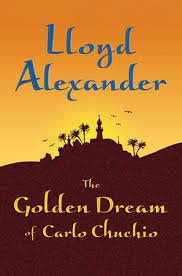
The Golden Dream of Carlo Chuchio by Lloyd Alexander (J Fantasy)

The Golden Dream of Carlo Chuchio

The Golden Dream of Carlo Chuchio

Lloyd Alexander (Juvenile Fantasy)

 If you were to ask Evariste what he thought of his nephew, Carlo Chuchio, he would say that the lad was nothing more than a thankless, dimwitted daydreamer.  A “chooch”.  And perhaps he was right.  Having an uncle who was an importer, Carlo spent his days loitering at the docks and imagining places waiting to be visited and explored—places far beyond his home in Magenta.  Adventure, as fate would have it, was a lot closer than Carlo had imagined for when he happened upon a bookseller in the market, he was offered a book of fantastic tales.  Stories of magic carpets and genies in lamps and caves filled with treasure.  But this particular book didn’t just contain wondrous stories, it also hid a map with the most intriguing and irresistible two words that Carlo could ever imagine: “Royal Treasury”.  Soon, Carlo would be embarking on a journey that involved an unlikely set of traveling companions…all heading to Cathai and the fabled “Road of Golden Dreams”.

Lloyd Alexander takes readers on a magical journey filled with suspense, danger, mishaps, missteps, humor, and romance.  Although there’s no flying carpet or bottled genie, there is plenty to delight and entertain readers of any age.  At the heart of this story is young Carlo Chuchio, a dreamer filled with integrity who would not let his desire to be held in high regard outweigh his need to do the right thing.  He soon realizes the burden of having a conscience, but the blessing that comes with listening to it.

Along Carlo’s journey, he meets up with a delightful set of companions.  Baksheesh, a camel-puller, proves to be an invaluable adviser and is always ready with a fast line or two in order to escape trouble…or work.  There’s quiet and observant Salamon, who is childlike in his eagerness, curiosity, and joy when discovering something new.  Then there’s Sira, who is not what she appears to be.  She bears a tragic past and although her heart is filled with vengeance and heartache, perhaps there’s still a bit of room left for love.  Together, the group encounters ruffians, warlords, a dream merchant, a painter, rivaling tribes, armies, a horse master, and perhaps the most repugnant of them all, a storyteller.  While encountering danger and death at almost every turn, our ragtag troupe reminds us that it is often cunning and cleverness that have a sharper edge and can cut just as deep as any saber or tulwar.

Of all the characters in this book, it is Salamon who is perhaps my favorite.  He is a kind and gentle man of few words, but when he does offer up some advice or wisdom, they are balm to the soul.  When Carlo was unsure about what his future held, Salamon replied, “What remains to be seen is always the most interesting.”  And when Carlo was telling Salamon about his quest for treasure, Salamon came up with a gem of his own: “As if a fortune could make up for the bother of gaining it.  No, no, my lad: The journey is the treasure.”

The Golden Dream of Carlo Chuchio teaches us so many lessons: not to judge a book by its cover, the virtues found by putting your faith in the untrustworthy, or the comfort gained from seeking hope amongst the impossible.  But above all, Lloyd Alexander gives us a wonderful and exciting story about a boy who discovers all the possibilities and treasure that the world has to offer all because one day, he seized upon the remarkable opportunity to open up a book.  How much richer can you possibly get?

Rating: 5/5

*Book cover image attributed to www.goodreads.com

**Want more?  Visit our Facebook page at www.facebook.com/thedustyjacket

The Buddha in the Attic by Julie Otsuka

The Buddha in the Attic

The Buddha in the Attic

Julie Otsuka (Adult Historical Fiction)

They came from all over Japan: Yamaguchi, Tokyo, Kyoto, Nara, Yamanashi, and Kagoshima.  Most were virgins ranging in age from just fourteen to thirty-seven years old.  Some came from the city and wore stylish clothes while those from the country wore patched and re-dyed kimonos.  They all came—from the mountains to the seashore—to board a boat that would take them to America.  All were going with a promise and a picture.  All were leaving to marry.

Julie Otsuka writes about the “picture brides” (similar to mail-order brides) of the early 1900s who, through a matchmaker and family recommendations, traveled from Japan to marry a fellow countryman in America.  The families of the brides were often influenced by money, the brides went to escape poverty and held dreams of a better life, and the grooms were looking for companionship while reaping the benefit of an extra pair of working hands.  The women quickly realized the folly of their aspirations and that their lives as migrant workers would define them as no better than slaves.  The promises of a picture showing a smiling young man with a hat in his hands standing in front of a white picket fence were quickly replaced with beatings, curfews, and living conditions often unfit for an animal.

Otsuka presents these women’s stories in eight sections: Boat Ride, First Night, Whites, Babies, The Children, Traitor, Last Day, and A Disappearance.  She takes her readers from the initial journey to America and then through marriage and childbirth and finally to the bombing of Pearl Harbor and the Japanese internment camps. We are dragged through an emotional gauntlet yet these disturbing and deeply personal stories lack any kind of emotional teeth.  There’s simply nothing to really sink in to due to the choice of the author’s writing style.  Otsuka opts to tell her story through first-person collective.  Because she paints her story using very wide brushstrokes, we are presented with anywhere from six to twelve lives in the span of a single paragraph.  She sacrifices depth for breadth and we end up with prose that reads more like a bulleted presentation.  When describing the dreams of the women’s children, she writes, “One wanted to save up money to buy his own farm.  One wanted to become a tomato grower like his father.  One wanted to become anything but.  One wanted to plant a vineyard. One wanted to start his own label.  One could not wait until the day she got off the ranch.”  And on and on.  The vast majority of the book is like this with sentences starting off with “Some of us” or “Most of us” or Many of us”.  Only briefly are we allowed some glimpse into the humanity of these women when we get flashes of names like Akiko, Kazuko, Chiyo, and Makiyo.  The only time we really get a sense of mourning and loss, ironically enough, is when the Japanese had been driven from their communities and it is their American neighbors who are left to deal with their absence and loss.  As they recollect memories of their displaced Japanese neighbors, only then do we get a sense as to who these people were and the impact they had on those around them.

I feel that Otsuka really missed an opportunity by choosing to tell an anonymous and faceless story.  Without some figures to latch on to, we fail to form any kind of connection with these women and their ill-fated lives.  I feel nothing would have been lost and so much more would have been gained had she decided to focus on three or four individual women and allowed us to follow each of their separate journeys.  We would have been able to hope, dream, despair, and mourn with them as they tried to navigate a world that was often cruel, unforgiving, and unfair.  Instead, we got Polaroids rather than a movie.  We got one-dimensional versus 3D.  We got an indistinguishable group and not a living, breathing person.

The title of this book refers to what these women had to leave behind.  Instead, it might have been nicer to focus on what these women carried with them: not just a lifetime of pain and hurt and sorrow, but also an abundance of hope and honor and resilience.  These women slaved and birthed and suffered and endured because to do otherwise would have brought dishonor to their family and to themselves.  Former hi-tech executive and mentor, Peter Strople wrote, “Legacy is not leaving something for people. It’s leaving something in people.”  I am grateful for Julie Otsuka for bringing the stories of the “picture brides” to light and although this particular book didn’t resonate with me, these women deserve to have their stories heard so that their legacy is not confined to the written page, but rather should live on within our hearts.

Rating: 3/5

*Book cover image attributed to www.amazon.com

**Want more?  Visit our Facebook page at www.facebook.com/thedustyjacket

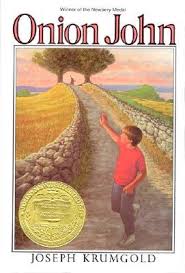
Onion John by Joseph Krumgold (J)

Onion John

Onion John

Joseph Krumgold (Juvenile Fiction)

Twelve-year-old Andy Rusch is a junior to his father’s senior and that carries a lot of weight and responsibility.  Seems that Andy’s father has big plans for him: working for General Magneto this summer, studying at MIT, being an engineer, and maybe one day going to the moon!  But all Andy wants to do is work in the family’s hardware store, play baseball, and hang out with his best friend, Onion John.  Not many people can understand Onion John, but Andy does.  Onion John is a beloved fixture in the small town of Serenity, New Jersey.  He lives a simple life in his stacked-stone house filled with bathtubs and has his own ideas about how to make apples grow bigger or how to make it rain.  Onion John’s fanciful ways clash with Andy’s father who wants his son to be practical and realistic.  But how can a boy possibly choose between his best friend and his father?  And what happens when your best friend starts to become friends with your father?  Up until that point, the worst thing that had ever happened was when Eechee Ries was pulled from the pond and worked over by the Pulmotor.

Joseph Krumgold was the first writer to have been awarded the Newbery Medal twice.  The first was for his 1954 novel …and now Miguel (which I read and really enjoyed) and he did it again in 1960 with this book.  If written today, Onion John would still hold the same strong themes of standing up for what you believe in, being true to yourself, and accepting people for who they are and not for who you would like them to be.  However, if you were pitching a story about a twelve-year-old boy befriending an unintelligible adult male who lives on the outskirts of town in a stone house today, it would clearly be a hard sell and, in all honesty, tend to come off as a bit creepy.  But in 1959, it was simply a story about an unlikely friendship and the virtues of believing in yourself.

In addition to the strong bond Andy builds with Onion John—which eventually spills over and affects his relationship with his father—there is the project that the entire town adopts for the benefit of their most cherished citizen…Onion John.  This is Krumgold providing a social commentary on how society tries to fit everyone into a convenient box and does so under the pretext of personal betterment.  He makes you challenge the nature of charity and poses the question: “When is doing good not really good?”  The people of Serenity wanted to do something very magnanimous for Onion John with the assumption that their efforts would make his life happier, easier, and better.  But one man’s heaven is another man’s hell and those subtleties tend to get in the way all for the sake of benevolence.

Joseph Krumgold packs so many wonderful lessons and moments in this book that it’s hard to choose just one to highlight for this review: Andy’s coming of age, Andy challenging his father, the town’s collective awakening, Andy’s father’s personal redemption, Andy’s deepening bond with his father.  These are all worth further discussion, but I chose one that particularly resonated with me and that was Onion John’s ability to listen.  How often are we talking to someone who is busy texting or reading or cleaning or something-ing and you’ll pause only to have them say, “Go ahead.  I’m listening.”  With Onion John, he would stop everything in order to let you know that at that moment, you were the singular, most important thing in the world.  There was absolutely nothing more important in life at that moment than you.  As Andy described, “One thing about Onion John, whatever he was doing, if someone came along he was always ready to stop and talk things over.”  What a rare quality it is to find someone who is able to put life on pause in order to afford another human being the courtesy of their undivided attention.  American journalist and author Krista Tippett wrote, “Listening is about being present, not just about being quiet.”  Perhaps that is why only Andy could understand Onion John and no one else could.  He was present.  Wouldn’t it be wonderful if we could all learn how to listen like that?

Rating: 4/5

*Book cover image attributed to www.goodreads.com

**Want more?  Visit our Facebook page at www.facebook.com/thedustyjacket
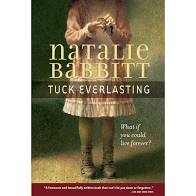
Tuck Everlasting by Natalie Babbitt (J Fantasy)

Tuck Everlasting

Tuck Everlasting

Natalie Babbitt (Juvenile Fantasy)

Winnie did not believe in fairy tales.  She had never longed for a magic wand, did not expect to marry a prince, and was scornful—most of the time—of her grandmother’s elves.  So now she sat, mouth open, wide-eyed, not knowing what to make of this extraordinary story.  It couldn’t—not a bit of it—be true.  And yet…

Ten-year-old Winnie Foster lives with her father, mother, and grandmother in Treegap.  They were the first family in the area and laid proud claim to Treegap wood and the touch-me-not cottage that laid on its outskirts.  She was the only child in the household and, on this particular day, she was bored.  And hot.  And it’s only the first week in August.  After being pecked at by both her mother and grandmother, Winnie ventures outside to seek solitude.  But peace won’t be hers that day for a man in a yellow suit comes up to the iron fence and is looking for a family.  He also has a particular interest in their wood.  Winnie has never ventured outside the fence let alone into the wood.  Maybe she can find some solitude there.  And who knows?  Maybe she’ll find something interesting.

Written in 1975, Tuck Everlasting has sold over 5 million copies and is considered a modern classic in children’s literature.  It’s the story of the Tuck family—father and mother (Angus and Mae), and brothers Miles and Jesse—who drink from a spring in Treegap wood and inadvertently discover immortality.  They’ve been able to keep their secret safe until a chance encounter with Winnie Foster threatens everything they’ve been concealing.  Tuck Everlasting is folkloric in nature and woven with bits of fantasy, drama, and a touch romance.  It’s written for ages 10 and up and its broad-based themes of sacrifice, friendship, loyalty, love, and family ensures a very wide appeal.

Babbitt delivers a detailed and beautifully told story that is rich in symbolism.  Watch for the toad that pops up throughout various points in Winnie’s story.  He’s more than just a convenient friend and marks notable shifts in Winnie’s maturity.  There are also numerous mentions of imprisonment or feeling trapped.  At one point, Winnie recalls a verse from an old poem (Richard Lovelace’s 1642 poem “To Althea, from Prison”) which goes, “Stone walls do not a prison make, / Nor iron bars a cage.”  Winnie feels imprisoned by her mother and grandmother (and the literal iron bars that surround her yard) while the Tucks are prisoners of time itself.  Both are trapped, but Winnie alone has any future chance of escape.

Tuck Everlasting was a quick read packed with moral lessons and questions (Would you want to live forever?).  The only criticism I had was that the ending felt forced and rushed.  Babbitt spent such an inordinate amount of time painting this detailed image of the wood and the Tucks into our minds, that the end fell a little flat.  This was one of those stories that an additional twenty pages might have helped give a more ample and satisfying conclusion rather than a one- to two-page condensed summary that wrapped everything up.  It just left this wonderful journey feeling incomplete and inadequate.

In closing, I will repeat a bit of wisdom that Miles imparted to Winnie, “People got to do something useful if they’re going to take up space in the world.”  During my limited time of taking up space in this world, it is my hope that my reviews and insights provide you with something useful and perhaps even help you discover a book and a story that will stay in your heart forever.

Rating: 4/5

*Book cover image attributed to www.target.com

**Want more?  Visit our Facebook page at www.facebook.com/thedustyjacket


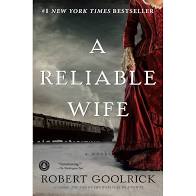
A Reliable Wife by Robert Goolrick

A Reliable Wife

A Reliable Wife

Robert Goolrick (Adult Fiction)

Ralph Truitt was fifty-four years old, rich, and alone.  He had been alone for twenty years and if the loneliness didn’t kill him, then another year in a bleak and barren Wisconsin winter might.  So, he placed an ad in the Chicago paper: “Country businessman seeks reliable wife.  Compelled by practical, not romantic reasons.  Reply by letter.”  He received many responses, but it was Catherine Land’s letter that he would choose.  He had read it so many times, he knew it by heart.  It was the first sentence that piqued his interest: “I am a simple honest woman.”  But letters can be deceiving and all this “simple honest woman” wanted—ever wanted—was to acquire both love and money.  Catherine would not live without some portion of both and Ralph Truitt was the ticket to her dream.  With a beautiful face and a sympathetic backstory, she was well on her way of inheriting a vast fortune…unless Ralph Truitt had other plans.

A Reliable Wife is one of those books that if you don’t stick with it, you would simply give up on it and unapologetically mark it as “Did Not Finish”.  With its foreboding and depressing backdrop of a 1907 Wisconsin winter, to its flawed and morally corrupt characters, to its underlying themes of lust and sexual fantasies, it really takes a herculean effort to weed through all of the debauchery and depression.  Thankfully, a nice story twist about midway through the book rewards those who stick it out and marks the beginning of several plot turns that will keep the reader’s interest and make the remaining scenes of lust and unrequited passion a little more forgivable.

The story centers on three main characters: Ralph Truitt, Catherine Lane, and Tony Moretti (Ralph’s illegitimate son).  All three do their fair share of whining and complaining and mourning a past that is lost and hating themselves for who they might have been.  Interestingly, I found Tony’s character the most sympathetic of the three, although Goolrick paints him as the antagonist.  He is the only one who truly deserves to feel betrayed and abandoned and can safely shroud himself in the term “victim”.  Don’t get me wrong, all three have their reasons to mope and feel wronged by life, but only one trophy can be awarded and I don’t give out participation ribbons so Tony gets the prize.

Robert Goolrick gives us a tale of regret and remorse and poses the question of how far would someone go in order to make a person love them?  I enjoyed this work far more than his book Heading Out to Wonderful, which I only gave 3/5 stars.  Unlike the latter, A Reliable Wife felt consistent all the way to the end and proved to be a suspenseful and compelling read.

I’ll end this review with four important takeways that I learned from A Reliable Wife: 1) If you live in Wisconsin, get out of Dodge before the first snowflake falls.  Winter marks the beginning of crazy season and you’re apt to either kill yourself, kill your family, kill yourself and your family (not in that order), or maim yourself (and possibly your family); 2) If your mother is a fanatical religious zealot, chances are you are going to grow up to be a hot mess; 3) A promise is a promise.  No matter how ridiculous, immoral, unethical, or illegal the promise is, you have to keep it.  No backing out.; and 4) Money doesn’t bring you happiness.  No matter how good looking you are, well educated, worldly, well-spoken.  It doesn’t matter.  You are going to be miserable so just pin that badge to your chest and wear it proudly.  So take a lesson from Ralph, Catherine, and Tony, just live a poor life in the tropics with a good therapist and don’t ever, EVER, make any promises.  You can thank me later.

Rating: 4/5

*Book cover image attributed to www.target.com

**Want more?  Visit our Facebook page at www.facebook.com/thedustyjacket


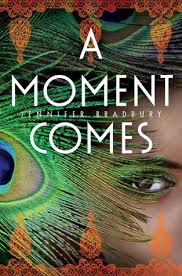
A Moment Comes by Jennifer Bradbury (YA Historical Fiction)

A Moment Comes

A Moment Comes

Jennifer Bradbury (Young Adult Historical Fiction)

“Safe.  I think about the word as we continue walking.  What does safe mean anymore?  I wonder if I’ll ever feel safe again.  I wandered these markets and streets freely just a few years ago.  And then I grew up.”

Tariq is Muslim born and raised in India.  He is eighteen and aspires to study at Oxford.  It is what Daadaa—his grandfather—dreamed for him and he will do anything to make it a reality.  Anupreet is Sikh and nearly sixteen years old.  She’s beautiful despite the scar that runs from her eye to her cheek.  It’s healing, but will always be there, just like the memory of that horrible day when she acquired it.  Margaret is sixteen and from London.  Her father was sent to Jalandhar to work for the boundary award.  His job is to help break India into pieces so that Muslims can have their own separate state.  She knows why her mother made her come here…to restore her virtue, make her “respectable” again.  Although she’s not sure how this hot, sticky, and loud place will be able to accomplish that.  It’s June 1947 and the worlds of these three teenagers are about to come together and their journey will take them to what history would later refer to as the Partition of India of 1947.

Books, like Bradbury’s, that are based on actual world history play such an important part in the lives of our younger population.  Historical Fiction is not only a way to educate, but to offer an all-important perspective.  In A Moment Comes, we are given three very different yet relatable young adults: each offering his or her own point of view about what is happening to them, their family, and the world around them.  Bradbury largely avoids stereotypes and instead offers up an honest landscape about a country being torn apart from the inside.

The Partition of India of 1947 began after the Second World War.  Lacking the sufficient resources to control its greatest asset, Britain exited India after three hundred years of British rule and partitioned the country into two independent nation states: India (with its Hindu majority) and Pakistan (with their Muslim majority).  It marked one of the greatest migrations in human history and resulted in more than fifteen million people losing their homes and between one to two million people losing their lives.  Bradbury is exceptionally careful not to choose sides and paint one party as “good” or another as “bad”.  Instead, she lays out three lives told through three alternating points of view and allows the reader to form his or her own judgments and opinions.  The story is fast-paced, harrowing, poignant, and bitter.  But in the end, Bradbury offers up some much-needed hope.  It’s faint and so very uncertain, but she places it there nonetheless so that we—along with Tariq, Anupreet, and Margaret—can grab it and hold onto it as tight as we can.

A Moment Comes reminds us that history is more than just words on a page.  Rather, it’s people who breathe, dream, hope, bleed, and die.  People who have risen above their own limitations in order to do something remarkable or historic or even heroic.  And just like history is more than just printed words, maps are more than just lines.  They are traditions and cultures and religions.  Bradbury summed this up perfectly through Margaret when she said, “Lines are funny things. They make us feel safe—at least for a while—knowing where we end and something or someone else begins.  But they can also make us want, can make us bitter, wanting what lies on the other side of the line.  But whether it’s a border on a map or a boundary between two people, the lines are still only lines.  Still something someone made up, decided on.  They’re not even real, but so long as everyone agrees to play along, they work fine.  But how can lines of a map tell a piece of land what to be any more than lines between one person and another can pretend to be what makes them different?”  In the end, Tariq, Anupreet, and Margaret were all able to let go of their own prejudices and realize that they themselves aren’t so very different from one another…regardless of what the lines might say.

Rating: 5/5

*Book cover image attributed to www.goodreads.com

**Want more?  Visit our Facebook page at www.facebook.com/thedustyjacket
 

Tracks by Jim Black

Tracks

Tracks

Jim Black (Adult Fiction)

It’s 1968 in the small town of Archer City, Texas.  Fifteen-year-old Jim and his friends, Charles and Gary, are freshmen in high school and the world is suddenly full of hope and possibility…and broken hearts, broken noses, and a few bruised egos.  Yes, life is good until strange things begin to happen.  There are reports of livestock being found mutilated just outside of town and rumors of satanic cults and aliens begin swirling around faster than a Texas dust storm.  Every nerve in town is raw and on edge and that could only mean one thing: the time is absolutely ripe for Jim, Charles, and Gary to pull off a prank worthy of the ages.

Tracks is the sequel to Jim Black’s delightful and humorous semi-autobiographical River Season.  I was gifted my copy of Tracks by the author himself (who also kindly signed it) who mailed it to me after reading my review of his first book and noting that I was looking for a copy of his sequel.  I must say, I was a bit apprehensive when I started reading Tracks.  Would it capture the same magic and nostalgia as its predecessor?  What if I didn’t like it?  How can I tell an author, who personally sent me a copy of his book, that it fell a little flat and then afterwards, how would I be able to fake my own death?  I shouldn’t have worried because Tracks captures the same heart, soul, and humanity that originally endeared me to three teenaged lads in a small Texas town.

Like Black, I grew up in a small, southern town.  During the 1970s, my town had a population of only 646 and I remember the barbershop with the lighted barber’s pole, the diner, the hardware store, post office, service station, bank, library, and courthouse that stood along Main Street.  Black’s novel isn’t just a story about the special bond of friendship and how family goes way beyond blood, it’s a sentimental and tender journey back to a time when after a fight or a bad date, all it took to set the world right again was a fried fruit pie and a flavored Coke with your best friends sitting beside you in the corner booth.  A time when you walked into the diner and all you had to be asked was, “The usual?”  A time when your mom served you Malt-O-Meal for breakfast, you played Parcheesi with your grandmother on Sunday, and you sat around the television set watching Bonanza at night.  It was a time when friendship meant that someone always had your back and was ready to offer up a hand or a shoulder when needed.  It’s a story about life and everything that goes with it: humor and heartbreak, hope and disappointment, pitfalls and promises.  It’s the uncertainty and the adventure that makes life worth living and a story that each of us writes for ourselves with every breath we take.

I will never be able to thank Jim Black enough for his kindness and generosity for sending me Tracks (he sent me a second book which I will be reading and reviewing in the very near future).  I read because I love getting lost in a story and I write because it is what God gifted me to do.  When the two meet and happen to come across an appreciative eye, it makes life all the more sweet.

Ben Franklin once said, “If you would not be forgotten as soon as you are dead, either write something worth reading or do something worth writing.”  With the help of his two best friends in the world, Jim Black was able to accomplish both.

Rating: 5/5

*Book cover image attributed to www.amazon.com

**Want more?  Visit our Facebook page at www.facebook.com/thedustyjacket
 

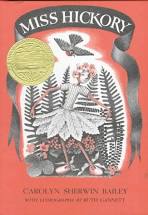
Miss Hickory by Carolyn Sherwin Bailey (J)

Miss Hickory

Miss Hickory

Carolyn Sherwin Bailey (Juvenile Fiction)

Miss Hickory had an apple-wood twig body, hickory nut head, and wore a rather smart checked gingham dress.  She lived a fine and comfortable life under the lilac bush in a corncob house.  Before winter set in, Great-Granny Brown would bring Miss Hickory’s house (and her along with it) into the Old Place and set both on the windowsill to pass the time amiably until springtime.  But this year, Crow had brought some terrible news.  It seems that Great-Granny Brown has closed up the Old Place for the winter and has decided to spend the winter in Boston in some place called the Women’s City Club.  Abandoned, dismayed, and soon-to-be evicted, what is Miss Hickory to do?  Leave it to her old friend Crow to not only offer up a solution, but an adventure to boot!

1947 Newbery Medal Winner, Miss Hickory is NOT to be confused with some run-of-the-mill children’s story.  Oh no!  For author Carolyn Sherwin Bailey advises her readers at the beginning of her story that all of her characters—from Miss Hickory to Crow to Squirrel and even Hen-Pheasant—are very much real and alive (save for one, but I don’t wish to spoil the story).  Bailey gives us a wonderful adventure tale that centers around one very prissy, self-centered, judgmental, and rather pretentious Miss Hickory.  We follow her seasonal exploits in the orchard that sits beside the Old Place.  Readers get to meet many colorful characters such as fearful Ground Hog, spoiled Chipmunk, and worldly Wild-Heifer.  As Miss Hickory encounters each of these wonderful creatures, she grows a bit in experience, character, and self-actualization.

Miss Hickory is a beautifully told story complemented by Ruth Gannett’s exquisite lithographs.  Her drawings give an earthy and rustic feel to a tale celebrating nature and wildlife.  Bailey spent her summers at a home in New Hampshire that adjoined an apple orchard.  Her keen observational skills allow readers to be transported to a world where you can delight in the purple asters, smell the fragrant pine needles, taste the berries and nuts, and feel the crunch of autumn leaves beneath your feet.

SPOILER: Although younger readers may find the ending a bit sad, Miss Hickory is truly a celebration of discovering your personal worth and finding your place in the world (adults may have to help them look for this silver lining).  In the end—although Miss Hickory was a bit “hardheaded”—she discovered that home is more than a structure, it’s a sense of belonging.  And although she was a bit of a nut (sorry!), Miss Hickory shows us that is does pay to listen to your heart rather than your head, that you can’t always judge a book by its cover, and—most importantly—that you should always, ALWAYS be nice to squirrels because making them angry would be just plain…nutty.

Rating: 4/5

*Book cover image attributed to www.discoverbooks.com

**Want more?  Visit our Facebook page at www.facebook.com/thedustyjacket
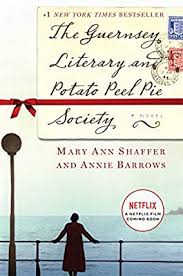
The Guernsey Literary and Potato Peel Pie Society by Mary Ann Shaffer and Annie Barrows

The Guernsey Literary and Potato Peel Pie Society

The Guernsey Literary and Potato Peel Pie Society

Mary Ann Shaffer and Annie Barrows (Adult Historical Fiction)

Juliet Ashton is tired of writing under the name of Izzy Bickerstaff and no longer wants to be considered a light-hearted journalist.  She wants to create something meaningful, but has no idea where to find inspiration…until a letter comes.  It’s a kind note from a Mr. Dawsey Adams of St. Martin’s, Guernsey who found her name and address written on the inside front cover of a book written by his favorite author, Charles Lamb.  He asks if she could kindly send him the name and address of other bookshops in London (for there aren’t any left on Guernsey after the war) so that he may acquire more Lamb books?  Through several letters, Juliet begins to learn more about Guernsey and its famed Guernsey Literary and Potato Peel Pie Society and she has questions.  Questions such as how could a pig begin a literary society and what exactly is a potato peel pie?  Perhaps this is the inspiration that Juliet has been looking for?

I admit I was in Heaven while reading this book—a book about people who love books.  What’s not to like?  It also doesn’t hurt that the writing was witty and sharp, the characters were endearingly flawed and humorously relatable, and the story had an equal mix of quirky, sadness, drama, humor, treachery, suspense, and yes, love.  The Guernsey Literary and Potato Peel Pie Society is a touching and bittersweet book about the residents of Guernsey during the German occupation of the Channel Islands during WWII.  Through the stories of the island’s residents, as well as a few of the prison camp survivors, we get a glimpse of the toll that the destruction, separation, and isolation had on the human psyche.  We are also given stories of bravery, selflessness, and heroism, which illustrates the strength of the human spirit even during the darkest of times.

What started out as a ruse to prevent dinner guests from being arrested by German soldiers, the literary society ended up showing its members how much power a book possesses.  Books can motivate, educate, inspire, entertain, and transport us to worlds far beyond our borders and imagination.  For the members of the Guernsey literary society, a book turned a fisherman into a Casanova, saved a man from a life of inebriation, allowed a collector to find his faith, and bridged two very unlikely friendships.

I was a little wary when I discovered that this book consisted entirely of letters.  Would it have the same depth and weight of a typical novel?  O me, of little faith.  The Guernsey Literary and Potato Peel Pie Society is a descriptive, warm, engaging, and satisfying read that will make you long for village life and allow you to believe in love again.  And while this book reminds us that life is often tragic and history sometimes reveals the worst in humankind, it also shows us how resilient the human spirit is and how expansive our hearts can be when the need arises.

Just as a particular song might come on the radio when you need it most or the perfect meme pops up on your Facebook feed that strikes a certain chord, I believe a book acts in the same capacity.  It finds us—chooses us—and makes us think, challenge, defend, or dream while allowing us to imagine, escape, explore, or be comforted.  The perfect book always seems to find us at just the right time and it changes us somehow.  And when it does, WE then become the conduit and pass it along to someone in need of a good laugh, cry, or shriek.  Books are indeed powerful.  As Juliet wrote in one of her letters to Dawsey, “Perhaps there is some secret sort of homing instinct in books that brings them to their perfect readers.  How delightful if that were true.”  Maybe as delightful as a potato peel pie?  I’ll let you decide.

Rating: 5/5

*Book cover image attributed to www.amazon.com

**Want more?  Visit our Facebook page at www.facebook.com/thedustyjacket

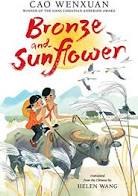
Bronze and Sunflower by Cao Wenxuan (J Historical Fiction)

Bronze and Sunflower

Bronze and Sunflower

Cao Wenxuan (Juvenile Historical Fiction)

Sunflower was lonely.  Her father was a revered sculptor in the city, but he—like so many others—had been sent to work at the Cadre School and now Sunflower has very little to do all day.  To pass the time, she goes down to the river and looks to the other side at the village called Damaidi.  In Damaidi, there is life, there is activity, and most of all, there are children.  She dreams of what it might be like to go over there and play and explore.  Then one day, Sunflower’s dad tragically drowns in the river and she is accepted into the home of Damaidi’s poorest family.  There she meets Baba, Mama, grandmother Nainai, and Bronze, their mute son.  Suddenly, Sunflower is a daughter, a granddaughter, and a sister and life amongst these poor people was about to make her richer than she could ever imagine.

Translated from Mandarin by Helen Wang, Bronze and Sunflower is a masterpiece in storytelling.  It tells the story of a family and a village caught up in China’s Cultural Revolution during the late 1960s and early 1970s.  Wenxuan doesn’t make this period in history the center of his story, but instead chooses to keep it as a backdrop.  He instead focuses on the unique and touching bond between Bronze and Sunflower and the family’s struggle to survive floods, locusts, famine, and dishonor.  It’s a tale replete with villains and heroes, sadness and joy, and despair and hope.  Wenxuan effortlessly weaves a tale showing us that life isn’t fair, that justice is often elusive, and that those in power—for better or worse—wield a mighty influence.  But he also shows us the importance of family, the power of redemption, and the value of integrity.  It’s a story absolutely brimming with moral lessons and human values and should be devoured by readers of all ages.

The only fault I had with this book is its ending.  It’s vague (I re-read it several times to make sure I didn’t miss any subtle clue or hidden meaning) and puts the burden on the reader to determine what happened.  I’m not a fan of this kind of ambiguous ending, but the overall story isn’t dependent upon it and so its vagueness shouldn’t serve as a detraction from an otherwise engaging and captivating tale that was an absolute joy to read and experience.

Without giving away any spoilers, the saddest part of the story—for me—was the eventuality of Bronze and Sunflower growing up…as children tend to do.  The head of the village of Damaidi stated as much when he met with Baba and Mama and said, “Time’s moving on.”  Simple words that remind us how fleeting and fragile time is and that everything should be cherished and savored for nothing is certain or guaranteed.  With the sudden loss of her father, Sunflower understood the unpredictability of life and the value that came with belonging.  Despite her poverty, Sunflower considered herself wealthy beyond measure because she was part of a family and that family loved her very much.  Actor, author, and activist Michael J. Fox once said, “Family is not an important thing. It’s everything.”  In that respect, Sunflower had everything and perhaps that made her the richest person in all of Damaidi.

Rating: 5/5

*Book cover image attributed to www.abebooks.com