
An Elephant in the Garden – Michael Morpurgo (YA Historical Fiction)

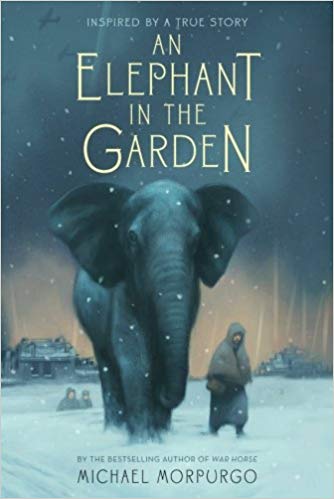
An Elephant in the Garden

An Elephant in the Garden    

Michael Morpurgo (Young Adult Historical Fiction)

Lizzie is eighty-two years old and is idly spending her days in a nursing home.  But today is February 13th and on this particular day, she has a story to tell.  It’s a rather sad story because on this day, in 1945, the bombers flew over Dresden, Germany and set the city on fire.  Lizzie, her brother, and her mother are forced to flee their home.  The Red Army is coming from the east and the allied forces—the Americans and British—are coming from the west.  They would go west, but they would not be going alone.  They would be bringing Marlene, a four-year-old elephant that Lizzie’s mother rescued from the zoo.  It would be this wonderful, gentle companion that would keep their spirits up, open unexpected doors, and ultimately save their lives.

Michael Morpurgo proves once again what a gifted and compassionate storyteller he is.  An Elephant in the Garden is a beautifully told and compelling story that transports the reader into war-torn Germany as thousands of refugees struggle for survival during World War II. His characters leap off the page and we are there to share in their daily quest for food, shelter, and obscurity from the encroaching Russian soldiers.  In his Author’s Note, Morpurgo writes that his story was inspired by an actual female zookeeper who saved one young elephant from certain death.  The zoo’s director had given orders that all animals were to be killed rather than risk their release into the town should the city fall under attack.  If you Google “Belgium, Zoo, Elephant, WWII”, you can see actual photographs and the story which inspired this heartwarming book.

At my library, this book is shelved in the young adult section; however, I think children as young as nine would appreciate and benefit from this story.  Stories about war are often dark and bleak, but the overall message of courage, resilience, friendship, and hope spans across all age groups and garners mutual appeal.

When Lizzie was conveying a moment in her youth, she recalled an instance when she was talking to Marlene, desperate to find some comfort and understanding from her silent friend.  She said, “For an answer she wafted her ears gently at me, and groaned deep inside herself.  It was enough to tell me that she had listened, and understood, and that she did not judge me.  I learned something that day from Marlene, about friendship, and I have never forgotten it.  To be a true friend, you have to be a good listener, and I discovered that day that Marlene was the truest of friends.”  Morpurgo reminds us that true friends not only listen with their ears, but also with their hearts and sometimes the best friends need not offer words in return, but simply just offer themselves.

Rating: 5/5

* Book cover image attributed to www.amazon.com 
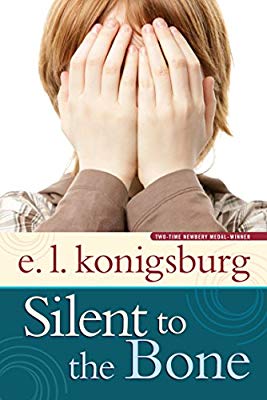


Silent to the Bone by E. L. Konigsburg (YA)

silent to the bone

Silent to the Bone    

E. L. Konigsburg (Young Adult Fiction)

“It is easy to pinpoint the minute when my friend Branwell began his silence.  It was Wednesday, November 25, 2:43 P.M., Eastern Standard Time.  It was there—or, I guess you could say not there—on the tape of the 911 call.”

They say, “For every Yin, there is a Yang”.  If that’s true, then Branwell Zamborska is the Yin to Connor Kane’s Yang.  Two friends the same age (born just weeks apart), going to the same school, and living just houses away from each other.  Connor will tell you that the biggest difference between them is that Branwell “is just plain different”.  He stands out in a crowd (quite literally—he is tall with bright red hair), is clumsy (he’s always dropping things), and likes offbeat music.  Still, they complement each other and even share secret “codes”.  Like BLUE PETER means “ready to go” and DAY CARE refers to their school.  Or SIAS, which requires you to “Summarize In A Sentence” a selected topic with points awarded afterward.  Given their closeness, it isn’t difficult to understand why Connor rushes to the aid of his friend, who has been rendered mute after his baby sister suffers a horrible accident and is struggling for life.  The message on the 911 tape is enough to send Barnwell to the Clarion County Juvenile Behavioral Center, but Connor knows his friend and is certain that Branwell is innocent.  But with Branwell rendered voiceless, how can the truth—whatever it is—be heard?

It is astonishing how many sensitive and provocative topics E. L. Konigsburg has dogpiled into one book:  psychological trauma, sexual awareness, emotional manipulation, divorce, jealousy, revenge.  But this isn’t the tawdry and explicit book that one might expect.  Instead, Konigsburg handles each subject with sensitivity and care and scratches just enough of the surface to allow readers to reach their own obvious conclusions.  This book is targeted from readers ages 10 and up, so some concepts may get a perplexed look from those on the younger end of the scale (“Hey, what’s Viagra?”) so be prepared for some possible teachable moments.

In addition to tackling so many complex issues with such finesse, Silent to the Bone received my highest review because of the deep bond that these two boys shared.  This book was published in 2000, and you don’t often see the kind of unshakable, unquestioning, and unwavering devotion that Connor has for Branwell in many of today’s young adult books.  In this age of jealousy, popularity, spite, ego, and peer pressure, friends are easily interchangeable.  Connor is placed in the most impossible and unthinkable of circumstances by a friend who has totally withdrawn from the world.  At any moment (and there are many), he could have simply given up and walked away.  But somehow Connor finds a faint voice in the silence and that alone drives him to not give up on his friend nor abandon his cause.

E.L. Konigsburg gives readers a suspenseful book that explores the bond of friendship and demonstrates just how far that connection can be stretched without ever really breaking.  I think if I had to SISA this book, I’d use the words of Yolanda, the day worker who lives across the street from the Zamborskas.  When Connor explained to her how he had found a way to “talk” with Branwell, she said, “Friends always find a way to keep in touch.”  Nine words.  I wonder how many points Connor and Branwell would give me for that one?

Rating: 5/5

* Book cover image attributed to www.amazon.com
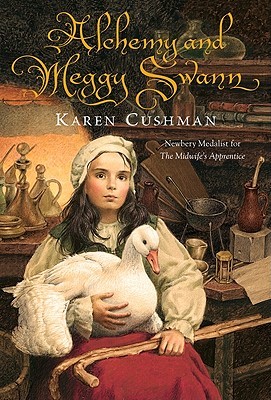


Alchemy and Meggy Swann by Karen Cushman (YA Historical Fiction)

Alchemy and Meggy Swann

Alchemy and Meggy Swann   

Karen Cushman (Young Adult Historical Fiction)

“The meeting of two personalities is like the contact of two chemical substances; if there is any reaction, both are transformed.” – Carl Jung

After the death of her gran, Margaret “Meggy” Swann is carted from Millford Village to London and unceremoniously deposited at the doorstep of her father, Master Ambrose, the local alchemist.  Meggy is none too pleased with her new home: heads mounted on sticks and placed on a bridge, the smell of fish and sewage everywhere, and streets slick and slippery from horse droppings.  Ye toads and vipers!  What kind of place IS this London?  Between a mother who was pleased to see the back of her and a father who assumes she is a beggar upon their first introduction, Meggy has found herself in a rather unenviable position.  She is crippled, penniless, and friendless…unless you count her goose, Louise.  But Meggy is stronger than she thinks and with the help of a cooper, a printer, and a rather smitten player, she’ll not only save a life, but she’ll manage to save a soul as well.

From her first utterance of, “Ye toads and vipers”, I fell in love with Meggy Swann.  She is scrappy, sassy, resourceful, impish, loyal, and brave.  She is disabled (suffering from what we would today recognize as bilateral hip dysplasia), but doesn’t seek sympathy, pity, or charity.  In a time when deformity and illness were viewed as a direct judgment from God, it would have been easy for Meggy to become bitter from the taunts and jeers unmercifully thrown at her by villagers both young and old alike.  While in Millford Village, she was able to stay somewhat isolated and protected within her mother’s alehouse; however, in London her lameness is on full display and it is at this moment when we see Meggy’s pluck and spirit begin to emerge.  No longer will she be the meek victim of unfair slurs and prejudices.  While her father is busy transforming metals in his laboratorium, Meggy is experiencing her own transformation into a strong, proud, and confident young woman who refuses to let her circumstances define or limit her.

This story is set in 1573 London and Cushman successfully transports readers to the Elizabethan Era through her usage of period-appropriate language.  This requires having to adjust to the frequent occurrences of words such as naught (nothing), certes (certainly), mayhap (perhaps), belike (very likely), and sooth (truth), but given the age this book targets (12 years and above), the acclimation should be quick and painless.

There are so many lessons that one could glean from this book, but perhaps the most poignant was one that Meggy learned from a flightless goose: “Even Louise had given the girl something, the knowledge that one did not have to be perfect to be beauteous.”  And that is something worth remembering, be ye toad or viper.

Rating: 5/5

* Book cover image attributed to www.goodreads.com

I Don’t Know How the Story Ends by J. B. Cheaney (YA Historical Fiction)

I Dont Know How the Story Ends

I Don’t Know How the Story Ends

J. B. Cheaney (Young Adult Historical Fiction)

“The first I heard of Mother’s big idea was May 20, 1918, at 4:35 p.m. in the entrance hall of our house on Fifth Street.  That was where my little sister ended up after I pushed her down the stairs.”

Matilda Ransom was tired of the dreariness of Seattle and the restlessness of her daughters and decided that the three of them would spend the summer in California.  Isobel (Izzy) wasn’t too keen on the idea, but between her father being in France serving in the Great War and her constant bickering with her little sister, Sylvie, her mother’s mind was made up.  The family was off to visit Aunt Buzzy in Los Angeles.  Izzy would soon find herself pulled away from the security of her books and thrust into the world of early Hollywood—filled with silent screen stars, bigger-than-life directors, Keystone Cops, a moving panorama, and a headstrong boy determined to make a name for himself in film.  For a girl who loves to tell stories, this summer would undoubtedly provide Izzy with more than enough content.

Historical Fiction is my favorite genre, so when I see an interesting topic written especially for younger readers, I am beyond thrilled.  Being surrounded by everything digital, it was a joy to escape to Hollywood’s earliest years and learn more about the world of the silent screen.  Cheaney introduces her readers to such directorial deity as D. W. Griffith, Mark Sennett, and Cecil B. DeMille, as well as screen legends Charlie Chaplin, Douglas Fairbanks, and Mary Pickford.  Cheaney allows us to be a part of the action by giving us a first-hand look at staging, lighting, makeup, filming, and post-production editing.  We often forget just how skilled and talented these early filmmakers were and I, for one, am grateful to her for reminding us of their groundbreaking brilliance.

In addition to the glamour and glitz of Hollywood, this book also examines the reality of a world at war and the brave men who returned home, but forever left a part of themselves on the battlefield.  During a particularly difficult moment, Izzy’s friend, Sam, once said to her, “Some film can’t be cut” meaning that some things just can’t be fixed and some matters can’t be undone.  While the entire book is informative and entertaining, it is the last few pages that are the most touching, emotional, and poignant.  For the first time, Izzy sees her story told and knows exactly how it ends.  Izzy’s Aunt Buzzy once told her, “Life is like that—the strangest or most unwelcome, even the saddest things that happen can come to make sense in the end.”  Like the movies in early Hollywood, Izzy’s story didn’t need any sound.  All it needed was a picture…a picture of what true love really looked like.

“Remember how small the world was before I came along?  I brought it all to life: I moved the whole world onto a 20-foot screen.”—D. W. Griffith, Director, Writer, Producer.  Thank you for making the world a whole lot bigger Mr. Griffith.

Rating: 5/5

* Book cover image attributed to www.goodreads.com 


Dogsong by Gary Paulsen (YA)

Dogsong.jpg

Dogsong    

Gary Paulsen (Young Adult Fiction)

During the winter, Russel Susskit and his father live in a sixteen by twenty government house in a small Eskimo village.  Come summer, both will move to the fish camps.  For now, Russel wakes up every morning to his father’s smoking-induced cough; the absence of his mother, who left with a white trapper; and the growing unhappiness he feels when he thinks of his current life and, more importantly, his future.  Russel wants to be more, but when he looks ahead, he only sees less.  Russel’s father sends him to the local shaman, Oogruk, who owns the last team of dogs in the village.  Oogruk tells Russel that he needs to discover his own song and returning to the old ways of his people may help.  Driven by a recurring dream and a team of five great red dogs, Russel heads north searching for answers and a song.

Dogsong is divided into two parts: Russel’s training with Oogruk and his solitary journey north.  It is the second part of this book that is disappointing and not particularly compelling.  We find ourselves caught in a seemingly tedious storyline loop:  run, eat, dream, repeat.  The story drags like a sled maneuvering through slush and Paulsen fails to provide enough action to hold either the reader’s interest or attention.  A sudden story twist near the end arrives far too late to save what could have been an interesting boy-versus-nature adventure story.

One notable bright spot was Oogruk’s advice to Russel about life and living.  “It isn’t the destination that counts,” Oogruk said.  “It is the journey.  That is what life is.  A journey.  Make it the right way and you will fill it correctly with days.  Pay attention to the journey.”  All too often we find ourselves consumed or distracted by the things that have little to no effect on our life or circumstances.  In hindsight, we often come to realize that it is the small things that have the biggest impact.  If we take an old shaman’s advice and simply look up, look around, and pay attention, perhaps we too can find the words to our own song.

Rating: 3/5

* Book cover image attributed to www.amazon.com 


The Canning Season by Polly Horvath (YA)

The Canning Season

The Canning Season     

Polly Horvath (Young Adult Fiction)

Thirteen-year old Ratchet Clark (her father wanted to name her Stinko) lives with her mother, Henriette, who dreams of belonging to the Pensacola Hunt Club (“Thank God for the Hunt Club” is the mantra in their household).  Henriette works two jobs, sustains the family on Cheerios, and constantly reminds her daughter to cover up That Thing on her shoulder (it is unsightly).  Life moves along at a predictable pace until the day that Henriette sends Ratchet to live with her two great aunts in Maine.  Tilly and Penpen Menuto (DON’T call them the Blueberry Ladies!) are twins, but as different as chalk and cheese.  Tilly is tiny and thin and Penpen is round and jolly, but both are as devoted to canning as they are to one another.  Between blueberries, bears, a one-way phone, an unexpected orphan, and countless stories of a headless mother, Ratchet’s summer will prove to be anything but predictable.

The Canning Season is a delightful, entertaining, and hilarious romp.  Fans of Philip Gulley or Ann B. Ross will find equal enjoyment in the Menuto sisters and their tales of loggers, love, and the lure of the woods.  Some of the language in this book is a bit salty, but is appropriate to the targeted age (13 and older) and shouldn’t shock anyone who watches PG-13 films or hangs out at the local mall.

Throughout the book, we see Henriette placing an unhealthy importance on belonging to the Pensacola Hunt Club, which remains an elusive aspiration.  We find out that the club really isn’t as exclusive as first thought and, in reality, is open to anyone wanting to join.  Drawing a nice parallel with Tilly and Penpen’s home, we see that the ominous house on the hill surrounded by bear-infested woods isn’t really what it appears to be either.  It is actually warm, welcoming, and inclusive; all who enter are taken care of and treated with respect, kindness, and love (except Myrtle Trout…Heaven help her).  The Canning Season reminds us that things are not often what they seem and that love is often found in the least likely of places.  Thank God for the Hunt Club, indeed.

Rating: 4/5

* Book cover image attributed to http://www.goodreads.com


The Decoding of Lana Morris by Laura & Tom McNeal (YA)

It’s Tween and Teen Tuesday where we review either a juvenile (J) or young adult (YA) book.

The Decoding of Lana Morris.jpg

The Decoding of Lana Morris  

Laura & Tom McNeal (Young Adult Fiction)

If you had one wish…just one…what would it be?

Sixteen-year old Lana Morris lives in a two-storied foster home that she shares with four special needs kids (Snicks for short) and her foster parents, Whit and Veronica.  Lana wishes for a different foster mother; she wishes to fit in with the cool kids; she wishes she didn’t have to live in Snick House; and she wishes she understood her feelings for Whit better.  Lana wishes for a lot of things and soon, after she visits Miss Hekkity’s Oddments & Antiques, she’ll have not just one wish, but 13.

First, I want to focus on the positive aspects of this book, which is the attention the McNeals devote to young people with special needs.  They give us insight into their daily lives and allow us to understand their challenges and individuality.  Too often society judges these amazing people by their outward appearance or behavior alone.  It is also heartwarming to see Lana’s role evolve from disparager to defender as she connects with her housemates and appreciates their uniqueness.

Unfortunately, the negative aspects of this book vastly outweigh the positives.  The McNeals make Veronica excessively cruel and evil for no apparent reason.  Her treatment of Lana is childish, snippy, and incredibly mean-spirited.  The authors provide no insight as to why this kind of person possesses such disdain and disregard for the children in her care.  We find out late in the book that she is unable to have children of her own.  So, are we then to assume that these children are somehow meant to fill a personal void or is she putting her own feelings aside and doing it out of selfless love for Whit?  Surely, she can’t be putting herself and these children through such torment for just a monthly stipend.

Additionally, and more disturbingly, is how the authors portray Whit.  Before Lana gains access to her “wishes”, Whit is a beloved, meek, and kind foster father.  The children adore him and Lana views him as a father (although her affections often overlap between familial and hormonal).  After her visit to Miss Hekkity’s, Whit inexplicably becomes increasingly salacious and lecherous toward Lana.  As a lonely teenage girl in want of a father figure, Lana is naturally drawn to Whit, but Whit’s reciprocation, and even encouragement, of her interest cross a very distinct line which is both disturbing and unsettling.  If the authors merely did this to shock their teen readers with provocative and edgy content, they handedly hit their mark.  What is supposedly a book about a teenage girl desperately trying to find love and acceptance dives abruptly into a world filled with infidelity, child exploitation, abuse, and neglect.

If I had one wish…just one…it would be that the McNeals had stayed a little truer to their book’s proposed purpose.  Unfortunately, the strong and encouraging themes of love, acceptance, and friendship are overshadowed by hate, jealousy, and lust and no amount of wishes can overcome that.

Rating: 2/5

* Book cover image attributed to http://www.goodreads.com


Hattie Big Sky by Kirby Larson (YA)

Hattie Big Sky

Hattie Big Sky  

Kirby Larson (Young Adult Fiction)

Hattie Inez Brooks refers to herself as Hattie Here-and-There.  Orphaned before she had lost her baby teeth, she spends her years being shuffled here and there amongst various relatives’ homes.  At 16, everything changes when she is left 320 acres and a house in Montana by her deceased mother’s brother, Uncle Chester.  With the only thing to look forward to in Arlington, Iowa is a job at a boardinghouse, Hattie writes back, “I’ll come.”  But to make her uncle’s claim her own, she has to cultivate 40 acres and lay 480 rods of fence…and she has less than a year to do it. With a strong faith and help from neighbors, can Hattie make her deepest wish a reality—to find a place to belong.

Hattie Big Sky is based on the life of Larson’s great-grandmother, Hattie Inez Brooks Wright, who herself had homesteaded as a young woman in eastern Montana.  Because most of the story takes place in 1918, we see more references to automobiles than covered wagons.  The United States was also embroiled in World War I and many German-born immigrants were subjected to a litany of anti-German persecution.  Larson weaves all of these facts, along with the countless struggles faced by homesteaders, into a beautifully-told story of hardship, bravery, and old-fashioned grit.

Hattie is pleasantly surprised to find that a paper in Iowa is willing to pay her a monthly fee for her homesteading stories.  In one such submission, she writes, “…the lesson this life has planted in my heart pertain more to caring than to crops, more to Golden Rule than gold, more to the proper choice than to popular choice.”  Hattie’s lesson is one we should all strive to implant upon our own heart.

Rating: 4/5

* Book cover image attributed to www.scholastic.com


The Wind in the Willows by Kenneth Grahame (YA)

The Wind in the Willows

The Wind in the Willows

Kenneth Grahame (Young Adult Fiction)

Mole was working hard to clean his little home when something enticing and intriguing and beguiling begins to beckon.  It is spring, and spring waits for no man…or mole.  So when she calls, it’s best to answer, which is exactly what Mole does on this particular day.  He pops out of his burrow and—with the sun warming his dark and rather dusty fur—heads out to see what he can see and what he sees…is a river!  Unbeknownst to Mole, this very river would be the beginning of many wonderful adventures to come.

When The Wind in the Willows was written in 1907, Kenneth Grahame delighted the world with four unforgettable characters: impetuous and curious Mole, kind and generous Rat, indulgent and self-important Toad, and reclusive and wise Badger.  But those who think this is merely just another children’s book should think again!  Between the pages of this dusty jacket is a story that features a brazened auto theft, a bold prison escape, breaking and entering by a gang of ruffians and hooligans, and a good old-fashioned brawl thrown in at the end for good measure.

The Wind in the Willows is a beautifully-told tale of courage, mischief, greed, and friendship and Grahame continues to delight readers with an adventure book for the ages.

Rating: 5/5


Fever 1793 by Laurie Halse Anderson (YA)

Fever 1793

Fever 1793

Laurie Halse Anderson (Young Adult Fiction)

It started with the sudden death of a young and healthy girl.  Within a week, 64 more would die from yellow fever and the capital city of Philadelphia would be filled with the endless ringing of bells—one toll for every year the victim had lived.

In the summer of 1793, 14-year old Matilda Cook helps run her family’s coffeehouse, where folks idly gossip or talk politics.  Lately, the conversations have turned to the fever:  Is it a sign from God?  A punishment for sinners?  Did the refugees bring it with them?  As death draws closer, she and her grandfather are forced to flee the city for the safety of the country.  But Matlida soon discovers that death is not easily escaped.

Anderson gives us a compelling, gripping, and suspenseful account of one of the worst epidemics in the history of the United States.  Wiping out 10% of Philadelphia’s population in under three months, the effects of the fever were devastating.  Many fled the city to escape the carnage, but it was those who stayed and tended to the sick, as well as the dead, that were the true heroes.

You don’t have to be a fan of history to thoroughly enjoy this book.  From the first page, the plot never slows and the story will keep you on the edge of your seat.  It reminds us how even the direst of circumstances can often bring out the best in people and that both disease and heroism are not bound by either social status or race.

Rating: 5/5