
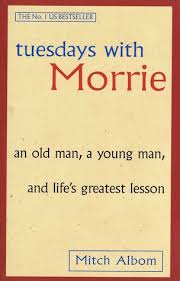
Tuesdays with Morrie by Mitch Albom

Tuesdays with Morrie

Tuesdays with Morrie

Mitch Albom (Adult Memoir)

 It was to be professor Morrie Schwartz’s final class.  A class with no grades, no textbooks, and no final exam.  Weekly oral exams were required and a long paper on what was learned was expected (a kiss good-bye earned an extra credit).  The subject would be The Meaning of Life and the class would cover such topics as family, work, aging, forgiveness, love, and death.  It would last fourteen weeks (fourteen Tuesdays to be exact), be held after breakfast, and would have just one pupil—a former student by the name of Mitch Albom who had lost his way somehow.  Thanks to Ted Koppel, Mitch found his way again because he had found Morrie Schwartz.

Tuesdays with Morrie reminded me of John Gunther’s 1949 memoir Death Be Not Proud.  Both were a celebration of life and showed us what true courage, grace, peace, and humility look like.  Mitch Albom provides us with an honest, candid, and raw account of his beloved professor’s last weeks on earth as he battles and eventually succumbs to the ravages of Amyotrophic Lateral Sclerosis (ALS) or Lou Gehrig’s disease.  His account of his time with Morrie is heartbreaking and humorous, tragic and hopeful, and gives us a precious glimpse into the life of a man who accepted his fate with dignity and generosity.  By openly sharing his steady decline with Albom and by conducting several interviews on national television, Morrie cast modesty and privacy aside with the hope that those touched by his story may cherish the time that they have been given and re-evaluate what was truly most important in life.

Throughout his memoir, Albom blesses us with many of Morrie’s aphorisms: “Do the kinds of things that come from the heart.”; “Love each other or perish.”; “Death ends a life, not a relationship.”; and his last one, “Don’t let go too soon, but don’t hang on too long.”  Albom’s story of his former professor and friend is bittersweet because we know how the story is going to end.  With each turn of the page, we understand that we’re getting closer to Morrie’s final day and although we hope that never turning another page might mean that Morrie could somehow avoid death, we know that isn’t possible and that his fate has already been determined and carried out.

Tuesdays with Morrie explores humanity and what it means to be a part of humankind.  Although published in 1997, Morrie’s insights and observations ring just as true today as they did almost twenty-five years ago.  Back then, while society was caught up with Princess Diana, John F. Kennedy, Jr., and the trial of O. J. Simpson, Morrie said to Albom, “The culture we have does not make people feel good about themselves.  And you have to be strong enough to say if the culture doesn’t work, don’t buy it.”  How unfortunate that this is just as relevant today as it was nearly a quarter of a century ago.

In his final weeks, scores of Morrie’s former students traveled domestically and internationally for the chance to visit their favorite professor one final time.  Morrie knew, better than anyone, that the role of educator carries a tremendous amount of responsibility and influence.  In death, as I imagine it was true in life, Morrie gave each one of his visitors his undivided attention and made them feel like they were the most important thing in the world.  He made everyone feel important, special, and loved.  That was Morrie’s legacy and his hope for the future.  That everyone would feel good about themselves.

At one time or another, we’ve all had a favorite teacher, camp counselor, or coach who had a profound impact on the way we wanted to model ourselves as adults.  They encouraged, supported, and challenged us and their influence will always be a part of us.  But what we often fail to realize, and what Albom reminds us of, is the effect that we—as students, campers, or athletes—have had on their lives as well.  The gestures of appreciation, the thirst for knowledge, the desire to please is just as important and meaningful.  It’s a fragile circle that can be strengthened with a simple “Thank You” or weakened with a harsh word.  But through Morrie and Mitch, we’re shown just how joyful this unique bond and relationship can be and even though graduations and retirements come and go, the learning—the loving—never stops.  As Morrie said, “The most important thing in life is to learn how to give out love, and to let it come in.”  Well said, Professor.  Class dismissed.

Rating: 5/5

*Book cover image attributed to www.goodreads.com

**Want more?  Visit our Facebook page at www.facebook.com/thedustyjacket
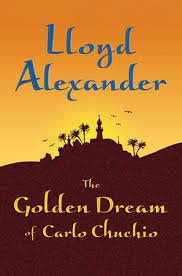
The Golden Dream of Carlo Chuchio by Lloyd Alexander (J Fantasy)

The Golden Dream of Carlo Chuchio

The Golden Dream of Carlo Chuchio

Lloyd Alexander (Juvenile Fantasy)

 If you were to ask Evariste what he thought of his nephew, Carlo Chuchio, he would say that the lad was nothing more than a thankless, dimwitted daydreamer.  A “chooch”.  And perhaps he was right.  Having an uncle who was an importer, Carlo spent his days loitering at the docks and imagining places waiting to be visited and explored—places far beyond his home in Magenta.  Adventure, as fate would have it, was a lot closer than Carlo had imagined for when he happened upon a bookseller in the market, he was offered a book of fantastic tales.  Stories of magic carpets and genies in lamps and caves filled with treasure.  But this particular book didn’t just contain wondrous stories, it also hid a map with the most intriguing and irresistible two words that Carlo could ever imagine: “Royal Treasury”.  Soon, Carlo would be embarking on a journey that involved an unlikely set of traveling companions…all heading to Cathai and the fabled “Road of Golden Dreams”.

Lloyd Alexander takes readers on a magical journey filled with suspense, danger, mishaps, missteps, humor, and romance.  Although there’s no flying carpet or bottled genie, there is plenty to delight and entertain readers of any age.  At the heart of this story is young Carlo Chuchio, a dreamer filled with integrity who would not let his desire to be held in high regard outweigh his need to do the right thing.  He soon realizes the burden of having a conscience, but the blessing that comes with listening to it.

Along Carlo’s journey, he meets up with a delightful set of companions.  Baksheesh, a camel-puller, proves to be an invaluable adviser and is always ready with a fast line or two in order to escape trouble…or work.  There’s quiet and observant Salamon, who is childlike in his eagerness, curiosity, and joy when discovering something new.  Then there’s Sira, who is not what she appears to be.  She bears a tragic past and although her heart is filled with vengeance and heartache, perhaps there’s still a bit of room left for love.  Together, the group encounters ruffians, warlords, a dream merchant, a painter, rivaling tribes, armies, a horse master, and perhaps the most repugnant of them all, a storyteller.  While encountering danger and death at almost every turn, our ragtag troupe reminds us that it is often cunning and cleverness that have a sharper edge and can cut just as deep as any saber or tulwar.

Of all the characters in this book, it is Salamon who is perhaps my favorite.  He is a kind and gentle man of few words, but when he does offer up some advice or wisdom, they are balm to the soul.  When Carlo was unsure about what his future held, Salamon replied, “What remains to be seen is always the most interesting.”  And when Carlo was telling Salamon about his quest for treasure, Salamon came up with a gem of his own: “As if a fortune could make up for the bother of gaining it.  No, no, my lad: The journey is the treasure.”

The Golden Dream of Carlo Chuchio teaches us so many lessons: not to judge a book by its cover, the virtues found by putting your faith in the untrustworthy, or the comfort gained from seeking hope amongst the impossible.  But above all, Lloyd Alexander gives us a wonderful and exciting story about a boy who discovers all the possibilities and treasure that the world has to offer all because one day, he seized upon the remarkable opportunity to open up a book.  How much richer can you possibly get?

Rating: 5/5

*Book cover image attributed to www.goodreads.com

**Want more?  Visit our Facebook page at www.facebook.com/thedustyjacket
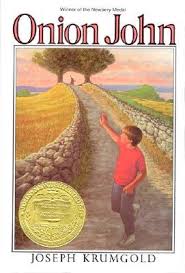
Onion John by Joseph Krumgold (J)

Onion John

Onion John

Joseph Krumgold (Juvenile Fiction)

Twelve-year-old Andy Rusch is a junior to his father’s senior and that carries a lot of weight and responsibility.  Seems that Andy’s father has big plans for him: working for General Magneto this summer, studying at MIT, being an engineer, and maybe one day going to the moon!  But all Andy wants to do is work in the family’s hardware store, play baseball, and hang out with his best friend, Onion John.  Not many people can understand Onion John, but Andy does.  Onion John is a beloved fixture in the small town of Serenity, New Jersey.  He lives a simple life in his stacked-stone house filled with bathtubs and has his own ideas about how to make apples grow bigger or how to make it rain.  Onion John’s fanciful ways clash with Andy’s father who wants his son to be practical and realistic.  But how can a boy possibly choose between his best friend and his father?  And what happens when your best friend starts to become friends with your father?  Up until that point, the worst thing that had ever happened was when Eechee Ries was pulled from the pond and worked over by the Pulmotor.

Joseph Krumgold was the first writer to have been awarded the Newbery Medal twice.  The first was for his 1954 novel …and now Miguel (which I read and really enjoyed) and he did it again in 1960 with this book.  If written today, Onion John would still hold the same strong themes of standing up for what you believe in, being true to yourself, and accepting people for who they are and not for who you would like them to be.  However, if you were pitching a story about a twelve-year-old boy befriending an unintelligible adult male who lives on the outskirts of town in a stone house today, it would clearly be a hard sell and, in all honesty, tend to come off as a bit creepy.  But in 1959, it was simply a story about an unlikely friendship and the virtues of believing in yourself.

In addition to the strong bond Andy builds with Onion John—which eventually spills over and affects his relationship with his father—there is the project that the entire town adopts for the benefit of their most cherished citizen…Onion John.  This is Krumgold providing a social commentary on how society tries to fit everyone into a convenient box and does so under the pretext of personal betterment.  He makes you challenge the nature of charity and poses the question: “When is doing good not really good?”  The people of Serenity wanted to do something very magnanimous for Onion John with the assumption that their efforts would make his life happier, easier, and better.  But one man’s heaven is another man’s hell and those subtleties tend to get in the way all for the sake of benevolence.

Joseph Krumgold packs so many wonderful lessons and moments in this book that it’s hard to choose just one to highlight for this review: Andy’s coming of age, Andy challenging his father, the town’s collective awakening, Andy’s father’s personal redemption, Andy’s deepening bond with his father.  These are all worth further discussion, but I chose one that particularly resonated with me and that was Onion John’s ability to listen.  How often are we talking to someone who is busy texting or reading or cleaning or something-ing and you’ll pause only to have them say, “Go ahead.  I’m listening.”  With Onion John, he would stop everything in order to let you know that at that moment, you were the singular, most important thing in the world.  There was absolutely nothing more important in life at that moment than you.  As Andy described, “One thing about Onion John, whatever he was doing, if someone came along he was always ready to stop and talk things over.”  What a rare quality it is to find someone who is able to put life on pause in order to afford another human being the courtesy of their undivided attention.  American journalist and author Krista Tippett wrote, “Listening is about being present, not just about being quiet.”  Perhaps that is why only Andy could understand Onion John and no one else could.  He was present.  Wouldn’t it be wonderful if we could all learn how to listen like that?

Rating: 4/5

*Book cover image attributed to www.goodreads.com

**Want more?  Visit our Facebook page at www.facebook.com/thedustyjacket
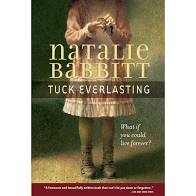
Tuck Everlasting by Natalie Babbitt (J Fantasy)

Tuck Everlasting

Tuck Everlasting

Natalie Babbitt (Juvenile Fantasy)

Winnie did not believe in fairy tales.  She had never longed for a magic wand, did not expect to marry a prince, and was scornful—most of the time—of her grandmother’s elves.  So now she sat, mouth open, wide-eyed, not knowing what to make of this extraordinary story.  It couldn’t—not a bit of it—be true.  And yet…

Ten-year-old Winnie Foster lives with her father, mother, and grandmother in Treegap.  They were the first family in the area and laid proud claim to Treegap wood and the touch-me-not cottage that laid on its outskirts.  She was the only child in the household and, on this particular day, she was bored.  And hot.  And it’s only the first week in August.  After being pecked at by both her mother and grandmother, Winnie ventures outside to seek solitude.  But peace won’t be hers that day for a man in a yellow suit comes up to the iron fence and is looking for a family.  He also has a particular interest in their wood.  Winnie has never ventured outside the fence let alone into the wood.  Maybe she can find some solitude there.  And who knows?  Maybe she’ll find something interesting.

Written in 1975, Tuck Everlasting has sold over 5 million copies and is considered a modern classic in children’s literature.  It’s the story of the Tuck family—father and mother (Angus and Mae), and brothers Miles and Jesse—who drink from a spring in Treegap wood and inadvertently discover immortality.  They’ve been able to keep their secret safe until a chance encounter with Winnie Foster threatens everything they’ve been concealing.  Tuck Everlasting is folkloric in nature and woven with bits of fantasy, drama, and a touch romance.  It’s written for ages 10 and up and its broad-based themes of sacrifice, friendship, loyalty, love, and family ensures a very wide appeal.

Babbitt delivers a detailed and beautifully told story that is rich in symbolism.  Watch for the toad that pops up throughout various points in Winnie’s story.  He’s more than just a convenient friend and marks notable shifts in Winnie’s maturity.  There are also numerous mentions of imprisonment or feeling trapped.  At one point, Winnie recalls a verse from an old poem (Richard Lovelace’s 1642 poem “To Althea, from Prison”) which goes, “Stone walls do not a prison make, / Nor iron bars a cage.”  Winnie feels imprisoned by her mother and grandmother (and the literal iron bars that surround her yard) while the Tucks are prisoners of time itself.  Both are trapped, but Winnie alone has any future chance of escape.

Tuck Everlasting was a quick read packed with moral lessons and questions (Would you want to live forever?).  The only criticism I had was that the ending felt forced and rushed.  Babbitt spent such an inordinate amount of time painting this detailed image of the wood and the Tucks into our minds, that the end fell a little flat.  This was one of those stories that an additional twenty pages might have helped give a more ample and satisfying conclusion rather than a one- to two-page condensed summary that wrapped everything up.  It just left this wonderful journey feeling incomplete and inadequate.

In closing, I will repeat a bit of wisdom that Miles imparted to Winnie, “People got to do something useful if they’re going to take up space in the world.”  During my limited time of taking up space in this world, it is my hope that my reviews and insights provide you with something useful and perhaps even help you discover a book and a story that will stay in your heart forever.

Rating: 4/5

*Book cover image attributed to www.target.com

**Want more?  Visit our Facebook page at www.facebook.com/thedustyjacket


Tracks by Jim Black

Tracks

Tracks

Jim Black (Adult Fiction)

It’s 1968 in the small town of Archer City, Texas.  Fifteen-year-old Jim and his friends, Charles and Gary, are freshmen in high school and the world is suddenly full of hope and possibility…and broken hearts, broken noses, and a few bruised egos.  Yes, life is good until strange things begin to happen.  There are reports of livestock being found mutilated just outside of town and rumors of satanic cults and aliens begin swirling around faster than a Texas dust storm.  Every nerve in town is raw and on edge and that could only mean one thing: the time is absolutely ripe for Jim, Charles, and Gary to pull off a prank worthy of the ages.

Tracks is the sequel to Jim Black’s delightful and humorous semi-autobiographical River Season.  I was gifted my copy of Tracks by the author himself (who also kindly signed it) who mailed it to me after reading my review of his first book and noting that I was looking for a copy of his sequel.  I must say, I was a bit apprehensive when I started reading Tracks.  Would it capture the same magic and nostalgia as its predecessor?  What if I didn’t like it?  How can I tell an author, who personally sent me a copy of his book, that it fell a little flat and then afterwards, how would I be able to fake my own death?  I shouldn’t have worried because Tracks captures the same heart, soul, and humanity that originally endeared me to three teenaged lads in a small Texas town.

Like Black, I grew up in a small, southern town.  During the 1970s, my town had a population of only 646 and I remember the barbershop with the lighted barber’s pole, the diner, the hardware store, post office, service station, bank, library, and courthouse that stood along Main Street.  Black’s novel isn’t just a story about the special bond of friendship and how family goes way beyond blood, it’s a sentimental and tender journey back to a time when after a fight or a bad date, all it took to set the world right again was a fried fruit pie and a flavored Coke with your best friends sitting beside you in the corner booth.  A time when you walked into the diner and all you had to be asked was, “The usual?”  A time when your mom served you Malt-O-Meal for breakfast, you played Parcheesi with your grandmother on Sunday, and you sat around the television set watching Bonanza at night.  It was a time when friendship meant that someone always had your back and was ready to offer up a hand or a shoulder when needed.  It’s a story about life and everything that goes with it: humor and heartbreak, hope and disappointment, pitfalls and promises.  It’s the uncertainty and the adventure that makes life worth living and a story that each of us writes for ourselves with every breath we take.

I will never be able to thank Jim Black enough for his kindness and generosity for sending me Tracks (he sent me a second book which I will be reading and reviewing in the very near future).  I read because I love getting lost in a story and I write because it is what God gifted me to do.  When the two meet and happen to come across an appreciative eye, it makes life all the more sweet.

Ben Franklin once said, “If you would not be forgotten as soon as you are dead, either write something worth reading or do something worth writing.”  With the help of his two best friends in the world, Jim Black was able to accomplish both.

Rating: 5/5

*Book cover image attributed to www.amazon.com

**Want more?  Visit our Facebook page at www.facebook.com/thedustyjacket


Miss Hickory by Carolyn Sherwin Bailey (J)

Miss Hickory

Miss Hickory

Carolyn Sherwin Bailey (Juvenile Fiction)

Miss Hickory had an apple-wood twig body, hickory nut head, and wore a rather smart checked gingham dress.  She lived a fine and comfortable life under the lilac bush in a corncob house.  Before winter set in, Great-Granny Brown would bring Miss Hickory’s house (and her along with it) into the Old Place and set both on the windowsill to pass the time amiably until springtime.  But this year, Crow had brought some terrible news.  It seems that Great-Granny Brown has closed up the Old Place for the winter and has decided to spend the winter in Boston in some place called the Women’s City Club.  Abandoned, dismayed, and soon-to-be evicted, what is Miss Hickory to do?  Leave it to her old friend Crow to not only offer up a solution, but an adventure to boot!

1947 Newbery Medal Winner, Miss Hickory is NOT to be confused with some run-of-the-mill children’s story.  Oh no!  For author Carolyn Sherwin Bailey advises her readers at the beginning of her story that all of her characters—from Miss Hickory to Crow to Squirrel and even Hen-Pheasant—are very much real and alive (save for one, but I don’t wish to spoil the story).  Bailey gives us a wonderful adventure tale that centers around one very prissy, self-centered, judgmental, and rather pretentious Miss Hickory.  We follow her seasonal exploits in the orchard that sits beside the Old Place.  Readers get to meet many colorful characters such as fearful Ground Hog, spoiled Chipmunk, and worldly Wild-Heifer.  As Miss Hickory encounters each of these wonderful creatures, she grows a bit in experience, character, and self-actualization.

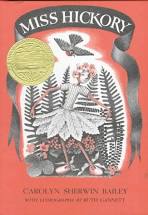
Miss Hickory is a beautifully told story complemented by Ruth Gannett’s exquisite lithographs.  Her drawings give an earthy and rustic feel to a tale celebrating nature and wildlife.  Bailey spent her summers at a home in New Hampshire that adjoined an apple orchard.  Her keen observational skills allow readers to be transported to a world where you can delight in the purple asters, smell the fragrant pine needles, taste the berries and nuts, and feel the crunch of autumn leaves beneath your feet.

SPOILER: Although younger readers may find the ending a bit sad, Miss Hickory is truly a celebration of discovering your personal worth and finding your place in the world (adults may have to help them look for this silver lining).  In the end—although Miss Hickory was a bit “hardheaded”—she discovered that home is more than a structure, it’s a sense of belonging.  And although she was a bit of a nut (sorry!), Miss Hickory shows us that is does pay to listen to your heart rather than your head, that you can’t always judge a book by its cover, and—most importantly—that you should always, ALWAYS be nice to squirrels because making them angry would be just plain…nutty.

Rating: 4/5

*Book cover image attributed to www.discoverbooks.com

**Want more?  Visit our Facebook page at www.facebook.com/thedustyjacket

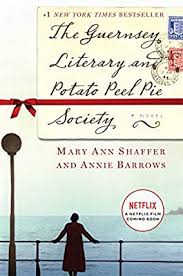
The Guernsey Literary and Potato Peel Pie Society by Mary Ann Shaffer and Annie Barrows

The Guernsey Literary and Potato Peel Pie Society

The Guernsey Literary and Potato Peel Pie Society

Mary Ann Shaffer and Annie Barrows (Adult Historical Fiction)

Juliet Ashton is tired of writing under the name of Izzy Bickerstaff and no longer wants to be considered a light-hearted journalist.  She wants to create something meaningful, but has no idea where to find inspiration…until a letter comes.  It’s a kind note from a Mr. Dawsey Adams of St. Martin’s, Guernsey who found her name and address written on the inside front cover of a book written by his favorite author, Charles Lamb.  He asks if she could kindly send him the name and address of other bookshops in London (for there aren’t any left on Guernsey after the war) so that he may acquire more Lamb books?  Through several letters, Juliet begins to learn more about Guernsey and its famed Guernsey Literary and Potato Peel Pie Society and she has questions.  Questions such as how could a pig begin a literary society and what exactly is a potato peel pie?  Perhaps this is the inspiration that Juliet has been looking for?

I admit I was in Heaven while reading this book—a book about people who love books.  What’s not to like?  It also doesn’t hurt that the writing was witty and sharp, the characters were endearingly flawed and humorously relatable, and the story had an equal mix of quirky, sadness, drama, humor, treachery, suspense, and yes, love.  The Guernsey Literary and Potato Peel Pie Society is a touching and bittersweet book about the residents of Guernsey during the German occupation of the Channel Islands during WWII.  Through the stories of the island’s residents, as well as a few of the prison camp survivors, we get a glimpse of the toll that the destruction, separation, and isolation had on the human psyche.  We are also given stories of bravery, selflessness, and heroism, which illustrates the strength of the human spirit even during the darkest of times.

What started out as a ruse to prevent dinner guests from being arrested by German soldiers, the literary society ended up showing its members how much power a book possesses.  Books can motivate, educate, inspire, entertain, and transport us to worlds far beyond our borders and imagination.  For the members of the Guernsey literary society, a book turned a fisherman into a Casanova, saved a man from a life of inebriation, allowed a collector to find his faith, and bridged two very unlikely friendships.

I was a little wary when I discovered that this book consisted entirely of letters.  Would it have the same depth and weight of a typical novel?  O me, of little faith.  The Guernsey Literary and Potato Peel Pie Society is a descriptive, warm, engaging, and satisfying read that will make you long for village life and allow you to believe in love again.  And while this book reminds us that life is often tragic and history sometimes reveals the worst in humankind, it also shows us how resilient the human spirit is and how expansive our hearts can be when the need arises.

Just as a particular song might come on the radio when you need it most or the perfect meme pops up on your Facebook feed that strikes a certain chord, I believe a book acts in the same capacity.  It finds us—chooses us—and makes us think, challenge, defend, or dream while allowing us to imagine, escape, explore, or be comforted.  The perfect book always seems to find us at just the right time and it changes us somehow.  And when it does, WE then become the conduit and pass it along to someone in need of a good laugh, cry, or shriek.  Books are indeed powerful.  As Juliet wrote in one of her letters to Dawsey, “Perhaps there is some secret sort of homing instinct in books that brings them to their perfect readers.  How delightful if that were true.”  Maybe as delightful as a potato peel pie?  I’ll let you decide.

Rating: 5/5

*Book cover image attributed to www.amazon.com

**Want more?  Visit our Facebook page at www.facebook.com/thedustyjacket

We Were Here by Matt de la Peña (YA)

We Were Here

We Were Here     

Matt de la Peña (Young Adult Fiction)

I can sometimes make stuff happen just by thinking about it.  I try not to do it too much because my head mostly gets stuck on bad stuff, but this time something good actually happened: the judge only gave me a year in a group home.  Said I had to write in a journal so some counselor could try to figure out how I think.  Dude didn’t know I was probably gonna write a book anyways.  Or that it’s hard as hell bein’ at home these days, after what happened.  So when he gave out my sentence it was almost like he didn’t give me a sentence at all.

Miguel Castañeda had a plan for getting through his one-year sentence in a group home: write in his journal, keep to himself, pretend to call his mom every Sunday, and read every book on the home’s bookshelves.  Just be a ghost—invisible and non-existent.  That plan was changed when he was assigned to share his room with Rondell, a big black kid that was once his cellmate in Juvi.  And then there was Mong, a skinny, tough, and silent Chinese dude with scars on his cheeks and a psycho smile.  Suddenly a year seemed a whole lot longer.  And then one night, Mong asked Miguel to escape with him to Mexico.  Maybe a new start away from California is just what he needed.  Maybe it’s the clean start he so wanted.

We Were Here was one of those books that I kept checking out and returning—always meaning to read it but getting distracted by something else.  Shame on me for not giving de la Peña’s work the attention it deserved.  We Were Here is gritty, raw, candid, bleak, and insightful.  It’s also a stark reminder to never judge a book by its cover.  The author introduces us to kids like Miguel, Mong, Rondell, and others who have found themselves on the wrong side of the law for one reason or another.  Each has their own story and shows us how one wrong decision or personal tragedy can set off a series of events that ultimately lands them in a group home, juvenile detention, or jail.  We get to meet these kids and understand that many are more than the sum of their parts and just need what Miguel so urgently desires—a second chance.

We Were Here is filled with heart, honesty, and hope.  The characters are realistically portrayed and de la Peña avoids simply making them ethnic caricatures by giving them depth, warmth, a deep vulnerability, and an underlying desire to make honorable and decent choices.  Narrated by Miguel through a series of personal journal entries, this story demonstrates just how far the bands of friendship can be stretched without breaking and the value of choosing loyalty over personal desire.

Matt de la Peña opened his book with an excerpt from Denis Johnson’s “From a Berkeley Notebook” and I thought it would be an appropriate way to close this review.  It beautifully depicts Miguel’s personal transformation and how events in our own lives can make each of us strangers to ourselves:  “One changes so much/ from moment to moment/ that when one hugs/ oneself against the chill/ air at the inception of spring, at night,/ knees drawn to chin,/ he finds himself in the arms/ of a total stranger,/ the arms of one he might move/ away from on the dark playground.”

Rating: 5/5

*Book cover image attributed to www.goodreads.com

**Want more?  Visit our Facebook page at www.facebook.com/thedustyjacket

The Boy in the Striped Pajamas by John Boyne (YA)

The Boy in the Striped Pajamas

The Boy in the Striped Pajamas   

John Boyne (Young Adult Fiction)

Bruno slowed down when he saw the dot that became a speck that became a blob that became a figure that became a boy.  Although there was a fence separating them, he knew that you could never be too careful with strangers and it was always best to approach them with caution.  So he continued to walk, and before long they were facing each other.

Bruno may have been just nine years old, but he knew something was wrong when he came home from school and found the family’s maid in his room packing up all of his belongings.  His father had received important military orders and the family was to leave their luxury home in Berlin to go someplace that Bruno had never heard of before.  When Bruno saw his new home, he didn’t like it all.  Theirs was the only house on the road.  And it was much smaller than their other home.  And behind it was a big yard with a spiky fence all around it.  A yard that contained small huts, several soldiers, and many, many men and boys all wearing identical striped pajamas with a matching cap.  It was all very strange.  Yes, Bruno didn’t like this place at all.

Bruno is innocent, naïve, and an unlikely protagonist who neither recognizes nor understands the horrors of the concentration camp located behind his new home.  Through his young and selfish lens, he only sees unfairness when he views the camp for why should there be so many boys on the other side of the fence who have one another to play with while he has no one?  Bruno is absolutely angered by this injustice.  Of course, the reader realizes what the true injustice is, which makes Bruno’s self-centeredness all the more unpalatable.  Boyne doesn’t introduce readers to the boy in the striped pajamas until halfway through the book, which allows readers ample time to become acquainted with Bruno.  During that period, we realize that Bruno’s “faults” are really just him being a small, sheltered, and unworldly boy of nine: he’s thoughtless, scared, self-indulgent, petulant, and irrational.  But Boyne also shows us a Bruno that is kindhearted, inquisitive, and who understands the value of maintaining a secret and the importance of keeping a promise.

I’ve read several books for both juvenile and young adult readers that deal with the Holocaust and concentration camps.  This one is unique in that Boyne shows us the horror through two young boys of the same age, height, and physical features—virtual mirror images of each other.  Bruno is essentially the “before” while Shmuel, the boy in the striped pajamas, is the “after”.  One is German, well fed, idealistic, and blissfully ignorant while the other is Polish, gaunt, hopeless, and worn down by hate, starvation, and fear.  It’s a stark contrast and Boyne is able to successfully illustrate the horrors of war and bigotry without having to delve into graphic detail.  Although this book is recommended for grades 9-12, its implied acts of violence (there is one brief mention of a dog being shot) and death make it suitable for younger readers although a knowledge of World War II would help put the subject matter into context.  The use of repetition and puns also help to successfully reinforce key points and ideas for readers.

Above its grisly subject matter, The Boy in the Striped Pajamas is a touching story about two lonely boys who find comfort and security through friendship.  American entrepreneur, author, and motivational speaker Emanuel James “Jim” Rohn said, “For every promise, there is a price to pay.”  Bruno had to weigh the value of a promise he made and although he knew very little about politics or geography or just the world in general, he did know that there was value to be placed on life and that you always, always keep a promise…especially to your best friend.

Rating: 5/5

*Book cover image attributed to www.barnesandnoble.com

**Want more?  Visit our Facebook page at www.facebook.com/thedustyjacket
Heft by Liz Moore

Heft

Heft 

Liz Moore (Adult Fiction)

Arthur Opp hasn’t been weighed in years.  Back then, he was 480 pounds, but he’s probably between 500 and 600 pounds now.  He lives in isolation in an aging yet expensive brownstone in Brooklyn and hasn’t taught a college class in eighteen years.  Kel Keller is seventeen, athletic, and popular amongst his friends.  He’s a poor kid from Yonkers who attends an affluent school and dreams of playing professional baseball.  What these two very different people don’t realize is that they have something in common…a woman by the name of Charlene Turner.  Charlene is Kel’s mother and Arthur’s former student and she is about to alter both their lives when she decides to pick up the phone and ask Arthur for a simple favor.  Suddenly, Arthur is forced to open himself up to the outside world while Kel is forced to open his eyes to discover the girl his mother used to be.

I really enjoyed Heft and was impressed with Moore’s proficiency in writing as a middle-aged ex-professor struggling with obesity and isolation and then as a teenaged boy caught between the worlds of poverty and prosperity while dealing with his mother’s insecurities.  The story moved along at a nice pace and rarely lagged, even through multiple character flashbacks.  There were several supporting and interesting characters in the story, but the one that stood out to me was Arthur’s maid, Yolanda.  She’s a spitfire and truly the yin to Arthur’s yang.  We see a whole new side of Arthur when Yolanda is around and that was a pleasure to experience.  Despite the praise, I did have a few issues with this book that prevented me from giving it a full five-star rating.

The first problem I had (might not be as big a deal to others) was when Moore was writing as Arthur.  For his “voice”, she chose to flip back and forth between using an ampersand (&) and the word “and”.  At first, I thought maybe something slipped by copy editing, but when it happened repeatedly and then when she started a sentence with an ampersand (and she even began a paragraph with it), I just about popped.  This is a deliberate style choice that Moore made for this character, but it prevented me from totally immersing myself in Arthur’s story since I had to constantly decode such sentences as “I read it twice. & then I read it three more times.”  *pop*

Another problem was the last part of the book. Although Moore delivers a story that is touching, insightful, and uplifting, I felt that at the end of the book, there was something missing.  If I were to describe it (so as not to spoil the story), it would be like buttoning your shirt and realizing only when you got to the bottom that your shirt was uneven.  You’re going along button to hole, button to hole, button to hole, but despite everything going swimmingly, it doesn’t end up right.  Moore gives us a beautifully written story that seamlessly fits together but the end of the book seems a bit off and I ended up with more questions than answers.

Aside from those issues, I did love how Moore presented Arthur and Kel with such fearless honesty.  Both men are flawed, fractured, and burdened with regret and loneliness, but they are also proud despite their brokenness and willing to open up their hearts regardless of the risk that love often carries with it.  Usually when a book presents two different character threads, I find myself enjoying one more than the other, but with Liz Moore’s Heft, I enjoyed both Arthur and Kel equally and loved laughing and crying with each of them.

Heft is an enjoyable read offering up a message of hope, forgiveness, redemption, and second chances.  It also serves as a reminder to never underestimate the full impact of a seemingly simple act…like making a phone call or asking for help.  As the Dalai Lama once said, “Just as ripples spread out when a single pebble is dropped into water, the actions of individuals can have far-reaching effects.”

Rating: 4/5

*Book cover image attributed to www.amazon.com

**Want more?  Visit our Facebook page at www.facebook.com/thedustyjacket