
The Art of Racing in the Rain by Garth Stein

The Art of Racing in the Rain

The Art of Racing in the Rain

Garth Stein (Adult Fiction)

Gestures are all that I have; sometimes they must be grand in nature.  And while I occasionally step over the line and into the world of the melodramatic, it is what I must do in order to communicate clearly and effectively. 

Enzo is just one of many mixed-breed pups (although he’s quite sure that his father was a terrier) living on a little farm in Spangle, Washington.  When Dennis “Denny” Swift sees him, he knows immediately that his heart will never again be his own.  “This one,” Denny states without a moment’s hesitation.  So begins a life that will include marriage, a child, some ups, more downs, but most of all, it will have racing.  Lots and lots of racing.

It isn’t often that you come across a book that allows you to view the world from a wonderfully unique perspective.  Seeing the world through the eyes of an aging Labrador-terrier mix was a delight and made for an unforgettable journey.  Enzo introduces us to his master, Denny, a semi-professional racecar driver whose natural talent behind the wheel is offset only by the misfortunes that seem to tail him at every one of life’s turns.  We also meet Eve, the woman Denny falls in love with and marries, and Zoë, Denny and Eve’s daughter.  Like all families, there is a mixture of good times and bad, only with this family, we are able to see their story unfold through a very special and astute lens.

Hailing from NASCAR country, I was familiar with most of the racing jargon that Garth uses throughout his book.  However, he goes the extra mile to ensure that non-racing enthusiasts will not only understand the terminology, but may also gain an appreciation for the sport and the talent and grit demanded of its drivers.  Several laugh-out-loud moments coupled with some tear-filled scenes balance out the racing sequences nicely to ensure that our story keeps moving along at a nice, smooth pace.

The Art of Racing in the Rain is the ultimate love story between a human and those furry, funny, and fantastically annoying yet adorable creatures we call family.  The book is also laden with racing metaphors that teach us a great deal about love and life in general: “The race is long—to finish first, first you must finish,” or “The car goes where the eyes go,” and my favorite, “It’s all about the ride.”  This last one comes after Denny takes Enzo on his first and only ride on a track and Enzo gets to experience the thrill and excitement that comes from actually racing versus simply viewing it through a dashcam video.  Throughout our story, Enzo is always wanting to go faster.  Faster, Denny, faster.  But as I was nearing the last page, all I wanted time to do was slow down.  I wasn’t yet ready to say goodbye to this wonderful narrator that showed me that life was about living, loving, and—most importantly—listening because listening is what Enzo, like all of our furry companions, does best.  Thank you, Garth Stein…and Enzo…for giving me a ride that I will surely remember for a long, long time.

Rating: 5/5

*Book cover image attributed to www.walmart.com

**Want more?  Visit our Facebook page at www.facebook.com/thedustyjacket


The Music of Dolphins by Karen Hesse (J)

The Music of Dolphins

The Music of Dolphins     

Karen Hesse (Juvenile Fiction)

I swim out to them on the murmuring sea.  As I reach them, their circle opens to let me in, then re-forms.  The dolphins rise and blow, floating, one eye open, the other shut in half sleep.

They discovered her during a routine surveillance flight.  At first, they thought she was a mermaid with hair down to her feet and a body blanketed in seaweed.  But as the flight crew on the Coast Guard Jay Hawk flew closer, they realized that what they spotted was not a mermaid, but a young girl.  The crew named her Mila meaning “miracle” for how else can one explain how a young girl could survive for so many years with only dolphins for mentors and companions?  As researchers teach Mila language and music, she slowly begins to understand what it means to be human and the more she understands, the more she longs to return to her beloved sea and the security of her dolphin family.

Hesse gives us a beautifully captivating story that is filled with love, loss, and a longing for home.  Mila narrates her journey from the sea to captivity and Hesse adeptly allows young readers to experience Mila’s learning curve and metamorphosis from “dolphin girl” to human through the use of font size.  A large font size is used initially to show Mila’s unfamiliarity with newly introduced customs and language.  As her proficiency and comfort increases, the font size decreases.  When Mila slowly begins to feel trapped within her human confines and her hope of being returned to the sea fades, the font begins to increase and the reader immediately understands that she is reverting to her former self.  This visual successfully creates a sense of suspense and anxiety for the reader.  By simply altering font sizes, the reader knows that the situation is turning dire for our young heroine and allows Hesse to avoid spelling it out for them.  It’s a clever use of fonts and highly effective.

Although Mila is enjoying her time on land and all the new discoveries she encounters on a daily basis, nothing ever quite matches the pull she feels for home.  Just as the cliff swallows make their 6,000-mile flight every March to San Juan Capistrano, California or you hear of a family pet traveling months and hundreds of miles to find its way back to its owner, nothing quite matches the lure of home.  Like another literary heroine who found herself picked up and then dropped into a foreign land, Mila reminds us that there really is no place like home.

Rating: 4/5

* Book cover image attributed to www.goodreads.com 

**Want more?  Visit our Facebook page at www.facebook.com/thedustyjacket

The Secret Scripture by Sebastian Barry

The Secret Scripture

The Secret Scripture

Sebastian Barry (Adult Fiction)

The Roscommon Regional Mental Hospital is scheduled for demolition.  All current patients are to be evaluated in order to determine whether they are mentally suitable for integration into the community.  This process goes fairly well until Dr. William Grene has to make a recommendation concerning Roseanne McNulty—a patient nearing her one hundredth year and who has spent over half of her life in hospitals.  Her original paperwork has long since vanished and the only history he has to go on are a combination of Roseanne’s memory of her past, the notes from a Catholic priest in her hometown of County Sligo, Ireland, and diary entries that she personally has made throughout her hospital commitment.  Can Dr. Grene put together enough of Roseanne’s past in order to safely and confidently determine her future?

The Secret Scripture was shortlisted for the Man Booker Prize, was the recipient of the Costa Book of the Year Award, and named a Best Book of the Year by Boston Globe and Economist.  For such a heralded book, it makes me wonder why I am seemingly in the minority for disliking it so much.  Firstly, this is one of those rare books that I was tempted—more than once—to discard and just move on to something else.  Although the writing was beautiful and the descriptions and details were vivid and elaborate, the stories of both Roseanne and Dr. Grene were boring and failed to capture either my imagination or interest.  Imagine being on a boat surrounded by beautiful sights, smells, and sounds and just when your anticipation for your upcoming excursion has reached its apex, you are kindly told to get out.  Of course, the obvious response would be, “But, we haven’t GONE anywhere yet.”  This is exactly what this story felt like…an abundance of artistry surrounding a journey to nowhere.  Secondly, I think Barry has built his entire story on a false premise.  Given the fact that Roseanne is nearing the century mark, her health is failing, she has spent almost sixty years in an infinitely convalescent state, and her mental capacity is such that neither she nor the evaluating psychiatrist can determine fact from fiction, why is this “evaluation” even taking place?  It’s clearly a nonstarter.

I finished this book with the singular purpose of providing an honest review, which I cannot do unless the entire book has been read.  After a very long two weeks, I am able to move on with life for this book is now done as is this review.  By my rating, this is clearly not the worst book that I’ve ever come across, but it certainly is far from being an award winner which is why I placed it squarely in the middle.  I wish I could have loved it as much as so many others undoubtedly did, but its draw and praises have left me as clouded and confused as the mind of our aged and sympathetic centenarian heroine.

Rating: 3/5

*Book cover image attributed to www.amazon.com

**Want more?  Visit our Facebook page at www.facebook.com/thedustyjacket
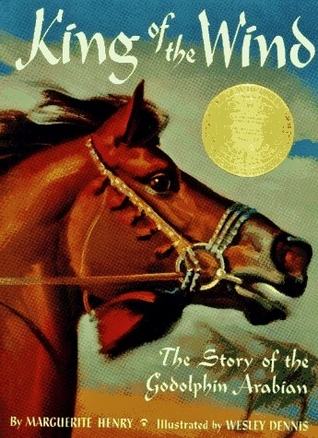
 

King of the Wind by Marguerite Henry (J Historical Fiction)

King of the Wind

King of the Wind    

Marguerite Henry (Juvenile Historical Fiction)

The foal was to be born under a favorable sign—a new moon in a new month—and thus assured strength and speed.  While the horseboy, Agba, was asleep, the foal was born and it appeared that indeed Agba’s master was correct for on the foal’s hind heel was a white spot, an emblem of swiftness.  Unfortunately, the foal also bore the wheat ear and this foretold of evil.  Agba knew this foal was special and he named it Sham, the Arabic word for sun, because its coat was a flaming red-gold.  Although orphaned and shunned by the other spring colts, Sham thrived under Agba’s watchful care until one day, one ill-placed foot and one well-placed hoof would forever change their destinies.

Marguerite Henry gives young readers a story detailing the origin of the Godolphin Arabian, one of three stallions that founded the modern Thoroughbred (Darley Arabian and the Byerley Turk being the other two).  Part fact and part fiction, this book follows Sham from Morocco to Paris and then finally to London.  His life passes through the hands of a sultan, king, carter, Quaker, innkeeper, and earl all the while keeping company with a loyal and mute horseboy and a tomcat named Grimalkin.  As King of the Wind is based on historical fact, our story takes place in the early 18th century and Henry stays true to the time period by portraying a harsh but realistic view of how life was for little Agba and Sham.  Younger readers, especially those fond of horses, may be uncomfortable reading of Sham’s harsh and unfair treatment, but Henry chooses realism over sentimentality so readers can glean an accurate understanding of Agba and Sham’s daily struggle for survival.

Early in Sham’s life, Agba makes him a promise: “My name is Agba.  Ba means “father”.  I will be a father to you, Sham, and when I am grown I will ride you before the multitudes.  And they will bow before you, and you will be King of the Wind.  I promise it.”  Henry gives us a beautiful adventure story that brims with friendship, honor, and loyalty and reminds us that any promise worth making is a promise certainly worth keeping.

Rating: 5/5

* Book cover image attributed to www.goodreads.com 

**Want more?  Visit our Facebook page at www.facebook.com/thedustyjacket
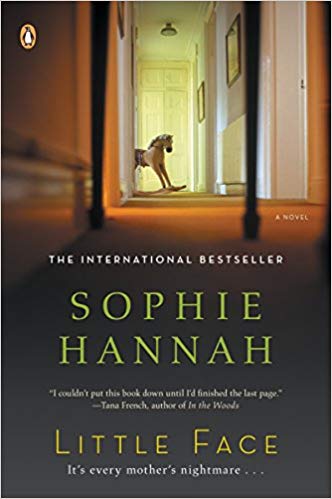
Little Face by Sophie Hannah

Little Face

Little Face

Sophie Hannah (Adult Fiction)

**Contains spoilers**

Imagine you leave your newborn at home with your spouse for just a few hours.  When you return, the front door is slightly ajar, your spouse has just awakened from a nap, and in your nursery lies a beautiful and perfect baby…only this baby is not yours.  Your baby is gone and life suddenly stops.  It’s every mother’s worst nightmare only this nightmare is now Alice Fancourt’s reality.  Her infant, Florence, has been mysteriously replaced with another baby and no one believes her—not the police, not her mother-in-law, and not even her husband, David.  Everyone attributes her hysteria to some kind of postpartum shock or psychosis, but when Alice and Florence disappear without a trace only a week later, suddenly this strange case takes an even stranger and unexpected turn.

Little Face is a provocative thriller that explores and examines the complex lives of two very different mothers: one willing to do anything to keep her family together and the other doing the unimaginable to keep her family safe.  It’s a story filled with action and suspense that delves into some rather weighty topics such as depression, sociopathic tendencies, emotional and psychological manipulation, and obsessive-compulsive personality disorder.  The action is kept at a heightened pace with chapters alternating between the day of Florence’s disappearance to the next week when both Alice and Florence vanish.  Narration switches from first-person (Alice) to third-person so we’re able to both clearly understand what Alice is thinking while also being able to view the effects of her decisions and actions through an impartial lens.  While Hannah effectively delivers an intense and absorbing psychological thriller, the only issue I had was with the characterization of her husband David.  Hannah chose to make this individual unseemly sadistic and his treatment of his wife, regardless of her credibility or sanity, is nothing less than barbarous and inhumane.  We are given a glimpse into his background and gather that his mother is overly controlling and protective of him, but that doesn’t justify his sudden spiral into depravity and the unexplained erosion of his both his humanity and morality.  The reader is literally blindsided with this side of him and this character trait appears to have been included for the sheer and sole sake of shock value.

American civil rights activist Rosa Parks once said, “There is just so much hurt, disappointment, and oppression one can take… The line between reason and madness grows thinner.”  Little Face demonstrates just how thin this line truly is by showing us what extraordinary measures a person is able and willing to take in order to protect whatever or whoever is most precious to them.

Rating: 4/5

*Book cover image attributed to www.amazon.com


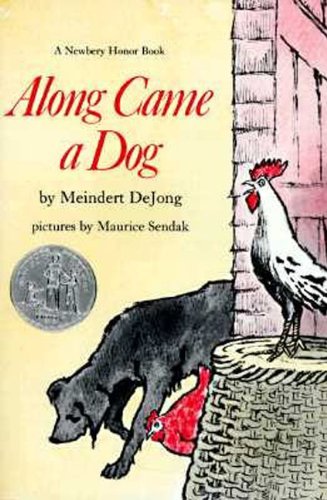
Along Came a Dog by Meindert DeJong (J)

It’s Tween & Teen Tuesday when we review either a Juvenile (J) or Young Adult (YA) book.

Along Came a Dog

Along Came a Dog    

Meindert DeJong (Juvenile Fiction)

The little red hen was having a splendid day in the barnyard.  Spring had finally arrived and the weather was warm, the sun was bright, and she had just laid her first egg of the season.  Proudly, she sat atop the man’s shoulder as he cleaned the coop floor and spread out fresh hay.  Life on the farm was splendid indeed…until the big black dog appeared.  Suddenly, this fur-covered menace had disrupted her otherwise splendid day and that wouldn’t stand one bit.  After all, it was a pack of dogs that had killed all of the red hens in her flock and she alone had survived.  No, the big black dog had to go and it was up to the man to do it.  But no matter how determined the man was to get rid of the dog, the dog was more determined to stay for he had decided that this farm was his and no distance was going to separate him from his newly found home.

This is the second book I’ve read by Meindert DeJong (the first being The Wheel on the School) and he again delights with a beautifully told story that reads almost like a fairytale.  The actions and emotions exhibited by the animals are true to their nature so don’t expect camaraderie within the flock or gentle misunderstandings between the hen and the dog.  DeJong gives us an accurate portrayal of farm life in all its splendor and savagery and readers will soon understand that life is hard and often unfair in the barnyard.  Thankfully, DeJong is mindful of the age of his intended reader so he makes sure that bad is always followed by good and those possessing purity of heart and deed are eventually rewarded.  Also, the story does seem to lag just a bit near the middle, so readers are encouraged to dutifully plow ahead as the ending will merit their effort and patience.

Along Came a Dog is a story of duty, purpose, loyalty, and an overwhelmingly desire to belong, and it serves as a wonderful example of the benefits of perseverance and the virtues of honor.  It was both heartbreaking and heartwarming to see dog so steadfast in his mission to return to a place where he obviously wasn’t welcome.  But, his rationale was quite simple: “He was back.  Twice he’d been taken away, and twice now he’d come back.  And if the man were to take him away thirty times, he’d come back thirty times.  He wasn’t dim-witted—he knew he wasn’t wanted here.  But every time he was taken away, he’d try to come back.  It wasn’t a plan in the big dog’s mind. It was a need, a desperation to have a home.  He was going to have a home!  It was that simple.”  On that fateful spring day, a friendship was formed and a home was discovered when a hen with broken feet and a dog with an unbroken spirit found each other.  When you think about it, it turned out to be a rather splendid day after all.

Rating: 4/5

* Book cover image attributed to www.amazon.com 

**Want more?  Visit our Facebook page at www.facebook.com/thedustyjacket
 

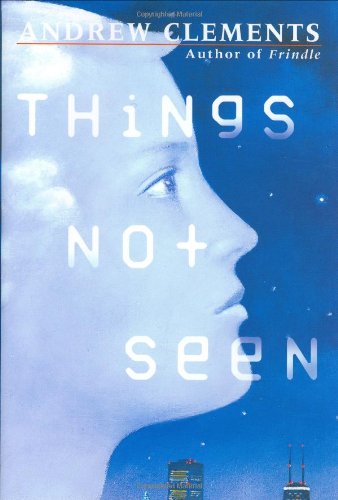
Things Not Seen by Andrew Clements (YA Science Fiction)

Things Not Seen

Things Not Seen    

Andrew Clements (Young Adult Science Fiction)

Did you ever wish that you were invisible or could just become invisible—even for a day?  Well that’s what happened to Robert “Bobby” Phillips one morning.  He goes to bed an average, normal fifteen-year-old boy and wakes up invisible.  There’s no explanation for it, although his physicist father knows that something doesn’t happen without a reason.  But how can this possibly happen?  What could have caused this?  Promising to keep his “condition” secret, Bobby and his parents frantically search for a cause and a cure because a boy that suddenly vanishes won’t go unnoticed for long.  But then Bobby meets Alicia, a blind girl he literally bumps into at the library.  Surely his secret would be safe with her?  After all, Bobby needs to share this with someone and maybe she can help because time is quickly running out.

Things Not Seen is the first of three books in the “Things” series by Andrew Clements.  In this installment, we are introduced to Bobby and his sarcastic yet devoted love interest Alicia Van Dorn.  This book has just enough science to make it a true science fiction, but not too much to bog down the story and lose reader interest.  Clements also gives us the standard fare of teenage angst: wanting acceptance from peers, craving independence from parents, and longing for a bit of attention from the opposite sex.  The need for acknowledgment, approval, and acceptance is truly universal, but these feelings are personified effectively through Bobby’s invisibility.

Throughout the book, we see Bobby’s new condition force an emotional awakening and maturity upon him.  What was a pleasant surprise was the evolution of his relationship with his parents (and vice versa).  Things Not Seen is a wonderful reminder that parents don’t always have the answers, and sometimes in order to really “see” someone, you simply just need to close your eyes and open your heart.

Rating: 4/5

* Book cover image attributed to www.amazon.com


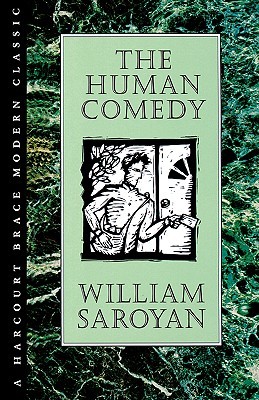
The Human Comedy by William Saroyan

The Human Comedy

The Human Comedy

William Saroyan (Adult Fiction)

In a small town in Ithaca, California, during World War II, there lived the Macauley family—Mrs. Macauley and her four children: Marcus, Bess, Homer, and Ulysses.  Marcus is serving in the army, Bess is attending college, Homer is determined to be the fastest telegraph messenger in the West, and young Ulysses, who at four years old, is enamored with everything in his very small world.  The Macauleys are workers, dreamers, and God-fearing folks who are living each day to its fullest while trying to find their own particular place in the world.  For Homer, it’s a time of hurdle races, playing catch, and riding his bike, but with the war and the grim news printed on each incoming telegram, he’s finding it increasingly difficult to put off manhood any longer.

This novel was billed as a coming-of-age story, but it truly is so much more.  With its short chapters—almost vignettes—The Human Comedy gives us a humorous and bittersweet peek into the lives of the citizens of Ithaca.  The elderly telegrapher fearing retirement, the son fighting in a war that he doesn’t understand, the town simpleton with a naïve heart of gold, a young boy with big dreams and ambitions, the teacher trying to impart a sense of civility and kindness into her students.  All of these wonderful characters’ stories are stitched together to form a tightknit community that mourns their fallen, cheers their heroes, comforts their sick, and opens their doors (and hearts) to strangers.

The Human Comedy is considered semi-autobiographical as many of the novel’s characters and situations are based on real-life people and events from Saroyan’s childhood.  Like Homer, Saroyan was a second-generation Armenian immigrant who lost a father quite early in life and worked as a telegraph messenger while a teenager.  Interestingly, The Human Comedy began as a screenplay written by Saroyan, but while Metro Goldwyn Mayer was filming the movie, Saroyan decided to turn his screenplay into what would become his first novel.

One of the novel’s youngest characters, Ulysses, gains great pleasure and satisfaction from the simplest things.  He often runs alongside the train as it travels through his town, waving to its occupants who always ignore our young man.  On one occasion however, a black man sees Ulysses and returns his wave while shouting, “Going home, boy—going back where I belong!”  The Human Comedy is a story of love, loss, decency, humanity, and kindness, but most of all, it is a story about home and the people we are blessed to call family.

Rating: 5/5

*Book cover image attributed to www.goodreads.com


The Lightning Dreamer by Margarita Engle (YA Historical Fiction)

The Lightning Dreamer

The Lightning Dreamer    

Margarita Engle (Young Adult Historical Fiction)

In a country where both men and words are closely guarded, it is the poet who proved to be the boldest and most daring abolitionist.  Gertrudis G mez de Avellaneda (nicknamed Tula) is thirteen and enjoying her last year of personal freedom in Cuba.  When she turns fourteen, she will be sold into matrimony to the highest bidder and her mother will use the proceeds from her marriage to buy more slaves.  Tula abhors slavery and often feels enslaved herself by a society that denies her an education, the right to vote, or the freedom to choose when and whom she will marry.  But Tula suddenly finds light in her dark world when she discovers the convent’s library.  Here, in a dusty corner, lies forbidden words of hope, rebellion, and the promise of freedom from a rebel-poet by the name of Jos  Mari  Heredia.

The Lightning Dreamer is a work of historical fiction and is based on the life of Gertrudis G mez de Avellaneda, a poet and playwright known as one of the world’s most influential female writers.  Written entirely in free verse, this story switches between numerous points of view to allow the reader to see firsthand the profound and unimagined impact that poetry has on its audience.  Engle’s work is stunningly vibrant and beautiful and conveys an expansive range of emotions with just a few carefully chosen words.  For example, we experience Tula’s heartbreak as she finally resigns herself to a life devoid of freedom and choices: “During those times,/ I find it easy to forget/ that I’m just a girl who is expected/ to live/ without thoughts.”  The nuns at the convent see Tula torn between two worlds and offer her the only comfort they can: “In a mother’s eyes,/ she can be only/ a monster of defiance/ or an angel of obedience,/ nothing/ in between.//So, we send her to the library,/ a safe place to heal/ and dream…”

During her lifetime, Avellaneda fought for racial and gender equality and although her ideas were considered shocking at the time, her vision was eventually accepted and Cuban slaves gained their freedom, schools became integrated, and young girls were able to enter into marriage voluntarily and for love.  Tula once said, “Books are door-shaped portals carrying me across oceans and centuries, helping me feel less alone.”  Engle reminds us of the power behind the written word and the hope, promise, and escape those words offer when nestled between the covers of a book.

Rating: 5/5

* Book cover image attributed to www.goodreads.com 


Heading Out to Wonderful by Robert Goolrick

Heading Out to Wonderful

Heading Out to Wonderful

Robert Goolrick (Adult Fiction)

At thirty-nine years old, Charlie Beale arrived in the town of Brownsburg, Virginia (population 538) in a beat-up truck and toting two suitcases—one holding his clothes and a set of butcher knives and the other filled with cash.  Brownsburg is a town where prestige is measured by the size of your floral blooms and the yield of your vegetable garden, where no one divorced, schools let out in May so the children could help with the family’s planting, and everyone believed in God and The Book.  It’s 1948 and as soon as Charlie drove into Brownsburg, he knew he was home.  When he saw Sylvan Glass, the teenage bride of the town’s wealthiest resident, he knew that he was heading to something wonderful.  But Brownsburg is a small town and news—good, bad, and particularly scandalous—travels fast and Charlie is about to find out that wonderful comes with a very hefty price tag.

If I were to give half ratings, this book would lean more towards three-and-one-half stars, but I gave it a three simply because the last twenty pages of the book were so severe and such a drastic departure from the rest of the story that it left me feeling confused and a bit angry.  Goolrick is a wonderful storyteller and gives readers an idyllic town where folks sit on their front porch and gossip and the shop merchants know what you want before you cross their threshold.  Being a small town, we know that no good will come from Charlie and Sylvan’s illicit relationship and that it is doomed from the beginning; however, Goolrick’s handling of these star-crossed lovers is not only severe, it’s incomprehensible.  The last few pages are such a stark contrast to the rest of the story, that it begs one to question what could possibly have made Goolrick deviate so unbelievably from his story and characters?  It was almost as if he handed the remainder of his novel to someone else and said, “You take it from here.”

When Charlie entered Will Haislett’s butcher shop looking for a job, Will said to him, “Let me tell you something, son.  When you’re young, and you head out to wonderful, everything is fresh and bright as a brand new penny, but before you get to wonderful you’re going to have to pass through all right.  And when you get to all right, stop and take a good, long look, because that may be as far as you’re ever going to go.”  The problem with Heading Out to Wonderful, is that we started out in Wonderful and were able to happily hang out and enjoy the scenery for a bit, but somehow we missed a sign or drove too far or made a right instead of a left and suddenly found ourselves far away from Wonderful and instead somewhere between All Right and Okay.  Unfortunately, Charlie Beale didn’t have the luxury of GPS tracking in 1948.

Rating: 3/5

*Book cover image attributed to www.goodreads.com