
Current Book Review

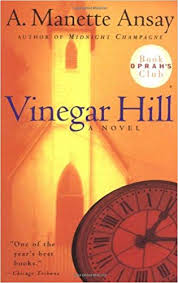
Vinegar Hill by A. Manette Ansay

Vinegar Hill

Vinegar Hill

A. Manette Ansay (Adult Fiction)

There are many ways to describe Ellen Grier: wife, mother, daughter, daughter-in-law, sister, caregiver, teacher.  All of these different roles and yet Ellen still feels incomplete…invisible almost.  She had been happy in Illinois in their rented house, but after her husband lost his job, she and her family are back in their hometown of Holly’s Field, Wisconsin and living with her in-laws at 512 Vinegar Hill—a harsh, loveless, and cold home filled with secrets.  She wants to be happy, but finds herself drowning under a sea of hopelessness and despair.  Can Ellen save herself and the ones she loves before Vinegar Hill consumes them all?

Vinegar Hill is an Oprah’s Book Club selection.  I’ve read several of her recommendations and often found them to be “hit” or “miss”.  This book is clearly a “miss”.  On the back cover, a review from Washington Post Book World calls it “Sweet, tender, and chilling.”  After reading this and several other critics’ comments printed on the book, I’m wondering if I actually read the same novel that they did.  Sweet?  Tender?  Vinegar Hill is the type of book that would make Edgar Allan Poe pause and say, “Wow!  Now THAT’S dark!”  This is a depressing, depraved, and disturbing story devoid of purpose, value, or meaning.  We’re introduced to several generations of individuals whose intolerance, callousness, cruelty, meanness and spite are clearly hereditary.  It’s an endless cycle of verbal and physical abuse with a skosh of religious hallucinations and psychological delusions thrown in for interest.  Ellen’s daughter, Amy, “buries” her “dead” dolls in shoeboxes; her husband, James, sees his children as the personification of Halloween with their skeletal hands and sunken ghostly eyes; and her elderly and bitter mother-in-law, Mary-Margaret, has dreams of her deceased twin infants growing back inside of her.  THIS is sweet and tender?  The Chicago Tribune even called Vinegar Hill “one of the year’s best books.”  I’m absolutely speechless.  I found the characters unpleasant and unsympathetic, religious judgements are frivolously tossed out as if they were beads at Mardi Gras, intelligence is scorned and vilified, and helplessness is encouraged and celebrated.

When Ellen sought advice from her fellow co-worker, she was told, “No one gets used to anything, they just get numb.”  After a while, with the constant derisions and disparagements, I too became numb and found myself eagerly counting down the pages until I could finally close the covers of this book and walk—or actually run—away from Vinegar Hill and all of its inhabitants…never to look back again.

Rating: 2/5

*Book cover image attributed to www.amazon.com

**Want more?  Visit our Facebook page at www.facebook.com/thedustyjacket
Fortunately, the Milk by Neil Gaiman (J)

Fortunately the Milk

Fortunately, the Milk   

Neil Gaiman (Juvenile Fiction)

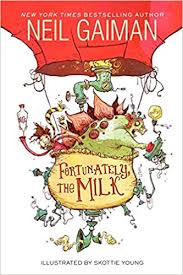
Mom was off to a conference so Dad was in charge.  She had given him loads to remember, but the most important of all was, “Oh, and we’re almost out of milk.  You’ll need to pick some up.”  You couldn’t very well put orange juice on your Toastios.  Or pickle juice.  Or mayonnaise or ketchup.  So Dad went to the corner store for milk (and NOT the fat-free kind because it tastes like water!!!).  After he returned after being gone an unusually long time, he plopped down the milk and told his two children the most unbelievable story they had ever heard.  A story about aliens and dinosaurs and time travel and pirates and ponies and vampires and…  Well, perhaps it’s best if you were to hear it from Dad himself because you wouldn’t believe it if I were to tell it.

From the imagination that is uniquely Neil Gaiman, Fortunately, the Milk is a story filled with charm, wit, and humor.  It’s a quick read that would make for a wonderfully entertaining bedtime story.  Bursting with unforgettable characters (a time-travelling stegosaurus inventor anyone?) and an action-packed race through time (literally), Gaiman gives us a tale where the universe sits precariously on the shoulders of a dad simply trying to get back home with a bottle of milk.

Perhaps the real star of this book is Skottie Young’s outrageously fantastic illustrations.  His pen-and-ink drawings are what you might get if you were to give Tim Burton’s brain a pen and a piece of paper.  They are as whimsical, outlandish, and over-the-top delightful as Gaiman’s story and both combine to give young readers an epic journey through space, time, and around the block to the corner grocer.

So whether you’re into science fiction, fantasy, comedy, or just enjoy reading about boogers and snot (those aliens are really quite disgusting), you’re sure to enjoy this little gem of a book.  Even if you do enjoy pickle juice with your Toastios…weirdo.

Rating: 4/5

*Book cover image attributed to www.amazon.com

**Want more?  Visit our Facebook page at www.facebook.com/thedustyjacket
In a Dark, Dark Wood by Ruth Ware

In a Dark Dark Wood

In a Dark, Dark Wood  

Ruth Ware (Adult Fiction)

Twenty-six-year-old crime writer Leonora “Nora” Shaw lives alone…and she loves it.  When you’re alone, you’re in control and she likes it that way.  So when she gets an e-mail from a stranger inviting her to a bachelorette party for Clare Cavendish, Nora’s world unexpectedly is turned upside down.  She hasn’t spoken to Clare in ten years so the invitation is obviously unsettling.  Why her?  Why now?  But it’s only for the weekend and perhaps it would be nice to see Clare again.  After all, they had been best friends.  But since she’s arrived at the “glass house” in the middle of the woods, Nora only seems to be accumulating more questions than answers, and when you’re in a dark, dark wood, it’s so very hard to see any light of what is real or true.

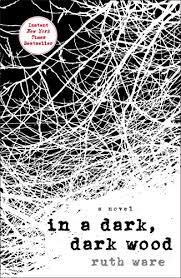
I admit that I am sometimes influenced by the marketing blurbs that appear on the front and back covers of a book.  Some excerpts for In a Dark, Dark Wood include “Prepared to be scared” or “Read it…with all the lights on” or “An unsettling thriller”.  I have found, much to my disappointment, that all of these are a far cry from what you are actually given.  It’s certainly not the fault of Ware that expectations are set so incredibly high, but when you have Reese Witherspoon on the cover of your book promising a frightfest of epic proportions (she’s the one who warns readers to prepare for a scare), I have to wonder if my fear-o-meter is just insanely high or if Ms. Witherspoon is just a little scaredy-cat.

Without pitting Ruth Ware against Ruth Ware, I did find her second novel, The Woman in Cabin 10, to be a more satisfying and suspenseful read with the twist ending that I thought In a Dark, Dark, Wood would have.  To be fair, this book did have a lot of energy and some unexpected moments, but the end really did just fall apart.  I found it to be a bit predictable largely due to the generous amounts of clues that the author provides throughout the book.  Also, our heroine and narrator, Nora (who goes by several names), makes some really dim decisions and –for her being such an accomplished crime author—doesn’t seem able to think logically or rationally when it would benefit her the most.  Lastly, there are several gaping plot holes (we’re left questioning several characters’ intentions and motivations) and we really have to suspend any sense of logic in order to digest the series of events that happen at the end of the book.

For a quick read that you can read at night, by yourself, during a storm, in a spooky house, feel free to pick up In a Dark, Dark, Wood.  For a suspenseful and thrilling book that will leave you guessing until the end, I invite you to leave the wood and go toward the water with Ware’s The Woman in Cabin 10—unless you’re Reese Witherspoon and then you should definitely stay away…or at least turn on the lights.

Rating: 3/5

*Book cover image attributed to www.amazon.com

**Want more?  Visit our Facebook page at www.facebook.com/thedustyjacket
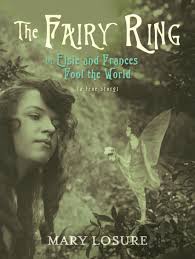
 

The Fairy Ring: Or Elsie and Frances Fool the World by Mary Losure (J NF)

The Fairy Ring

The Fairy Ring: Or Elsie and Frances Fool the World

Mary Losure (Juvenile Non-Fiction)

Elsie loved a good laugh, she loved to paint, and she didn’t like being teased.  Needless to say, when her young cousin, Frances, was being mocked by her family after she told them that she had seen fairies down by the stream, well it was enough to make Elsie’s blood boil.  But when they had the audacity to begin teasing HER, that simply was the last straw!  Elsie thought up a clever plan to show the adults that fairies were in fact real and she would do so by offering up photographic evidence.  Little did Elsie know at the time that her fairy photos would someday attract the attention of someone who really did believe in spirits and fairies.  Someone who her own father admired and adored.  Someone by the name of Sir Arthur Conan Doyle.

Author Mary Losure said that her idea for The Fairy Ring came after a visit to an independent bookstore in Minnesota.  There she came across The Coming of Fairies by Sir Arthur Conan Doyle—a book built around the photographs taken by Elsie Wright and Frances Griffiths and the implications behind their much-believed authenticity.  Frances wrote her own book, Reflections on the Cottingley Fairies, a memoir that was completed by her daughter, Christine Lynch, after her death.  Looking at the original photos now, people would obviously see them as the forgeries they were.  But back in 1917, a time when the news cycle was dominated by the First World War, the demand for legitimacy may not have been on the forefront of anyone’s mind.

It is remarkable how two girls—ages 15 and 9—were able to pull off what would later be known as one of the greatest hoaxes of the 20th century.  What is even more astonishing was their ability to wholeheartedly ensnare one Sir Arthur Conan Doyle.  How could one of the greatest authors of his time, and a medical doctor to boot, have been so gullible?  Doyle was a scientific man, but he was also spiritual and the death of his son, Kinglsey, in 1918 caused him to fully embrace spiritualism and the idea of spirits and otherworldly beings.  With that in mind, it’s no wonder why in mid-1919, when the Cottingley fairy photos were made public, that Doyle was quick to embrace the idea that fairies were indeed real, thus bringing some semblance of validation and comfort to a still grieving father.

Elsie and Frances’s story is as fascinating as it is unbelievable.  Remarkably, both women kept their secret long enough so that many reputations, including that of Sir Arthur Conan Doyle, were kept intact and untarnished.  It was a hoax that would transcend all others and spawned simply because one talented and easily offended teenager simply didn’t like being teased.  While Elsie eventually admitted to revealing the truth, Frances—even up to her death—never wavered from her belief in fairies.  Even Sherlock Holmes may have been inclined to believe in the Cottingley fairies for he once said, “When you have eliminated the impossible, whatever remains, however improbable, must be the truth.”  Are fairies impossible?  I, for one, would like to believe that fairies exist, for in the grand scheme of things, what harm would there be really to believe otherwise?

Rating: 5/5

*Book cover image attributed to www.amazon.com

**Want more?  Visit our Facebook page at www.facebook.com/thedustyjacket

We Were Here by Matt de la Peña (YA)

We Were Here

We Were Here     

Matt de la Peña (Young Adult Fiction)

I can sometimes make stuff happen just by thinking about it.  I try not to do it too much because my head mostly gets stuck on bad stuff, but this time something good actually happened: the judge only gave me a year in a group home.  Said I had to write in a journal so some counselor could try to figure out how I think.  Dude didn’t know I was probably gonna write a book anyways.  Or that it’s hard as hell bein’ at home these days, after what happened.  So when he gave out my sentence it was almost like he didn’t give me a sentence at all.

Miguel Castañeda had a plan for getting through his one-year sentence in a group home: write in his journal, keep to himself, pretend to call his mom every Sunday, and read every book on the home’s bookshelves.  Just be a ghost—invisible and non-existent.  That plan was changed when he was assigned to share his room with Rondell, a big black kid that was once his cellmate in Juvi.  And then there was Mong, a skinny, tough, and silent Chinese dude with scars on his cheeks and a psycho smile.  Suddenly a year seemed a whole lot longer.  And then one night, Mong asked Miguel to escape with him to Mexico.  Maybe a new start away from California is just what he needed.  Maybe it’s the clean start he so wanted.

We Were Here was one of those books that I kept checking out and returning—always meaning to read it but getting distracted by something else.  Shame on me for not giving de la Peña’s work the attention it deserved.  We Were Here is gritty, raw, candid, bleak, and insightful.  It’s also a stark reminder to never judge a book by its cover.  The author introduces us to kids like Miguel, Mong, Rondell, and others who have found themselves on the wrong side of the law for one reason or another.  Each has their own story and shows us how one wrong decision or personal tragedy can set off a series of events that ultimately lands them in a group home, juvenile detention, or jail.  We get to meet these kids and understand that many are more than the sum of their parts and just need what Miguel so urgently desires—a second chance.

We Were Here is filled with heart, honesty, and hope.  The characters are realistically portrayed and de la Peña avoids simply making them ethnic caricatures by giving them depth, warmth, a deep vulnerability, and an underlying desire to make honorable and decent choices.  Narrated by Miguel through a series of personal journal entries, this story demonstrates just how far the bands of friendship can be stretched without breaking and the value of choosing loyalty over personal desire.

Matt de la Peña opened his book with an excerpt from Denis Johnson’s “From a Berkeley Notebook” and I thought it would be an appropriate way to close this review.  It beautifully depicts Miguel’s personal transformation and how events in our own lives can make each of us strangers to ourselves:  “One changes so much/ from moment to moment/ that when one hugs/ oneself against the chill/ air at the inception of spring, at night,/ knees drawn to chin,/ he finds himself in the arms/ of a total stranger,/ the arms of one he might move/ away from on the dark playground.”

Rating: 5/5

*Book cover image attributed to www.goodreads.com

**Want more?  Visit our Facebook page at www.facebook.com/thedustyjacket

Ethan Frome by Edith Wharton

Ethan Frome

Ethan Frome    

Edith Wharton (Adult Fiction)

It was a long time since any one had spoken to him as kindly as Mrs. Hale.  Most people were either indifferent to his troubles, or disposed to think it natural that a young fellow of his age should have carried without repining the burden of three crippled lives.  But Mrs. Hale had said, “You’ve had an awful mean time, Ethan Frome,” and he felt less alone with his misery.

Ethan Frome’s daily existence is just as cold, bleak, and barren as the winters in his Starkfield, MA hometown.  His farm is in neglect, his mill is in decline, and whatever money he has left goes to the care and treatment of his ever sickly, spiteful, and sour wife, Zeena.  The only bright spot is Mattie Silver, Zeena’s cousin who comes to the farm to act as housekeeper and caregiver.  Though highly moral and virtuous, Ethan can’t deny the forbidden feelings he has for Mattie and can’t help imagining an alternate life where the two of them might be together and happy.

Edith Wharton was the first woman to win a Pulitzer Prize and it’s no surprise why after reading Ethan Frome.  Only an author as skilled as Wharton can make bleakness so beautiful and tragedy so fascinating.  Here’s how she describes Mrs. Ned Hale, the daughter of the village lawyer: “It was not that Mrs. Ned Hale felt, or affected, any social superiority to the people about her; it was only that the accident of a finer sensibility and a little more education had put just enough distance between herself and her neighbors to enable her to judge them with detachment.”  What a delicious way of saying that Mrs. Ned Hale was nothing but an uppity and moralistic snob…although to her credit, she is quite fond of our Mr. Frome and sympathetic to his unfortunate circumstances.

In anyone else’s hands, Ethan Frome would be a very dark, depressing, and dispirited story, which it undoubtedly is.  However, Wharton presents readers with a thoughtful and illustrative commentary on morality, responsibility, and the burdens that come with decency, loyalty, and honor.  I was quite surprised to find that Ethan Frome was made into a movie in 1993 (starring Liam Neeson, Patricia Arquette, and Joan Allen).  My first and only reaction to this discovery was, “Why?”  Once you’ve read Wharton’s 1911 novella, you know that translating her words to film is not going to have the same impact and would only spell doom (and Roger Ebert agreed).  One reviewer of the book likened Ethan Frome to Romeo and Juliet, but if Wharton were to hear this comparison, I would imagine her reply being something like, “Oh, if Ethan and Mattie should only be so lucky.”  Frome’s story is pathetic, cruel, sad, and hopeless and we love him all the more for it.

I put off reading Ethan Frome for a while as I had always imagined it to be a daunting and challenging read, but it was actually quite engaging and immersive, and I never felt overwhelmed by its imagery or subject matter.  It’s truly deserving of the term “classic” and although I didn’t form a connection with this particular work (which is why I rated it a four versus five), it has given me the confidence to seek out other works by Wharton, which I will do without fear of consequence.  If only Ethan Frome was capable of doing the same.

Rating: 4/5

*Book cover image attributed to www.simonandschuster.ca

**Want more?  Visit our Facebook page at www.facebook.com/thedustyjacket

The Boy in the Striped Pajamas by John Boyne (YA)

The Boy in the Striped Pajamas

The Boy in the Striped Pajamas   

John Boyne (Young Adult Fiction)

Bruno slowed down when he saw the dot that became a speck that became a blob that became a figure that became a boy.  Although there was a fence separating them, he knew that you could never be too careful with strangers and it was always best to approach them with caution.  So he continued to walk, and before long they were facing each other.

Bruno may have been just nine years old, but he knew something was wrong when he came home from school and found the family’s maid in his room packing up all of his belongings.  His father had received important military orders and the family was to leave their luxury home in Berlin to go someplace that Bruno had never heard of before.  When Bruno saw his new home, he didn’t like it all.  Theirs was the only house on the road.  And it was much smaller than their other home.  And behind it was a big yard with a spiky fence all around it.  A yard that contained small huts, several soldiers, and many, many men and boys all wearing identical striped pajamas with a matching cap.  It was all very strange.  Yes, Bruno didn’t like this place at all.

Bruno is innocent, naïve, and an unlikely protagonist who neither recognizes nor understands the horrors of the concentration camp located behind his new home.  Through his young and selfish lens, he only sees unfairness when he views the camp for why should there be so many boys on the other side of the fence who have one another to play with while he has no one?  Bruno is absolutely angered by this injustice.  Of course, the reader realizes what the true injustice is, which makes Bruno’s self-centeredness all the more unpalatable.  Boyne doesn’t introduce readers to the boy in the striped pajamas until halfway through the book, which allows readers ample time to become acquainted with Bruno.  During that period, we realize that Bruno’s “faults” are really just him being a small, sheltered, and unworldly boy of nine: he’s thoughtless, scared, self-indulgent, petulant, and irrational.  But Boyne also shows us a Bruno that is kindhearted, inquisitive, and who understands the value of maintaining a secret and the importance of keeping a promise.

I’ve read several books for both juvenile and young adult readers that deal with the Holocaust and concentration camps.  This one is unique in that Boyne shows us the horror through two young boys of the same age, height, and physical features—virtual mirror images of each other.  Bruno is essentially the “before” while Shmuel, the boy in the striped pajamas, is the “after”.  One is German, well fed, idealistic, and blissfully ignorant while the other is Polish, gaunt, hopeless, and worn down by hate, starvation, and fear.  It’s a stark contrast and Boyne is able to successfully illustrate the horrors of war and bigotry without having to delve into graphic detail.  Although this book is recommended for grades 9-12, its implied acts of violence (there is one brief mention of a dog being shot) and death make it suitable for younger readers although a knowledge of World War II would help put the subject matter into context.  The use of repetition and puns also help to successfully reinforce key points and ideas for readers.

Above its grisly subject matter, The Boy in the Striped Pajamas is a touching story about two lonely boys who find comfort and security through friendship.  American entrepreneur, author, and motivational speaker Emanuel James “Jim” Rohn said, “For every promise, there is a price to pay.”  Bruno had to weigh the value of a promise he made and although he knew very little about politics or geography or just the world in general, he did know that there was value to be placed on life and that you always, always keep a promise…especially to your best friend.

Rating: 5/5

*Book cover image attributed to www.barnesandnoble.com

**Want more?  Visit our Facebook page at www.facebook.com/thedustyjacket

Heft by Liz Moore

Heft

Heft 

Liz Moore (Adult Fiction)

Arthur Opp hasn’t been weighed in years.  Back then, he was 480 pounds, but he’s probably between 500 and 600 pounds now.  He lives in isolation in an aging yet expensive brownstone in Brooklyn and hasn’t taught a college class in eighteen years.  Kel Keller is seventeen, athletic, and popular amongst his friends.  He’s a poor kid from Yonkers who attends an affluent school and dreams of playing professional baseball.  What these two very different people don’t realize is that they have something in common…a woman by the name of Charlene Turner.  Charlene is Kel’s mother and Arthur’s former student and she is about to alter both their lives when she decides to pick up the phone and ask Arthur for a simple favor.  Suddenly, Arthur is forced to open himself up to the outside world while Kel is forced to open his eyes to discover the girl his mother used to be.

I really enjoyed Heft and was impressed with Moore’s proficiency in writing as a middle-aged ex-professor struggling with obesity and isolation and then as a teenaged boy caught between the worlds of poverty and prosperity while dealing with his mother’s insecurities.  The story moved along at a nice pace and rarely lagged, even through multiple character flashbacks.  There were several supporting and interesting characters in the story, but the one that stood out to me was Arthur’s maid, Yolanda.  She’s a spitfire and truly the yin to Arthur’s yang.  We see a whole new side of Arthur when Yolanda is around and that was a pleasure to experience.  Despite the praise, I did have a few issues with this book that prevented me from giving it a full five-star rating.

The first problem I had (might not be as big a deal to others) was when Moore was writing as Arthur.  For his “voice”, she chose to flip back and forth between using an ampersand (&) and the word “and”.  At first, I thought maybe something slipped by copy editing, but when it happened repeatedly and then when she started a sentence with an ampersand (and she even began a paragraph with it), I just about popped.  This is a deliberate style choice that Moore made for this character, but it prevented me from totally immersing myself in Arthur’s story since I had to constantly decode such sentences as “I read it twice. & then I read it three more times.”  *pop*

Another problem was the last part of the book. Although Moore delivers a story that is touching, insightful, and uplifting, I felt that at the end of the book, there was something missing.  If I were to describe it (so as not to spoil the story), it would be like buttoning your shirt and realizing only when you got to the bottom that your shirt was uneven.  You’re going along button to hole, button to hole, button to hole, but despite everything going swimmingly, it doesn’t end up right.  Moore gives us a beautifully written story that seamlessly fits together but the end of the book seems a bit off and I ended up with more questions than answers.

Aside from those issues, I did love how Moore presented Arthur and Kel with such fearless honesty.  Both men are flawed, fractured, and burdened with regret and loneliness, but they are also proud despite their brokenness and willing to open up their hearts regardless of the risk that love often carries with it.  Usually when a book presents two different character threads, I find myself enjoying one more than the other, but with Liz Moore’s Heft, I enjoyed both Arthur and Kel equally and loved laughing and crying with each of them.

Heft is an enjoyable read offering up a message of hope, forgiveness, redemption, and second chances.  It also serves as a reminder to never underestimate the full impact of a seemingly simple act…like making a phone call or asking for help.  As the Dalai Lama once said, “Just as ripples spread out when a single pebble is dropped into water, the actions of individuals can have far-reaching effects.”

Rating: 4/5

*Book cover image attributed to www.amazon.com

**Want more?  Visit our Facebook page at www.facebook.com/thedustyjacket
Dead Boy by Laurel Gale (J)

Dead Boy

Dead Boy

Laurel Gale (Juvenile Fiction)

Being dead stank.  Literally.  With everything rotting, decaying, and decomposing, it really did stink.  And let’s not talk about the maggots and the skin falling off and the hair falling out.  Death was really the pits and eleven-year-old Crow Darlingson should know because Crow is dead.  Well, dead but somehow alive.  If you ask Crow what’s worse than being dead, he would tell you that it’s being alone.  Loneliness really stank.  But along came Melody Plympton, his new neighbor, who somehow accepted his deadness.  Just when things were looking up, Crow and Melody discover a terrifying and mysterious creature hiding in the park.  A monster that also grants wishes.  Could this same creature be the cause of Crow’s unusual existence?  Could Crow somehow wish himself a normal life?  Crow is willing to face whatever tests and dangers the monster throws at him.  After all, once you’re dead, what’s the worst that can happen?

Dead Boy is Laurel Gale’s debut novel and she sure delivers!  She delights and entertains readers with a creepy, ghoulish, sweet, and imaginative story that’s full of heart.  Although it’s labeled as a “horror” story and depicts scenes of maggots falling out of various body parts at inappropriate times (not that there’s an appropriate time), Dead Boy is really a story about a young boy wanting to be accepted and longing for a friend.  Anyone who’s ever wanted a friend who liked and accepted them for just the way they are will empathize with Crow and his unfortunate situation.

What I found refreshing about Crow was his ability to see the positive in any situation and to enjoy what little pleasure life might happen to toss his way.  Here’s a boy with no friends, unable to eat food, incapable of sleep, and whose entire existence is spent indoors surrounded by the safety of air conditioning (he lives in the desert of all places), yet he delights in the simple act of lying beneath the stars and gazing up at the night’s sky.  He’s selfless, understanding, intelligent, loyal, and a true friend in every sense of the word.  He’s probably one of the most unlikely protagonists that I’ve come upon in a long time and I certainly hope he won’t be the last.

Near the end of the book, when the dust has settled after all of his exploits and adventures, Crow realized something important that beautifully sums up the meaning of this book: “Maybe having friends wasn’t as important as having the right friends”.

Rating: 4/5

*Book cover image attributed to www.goodreads.com

**Want more?  Visit our Facebook page at www.facebook.com/thedustyjacket

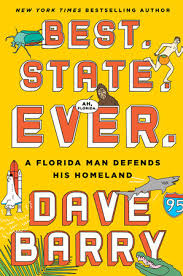
Best. State. Ever. A Florida Man Defends His Homeland by Dave Barry

Best State Ever

Best. State. Ever. A Florida Man Defends His Homeland

Dave Barry (Adult Non-Fiction)

Poor Florida.  A state that has become synonymous with all things weird, daft, looney, loco, nutty, and just plain one-beer-short-of-a-six-pack crazy.  Don’t believe me?  Just Google “Florida Man” along with your birth month and day and ten times out of ten (or REALLY close to it), a corresponding headline will pop up.  For example, on my birthday, this made the headlines: “Naked Florida man breaks into home, tries on woman’s clothes, police say”.  See?  Well let me tell you something.  Dave Barry is S-I-C-K of people wrongfully labeling his beloved state and he’s set out to defend the good name of his hometown by showing us the lighter and brighter (and not necessarily saner) side of “The Sunshine State”.  So, buckle up because you’re in for an interesting and unforgettable ride!

According to Cosmopolitan magazine, women are attracted to guys with a sense of humor.  If that’s the case, then Dave Barry is one of the sexiest men alive.  With Best. State. Ever. A Florida Man Defends His Homeland, Barry gives us Fodor’s on laughing gas.  His book contains countless (truly) laugh-out-loud moments that makes reading in public a somewhat perilous undertaking…unless you love awkward moments and getting suspicious side glances from complete strangers.  Barry lovingly introduces us to real-life, overlooked treasures and he does so with the warmth, adoration, and pride as a parent would present his first-born to the world.  Through wit and black and white photos, we meet Dave Shealy, operator of Skunk-Ape Research Headquarters in Ochopee; we delight in watching mermaids eat underwater (they get hungry, you know) and waving an American flag at Weeki Wachee Springs; and we get to know more than we ever thought imaginable at the Spongeorama in Tarpon Springs.  Using a Florida Tourist Attraction rating system of Out-of-Order Mold-A-Matics, Barry ranks these unsung heroes on a scale from one to five (five being the BEST…and he even rates one attraction a six, but you have to read the book to discover this hidden gem) and offers valuable insights that only a native can appreciate and share.

Read Best. State. Ever. and I promise (or at least hope) that you’ll laugh, you’ll cry (from laughing), and you’ll probably Google “Florida Man” and your birthday as soon as you finish reading this review.  But mostly, you’ll have fun gaining a whole new perspective and appreciation for a state that was not only known as the birthplace of the “hanging chad”, but is also chockful of anything and everything that is weird, daft, looney, loco, nutty, and just plain one-beer-short-of-a-six-pack crazy.

(Reviewer’s Note: If you love the gloriously quirky, kitschy, and sometimes tacky roadside attractions that are a part of our unique culture, then I highly recommend you continue your journey with Betsy Carter’s book entitled Swim to Me about the mermaids of Weeki Wachee.  I think Dave would approve.)

Rating: 5/5

*Book cover image attributed to www.penguinrandomhouse.com