

Current Book Review

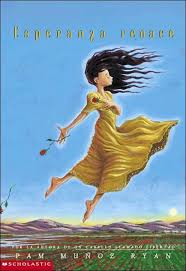
Esperanza Rising by Pam Muñoz Ryan (YA)

Esperanza Rising

Esperanza Rising

Pam Muñoz Ryan (Young Adult Historical Fiction)

Esperanza was the pride and joy of her papa.  The daughter of wealthy ranchers, Sixto and Ramona Ortega, she had everything a twelve-year old could possibly want.  But not far beyond the borders of El Rancho de las Rosas, trouble brewed in Aguascaliente, Mexico.  It was 1930 and the revolution in Mexico had happened over ten years ago, but there were still those who resented the wealth and circumstances of the local landowners.  Soon that hate would spill over into Esperanza’s idyllic and pampered world and would ultimately rob her of everything that she knows and holds dear.

Pam Muñoz Ryan gives us a heartwarming and often heartbreaking riches-to-rags story of a young, spoiled, and arrogant girl who learns the value of humility, empathy, generosity, and kindness.  Inspired by her own grandmother, Esperanza Ortega, Ryan shows us the lavishness and bounty of a prosperous Mexican ranch, as well as the poverty, squalor, and hardship endured by migrant workers living in company farm camps.  She also provides insight into the Mexican Repatriation, which included the deportations of thousands of legalized and native United States citizens to Mexico between 1929 and 1935.  Up until that time, it was the largest involuntary migration in the U.S. with numbers reaching almost a half million.  Ryan also describes the struggles of the workers to compete with cheaper labor from states like Oklahoma, as well as their efforts for a better wage and living conditions through unionization.

In addition to giving readers a story overflowing with moral lessons—Don’t judge a person until you’ve walked a mile in their shoes or Appreciate what you have before you lose it—Ryan also gives us a character who slowly begins to realize that life is more than fancy dresses and porcelain dolls.  Through humiliation, heartache, and despair, Esperanza understands how life is like her father’s beautiful and precious rose garden: “No hay rosa sin espinas.” There is no rose without thorns.  For despite the beauty and splendor that life often provides, there will also be some degree of pain and suffering.  But like her grandmother taught her as she undid Esperanza’s rows of uneven or bunched crochet, “Do not ever be afraid to start over.”  And when Esperanza did, she truly blossomed.

Rating: 5/5

*Book cover image attributed to www.barnesandnoble.com

**Want more?  Visit our Facebook page at www.facebook.com/thedustyjacket
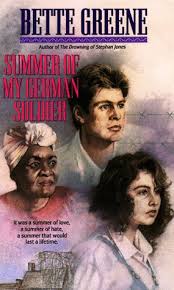
Summer of My German Soldier by Bette Green (YA)

Summer of My German Soldier

Summer of My German Soldier

Bette Greene (Young Adult Historical Fiction)

It was the most exciting thing to have ever happened to Jenkinsville, Arkansas.  German POWs, maybe twenty in all, arrived by train and would be housed in a camp in the small southern town.  Twelve-year-old Patty Bergen was among the many townspeople there to witness the event.  Each hoping to do their patriotic part to make President Roosevelt proud during this summer of World War II.  During a chance encounter in her family’s store, Patty meets young Anton Reicker, a handsome, educated young man who is one of the POWs.  Although he is German and she is Jewish, they begin an unlikely friendship that will test Patty’s family bonds, as well as question her national loyalty.

Written in 1973, Bette Greene’s Summer of My German Soldier was not only listed on the American Library Association’s Top 100 Most Frequently Challenged Books from 1990-1999, it also made the ALA’s Top 10 Most Challenged Books for 2001.  According to the ALA’s website (www.ala.org), “The American Library Association condemns censorship and works to ensure free access to information.”  To educate schools and libraries about censorship, they publish these lists which are compiled by the Office for Intellectual Freedom (OIF).  With that said, this book (recommended for ages 11 and up) is full of racial slurs, derogatory language, sexual innuendoes, and many instances of physical, verbal, and psychological abuse.  It truly runs the gamut for a story written for fifth graders and up.  These issues alone are enough to give a reader pause, but these aren’t the only reasons that I found myself disappointed with this book.

First, Patty’s father and mother are inexplicably cruel and violent to her.  They fawn over her little sister, Sharon, while Patty endures taunts, intolerance, dismissiveness, and even physical beatings at the hands of her father.  I kept hoping for some enlightening backstory as to why these two people could possibly hate their own child so much, but Greene doesn’t even provide a hint to explain their savage and inhuman behavior.  Their treatment of Patty is repugnant and demoralizing, which serves as the ideal foundation for many of Patty’s choices—which are often hasty and incredibly unwise.  Here is a girl so desperate for acceptance and so eager for kindness that she would say or do anything in order to achieve some modicum of happiness.

Second, Greene gives us a story that seems devoid of any moral lessons.  The Bergen family’s black housekeeper, Ruth—who takes on the role of mother figure—is very religious and is often heard singing hymns while doing chores and encourages the children to pray at lunchtime.  Despite this being a story about a Jewish family, we get a healthy dose of Christianity and the glory that comes with salvation.  Even with this, there really isn’t a central theme tying the entire story together.  We understand the courage of putting someone else’s wellbeing ahead of your own and the virtues of seeing beyond religion, ethnicity, or skin color, but these platitudes fall by the wayside with an ending that is absent any sort of clarity, closure, or inspiration.  The reader is left feeling just as bewildered and discouraged as Patty whose only “real” friends are the housekeeper, a POW, and the town’s sheriff.

I read Greene’s Philip Hall Likes Me. I Reckon Maybe. (which I rated 4/5) and was so hoping to find that same feeling of hope and triumph in this book.  Instead, Greene delivers a bleak look at family and life and gives us a girl so disillusioned and unsatisfied with her life, that the only thing she clings to is the day she turns eighteen.  Unfortunately for Patty, that’s still six very long summers away.

Rating: 3/5

*Book cover image attributed to www.amazon.com

**Want more?  Visit our Facebook page at www.facebook.com/thedustyjacket
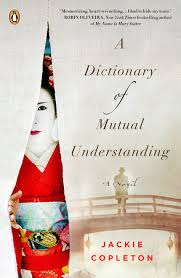
 

A Dictionary of Mutual Understanding by Jackie Copleton

A Dictionary of Mutual Understanding

A Dictionary of Mutual Understanding

Jackie Copleton (Adult Historical Fiction)

On August 9, 1945 a new word entered the Japanese vernacular:  pikadon.  PIKA meaning brilliant light and DON meaning boom.  It aptly described what Amaterasu Takahashi and thousands of others saw and heard in Nagasaki at 11:02 am.  A brilliant light and then a boom.  Ama lost her daughter and grandson on that fateful morning.  They were everything to her.  Pushing past the dead or dying and sifting through the ashes, she knew she would never see Yuko or little Hideo again.  But nearly forty years later, a man—badly scarred and disfigured—knocked on her door bringing good news.  “Please don’t be alarmed,” the stranger said.  “My name is Hideo Wantanabe.  It is good to see you Grandmother.”  He left her a letter to read to get their journey started.  A journey that would take Ama back to a tragic past and a man who would be the common thread to everyone she has ever loved and lost.

A Dictionary of Mutual Understanding is Jackie Copleton’s first novel and it truly is a hauntingly beautiful story.  Using Ama as our narrator, we experience the horror when the second of two atomic bombs hit the city of Nagasaki on August 9th (the first hit Hiroshima three days prior on August 6th).  Through Ama’s eyes, we witness the carnage, fear, destruction, chaos, and terror as survivors desperately searched for loved ones while the injured begged for water or aid.  As our story progresses, we begin to learn more about Ama, her husband, Kenzo, and her daughter.  Through Ama’s memories, as well as a series of entries in Yuko’s diary, we begin to understand the reasons behind Ama’s feelings of guilt and bitterness.  She is a woman living a life of “What ifs” and “If onlys” and is constantly questioning her own maternal motives.  Any parent will be able to relate to Ama and her need to shield her child from harm and heartache, but as the saying goes, “The road to hell is paved with good intentions” and Ama quickly realizes that protection often comes with a price.

Copleton gives readers a multi-layered story that is brimming with pain, loss, regret, and love.  But the singular theme that runs throughout the story is hope.  Whether you are extended it, enticed by it, or desperately hold onto it, hope has many faces: a grandmother looking for comfort, a scarred man searching for healing, a young wife waiting for her husband’s return from war, a lover wanting a second chance, or a city emerging from the rubble.  Copleton gives us a poignant and touching story of hope and reminds us that it is when things are at their darkest that hope often comes knocking on our door.

Rating: 5/5

*Book cover image attributed to www.penguinrandomhouse.com

**Want more?  Visit our Facebook page at www.facebook.com/thedustyjacket

Hoot by Carl Hiaasen (J)

Hoot

Hoot

Carl Hiaasen (Juvenile Fiction)

It’s tough always being “the new kid”.  It’s even tougher when there is a bully involved, but the day that Dana Matherson mashed Roy Eberhardt’s face against the school bus window was perhaps the greatest stroke of luck since Alexander Graham Bell spilled acid on his leg.  For it was at that exact moment that Roy saw the mysterious running boy bolting past the bus.  He was wearing no shoes and carrying no backpack or books.  What was he running from?  Where was he going?  And why wasn’t he wearing any shoes?  Turns out, that wasn’t the only mystery in the sleepy little town of Coconut Cove, Florida.  Someone is trying to prevent the newest Mother Paula’s All-American Pancake House from being built.  Between burrowing owls, alligators, sparkly-tailed snakes, fake farts, and nightly pranks, perhaps Coconut Cove isn’t so sleepy after all.

Carl Hiaasen’s Hoot was awarded a Newbery Honor in 2003.  He gives us two mysteries in one: a strange running boy and a vandal thwarting the efforts of a big-time corporation.  The story is witty, fast-paced, and full of heart.  Our hero, Roy, is likeable and full of moxie.  For a kid who just wants to get through the school day unnoticed, he makes it a point to stand out from the crowd.  From taking on the school bully to striking up an unusual friendship with Beatrice Leep, an elite soccer star, Roy quickly makes a name for himself and becomes the unlikeliest of heroes.

Hoot is more than just a story about friendship and courage.  It is a David-versus-Goliath story as environmentalism goes head-to-head with capitalism.  It’s burrowing owls against big bucks and a group of average kids willing to go to great lengths in order to protect something far more valuable than a building or a brand.  In addition, we are introduced to a rather unseemly group of adults: an opportunistic officer, a nasty vice-principal, crooked politicians, a vile stepmother, greedy corporate heads, and so on.  Luckily, there are a few adults in the book who haven’t sold their soul to the devil, but the spotlight is really on Roy, Beatrice, and our mysterious running boy, which proves that good things do come in small packages.

American writer and poet Suzy Kassem wrote, “Stand up for what is right, even if you stand alone.”  Carl Hiaasen gives readers a story about defending the weakest among us—the helpless and vulnerable who either lack the voice to speak up or the courage to stand up.  He provides instances showing people doing good in order to curry favor or to get ahead, but it’s the instances where good is done simply because it is the right thing to do that proves to be the truest measure of a person.  Hiaasen illustrates this through a new kid, a mysterious running boy, and a soccer star—three unlikely friends who wouldn’t give up despite the odds and showed that every life is precious and worth preserving.  That, dear friends, is something we should all give a hoot about.

Rating: 4/5

*Book cover image attributed to www.target.com

**Want more?  Visit our Facebook page at www.facebook.com/thedustyjacket
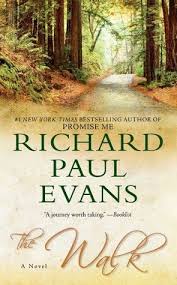
The Walk by Richard Paul Evans

The Walk

The Walk

Richard Paul Evans (Adult Inspirational)

Alan Christoffersen had it all: a successful advertising agency, a big house, luxury cars, and a beautiful wife who was the love of his life.  But a horrible accident would set off a series of events that would send his world crashing down.  Within weeks, he would lose everything and Alan Christoffersen, the man who had everything, was suddenly left with nothing.  It seemed that even God had abandoned him.  So, Alan decided to walk away from his troubles…literally.  With nothing more than a backpack and a few essentials, Alan set off on a near 3,500 journey stretching from Seattle, Washington to Key West, Florida hoping that this walk might bring him some clarity to a life that didn’t make sense anymore.

I’ve read many What-would-you-do-if-type books: What would you do if you could live forever?  What would you do if you had one wish?  Go back in time?  Trade places with someone?  Were invisible?  This one was different.  Tackling the idea of how to move forward after you’ve lost everything is daunting.  Alan faced this situation, questioned his own faith, and wondered why love, hope, and grace had been so mercilessly taken from him.

The Walk is the first in a series of five books in The Walk Series by Richard Paul Evans.  This first installment takes Alan all the way across the state of Washington: from Seattle to Spokane.  During this first leg of his journey, he meets several people who remind him what kindness, generosity, and gratitude look like: a handless man looking for answers, a scarred woman offering hope, an innkeeper who faced death, and a stranger returning a favor.  Each person along his journey offers Alan little bits of wisdom and insight and their brief presence in his life leaves him undeniably changed.

The Walk is an easy and quick read.  Evans deals with religion and faith without being overly preachy and gives us a likeable protagonist who seeks the good in humanity although he himself has been betrayed by those he had trusted most.  In the opening pages, we know Alan completes his walk and eventually reaches Key West, but as Ralph Waldo Emerson once said, “It’s not about the destination, it’s about the journey” and we know that Alan has a very long journey ahead of him.  A journey that will hopefully answer some of his questions and perhaps even restore his faith.

Alan keeps a diary of his walk.  In one entry, he wrote, “We truly do not know what’s in a book until it is opened.”  Likewise, we often don’t know what’s in a person until we ask or until we have the opportunity to get to know them.  We don’t know their past, the burdens they may carry, or the pain they may be enduring.  The few people that Alan encountered during his walk through Washington began as unopened books, but by extending a kindness or even just a simple greeting, those books began to open and Alan discovered that perhaps the love, hope, and grace that he thought had been denied him had never really abandoned him after all.

Rating: 4/5

*Book cover image attributed to www.goodreads.com

**Want more?  Visit our Facebook page at www.facebook.com/thedustyjacket
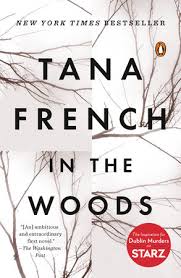
 

In the Woods by Tana French

In the Woods

In the Woods

Tana French (Adult Mystery)

On August 14, 1984, Jaime Rowan, Adam Ryan, and Peter Savage—all twelve years old—were playing in the surrounding woods of their small Dublin neighborhood of Knocknaree when the unthinkable happened.  Jaime and Peter disappeared and Adam was found in blood-soaked sneakers clinging to a tree with no memory of the event.  Flash forward twenty years and Adam Ryan, now Detective Rob Ryan, is investigating the murder of twelve-year-old Katy Devlin in Knocknaree.  Ryan and his partner, Cassie Maddox, diligently work the case to find Katy’s killer while Ryan grapples with lost memories that may link the two cases together.  But Knocknaree is a small place.  What are the chances that two different child murderers live in the same village?

In the Woods is French’s debut novel and she handily presents an interesting and compelling police procedural.  Clocking in at 429 pages, she manages to hold our interest throughout her novel while creating a slow and steady momentum as our main characters flesh out four different threads of theories and begin peeling back multiple layers on two seemingly-connected murder cases.  Her characters are multi-dimensional and French gives us time to become familiar with them; however, the portrayals are a bit biased since we are seeing everything through Ryan’s eyes, our story’s narrator.  By his own admission, he lies and so we are already aware that throughout the case, we’re going to run into credibility problems.  (Personally, I don’t like unreliable or untrustworthy narrators, but I digress.)  The thing which pleasantly surprised me was the relationship between Ryan and Maddox.  French chose a professional relationship for these two versus the obligatory romantic/sexual conflict that readers often get when presented with a male/female partner pairing.  We see the ease they have around one another, as well as the mutual respect they share.  This platonic relationship allows the reader to concentrate on the case rather than muddy the waters with “will they/won’t they” expectations.

Despite these positives, I found this book fell short on multiple levels.  In the Woods starts off riveting and suspenseful and then—through a series of professional negligence (some folks should have lost their jobs), self-destructive decisions, and just plain sloppiness (or laziness) on the author’s part—the story begins to unravel and disintegrate right before our eyes.  Ryan is not a very likeable guy and he knows this: “I am intensely aware, by the way, that this story does not show me in a particularly flattering light.”  More often than not, he comes off as whiny and immature and his love for the bottle (which leads to more hangovers that I could count) makes me wonder how he manages to stay gainfully employed let alone be put in charge of a murder investigation.  Despite his horrifying backstory (which should have earned him at least a few pity points), it was simply impossible for me to connect with Ryan and feel any kind of sympathy for him.  Conversely, Cassie Maddox is bright, intuitive, hardworking, and a much more likeable character, which is probably why Tana French gave her the starring role in her novel’s sequel The Likeness (book two of six in the Dublin Murder Squad series).  Positives and negatives aside, the biggest problem I had with this book is the giant red herring that French made the cornerstone of her story.  I won’t divulge any spoilers, but I will say that by the end of the book, I was left feeling irritated, unsatisfied, and frankly duped.  I did stop myself from throwing the book against the wall so I guess this can be added to the positive column.

In the Woods won several awards and inspired an eight-episode series for the BBC and Starz.  Obviously, a lot of people thought that this novel and its sequel were the greatest thing since the melon baller.  However, between an annoying main character and a plot line that utterly evaporated, I hope to find satisfaction in French’s sequel.  Until then, any closure that I thought I would find in this book will remain elusive for I believe that it is still probably hiding somewhere.  Somewhere in the woods.

Rating: 3/5

*Book cover image attributed to www.penguinrandomhouse.com

**Want more?  Visit our Facebook page at www.facebook.com/thedustyjacket

A Year Down Yonder by Richard Peck (J Historical Fiction)

A Year Down Yonder

A Year Down Yonder

Richard Peck (Juvenile Historical Fiction)

 It was 1937 and the country was in the midst of what people were calling the Roosevelt recession.  The Dowdel family, like so many others, had hit upon hard times and Mary Alice was to be sent to live with her grandmother until the family got back on their feet.  She and her brother, Joey, had spent many summers with Grandma Dowdel in her sleepy Illinois town, but Mary Alice was fifteen now and this visit was going to be a full twelve months!  With no telephone, an outdoor privy, a spooky attic, and everything being as old as Grandma…if not older…how was a city girl from Chicago going to survive in this hick town for one whole year?

A Year Down Yonder received the Newbery Medal in 2001 and was the sequel to Peck’s A Long Way from Chicago, recipient of a Newbery Honor in 1999.  In this wildly amusing and heartfelt book, Peck delivers one of the most outrageous, audacious, outlandish, and unforgettable characters when he gave us Grandma Dowdel.  She’s trigger-happy (and the whole town knows it) and not afraid to speak her mind.  But behind that gruff and crusty exterior lies a woman who’s generous to a fault and genuinely cares about her neighbors…although she would be the first to deny it.  Peck gives us small-town life and everything that comes with it.  From turkey shoots and Halloween hijinks to Burdicks (you’ll know one when you see ‘em) and burgoo, Grandma Dowdel handles everything with humor and candor and might even treat you to a glass of buttermilk and a square of corn bread in the process.

A Year Down Yonder takes readers to rural America and back to a time where folks learned how to make the most with what little they had and considered themselves blessed if they had their health, their family, and one or two people that could be counted on when it mattered most.  It’s a delightful and amusing book that extolls the virtues of kindness and the importance of family.  It also reminds us not to judge a book by its cover for it is often the tartest apples that make the best pies.  Just ask Grandma Dowdel.

Rating: 4/5

*Book cover image attributed to www.amazon.com

**Want more?  Visit our Facebook page at www.facebook.com/thedustyjacket

Philip Hall Likes Me. I Reckon Maybe. by Bette Greene (J)

Philip Hall Likes Me I Reckon Maybe

Philip Hall Likes Me. I Reckon Maybe.

Bette Greene (Juvenile Fiction)

 There are a few things that Elizabeth “Beth” Lorraine Lambert cannot stand: being cheated, allergies, being told she can’t do something because she’s a girl, and giving that low-down dumb bum of a polecat Philip Hall the satisfaction of beating her at anything.  Truth be told, Beth is smart—really, really smart—but when it comes to Philip Hall, she can be kind of a dumb bum, too.  But Philip is the cutest boy at J. T. Williams School and with that dimpled smile…does it really hurt if Beth lets him win at a few things every now and then?

Haven’t most of us, at one time or another, happily played the part of “chump” when it comes to being noticed or liked by someone that we felt was a bit out of our league?  Whether that someone was too good looking, too popular, too smart, too athletic, or just too…well…too.  For one reason or another, we sacrifice self-respect for the opportunity to just be around that person.  Well, our young Beth Lambert is no different, but the good news is, she knows it and better still, she realizes that the long-term rewards that come with being yourself greatly outweigh the temporary benefits of being around someone who’s not even seeing the real you, but rather a lesser, compromised version of you.

I’m always drawn to books that feature plucky female protagonists: Anne Shirley (Anne of Green Gables), Dovey Coe (Dovey Coe), Fern Arable (Charlotte’s Web) and Francie Nolan (A Tree Grows in Brooklyn) are just a few of my favorites.  Girls and young ladies who have a mind of their own and will not yield to societal norms or expectations.  They prove to be intelligent, loyal, resilient, principled, and brave.  Beth Lambert is one such girl who not only stands up to turkey thieves and an unscrupulous store owner, but also to her own insecurities that tell her that she has to be inferior in order to gain and keep a friendship.  Lucky for us, she realizes the error of her ways and evolves into the kind of young lady that she was meant to be.

Bette Greene shows us the power of believing in ourselves and the gift that comes when someone we respect and admire has faith in us.  Beth received such support from her doctor and the few words of encouragement that he offered her allowed Beth to see the possibilities that awaited her and to explore the opportunities that she thought were well out of her reach.  I enjoyed Philip Hall Likes Me. I Reckon Maybe. and cheered as our Beth evolved from being a pleaser to an assertive and confident girl that anyone would fall in love with.  Even a low-down dumb bum of a polecat like Philip Hall.

Rating: 4/5

*Book cover image attributed to www.scholastic.com

**Want more?  Visit our Facebook page at www.facebook.com/thedustyjacket
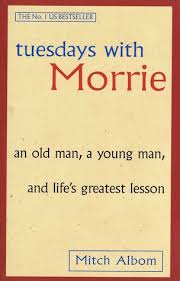
Tuesdays with Morrie by Mitch Albom

Tuesdays with Morrie

Tuesdays with Morrie

Mitch Albom (Adult Memoir)

 It was to be professor Morrie Schwartz’s final class.  A class with no grades, no textbooks, and no final exam.  Weekly oral exams were required and a long paper on what was learned was expected (a kiss good-bye earned an extra credit).  The subject would be The Meaning of Life and the class would cover such topics as family, work, aging, forgiveness, love, and death.  It would last fourteen weeks (fourteen Tuesdays to be exact), be held after breakfast, and would have just one pupil—a former student by the name of Mitch Albom who had lost his way somehow.  Thanks to Ted Koppel, Mitch found his way again because he had found Morrie Schwartz.

Tuesdays with Morrie reminded me of John Gunther’s 1949 memoir Death Be Not Proud.  Both were a celebration of life and showed us what true courage, grace, peace, and humility look like.  Mitch Albom provides us with an honest, candid, and raw account of his beloved professor’s last weeks on earth as he battles and eventually succumbs to the ravages of Amyotrophic Lateral Sclerosis (ALS) or Lou Gehrig’s disease.  His account of his time with Morrie is heartbreaking and humorous, tragic and hopeful, and gives us a precious glimpse into the life of a man who accepted his fate with dignity and generosity.  By openly sharing his steady decline with Albom and by conducting several interviews on national television, Morrie cast modesty and privacy aside with the hope that those touched by his story may cherish the time that they have been given and re-evaluate what was truly most important in life.

Throughout his memoir, Albom blesses us with many of Morrie’s aphorisms: “Do the kinds of things that come from the heart.”; “Love each other or perish.”; “Death ends a life, not a relationship.”; and his last one, “Don’t let go too soon, but don’t hang on too long.”  Albom’s story of his former professor and friend is bittersweet because we know how the story is going to end.  With each turn of the page, we understand that we’re getting closer to Morrie’s final day and although we hope that never turning another page might mean that Morrie could somehow avoid death, we know that isn’t possible and that his fate has already been determined and carried out.

Tuesdays with Morrie explores humanity and what it means to be a part of humankind.  Although published in 1997, Morrie’s insights and observations ring just as true today as they did almost twenty-five years ago.  Back then, while society was caught up with Princess Diana, John F. Kennedy, Jr., and the trial of O. J. Simpson, Morrie said to Albom, “The culture we have does not make people feel good about themselves.  And you have to be strong enough to say if the culture doesn’t work, don’t buy it.”  How unfortunate that this is just as relevant today as it was nearly a quarter of a century ago.

In his final weeks, scores of Morrie’s former students traveled domestically and internationally for the chance to visit their favorite professor one final time.  Morrie knew, better than anyone, that the role of educator carries a tremendous amount of responsibility and influence.  In death, as I imagine it was true in life, Morrie gave each one of his visitors his undivided attention and made them feel like they were the most important thing in the world.  He made everyone feel important, special, and loved.  That was Morrie’s legacy and his hope for the future.  That everyone would feel good about themselves.

At one time or another, we’ve all had a favorite teacher, camp counselor, or coach who had a profound impact on the way we wanted to model ourselves as adults.  They encouraged, supported, and challenged us and their influence will always be a part of us.  But what we often fail to realize, and what Albom reminds us of, is the effect that we—as students, campers, or athletes—have had on their lives as well.  The gestures of appreciation, the thirst for knowledge, the desire to please is just as important and meaningful.  It’s a fragile circle that can be strengthened with a simple “Thank You” or weakened with a harsh word.  But through Morrie and Mitch, we’re shown just how joyful this unique bond and relationship can be and even though graduations and retirements come and go, the learning—the loving—never stops.  As Morrie said, “The most important thing in life is to learn how to give out love, and to let it come in.”  Well said, Professor.  Class dismissed.

Rating: 5/5

*Book cover image attributed to www.goodreads.com

**Want more?  Visit our Facebook page at www.facebook.com/thedustyjacket

Call It Courage by Armstrong Sperry (J)

Call it Courage

Call It Courage

Armstrong Sperry (Juvenile Fiction)

 It happened many years ago, before the traders and missionaries first came into the South Seas, while the Polynesians were still great in numbers and fierce of heart.  But even today the people of Hikueru sing the story in their chants and tell it over the evening fires.  It is the story of Mafatu, the Boy Who Was Afraid.

Fifteen-year-old Mafatu was afraid of the sea.  He’s had this fear for as long as he could remember.  His father, Tavana Nui, the Great Chief of Hikeuru, was ashamed of him for his people were great seafarers who worshipped courage.  There was no room—no tolerance—for cowardice.  It’s no wonder that Mafatu felt alone and out of place.  Angry and ashamed, Mafatu sets off one night in a canoe with his dog, Uri, and his albatross, Kivi, as his only companions.  His father had christened him “Stout Heart” upon his birth and Mafatu was determined to earn that name…or perish trying.

Armstrong Sperry’s Call It Courage was the recipient of the Newbery Medal in 1941.  Although there are mentions of Maui (God of the Fishermen) and Moana (the Sea God) and even Maui’s famed fishhook, Disney fans shouldn’t confuse this book with the movie about a spunky Polynesian princess.  Rather, it is more along the lines of Island of the Blue Dolphins (1961 Newbery Medal recipient) by Scott O’Dell, but told from a boy’s perspective.  If you enjoyed O’Dell’s book, you’ll most likely enjoy Sperry’s as well.

Sperry gives readers the story of a boy who not only has to deal with his own fears and shortcomings, but has to do so under the weight of being the island chief’s son.  To be a coward amongst people who worship heroism is one thing, but add the burden of being the island’s heir apparent and you’ve got quite a heavy load.  As the ridicule—especially from one who was seemingly a friend—intensifies, we see Mafatu being crushed under its unforgiving and unrelenting weight day after day until he sees no other alternative but to flee his homeland in search of courage and worth.

Call It Courage is fast-paced, tense, and suspenseful due to its numerous forms of conflict: Man vs. Man, Man vs. Nature, Man vs. Society, Man vs. Fate/Supernatural, and Man vs. Self.  Like in Island of the Blue Dolphins, we have a smart protagonist who relies heavily on wit and skill to survive.  The mundane tasks that Mafatu was assigned while on Hikueru are quickly utilized and performed with speed and skill.  Rushes or lapses in judgement could mean death so we see Mafatu being patient, deliberate, calculating, and thoughtful in all of his decision making.  Books (especially for younger readers) could use more characters like this.

Sperry delivers a powerful message in a very short book (mine was only 92 pages).  He shows us a boy who despite his insecurity, frailty, and vulnerability, is capable of doing rather extraordinary things.  Whether you call it courage, impulse, or instinct, Mafatu discovers his inner strength which allows him to begin believing in himself.  Famed American pianist Liberace once said, “Nobody will believe in you unless you believe in yourself.”  Mafatu, along with a yellow dog and a gimpy albatross, found the courage to believe in himself and I would call that pretty remarkable.

Rating: 5/5

*Book cover image attributed to www.amazon.com

**Want more?  Visit our Facebook page at www.facebook.com/thedustyjacket