
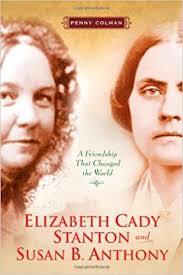
Elizabeth Cady Stanton and Susan B. Anthony: A Friendship That Changed the World by Penny Colman (J Biography)

Elizabeth Cady Stanton and Susan B. Anthony: A Friendship That Changed the World

Penny Colman (Juvenile Biography)

On a spring day in May of 1851—following an antislavery meeting in Seneca Falls, New York—Amelia Bloomer made a simple introduction that would alter the way that women were viewed, treated, and legally recognized. It was on a street corner where Susan B. Anthony and Elizabeth Cady Stanton met and would begin a 51-year friendship that would survive religious differences, geographical distances, legislative setbacks, societal obstacles, and personal obligations. Elizabeth, a gifted writer, and Susan, an adept organizer, were on the forefront of the women’s reform movement and would not only travel throughout the nation to end slavery, but would lead the charge in fighting for the rights of women to receive a higher education, to divorce, to own property, to earn equal pay, and to vote. Together, these women amassed ardent supporters, as well as bitter detractors. They suffered financially, physically, and emotionally but they remained as committed to their friendship as to their cause.

Colman’s research is exhaustive and extensive. Rather than begin her book with Susan and Elizabeth’s initial meeting, she explores each of their childhoods and upbringing, allowing readers to get a more complete picture as to how these two very different women would eventually be drawn together through a common cause. What I enjoyed was being able to go beyond the history in order to understand each woman’s unique motivation that set them on their shared trajectory. In Elizabeth’s case, it was her desire to offer consolation to her father after the death of his son. Her desire to bring him comfort by being “all my brother was” made her realize just how limited and exclusive her options were. Also, since her father was a judge and his office adjoined their home, Elizabeth was privy to numerous conversations dealing with the law and its negative impact on women, especially married women. In Susan’s case, it was her family’s plummet into bankruptcy and watching her personal items being auctioned off that left an indelible mark on her. Her need to earn money and help pay off family debts thrust her into the world of teaching, where she immersed herself in the issues of the day: temperance, slavery, and the fate of the country. With so many personal details taken from diary entries, letters, journals, biographies, and autobiographies, Colman enables readers to not only value these women as historical figures, but to also connect with them on a personal level. Their struggle was extraordinary and their impact immeasurable.

Before Elizabeth’s 87th birthday (which she would never get to celebrate), she received a letter from her dearest Susan. The letter read, “If is fifty-one years since we first met and we have been busy through every one of them, stirring up the world to recognize the right of women. . . . We little dreamed when we began this contest . . .that half a century later we would be compelled to leave the finish of the battle to another generation of women. But our hearts are filled with joy to know that they enter upon this task equipped with a college education, with business experience, with the freely admitted right to speak in public—all of which were denied to women fifty years ago. . . . These strong, courageous, capable, young women will take our place and complete our work. There is an army of them where we were but a handful.”

In an age where social media influencers, fashion and beauty bloggers, and reality stars fight for the attention and devotion of our young girls, it is important to remind them that it wasn’t that long ago when women were considered “members of the state” and not recognized as citizens of the United States. Women were denied rights, choices, and privileges that were eventually given to freed male slaves. Susan and Elizabeth were trailblazers and pioneers who made it possible for women to have a seat at the table…to have a voice in the discussion. They weren’t just reformers, activists, and suffragists, they were crusaders, soldiers, and warriors. Before our young girls and women put on a soccer jersey, sit down to choose their college, or review a ballot before an upcoming election, they need to remember that these choices are possible because of an introduction between two women who were outside enjoying a pretty spring day in New York.

Rating: 5/5

*Book cover image attributed to www.amazon.com

**Want more?  Visit our Facebook page at www.facebook.com/thedustyjacket
Drowning Ruth by Christina Schwarz

Drowning Ruth

Christina Schwarz

Ruth remembered drowning. “That’s impossible,” Aunt Amanda said. “It must have been a dream.” But Ruth maintained that she drowned, insisted on it for years, even after she should have known better.

Amanda Starkey is a nurse—a brilliant one in fact. She’s known for having “the touch”, but recent events have brought her mental stability into question and has forced her to leave her work at the hospital. Seeking a change of venue, she travels to her family farm at Nagawaukee. Perhaps there she’ll get the rest and clarity she needs while allowing her to reconnect with her younger sister, Mathilda, and Ruth, her niece. Soon, tragedy strikes and mystery surrounds the shocking drowning of Mathilda and as the years pass, dark secrets begin to crowd the deepest corners of both Amanda’s and Ruth’s memories. What happened that winter night in 1919 that led to a young mother’s watery death? How much does Ruth remember? What are those horrible scars on Amanda’s hand?  Are they a clue to the past? But like ice, secrets eventually thaw and allow the truth to rise to the surface. What will happen to Amanda and Ruth once these secrets are finally discovered?

Christina Schwarz’s Drowning Ruth is an Oprah Book Club pick and I can see why. Oprah’s selections often involve dark, broody themes with complex characters and intricate plots. This book is wonderfully no exception. Schwarz packs her book with flawed and fractured characters who carry their own unique burdens and baggage. Schwarz is able to flesh out each of her pivotal characters amply (from Amanda’s old love interest to Ruth’s beautiful and vivacious new friend) and doesn’t waste precious words with throw-away details or pointless subplots. The story switches from past to present and from third-person narrative to first-person points of view of both Amanda and Ruth. It is perhaps these personal perspectives that give readers the most honest and raw insights into these women, the motivations behind their actions, and how each are dealing with loss, adversity, betrayal, and heartache. Drowning Ruth moves along at a vigorous pace with plenty of plot twists to keep the reader engaged and guessing. The farther you get into this story, the more you realize how all of Schwarz’s character’s lives are deeply intertwined and entangled. The result is a satisfyingly suspenseful and captivating read.

One of my favorite authors, Carlos Ruiz Zafón, wrote in his book The Shadow of the Wind, “A secret’s worth depends on the people from whom it must be kept.” Like Mathilda and Ruth, Amanda Starkey was drowning as well, but her water was the weight of the secrets she wrapped around herself. Despite her need to keep them submerged, Amanda’s dark secrets eventually found their way to the bright surface and as they emerged, they brought Amanda up as well and introduced her to the fresh air that only life and living can provide.    

Rating: 4/5

*Book cover image attributed to www.thriftbooks.com

**Want more?  Visit our Facebook page at www.facebook.com/thedustyjacket

Darius the Great is Not Okay by Adib Khorram (YA)

Darius the Great is Not Okay

Adib Khorram (Young Adult Fiction)

Darius Kellner has some very big shoes to fill. After all, he was named after Darius the Great, one of the greatest rulers of the Achaemenid dynasty. Darius the Great was strong, smart, and brave, conquered lands and expanded the Persian Empire.  Darius Kellner is none of these things and has never really accomplished anything…although he can brew a mean pot of tea. For one thing, he’s only half Persian or a “Fractional Persian” as he refers to himself.  Also, he never stands up for himself. The school bullies (the Soulless Minions of Orthodoxy) keep him in his place, which makes life at Chapel Hill High School (Go Chargers!) a living nightmare. On top of all of that, the medication he takes for his depression causes weight gain, which only makes the target on his back that much easier to spot. But life is about to get a little more complicated as the family boards a plane to Iran to visit his sickly maternal grandfather. How can a shy, non-confrontational Fractional Persian with a penchant for The Hobbit and Star Trek: The Next Generation be able to live up to his namesake in his mother’s homeland? Darius doesn’t need to be great. What Darius needs is a miracle.

Author Adib Khorram, who himself suffers from depression, delivers a warm and realistic take on teenage life and the struggle with balancing family expectations with personal aspirations. What is refreshing about Darius the Great is Not Okay is that Khorram fills his book with characters who are not caricatures. It could have been easy to paint Darius as the hapless victim. The “typical” bullied teenager who is sullen and solitary. Instead, Khorram takes great care to give our main character heart and who experiences deep feelings of jealousy, resentment, humiliation, and gratitude without the need for a fall guy or martyr. When Darius is around his little sister, Laleh (an adorable and precocious second grader), we see his kindness, compassion, and various bits of exasperation peek through. As his friendship with Sohrab begins to evolve, we witness a more confident and joyful Darius emerging. Also, Khorram avoids depicting Darius’s intelligent, and charismatic father, Stephen, as the elitist, cold-hearted, and controlling patriarch. Through various situations, we understand that Stephen’s repeated criticisms of Darius are not cruel, but rather a father’s desire for his child to be accepted, appreciated, and happy. All of Khorram’s characters are perfectly imperfect and are so well developed, that we find ourselves laughing, crying, and cursing right alongside them.

Khorram’s story also gave me the opportunity to learn more about Iran and her people, culture, and history. Iran is truly a separate character in this book and although Khorram was born in Kansas City, Missouri, his father is Iranian and the love he has for his father’s birthplace is evident in every single page. As Darius experiences Iran for the first time, we too get to feel the dust on our skin, smell the savory teas brewing in their pots, taste the confectioners sugar on top of the qottab, and marvel at the magnificence of the Zoroastrian Towers of Silence and Persepolis. Darius the Great is Not Okay is not only an expertly told story about family, friendship and acceptance, but it is also a lavish feast for the senses and truly a trip worth taking.

Rating: 5/5

*Book cover image attributed to www.goodreads.com

**Want more?  Visit our Facebook page at www.facebook.com/thedustyjacket

The Tiger Rising by Kate DiCamillo (J Fiction)

The Tiger Rising

Kate DiCamillo (Juvenile Fiction)

He took a breath. He opened his mouth and let the words fall out. “I know where there’s a tiger.” Sistine stood in the drizzly rain and stared at him, her eyes black and fierce. She didn’t say “A real one?” She didn’t say “Are you crazy?” She didn’t say “You’re a big old liar.” She said one word: “Where?” And Rob knew then that he had picked the right person to tell.

Rob Horton was the best no-crier in the world. That was due in large part to his way of not-thinking about things: his mother’s death, the bullies at school, or the continual rash on his legs. He kept those feelings, along with his no-wish things, locked up tight in a suitcase. As his father always reminded him, crying, worrying or wishing won’t change a thing. So Rob really wasn’t sure what to think when he found a caged tiger behind the old Beauchamp gas station building one day. He also wasn’t sure what to think about that new girl, Sistine, who showed up to school one day in her pink lacy dress since nobody wears pink lacy dresses to school. Suddenly Rob found himself trying to not-think about a whole lot of thinkable things and he wasn’t sure just how much more that old suitcase of his could hold.

It’s tricky being an adult reading a book targeted for younger readers. I feel it’s important to view these stories from their perspective and through their unique lens. With that in mind, I still found myself disappointed with this book. Kate DiCamillo is by far one of my favorite authors and a brilliant storyteller so I was surprised with feeling shortchanged with The Tiger Rising. Her characters seem shallow and could have been developed more fully.  Rob’s father, in particular, could have benefited the most from some kind of backstory. Without understanding his past, he came off as a hot-headed, unfeeling, and violent father who garners little to no sympathy from readers. Also, this story felt forced and rushed—as if DiCamillo is hurrying us across a self-imposed finish line rather than allowing us the opportunity to fully experience the thrill or the energy of the race.  The Tiger Rising feels more like a story pitch or outline rather than a fully fleshed out tale of loss and friendship.  Although the lessons of realizing the importance of grieving and the power of forgiveness are important, they get buried under the weight of too many loose ends that are left to simply dangle in the wind.

One of the most interesting and grounded characters in the book is Willie May, the housekeeper of the hotel that both Rob and his father live and work. Sistine refers to her as a “prophetess” as Willie May is always providing little nuggets of truth and wisdom.  When Willie May saw Rob and Sistine together, she said, “Ain’t that just like God throwing the two of you together?” It is a powerful thing when two seemingly opposite or contrary things find their way to one another and connect. I wish I could have connected with this story, but I feel the best parts of it are still locked away somewhere and is just awaiting the right key to set it free.

Rating: 3/5

*Book cover image attributed to www.thriftbooks.com

**Want more?  Visit our Facebook page at www.facebook.com/thedustyjacket

The Glass Castle by Jeannette Walls (Memoir)

The Glass Castle

Jeannette Walls (Memoir)

Jeannette Walls’s earliest memory was when she was just three years old.  She was living in a trailer park in a southern Arizona town with her parents and two siblings.  She was on a chair cooking hot dogs.  She was wearing a pretty pink dress bought for her by her grandmother.  And she was on fire.  She was burned so badly that she spent six weeks in the hospital and endured a series of painful skin grafts.  Yet quite unbelievably, things for Jeannette and her family would only go downhill from there.  Always one step ahead of the FBI, gestapo, or Mafia (cleverly disguised as bill collectors), Jeannette’s father Rex skeddadled his family across the desert from one little mining town to the next.  Dealing with bullying, squalor, hunger, a brilliant alcoholic father, and an apathetic artistic mother, this is Jeannette’s remarkable story, candidly and humorously told without fear or favor.  This is her early life presented as transparently as the glass castle that her father had always promised to build.

The Glass Castle is one of those stories that if it wasn’t true, you’d scoff at the bizarre storyline and ridiculous lengths the author puts her main characters through.  As I turned page after page, the one sentence I kept repeating to myself was, “How did this woman ever survive childhood?”  Walls was severely burned at three (and ironically developed an unhealthy fascination with fire after that) and by the time she turned four, she not only survived being thrown out of a moving car, but handedly acquired such “basic skills” as firing her father’s pistol, throwing a knife by the blade, and shooting her mother’s bow and arrow. On top of that, she conducted experiments with toxic and hazardous waste found at the dump, nearly drowned during her swimming “lessons” with her father, hunted for perverts in the dead of night with her brother, escaped several sexual deviants (many times due to her father’s lack of good judgement), and climbed under a fence to pet a cheetah at the zoo.  Growing up, Jeannette clearly had more luck than sense, but her ability to see the good in everything and her unfailing faith in her father often led to heartbreak and disappointment, but clearly made her the tough and grounded adult that she is today.

American game designer and sci-fi novelist Aaron Allston once noted that the difference between tragedy and comedy is that “tragedy is something awful happening to somebody else, while comedy is something awful happening to somebody else.” Indeed, there are parts of Jeannette’s story where you momentarily suspend the idea that this ACTUALLY happened and allow yourself to laugh at the sheer outrageousness of this family’s history (while secretly realizing that your own family and life REALLY aren’t so terribly bad). The only thing that will undeniably make you throw this book against the wall (repeatedly) are Jeannette’s insufferable parents: Rex and Rose Mary Walls.  These are two people who clearly should not have been responsible for the lives of other human beings.  Although their intentions MAY have been unselfish and well-intended, you just can’t get past their self-indulgent, self-destructive, self-righteous, and self-pitying behavior and how their actions caused unnecessary hardship to their situation and to the health and lives of their children.  Kudos to Walls for writing a book that immerses you so totally in her story that you often find yourself yelling at the characters and their misplaced ideologies and lofty platitudes of optimism.  Well done, Ms. Walls…although my wall is still cross.   

In one of Jeannette’s most humiliating moments (and that’s saying something), her mother candidly told her, “Life is a drama full of tragedy and comedy. You should learn to enjoy the comedic episodes a little more.” The life of the Walls family indeed had its share of comedy and tragedy.  Theirs was a family torn apart by alcohol and self-indulgence, but also held together by loyalty and love. Novelist Georgette Heyer wrote, “But it is only in epic tragedies that gloom is unrelieved. In real life tragedy and comedy are so intermingled that when one is most wretched ridiculous things happen to make one laugh in spite of oneself.” After finishing this book, I couldn’t imagine how on earth Jeannette Walls not only survived her childhood, but managed to emerge as a successful, happy, and fulfilled adult.  Attribute it to grit, willpower, or sheer obstinance, but I think Jeannette realized that sometimes Mother does know best and that the only way to navigate the broken promises, failed illusions, and mounting disappointments of life is to simply just laugh.

Rating: 5/5

*Book cover image attributed to www.amazon.com

**Want more?  Visit our Facebook page at www.facebook.com/thedustyjacket

Bed & Breakfast by Lois Battle

Bed & Breakfast

Lois Battle

Josie Tatternall, military widow turned Bed & Breakfast proprietor, is about to reunite her thrown grown daughters for the holidays.  Following a sudden medical emergency of one of her closest friends, Josie realizes the fragility and uncertainty of life and decides that there is no time like the present to bring her estranged family together after ten long years apart.  But will her three headstrong daughters agree?  Can the beauty and majesty of Christmas yield hope and forgiveness and unite this broken family?  Josie is about to find out.

I began this book with very high expectations.  After all, the cover is brimming with glowing reviews: “Full of warmth, humor, and characters I completely adore,” touted author Dorothea Benton Frank and “An irreverent holiday treat,” exclaimed the Chicago Tribune.  Author Cassandra King said the characters in Battle’s book were “wonderfully eccentric” and “heartwarming” who have “become her friends”.  But alas, you truly can’t judge a book by its cover and my experience with this story and its characters left me feeling more bah humbug than holly and jolly.  Before delving further, let me explain how I rate books—50% of my review is about the book itself (story, characters, pace, themes, etc.) and the other 50% is how the book left me feeling (enlightened, hopeful, disturbed, retrospective, etc.).  With a rating of 2/5 stars, the latter far outweighed the former as I am still reeling with contempt at such an aggravating cast of characters. Allow me to elaborate without spoiling the story too much…

First, let me go down the list of main characters that ran the gamut of predictable and overused stereotypes: Josie, the dutiful military wife who puts her own wants and needs last; Josie’s domineering and womanizing military husband, Bear; Cam, Josie’s eldest who fled small town South Carolina for the bright lights of New York only to be rudely awakened by the fact that she is a very small fish in a huge pond; Lila, middle child, doting daughter, and perfect Southern wife who seemingly leads an idyllic, charmed life; and Evie, Josie’s youngest who was a one-time runner-up in the Miss South Carolina pageant and who uses her legs and lashes to their full advantage.

Second, it was actually surprising to read a book, written by a woman, with so many unlikeable female characters.  The daughters were all self-centered, selfish, whiny, immature, and just plain insufferable. Josie was a little more tolerable, but it’s one thing to be loyal to a husband who is a known philanderer (at least she respects and honors her vows) and quite another to pledge allegiance to a friend who—more likely than not—had abused her trust and taken advantage of their friendship.  This makes Josie more of a chump than a champion.  Overall, I’ve never met a more contemptible set of women that I disliked a lot, respected less, and fell victim to their own self-destructive behaviors and personalities.  Oddly, it was the men (Josie’s brother-in-law, Cam’s love interest, and Lila’s husband) who came across as decent, sympathetic, reliable, honorable, and morally grounded. 

This was the first book by Lois Battle that I’ve read.  The Florabama Ladies’ Auxiliary & Sewing Circle is still on my bookshelf and, rather than potentially throw the baby out with the bathwater, I will be giving Battle another try to see if her female leads fare any better in this book. 

I’ll end this review by mentioning a sentiment of Josie’s that she recalls several times throughout the book as she looks at the lives of her grown daughters: she did the best she could.  Unfortunately, I believe Battle could have done a little better for all of the women in the Tatternall family.

Rating: 2/5

*Book cover image attributed to www.amazon.com

Annual Top Ten Picks

It’s here! Our annual Top Ten Picks for 2020! We had LOADS of time to read this year and we read some truly great ones. Just a reminder that these are books that we reviewed in 2020 and not books published in 2020. We hope you will discover some new favorites from our list and if you have any that we should check out ourselves, please let us know in the Comments section! Happy reading!

Adult Fiction/Biography/Historical Fiction

  1. The Girl in the Red Coat by Kate Hamer (reviewed January 2020)
  2. Jewel by Bret Lott (reviewed January 2020)
  3. Paris is Always a Good Idea by Nicolas Barreau (reviewed February 2020)
  4. Best. State. Ever. A Florida Man Defends His Homeland by Dave Barry (reviewed March 2020)
  5. The Guernsey Literary and Potato Peel Pie Society (Historical Fiction) by Mary Ann Shaffer (reviewed April 2020)
  6. Tracks by Jim Black (reviewed May 2020)
  7. Tuesdays with Morrie (Memoir) by Mitch Albom (reviewed June 2020)
  8. A Dictionary of Mutual Understanding (Historical Fiction) by Jackie Copleton (reviewed June 2020)
  9. The Walk (Inspirational) by Richard Paul Evans (reviewed July 2020)
  10. The Zookeeper’s Wife (Non-Fiction) by Diane Ackerman (reviewed August 2020)

Juvenile/Young Adult

  1. Dovey Coe by Frances O’Roark (reviewed January 2020)
  2. Shadow of a Bull (Newbery Medal) by Maia Wojciechowska (reviewed February 2020)
  3. The Boy in the Striped Pajamas (Historical Fiction) by John Boyne (reviewed March 2020)
  4. We Were Here by Matt de la Peña (reviewed April 2020)
  5. Bronze and Sunflower (Historical Fiction) by Cao Wenxuan (reviewed April 2020)
  6. A Moment Comes (Historical Fiction) by Jennifer Bradbury (reviewed May 2020)
  7. The Golden Dream of Carlo Chuchio (Fantasy) by Lloyd Alexander (reviewed June 2020)
  8. Esperanza Rising (Historical Fiction) by Pam Muñoz Ryan (reviewed July 2020)
  9. It’s Kind of a Funny Story by Ned Vizzini (reviewed October 2020)
  10. Hang a Thousand Trees with Ribbons: The Story of Phillis Wheatley (Historical Fiction) by Ann Rinaldi (reviewed October 2020)

Castle in the Air (YA Fantasy)

Castle in the Air

Diana Wynne Jones (YA Fantasy)

Abdullah was a young carpet merchant who lived in the city of Zanzib.  It was clear that he had always been a disappointment to his father for upon his passing, all he left Abdullah was just enough money to buy and stock a modest booth in the northwest corner of the Bazaar.  Despite this, Abdullah knew he was destined for greater things.  In his daydreams, he was actually the kidnapped son of a mighty prince who must now live a life filled with heat, haggling, and the smell of fried squid.  But soon came the day when a man entered Abdullah’s booth.  A rude, imperious stranger bearing a worn out carpet that he wished to sell.  A carpet that was magical.  Could this carpet be the key to what his prophecy foretold upon his birth: “…he will be raised above all others in this land.”?  With a flying carpet in hand, Abdullah would soon find himself encountering an evil djinn, a bottled genie, an enchanted cat, and the beautiful girl of his dreams.

Castle in the Air is the second book in Diana Wynne Jones’s Howl’s Castle series.  Like its predecessor, this book is filled with wit, charm, action, adventure, and a lot of heart.  It’s the stuff that fairy tales are made of: a conniving stepmother, evil beasts, magical objects, princesses, curses, and large doses of bravery, kindness, loyalty, and love.  One thing that I appreciate about Jones is that she makes both her male and female protagonists equally strong, clever, and resourceful.  She resists the urge to diminish one character in order to elevate his or her counterpart and even writes that Abdullah’s love for his princess was strengthened by these admirable qualities: “Here Abdullah was somewhat amazed to discover that he, really and truly, did love Flower-in-the-Night just as ardently as he had been telling himself he did—or more, because he now saw he respected her. He knew he would die without her.”       

The first two-thirds of the book could very well have been a standalone story since only minor references to Howl’s Moving Castle were made.  However, once you just about hit the 200-page mark, that’s when things really pick up and several characters that readers fell in love with in the first book begin to make their appearances.  It’s not a showstopper if Castle in the Air is your first introduction to Jones’s wonderful flying castle trilogy, but you are lacking a bit of backstory that deepens the journey and makes reconnecting with these characters a nice reunion.    

Even though this series is targeted to young adult readers, it would be an engaging and delightful read for children grades five and up.  With strong females and morally-centered males, Jones gives us a nice alternative to darker fantasy books that tend to monopolize library and bookstore shelves.   With good triumphing in the end, bad getting its comeuppance after learning a valuable lesson, and a happy ending never far from sight, Castle in the Air reminds us that you cannot cheat Fate, to be very careful what you wish for, and that a little bit of kindness can go a very long way.

Rating: 4/5

*Book cover image attributed to www.goodreads.com

**Want more?  Visit our Facebook page at www.facebook.com/thedustyjacket
The Girl She Used to Be by David Cristofano

The Girl She Used to Be 

David Cristofano

I open my eyes and realize there is no way to turn this around. Before, there was one good guy and one bad guy; now I’m lost in a world of distrust and corruption and the odds of my survival have slipped to about one in a thousand.  The only person left I can trust is myself—and I have no idea who I am.

Melody Grace McCartney has been in the Witness Protection Program since she and her parents observed a violent murder on the morning of her sixth birthday.  By the age of 13, Melody had already exhausted six identities.  Through years of countless cities, occupations, and names, the only thing that Melody knows is that there is certainty in numbers.  In numbers, there is stability and consistency.  Math never lies.  Now 26, Melody is about to be relocated again when she encounters Jonathan Bovaro.  He’s charming, rich, and the son of the man who is the reason behind her seclusion and the murder of her parents.  Jonathan tells her that she is safe while she is with him, but after twenty years of hiding in the dark, can this man actually show Melody the light?

The Girl She Used to Be is a prime example of when people make very (very, very) bad decisions.  The book starts off promising, but with each chapter, the ludicrous choices begin to pile up faster than traffic on US 101 in California during rush hour.  Although we lament Melody’s loss of a “normal” childhood because of the secret she’s forced to keep, her twenty-year plight becomes a bit tedious and whiny as she is being relocated for the umpteenth time due to boredom (she gets a tad itchy at about the 18-month mark). Sadly, Jonathan “Johnny” Bovaro doesn’t come across any more likable or sympathetic.  His good intentions are clouded by a quick-trigger violent streak and his optimism of his Mafia family is laughable (hasn’t he seen The Godfather?  Even Zootopia should have clued him in—the arctic shrew mafia boss is cinematic genius by the way).   

All in all, David Cristofano’s novel isn’t the worst book I’ve ever read, but after an interesting enough start, it begins to fall apart about midway through and then just ends up in a tangled pile of spaghetti.  The actions and judgments of the story’s two main characters make the story implausible (surely adults aren’t THIS naïve) and hard to wrap your arms around.  Interestingly, Cristofano starts each chapter not with a title, but with an equation.  Unfortunately, his numbers just don’t quite add up.

Rating: 3/5

*Book cover image attributed to www.thriftbooks.com

**Want more?  Visit our Facebook page at www.facebook.com/thedustyjacket

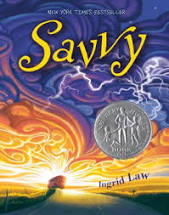
Savvy by Ingrid Law (J Fantasy)

Savvy 

Ingrid Law (J Fantasy)

There are certain things that the Beaumont family knows about secrets: they need them, they have them, and they keep them. In just a few days, when Mibs turns 13, she’ll join her mother’s side of the family and will have a secret of her very own. That’s when she’ll get her own savvy and her world—as she currently knows it—will never be the same. But before her big day, her father is involved in a terrible accident and left seriously injured. With her newly acquired supernatural power and a pink bible bus filled with a handful of misfits, Mibs encounters bikers, brawls, and plenty of banana cream pie in a race to bring her whole family together and to save her broken father.

A 2009 Newbery Honor Book, Savvy is an imaginative and heart-pounding adventure story filled with many relatable themes that are standard fare for young readers: bullying, standing out, fitting in, first love, and making friends. The first in a series of three books (Scumble and Switch are both complete stories, but make small references to the original book), Savvy is an easy-to-read, thrilling ride that introduces us to a quirky set of characters including the preacher’s daughter, a belittled bible salesman, and a waitress with a heart of gold. Each of these people allow Mibs to slowly understands that perhaps the Beaumonts aren’t the only ones that possess supernatural powers. The ability to encourage, to help, to listen, and to accept are just as powerful as any savvy and Mibs quickly realizes just how special her new friends are in their own way.

Ingrid Law packs so many wonderful lessons in this book and that alone is worth the read. Along the way, Mibs learns that sometimes a bad thing can make a good thing happen or that happy endings come in all shapes and sizes or that things don’t always happen the way you want them to. Perhaps the most valuable lesson Mibs receives was from her mother who told her, “In most ways, we Beaumonts are just like other people. We get born, and sometime later we die. And in between, we’re happy and sad, we feel love and we feel fear, we eat and we sleep and we hurt like everyone else.” Through the eyes of an awkward teenaged girl, Law reminds us of how much good can be accomplished and gained when we focus on our similarities rather than our differences.

Rating: 4/5

*Book cover image attributed to www.thriftbooks.com

**Want more?  Visit our Facebook page at www.facebook.com/thedustyjacket