

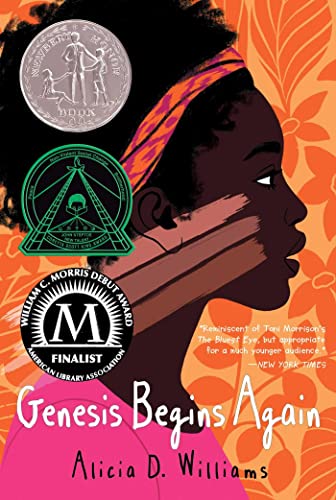
Genesis Begins Again
Alicia D. Williams (YA Fiction)
Thirteen-year-old Genesis Anderson hates moving (her family is on number four), broken promises (too many to count), her father’s hateful words when he’s had too much to drink (too painful to count), her hair, and staying with her grandmother. She also hates the darkness of her skin, which she’s tried to lighten using a variety of household products. But mostly, Genesis hates the list that was started back in sixth grade by two classmates who listed one hundred things (the stupid girls only listed sixty) they hated about her. The joke’s on them because Genesis has been adding to that list on her own and will probably make it to 100 in no time. There’s a lot of things Genesis hates, but a new school with new friends and new opportunities finally show Genesis that there are a lot of things to like. With things finally beginning to look up, you can bet that it won’t be long before something comes along to mess it all up. Genesis hates that.
Very few young adult books have grabbed me the way Genesis Begins Again has. Williams’s opening paragraph leads us into a false sense of security that is quickly and horribly stripped away in a matter of paragraphs. Williams snuffs out our girl’s light in one raw and shameful event that immediately shows us the obstacles that Genesis faces, the character of the “friends” she has, and the girl that she ultimately is. Behind all that self-loathing is a strong, loyal, fierce, and intelligent girl who is wise beyond her years and determined to make her fractured world whole again…no matter the cost. She is instantly a character that we root for and we find ourselves either wanting to take her by the shoulders to remind her that she’s better than she thinks or wrap our arms around her to reassure her that everything will be alright.
It’s hard to believe that this is Williams’s debut novel. It received the Newbery Honor award in 2020, as well as the John Steptoe Award for New Talent. Her book began as an autobiography but was soon revised to better reflect the present rather than the past. The themes of bullying and colorism play predominantly throughout the story and often emanate from surprising and unexpected sources. The characters are wonderfully developed, the prose is engaging and allows us to fully immerse ourselves within Genesis’s world, the conflicts and outcomes are realistic, and there’s enough drama and tension to keep the story moving at a wonderful pace.
Highlighting the important and influential role that teachers have on our children, Genesis is highly influenced by her music teacher, Mrs. Hill. It is she who introduces Genesis to Billie Holiday, Ella Fitzgerald, and Etta James who showed her that there is beauty in brokenness and joy beyond the pain. Music healed Genesis…it freed her…and proved to be a lifeline to those around her who needed it the most. Billie Holiday once said, “If I’m going to sing like someone else, then I don’t need to sing at all.” All through the story, Genesis was always trying to be someone else: lighter, braver, smarter, hipper, or more popular. It was only after she discovered and began to sing her own song, that she was truly able to begin again.
Rating: 5/5
* Book cover image attributed to: www.abebooks.com
We’re now posting videos of some of our book reviews! Follow us on Facebook at www.facebook.com/thedustyjacket or on Instagram @tdjreviews and join in on the fun!
 The Dusty Jacket