
Shadow by Michael Morpurgo (J Historical Fiction)

“She may be a dog, but I think she is more like a friend than a dog, like a friendly shadow that does not want to leave us. You never lose your shadow.”

Shadow

Michael Morpurgo (J Historical Fiction)

Aman and his family lived in the beautiful and peaceful valley of Bamiyan. When Russian fighters came followed by the Taliban, Afghanistan was no longer the safe home that Aman and his people once knew. Forced to flee his homeland, Aman and his mother make the perilous journey to England through Kabul, Kandahar, Iran, Turkey, and across the English Channel. Through it all, he was given comfort, joy, and hope through a Springer Spaniel that he named Shadow. Now, six years later, Aman and his mother face deportation and it’s up to his classmate Matt and his grandfather to find a way to keep Aman in England. With time running out, will Aman lose his new home just like he lost Shadow?

Michael Morpurgo is the reason why historical fiction is my favorite genre. His strong characters take center stage while historical facts and pivotal details provide a colorful backdrop to a compelling and heart-pounding story. Morpurgo sheds light on a region where the police are just as dangerous as the area warlords and local militias; and he shows readers that money can’t guarantee safety and trusted allies are easily corrupted by force or bribery. It is a dangerous world and Aman discovers this all too soon at the young age of eight.  

Morpurgo also introduces readers to Yarl’s Wood—a place where Aman and his mother are kept prior to their scheduled deportation. Opened in 2001, the facility is in Bedfordshire, UK and is the main removal center for up to 405 individuals. A second wing added in 2002 increased capacity to 900. Shadow details the horrific conditions of the facility including poor living conditions, children being separated from their parents, and a lack of access to legal representation. According to a recent online article by the BBC (https://www.bbc.com/news/uk-england-beds-bucks-herts-66121098), the facility now houses only men and although conditions seem to be improving, officials admit that there is still more work to be done.

Shadow is told from three points of view: Aman, Matt, and Matt’s grandfather. For the most part, Aman is our main narrator and through his lens we experience courage and hope of the strongest measure. This book is recommended for readers ages 10 to 14 and contains passages dealing with physical abuse, death, and animal cruelty. Opting for the higher end of the age range might be a safe choice for sensitive readers although all will benefit from the accurate account of a region and people in turmoil while navigating the emotions that this raw, immersive, and captivating story provides.

Shadow reminds us to never underestimate the human spirit or the impact that a loyal and brave companion has on our own capacity to trust and endure the seemingly unbearable. During one of their more difficult times, Aman’s mother said to him, “She may be a dog, but I think she is more like a friend than a dog, like a friendly shadow that does not want to leave us. You never lose your shadow.”

Rating: 5/5

* Book cover image attributed to: www.abebooks.com

We’re now posting videos of some of our book reviews! Follow us on Facebook at www.facebook.com/thedustyjacket or on Instagram @tdjreviews and join in on the fun!
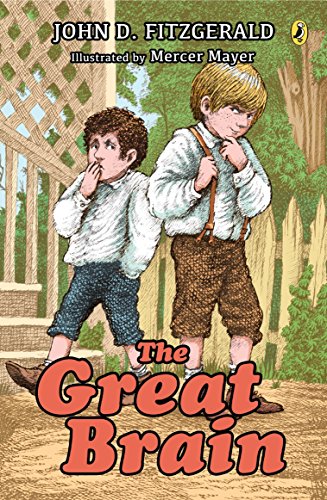
The Great Brain by John D. Fitzgerald (J Historical Fiction)

The Great Brain (Great Brain #1) 

John D. Fitzgerald (J Historical Fiction)

It’s 1896 and the territory of Utah officially became a state. But to the 2,500 residents in the town of Adenville, it was the year of The Great Brain’s reformation. Having The Great Brain as a brother has its ups and downs. Just ask his little brother J.D. It was nearly impossible to catch any sunlight while constantly in the shadow of such magnificence and brilliance. Expert eavesdropping, a perilous cave rescue, and the great whiskey raid were the works of one Tom Dennis Fitzgerald and his intellect was the stuff of legend. But, has The Great Brain finally changed his scheming ways? Why, that would be bigger news than the day Adenville got its very first water closet!

Published in 1967, The Great Brain is the first in an eight-book series and loosely based on author John D. Fitzgerald’s own childhood experiences. The story is narrated by the Fitzgerald’s youngest son John (J.D.) who is seven—going on eight. This is one of those books that I have equally strong feelings of delight and horror. With a publisher-recommended reading age of 8 and up, it is important to note that this is a 1967 book and times they did change (and boy, did they ever)!

Setting aside the starting reading age (which I would emphatically suggest bumping up to at least 12), this book deals with some heavy societal and political issues largely centering around ethnic prejudice and hatred. Fitzgerald details how Adenville’s first Greek immigrant family (their son in particular) was the object of brutal bullying and verbal assault. The author also goes into a multi-page diatribe regarding the treatment of Jews compared to other ethnicities within their community and how a “beloved” member of their town somehow slipped through the cracks with devastating consequences. This wasn’t just a matter of negligence or ignorance, it was apathy and this entire topic—and its importance and relevance—is sadly bound to go right over a young reader’s scope of understanding.

Also, Tom is really nothing more than an opportunistic schemer. Would a young reader delight in his antics and ability to always find a way to one-up his friends? It seems so since this book not only gave way to seven successors, but earned Fitzgerald The Young Reader’s Choice Award for children’s literature in both 1976 and 1978. Shows what I know. Tom’s ability to do good does benefit those around him who learn how to defend themselves and develop a sense of self-worth, but the fact that he always seeks an “angle” puts him one step above a sleezy snake oil salesman. The upside is that Tom truly does have his beneficiaries’ best interests in mind and eventually experiences a moral awakening, but we know it doesn’t last long and future books probably contain more of the same self-serving behavior.   

Perhaps THE most disturbing part of this book comes near the end when John is helping another boy end his life because he wants to prove himself to be a good pal. The various ways the boys plot and attempt to carry out this horrific act is beyond boyish hijinx and madcap mayhem. I can’t possibly think what was going on in the author’s head that he thought this would be appropriate material to print for a child of eight. I was a child of the 70s and I wouldn’t look at this entire passage as merely being slapstick fun (Oopsies! THAT didn’t work. Let’s try this!) I shudder to think just HOW much of this book falls into the “own childhood experience” category.

My overall impression is that this book didn’t age well and should be left for a much older and morally mature reader. And even though my brain is not-so-great, I know there are more appropriate books out there for young readers that teach the virtues of friendship, the value of community, the strength of family, and the satisfaction you get from doing good with the expectation of receiving absolutely nothing in return.

Rating: 3/5

* Book cover image attributed to: www.abebooks.com

We’re now posting videos of some of our book reviews! Follow us on Facebook at www.facebook.com/thedustyjacket or on Instagram @tdjreviews and join in on the fun!
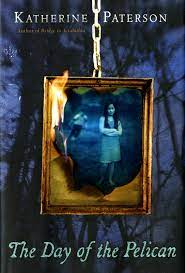
The Day of the Pelican by Katherine Paterson (J Historical Fiction)

The Day of the Pelican

Katherine Paterson (J Historical Fiction)

Terrible things should never happen in springtime, and it was almost spring.

Meli Lleshi and her family lived a comfortable life in Dukagjin. Her father came from a farm village so although her classmates didn’t look down on her like the Gypsies or hated her like the Serbs, she was still treated differently. She didn’t understand why the Serbs hated the Albanians so much…although most Albanians hated the Serbs equally. Baba, Meli’s father, had always taught his family to respect and not to hate, and so Meli did as she was told until the day her brother, Mehmet, disappeared. Now, with her country no longer safe, Meli will need to hold on tight to her family as they fight to survive and look for a way to escape their beloved Kosovo.

The Day of the Pelican is based on an actual Kosovar refugee family who was sponsored by Katherine Paterson’s own church in 1999. This is a harrowing, gritty, and brutal account of the war in Kosovo, which was the direct result of Slobodan Milošević’s decade-long oppression of the ethnic Albanian people. The book is recommended for ages 12 and above and its subject matter of ethnic cleansing and racial prejudice is worthy of in-depth discussions, making it an ideal book for a middle or high school social studies class. As far as it being an independent read, I—as an adult—found it to be a bit dry and often struggled to maintain interest in the story, so a younger reader with far less tenacity may give up on this book entirely. I think the primary reason for my detachment is that it’s written in the third person. Had Paterson chosen to use alternating, first-person points of view between Meli and Mehmet, I would have felt Meli’s fear for her brother, as well as better understand the reason behind Mehmet’s slow and painful separation from his father and family. As it is, the story lies just above the surface and never fully allows the reader to connect with this amazing family.

I appreciate any book that teaches history to young readers and especially love a book that shows the strength of the human spirit and the power of hope. The Day of the Pelican accomplishes both, while being deeply rooted in faith, courage, and family.

Throughout the book, Baba was always counting heads to make sure everyone in his family was accounted for. He kept repeating to Meli the importance of staying together: We must hold onto each other. Even in the chaos of fleeing their burning homeland, Meli kept reminding herself that they were all together and that was the important thing. Throughout his family’s struggles, Baba knew that villages may crumble, governments may fall, and possessions may be lost forever, but if you have family, you have everything you’ll ever need: Inshallah. God willing.

Rating: 4/5

* Book cover image attributed to: www.amazon.com

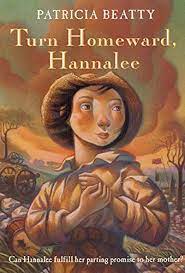
Turn Homeward, Hannalee (J Historical Fiction)

Turn Homeward, Hannalee

Patricia Beatty (J Historical Fiction)

The Civil War has been raging for three years now. Twelve-year-old Hannalee Reed’s father died in an Army hospital last winter and her older brother was currently in Virginia fighting for the Confederacy. She and her little brother, Jem, spend their days working in the mill making cloth for the soldiers while her mother awaits the birth of her fourth child. When Union soldiers arrive in her hometown of Roswell, Georgia, they burn down the mill and gather all of the millworkers—charging each one with treason and sending them to Tennessee and Kentucky by train. Before Hannalee is taken away, her mother pulls a button from her blouse and tells her daughter, “Wherever you go, keep this to remind yourself to come home. Turn your heart to me. Turn homeward, Hannalee!” Despite the miles between them and the impossible odds that lie ahead of her, Hannalee made her mother a promise that she would find a way home again and that is what she intended to do.

Precious is the book that not only entertains the soul of a young reader, but also enlightens their mind as well. Patricia Beatty’s Turn Homeward, Hannalee is such a book. The first half of Beatty’s book is based on actual events that occurred in July 1864 when the Yankee cavalry arrived in Roswell, Marietta, and New Manchester, Georgia, rounded up nearly two thousand mill workers, and put them all on trains heading north to either work in Union mills or to provide household or farm help to northern families. Like most of the soldiers before them, most of these workers were never heard from again—their futures forever remaining a mystery. Although Beatty targets her book for readers aged ten and older, she doesn’t shy away from depicting the cruelty, ugliness, and inhumanity that comes with war. Hannalee and Jem get to witness first-hand the horrors of the battle of Franklin, which lasted only six hours but was a terrible defeat for the Confederacy. Hannalee described the bloody scene before her by uttering, “I reckoned it was like looking into hell, and I felt sick inside.”

Although Beatty provides readers with a lot of facts and details surrounding the war, her book reads less like a history lesson and more like a thrilling action and adventure story where a new danger or challenge awaits our fearless heroine at every turn of the page. And even though Hannalee Reed sprang from Beatty’s wonderful imagination, it would be nice to think that among the eighteen hundred Georgian mill workers that simply vanished from government records, that there were a few girls—like Hannalee Reed—who traveled hundreds of miles through battlefields and blood and who survived hunger and the elements to make their way back home. That they did all of this because they had made a promise to their mothers and that was a promise worth keeping.

Rating: 4/5

* Book cover image attributed to: www.amazon.com

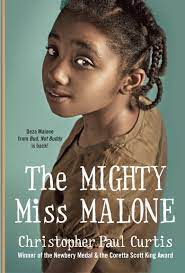
The Mighty Miss Malone by Christopher Paul Curtis (J Historical Fiction)

The Mighty Miss Malone

Christopher Paul Curtis (Juvenile Historical Fiction)

The best-laid schemes o’ mice an’ men/Gang aft a-gley

And leave us nought but grief and pain/For promised joy.

Her teacher told her that it was from a poem by Robert Burns called “To a Mouse”. Deza didn’t quite understand what those words meant—especially the “gang aft a-gley” part—but Mrs. Needham said that it just meant that even the most carefully planned out things could go wrong. Deza knew about this since a lot of the Malone family plans haven’t been quite working out lately. But if there’s one thing that the Malones do well it’s sticking together. After all, their motto was “We are a family on a journey to a place called Wonderful”. Before the Malones could get to Wonderful however, Deza and her family would have to travel through a whole lot of awful first.

Set against the backdrop of the Great Depression, homeless camps, speakeasies, and the much-hyped 1936 boxing match between Joe Louis and Max Schmeling, Curtis gives us yet another story centered around a tough-as-nails, plucky, and absolutely endearing main character. At twelve, Deza Malone is the smartest in her class and destined for something special. With a dictionary in one hand and a thesaurus in the other, she’s more than ready to take on the world one adjective and adverb at a time. Deza is charming, loyal, fiercely protective of her family—especially of her older brother, Jimmie—and principled to a fault. Deza is not a girl who’s afraid to take matters into her own hands in order to set things right…even if it means a little forgery or rule breaking now and then. Struggling to make something of herself while fighting racial prejudice, financial hardship, and social injustice may prove to be formidable challenges for some, but not for the mighty Miss Malone.

The Mighty Miss Malone is the second book by Curtis that I’ve read (the first being Bud, Not Buddy). In both stories, he gives us a main character who rises above their circumstances with grace, dignity, and integrity. His stories are built around the strength of family, the importance of hope, and the resilience of the human spirit. Through Deza Malone, Curtis reminds us that even though plans “gang aft a-gley”, tomorrow is always a brand-new day that brings with it another opportunity to get a little bit closer to a place called Wonderful.

Rating: 5/5

* Book cover image attributed to www.amazon.com

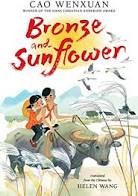
Bronze and Sunflower by Cao Wenxuan (J Historical Fiction)

Bronze and Sunflower

Bronze and Sunflower

Cao Wenxuan (Juvenile Historical Fiction)

Sunflower was lonely.  Her father was a revered sculptor in the city, but he—like so many others—had been sent to work at the Cadre School and now Sunflower has very little to do all day.  To pass the time, she goes down to the river and looks to the other side at the village called Damaidi.  In Damaidi, there is life, there is activity, and most of all, there are children.  She dreams of what it might be like to go over there and play and explore.  Then one day, Sunflower’s dad tragically drowns in the river and she is accepted into the home of Damaidi’s poorest family.  There she meets Baba, Mama, grandmother Nainai, and Bronze, their mute son.  Suddenly, Sunflower is a daughter, a granddaughter, and a sister and life amongst these poor people was about to make her richer than she could ever imagine.

Translated from Mandarin by Helen Wang, Bronze and Sunflower is a masterpiece in storytelling.  It tells the story of a family and a village caught up in China’s Cultural Revolution during the late 1960s and early 1970s.  Wenxuan doesn’t make this period in history the center of his story, but instead chooses to keep it as a backdrop.  He instead focuses on the unique and touching bond between Bronze and Sunflower and the family’s struggle to survive floods, locusts, famine, and dishonor.  It’s a tale replete with villains and heroes, sadness and joy, and despair and hope.  Wenxuan effortlessly weaves a tale showing us that life isn’t fair, that justice is often elusive, and that those in power—for better or worse—wield a mighty influence.  But he also shows us the importance of family, the power of redemption, and the value of integrity.  It’s a story absolutely brimming with moral lessons and human values and should be devoured by readers of all ages.

The only fault I had with this book is its ending.  It’s vague (I re-read it several times to make sure I didn’t miss any subtle clue or hidden meaning) and puts the burden on the reader to determine what happened.  I’m not a fan of this kind of ambiguous ending, but the overall story isn’t dependent upon it and so its vagueness shouldn’t serve as a detraction from an otherwise engaging and captivating tale that was an absolute joy to read and experience.

Without giving away any spoilers, the saddest part of the story—for me—was the eventuality of Bronze and Sunflower growing up…as children tend to do.  The head of the village of Damaidi stated as much when he met with Baba and Mama and said, “Time’s moving on.”  Simple words that remind us how fleeting and fragile time is and that everything should be cherished and savored for nothing is certain or guaranteed.  With the sudden loss of her father, Sunflower understood the unpredictability of life and the value that came with belonging.  Despite her poverty, Sunflower considered herself wealthy beyond measure because she was part of a family and that family loved her very much.  Actor, author, and activist Michael J. Fox once said, “Family is not an important thing. It’s everything.”  In that respect, Sunflower had everything and perhaps that made her the richest person in all of Damaidi.

Rating: 5/5

*Book cover image attributed to www.abebooks.com

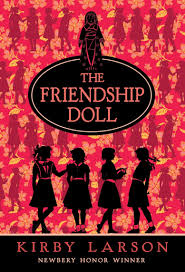
The Friendship Doll by Kirby Larson (J Historical Fiction)

The Friendship Doll

The Friendship Doll

Kirby Lawson (Juvenile Historical Fiction)

Miss Kanagawa was the last doll that master dollmaker Tatsuhiko would ever make.  She was a doll like no other and was to be Master Tatsuhiko’s masterpiece.  Miss Kanagawa, along with her fifty-seven sisters, were being sent to the children of the United States by the children of Japan as a gesture of friendship.  These fifty-eight ambassadors of peace and goodwill carried with them the assurance that Japan was indeed a friend of America.  But Master Tatsuhiko wanted his prized creation to be more than just a messenger and wished that she would discover her true purpose as a doll: “to be awakened by the heart of a child”.  Sadly, Miss Kanagawa was as callous as she was beautiful and she was very certain that a doll with a samurai spirit such as hers would never have a need for a child.

The Friendship Doll is based on the actual arrival of fifty-eight dolls from Japan to the United States in November 1927.  In her book, Kirby Larson takes us from 1927 to the present day and introduces readers to such events as the Great Depression, the Chicago World’s Fair, and the attack on Pearl Harbor.  Through Miss Kanagawa, we meet a hopeful orator, an aspiring pilot, a voracious reader, and a devoted writer—each with her own remarkable story and each changed by a chance encounter with a unique and proud doll.

While reading The Friendship Doll, I couldn’t help but notice several similarities between it and Kate DiCamillo’s The Miraculous Journey of Edward Tulane (one of my favorite books).  Both stories revolve around an exquisite doll with an overly-high opinion of itself who imparts something of value with those it meets while simultaneously discovering the joy that comes from being wanted and loved.  While Edward is a silent presence, Miss Kanagawa somehow speaks directly to her visitor’s subconscious.  Young readers won’t be bothered by this, but those of us old enough to remember The Twilight Zone episode entitled “Living Doll” featuring Talking Tina might be overly susceptible to the heebie-jeebies.  Still, if you liked Edward, you’re sure to enjoy Miss Kanagawa as well.

Although this book does touch upon the sensitive subjects of death and dementia, its historical insights offer readers a valuable glimpse at a few events from our nation’s past.  It also serves as a reminder that it is often the smallest of things that can bring about the greatest change within ourselves and there is nothing heebie or jeebie about that.

Rating: 5/5

*Book cover image attributed to www.amazon.com

**Want more?  Visit our Facebook page at www.facebook.com/thedustyjacket