
By the Great Horn Spoon! by Sid Fleischman (J Historical Fiction)

By the Great Horn Spoon!

Sid Fleischman (J Historical Fiction)

Jack’s Aunt Arabella is about to lose their beloved home due to financial hardships so he, along with the family’s faithful butler Praiseworthy, stowaway on a sailing ship headed to California in hopes of striking it rich. Young Jack wants adventure, but is he ready to face the perilous sea, dangerous outlaws, and the back-breaking life of a prospector for the slim chance of finding gold? By the great horn spoon he is! And with his loyal butler by his side, he’s sure that there’s no problem they can’t solve, no scoundrel they can’t outwit, and no gold they can’t find.

By the Great Horn Spoon! is one of the best—if not the best—Gold Rush books for kids that I’ve come across. It’s a high-stakes thriller that’s packed with action, adventure, and plenty of twists to keep any reader engaged. At the center of it all are two of the unlikeliest prospectors to ever live between the covers of a book: a spunky yet naïve 12-year-old boy and a reserved, intelligent butler. Jack and Praiseworthy are the heart of this story and their relationship is one centered on trust, mutual adoration, and loyalty. Through their own personal growth, we see their bond strengthen and their relationship evolve from one of servant and master to father and son. What is most appealing are the virtues that Praiseworthy imparts on Jack: always keep your word, offer compassion whenever possible, and stand up for what you believe in.

The storyteller Aesop once wrote, “No act of kindness, no matter how small, is ever wasted” and Praiseworthy proves this time and time again. Whether he’s helping a prospector look his best for his new bride, defending a known criminal to help fulfill the wish of a dying friend, or protecting the honor of a young woman in Boston, our proper gentleman with his white gloves, reliable umbrella, and black bowler hat always seems to know the right thing to do and is there to reap the unexpected rewards of his actions.

Praiseworthy spends the entire book thinking himself unworthy of the affections of a certain miss back home because of his social status, but as his name suggests, this humble and mild man is truly worthy of praise and his generosity and kindness make him far richer than any amount of gold he might find.   

Rating: 5/5

Bring Jack and Praiseworthy to your class with our study guide: https://www.teacherspayteachers.com/Product/Study-Guide-By-the-Great-Horn-Spoon-by-Sid-Fleischman-12249210

Study Guide: By the Great Horn Spoon! by Sid Fleischman

A great ELA supplement to Sid Fleischman’s epic gold rush adventure about a spunky 12-year-old boy and his loyal butler who set off to California to strike it rich. Wonderful themes of kindness, compassion, courage, honor, and friendship. https://www.teacherspayteachers.com/Product/Study-Guide-By-the-Great-Horn-Spoon-by-Sid-Fleischman-12249210
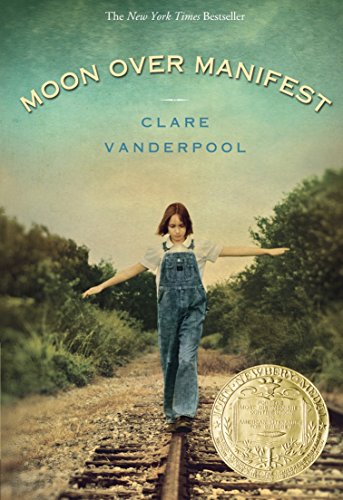
Moon Over Manifest by Clare Vanderpool (J Historical Fiction)

“To write a good story, one must watch and listen.”

Moon Over Manifest

Clare Vanderpool (J Historical Fiction)

Every story has a beginning, middle, and an end, but Abilene Tucker’s story seemed to be nothing but middle. It’s 1936 and while her father, Gideon, works a railroad job in Iowa, she is sent to the town where he grew up…Manifest, Kansas. She’s to spend the summer with her father’s old friend, Pastor Shady Howard, whose home is a combination saloon, church, and carpenter’s shop. While upstairs in her father’s old room, Abilene discovers an old cigar box with various trinkets, as well as some handwritten letters addressed to a boy named Jinx. Could these items—a cork, fishhook, silver dollar, key, and a little wooden doll—help Abilene uncover the mystery of her father’s past? With the help of two new friends, Abilene embarks on a hunt for a possible spy and meets a diviner who helps her uncover a few things about her father and herself.

This book covers two periods of time: 1936 (present day narrated by Abilene) and 1918 (told in third person). Although this book makes multiple time jumps involving several characters, Vanderpool does a terrific job at making sure young readers stay engaged by keeping the two storylines separate and straightforward. Our diviner, Sadie, eases readers into the past as she reveals Manifest’s history that involves several actual events including World War I, orphan trains, and the Spanish influenza. Moon Over Manifest does deal with some disturbing content such as racism, murder, alcohol use, and the ugliness of war, but in doing so gives readers an honest and rare opportunity to learn about important periods in American history through the unique lenses of a twelve-year-old hardworking and fearless girl and a thirteen-year-old runaway conman. Together, these two protagonists teach us that everyone deserves a do-over, things are not always what they seem, and perhaps there’s nothing more dangerous than hope.

Vanderpool packs so many wonderful takeaways and lessons into this book but overall, Moon Over Manifest is a celebration of immigrants and the richness and vibrancy they add to the American fabric. Manifest is a community represented by Scotland, Poland, Greece, Norway, Italy, Germany, Hungary, and Russia. These people—from very different countries and cultures—all unite behind a young con artist and collectively take a leap of faith to not only save their town, but to save their way of life and themselves. U.S. President Lyndon B. Johnson said on October 3, 1965 at the Statue of Liberty, “The land flourished because it was fed from so many sources—because it was nourished by so many cultures and traditions and peoples.” Although Manifest was a town torn apart by racism and stricken with war and an epidemic, its community flourished because of the strength and uniqueness of its people…people who were all lucky enough to call Manifest home.

Rating: 5/5

* Book cover image attributed to: www.abebooks.com

We’re now posting videos of some of our book reviews! Follow us on Facebook at www.facebook.com/thedustyjacket or on Instagram @tdjreviews and join in on the fun!

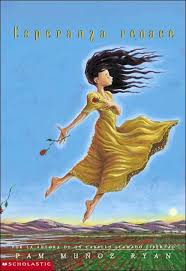
Esperanza Rising by Pam Muñoz Ryan (YA)

Esperanza Rising

Esperanza Rising

Pam Muñoz Ryan (Young Adult Historical Fiction)

Esperanza was the pride and joy of her papa.  The daughter of wealthy ranchers, Sixto and Ramona Ortega, she had everything a twelve-year old could possibly want.  But not far beyond the borders of El Rancho de las Rosas, trouble brewed in Aguascaliente, Mexico.  It was 1930 and the revolution in Mexico had happened over ten years ago, but there were still those who resented the wealth and circumstances of the local landowners.  Soon that hate would spill over into Esperanza’s idyllic and pampered world and would ultimately rob her of everything that she knows and holds dear.

Pam Muñoz Ryan gives us a heartwarming and often heartbreaking riches-to-rags story of a young, spoiled, and arrogant girl who learns the value of humility, empathy, generosity, and kindness.  Inspired by her own grandmother, Esperanza Ortega, Ryan shows us the lavishness and bounty of a prosperous Mexican ranch, as well as the poverty, squalor, and hardship endured by migrant workers living in company farm camps.  She also provides insight into the Mexican Repatriation, which included the deportations of thousands of legalized and native United States citizens to Mexico between 1929 and 1935.  Up until that time, it was the largest involuntary migration in the U.S. with numbers reaching almost a half million.  Ryan also describes the struggles of the workers to compete with cheaper labor from states like Oklahoma, as well as their efforts for a better wage and living conditions through unionization.

In addition to giving readers a story overflowing with moral lessons—Don’t judge a person until you’ve walked a mile in their shoes or Appreciate what you have before you lose it—Ryan also gives us a character who slowly begins to realize that life is more than fancy dresses and porcelain dolls.  Through humiliation, heartache, and despair, Esperanza understands how life is like her father’s beautiful and precious rose garden: “No hay rosa sin espinas.” There is no rose without thorns.  For despite the beauty and splendor that life often provides, there will also be some degree of pain and suffering.  But like her grandmother taught her as she undid Esperanza’s rows of uneven or bunched crochet, “Do not ever be afraid to start over.”  And when Esperanza did, she truly blossomed.

Rating: 5/5

*Book cover image attributed to www.barnesandnoble.com

**Want more?  Visit our Facebook page at www.facebook.com/thedustyjacket

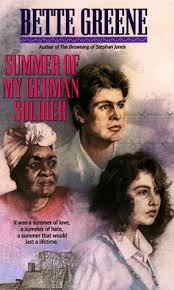
Summer of My German Soldier by Bette Green (YA)

Summer of My German Soldier

Summer of My German Soldier

Bette Greene (Young Adult Historical Fiction)

It was the most exciting thing to have ever happened to Jenkinsville, Arkansas.  German POWs, maybe twenty in all, arrived by train and would be housed in a camp in the small southern town.  Twelve-year-old Patty Bergen was among the many townspeople there to witness the event.  Each hoping to do their patriotic part to make President Roosevelt proud during this summer of World War II.  During a chance encounter in her family’s store, Patty meets young Anton Reicker, a handsome, educated young man who is one of the POWs.  Although he is German and she is Jewish, they begin an unlikely friendship that will test Patty’s family bonds, as well as question her national loyalty.

Written in 1973, Bette Greene’s Summer of My German Soldier was not only listed on the American Library Association’s Top 100 Most Frequently Challenged Books from 1990-1999, it also made the ALA’s Top 10 Most Challenged Books for 2001.  According to the ALA’s website (www.ala.org), “The American Library Association condemns censorship and works to ensure free access to information.”  To educate schools and libraries about censorship, they publish these lists which are compiled by the Office for Intellectual Freedom (OIF).  With that said, this book (recommended for ages 11 and up) is full of racial slurs, derogatory language, sexual innuendoes, and many instances of physical, verbal, and psychological abuse.  It truly runs the gamut for a story written for fifth graders and up.  These issues alone are enough to give a reader pause, but these aren’t the only reasons that I found myself disappointed with this book.

First, Patty’s father and mother are inexplicably cruel and violent to her.  They fawn over her little sister, Sharon, while Patty endures taunts, intolerance, dismissiveness, and even physical beatings at the hands of her father.  I kept hoping for some enlightening backstory as to why these two people could possibly hate their own child so much, but Greene doesn’t even provide a hint to explain their savage and inhuman behavior.  Their treatment of Patty is repugnant and demoralizing, which serves as the ideal foundation for many of Patty’s choices—which are often hasty and incredibly unwise.  Here is a girl so desperate for acceptance and so eager for kindness that she would say or do anything in order to achieve some modicum of happiness.

Second, Greene gives us a story that seems devoid of any moral lessons.  The Bergen family’s black housekeeper, Ruth—who takes on the role of mother figure—is very religious and is often heard singing hymns while doing chores and encourages the children to pray at lunchtime.  Despite this being a story about a Jewish family, we get a healthy dose of Christianity and the glory that comes with salvation.  Even with this, there really isn’t a central theme tying the entire story together.  We understand the courage of putting someone else’s wellbeing ahead of your own and the virtues of seeing beyond religion, ethnicity, or skin color, but these platitudes fall by the wayside with an ending that is absent any sort of clarity, closure, or inspiration.  The reader is left feeling just as bewildered and discouraged as Patty whose only “real” friends are the housekeeper, a POW, and the town’s sheriff.

I read Greene’s Philip Hall Likes Me. I Reckon Maybe. (which I rated 4/5) and was so hoping to find that same feeling of hope and triumph in this book.  Instead, Greene delivers a bleak look at family and life and gives us a girl so disillusioned and unsatisfied with her life, that the only thing she clings to is the day she turns eighteen.  Unfortunately for Patty, that’s still six very long summers away.

Rating: 3/5

*Book cover image attributed to www.amazon.com

**Want more?  Visit our Facebook page at www.facebook.com/thedustyjacket


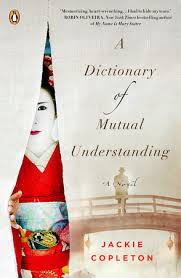
A Dictionary of Mutual Understanding by Jackie Copleton

A Dictionary of Mutual Understanding

A Dictionary of Mutual Understanding

Jackie Copleton (Adult Historical Fiction)

On August 9, 1945 a new word entered the Japanese vernacular:  pikadon.  PIKA meaning brilliant light and DON meaning boom.  It aptly described what Amaterasu Takahashi and thousands of others saw and heard in Nagasaki at 11:02 am.  A brilliant light and then a boom.  Ama lost her daughter and grandson on that fateful morning.  They were everything to her.  Pushing past the dead or dying and sifting through the ashes, she knew she would never see Yuko or little Hideo again.  But nearly forty years later, a man—badly scarred and disfigured—knocked on her door bringing good news.  “Please don’t be alarmed,” the stranger said.  “My name is Hideo Wantanabe.  It is good to see you Grandmother.”  He left her a letter to read to get their journey started.  A journey that would take Ama back to a tragic past and a man who would be the common thread to everyone she has ever loved and lost.

A Dictionary of Mutual Understanding is Jackie Copleton’s first novel and it truly is a hauntingly beautiful story.  Using Ama as our narrator, we experience the horror when the second of two atomic bombs hit the city of Nagasaki on August 9th (the first hit Hiroshima three days prior on August 6th).  Through Ama’s eyes, we witness the carnage, fear, destruction, chaos, and terror as survivors desperately searched for loved ones while the injured begged for water or aid.  As our story progresses, we begin to learn more about Ama, her husband, Kenzo, and her daughter.  Through Ama’s memories, as well as a series of entries in Yuko’s diary, we begin to understand the reasons behind Ama’s feelings of guilt and bitterness.  She is a woman living a life of “What ifs” and “If onlys” and is constantly questioning her own maternal motives.  Any parent will be able to relate to Ama and her need to shield her child from harm and heartache, but as the saying goes, “The road to hell is paved with good intentions” and Ama quickly realizes that protection often comes with a price.

Copleton gives readers a multi-layered story that is brimming with pain, loss, regret, and love.  But the singular theme that runs throughout the story is hope.  Whether you are extended it, enticed by it, or desperately hold onto it, hope has many faces: a grandmother looking for comfort, a scarred man searching for healing, a young wife waiting for her husband’s return from war, a lover wanting a second chance, or a city emerging from the rubble.  Copleton gives us a poignant and touching story of hope and reminds us that it is when things are at their darkest that hope often comes knocking on our door.

Rating: 5/5

*Book cover image attributed to www.penguinrandomhouse.com

**Want more?  Visit our Facebook page at www.facebook.com/thedustyjacket

A Year Down Yonder by Richard Peck (J Historical Fiction)

A Year Down Yonder

A Year Down Yonder

Richard Peck (Juvenile Historical Fiction)

 It was 1937 and the country was in the midst of what people were calling the Roosevelt recession.  The Dowdel family, like so many others, had hit upon hard times and Mary Alice was to be sent to live with her grandmother until the family got back on their feet.  She and her brother, Joey, had spent many summers with Grandma Dowdel in her sleepy Illinois town, but Mary Alice was fifteen now and this visit was going to be a full twelve months!  With no telephone, an outdoor privy, a spooky attic, and everything being as old as Grandma…if not older…how was a city girl from Chicago going to survive in this hick town for one whole year?

A Year Down Yonder received the Newbery Medal in 2001 and was the sequel to Peck’s A Long Way from Chicago, recipient of a Newbery Honor in 1999.  In this wildly amusing and heartfelt book, Peck delivers one of the most outrageous, audacious, outlandish, and unforgettable characters when he gave us Grandma Dowdel.  She’s trigger-happy (and the whole town knows it) and not afraid to speak her mind.  But behind that gruff and crusty exterior lies a woman who’s generous to a fault and genuinely cares about her neighbors…although she would be the first to deny it.  Peck gives us small-town life and everything that comes with it.  From turkey shoots and Halloween hijinks to Burdicks (you’ll know one when you see ‘em) and burgoo, Grandma Dowdel handles everything with humor and candor and might even treat you to a glass of buttermilk and a square of corn bread in the process.

A Year Down Yonder takes readers to rural America and back to a time where folks learned how to make the most with what little they had and considered themselves blessed if they had their health, their family, and one or two people that could be counted on when it mattered most.  It’s a delightful and amusing book that extolls the virtues of kindness and the importance of family.  It also reminds us not to judge a book by its cover for it is often the tartest apples that make the best pies.  Just ask Grandma Dowdel.

Rating: 4/5

*Book cover image attributed to www.amazon.com

**Want more?  Visit our Facebook page at www.facebook.com/thedustyjacket

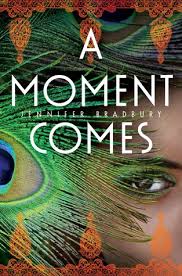
A Moment Comes by Jennifer Bradbury (YA Historical Fiction)

A Moment Comes

A Moment Comes

Jennifer Bradbury (Young Adult Historical Fiction)

“Safe.  I think about the word as we continue walking.  What does safe mean anymore?  I wonder if I’ll ever feel safe again.  I wandered these markets and streets freely just a few years ago.  And then I grew up.”

Tariq is Muslim born and raised in India.  He is eighteen and aspires to study at Oxford.  It is what Daadaa—his grandfather—dreamed for him and he will do anything to make it a reality.  Anupreet is Sikh and nearly sixteen years old.  She’s beautiful despite the scar that runs from her eye to her cheek.  It’s healing, but will always be there, just like the memory of that horrible day when she acquired it.  Margaret is sixteen and from London.  Her father was sent to Jalandhar to work for the boundary award.  His job is to help break India into pieces so that Muslims can have their own separate state.  She knows why her mother made her come here…to restore her virtue, make her “respectable” again.  Although she’s not sure how this hot, sticky, and loud place will be able to accomplish that.  It’s June 1947 and the worlds of these three teenagers are about to come together and their journey will take them to what history would later refer to as the Partition of India of 1947.

Books, like Bradbury’s, that are based on actual world history play such an important part in the lives of our younger population.  Historical Fiction is not only a way to educate, but to offer an all-important perspective.  In A Moment Comes, we are given three very different yet relatable young adults: each offering his or her own point of view about what is happening to them, their family, and the world around them.  Bradbury largely avoids stereotypes and instead offers up an honest landscape about a country being torn apart from the inside.

The Partition of India of 1947 began after the Second World War.  Lacking the sufficient resources to control its greatest asset, Britain exited India after three hundred years of British rule and partitioned the country into two independent nation states: India (with its Hindu majority) and Pakistan (with their Muslim majority).  It marked one of the greatest migrations in human history and resulted in more than fifteen million people losing their homes and between one to two million people losing their lives.  Bradbury is exceptionally careful not to choose sides and paint one party as “good” or another as “bad”.  Instead, she lays out three lives told through three alternating points of view and allows the reader to form his or her own judgments and opinions.  The story is fast-paced, harrowing, poignant, and bitter.  But in the end, Bradbury offers up some much-needed hope.  It’s faint and so very uncertain, but she places it there nonetheless so that we—along with Tariq, Anupreet, and Margaret—can grab it and hold onto it as tight as we can.

A Moment Comes reminds us that history is more than just words on a page.  Rather, it’s people who breathe, dream, hope, bleed, and die.  People who have risen above their own limitations in order to do something remarkable or historic or even heroic.  And just like history is more than just printed words, maps are more than just lines.  They are traditions and cultures and religions.  Bradbury summed this up perfectly through Margaret when she said, “Lines are funny things. They make us feel safe—at least for a while—knowing where we end and something or someone else begins.  But they can also make us want, can make us bitter, wanting what lies on the other side of the line.  But whether it’s a border on a map or a boundary between two people, the lines are still only lines.  Still something someone made up, decided on.  They’re not even real, but so long as everyone agrees to play along, they work fine.  But how can lines of a map tell a piece of land what to be any more than lines between one person and another can pretend to be what makes them different?”  In the end, Tariq, Anupreet, and Margaret were all able to let go of their own prejudices and realize that they themselves aren’t so very different from one another…regardless of what the lines might say.

Rating: 5/5

*Book cover image attributed to www.goodreads.com

**Want more?  Visit our Facebook page at www.facebook.com/thedustyjacket


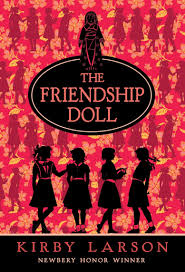
The Friendship Doll by Kirby Larson (J Historical Fiction)

The Friendship Doll

The Friendship Doll

Kirby Lawson (Juvenile Historical Fiction)

Miss Kanagawa was the last doll that master dollmaker Tatsuhiko would ever make.  She was a doll like no other and was to be Master Tatsuhiko’s masterpiece.  Miss Kanagawa, along with her fifty-seven sisters, were being sent to the children of the United States by the children of Japan as a gesture of friendship.  These fifty-eight ambassadors of peace and goodwill carried with them the assurance that Japan was indeed a friend of America.  But Master Tatsuhiko wanted his prized creation to be more than just a messenger and wished that she would discover her true purpose as a doll: “to be awakened by the heart of a child”.  Sadly, Miss Kanagawa was as callous as she was beautiful and she was very certain that a doll with a samurai spirit such as hers would never have a need for a child.

The Friendship Doll is based on the actual arrival of fifty-eight dolls from Japan to the United States in November 1927.  In her book, Kirby Larson takes us from 1927 to the present day and introduces readers to such events as the Great Depression, the Chicago World’s Fair, and the attack on Pearl Harbor.  Through Miss Kanagawa, we meet a hopeful orator, an aspiring pilot, a voracious reader, and a devoted writer—each with her own remarkable story and each changed by a chance encounter with a unique and proud doll.

While reading The Friendship Doll, I couldn’t help but notice several similarities between it and Kate DiCamillo’s The Miraculous Journey of Edward Tulane (one of my favorite books).  Both stories revolve around an exquisite doll with an overly-high opinion of itself who imparts something of value with those it meets while simultaneously discovering the joy that comes from being wanted and loved.  While Edward is a silent presence, Miss Kanagawa somehow speaks directly to her visitor’s subconscious.  Young readers won’t be bothered by this, but those of us old enough to remember The Twilight Zone episode entitled “Living Doll” featuring Talking Tina might be overly susceptible to the heebie-jeebies.  Still, if you liked Edward, you’re sure to enjoy Miss Kanagawa as well.

Although this book does touch upon the sensitive subjects of death and dementia, its historical insights offer readers a valuable glimpse at a few events from our nation’s past.  It also serves as a reminder that it is often the smallest of things that can bring about the greatest change within ourselves and there is nothing heebie or jeebie about that.

Rating: 5/5

*Book cover image attributed to www.amazon.com

**Want more?  Visit our Facebook page at www.facebook.com/thedustyjacket


King of the Wind by Marguerite Henry (J Historical Fiction)

King of the Wind

King of the Wind    

Marguerite Henry (Juvenile Historical Fiction)

The foal was to be born under a favorable sign—a new moon in a new month—and thus assured strength and speed.  While the horseboy, Agba, was asleep, the foal was born and it appeared that indeed Agba’s master was correct for on the foal’s hind heel was a white spot, an emblem of swiftness.  Unfortunately, the foal also bore the wheat ear and this foretold of evil.  Agba knew this foal was special and he named it Sham, the Arabic word for sun, because its coat was a flaming red-gold.  Although orphaned and shunned by the other spring colts, Sham thrived under Agba’s watchful care until one day, one ill-placed foot and one well-placed hoof would forever change their destinies.

Marguerite Henry gives young readers a story detailing the origin of the Godolphin Arabian, one of three stallions that founded the modern Thoroughbred (Darley Arabian and the Byerley Turk being the other two).  Part fact and part fiction, this book follows Sham from Morocco to Paris and then finally to London.  His life passes through the hands of a sultan, king, carter, Quaker, innkeeper, and earl all the while keeping company with a loyal and mute horseboy and a tomcat named Grimalkin.  As King of the Wind is based on historical fact, our story takes place in the early 18th century and Henry stays true to the time period by portraying a harsh but realistic view of how life was for little Agba and Sham.  Younger readers, especially those fond of horses, may be uncomfortable reading of Sham’s harsh and unfair treatment, but Henry chooses realism over sentimentality so readers can glean an accurate understanding of Agba and Sham’s daily struggle for survival.

Early in Sham’s life, Agba makes him a promise: “My name is Agba.  Ba means “father”.  I will be a father to you, Sham, and when I am grown I will ride you before the multitudes.  And they will bow before you, and you will be King of the Wind.  I promise it.”  Henry gives us a beautiful adventure story that brims with friendship, honor, and loyalty and reminds us that any promise worth making is a promise certainly worth keeping.

Rating: 5/5

* Book cover image attributed to www.goodreads.com 

**Want more?  Visit our Facebook page at www.facebook.com/thedustyjacket