
In the Year of the Boar and Jackie Robinson by Bette Bao Lord (J)

In the Year of the Boar and Jackie Robinson

In the Year of the Boar and Jackie Robinson   

Bette Bao Lord (Juvenile Fiction)

Bandit is confused.  What would make Mother smirk, Grandmother cry, and Grandfather angry?  The House of Wong is certainly unsettled, but why?  Bandit quickly learns that her father will not be returning to Chungking.  Instead, she and her mother will be going to him…to America.  But Bandit isn’t worried because no bad luck will come her way.  This is the year of the Boar and travel, adventure, and double happiness await her.  Soon, Bandit will begin her journey from China to San Francisco to her eventual home in Brooklyn, New York.  She will travel thousands of miles with a new name and new dreams.  But will America be all that Bandit hopes it will be?

In the Year of the Boar and Jackie Robinson is a charming and humorous story largely based on Bette Bao Lord’s own experiences as a newcomer to America.  Bandit (who adopts an American name of Shirley Temple Wong) endures teasing, bullying, and rejection that often comes with simply being different.  Despite her difficulties with fitting in, she is constantly reminded by her mother of the importance of maintaining your self-respect despite struggling through ridicule: “Always be worthy, my daughter, of your good fortune.  Born to an illustrious clan from an ancient civilization of China, you now live in the land of plenty and opportunity.  By your conduct show that you deserve to enjoy the best of both worlds.”  Her mother’s words serve as a valuable reassurance to Bandit that her past life in China need not be forgotten or sacrificed for her present life in America.  She is much richer for having both.

Despite her trials and torments, Bandit makes friends through America’s favorite pastime—baseball—and its formidable hero, Jackie Robinson and realizes that things are not always what they appear to be.  On the day Bandit gains the unlikeliest of allies, she recalls something that her grandfather had told her many times: “Things are not what they seem.  Good can be bad.  Bad can be good.  Sadness can be happiness.  Joy, sorrow.”  In the year of the Boar, Bandit discovers the pride in being yourself and the value of friends who accept you just the way you are.  Double happiness.

Rating: 4/5

* Book cover image attributed to www.harpercollins.com


A Christmas Memory by Truman Capote (J)

A Christmas Memory

A Christmas Memory     

Truman Capote (Juvenile Fiction)

There was something special about that late November morning: the air lacked the songs of birds; the courthouse bell sounded cold and clear; and the once-empty hearth boasted a blazing fire.  All of these meant only one thing—it was fruitcake weather!

A Christmas Memory is Truman Capote’s earliest memories of his life in a small rural Alabama town.  Up until the age of ten, he lived there with a family of distant and elderly cousins.  One cousin, in particular, he was especially fond of and considered her to be his best friend.  She called him “Buddy”, after her former best friend who died in the 1880’s, and he referred to her as simply “my friend”.  Capote’s book is filled with his personal heartwarming memories of Christmas—beginning with the inaugural baking of the fruitcakes (which includes a charming visit to one Mr. Haha Jones) and followed by searching for the perfect tree, hanging wreaths on all the front windows, and making gifts for the family.  Capote’s vivid descriptions and eloquent prose allow us to smell the fruitcakes baking in the oven and luxuriate in the warmth emanating from the home’s stone fireplace.

On Christmas Eve night, “my friend” confesses to Buddy her desperate desire to give him a bicycle for Christmas, but her inability to do so for lack of money.  “It’s bad enough in life to do without something you want,” she laments, “but confound it, what gets my goat is not being able to give somebody something you want them to have.”  During this time of year, we seem to be inundated with an endless barrage of commercials, movies, and television shows that all seek to remind us about the true meaning of Christmas through animated animals, complicated romantic triangles, or splashy musicals.  I’m grateful for Mr. Capote for sharing his personal Christmas memory and for showing us in a loving, compassionate, and quiet way that we should be thankful not for the gifts that lie under our tree, but rather for those who gather around it.

Rating: 5/5

* Book cover image attributed to www.goodreads.com 


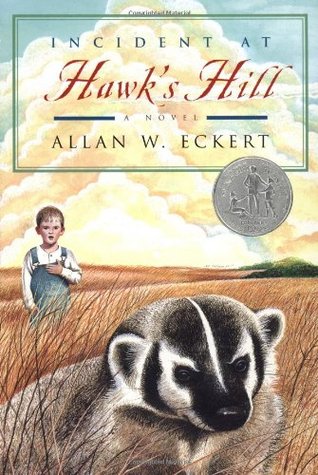
Incident at Hawk’s Hill by Allan W. Eckert (J)

Incident at Hawk's Hill

Incident at Hawk’s Hill     

Allan W. Eckert (Juvenile Fiction)

Twenty miles north of Winnipeg, in the year 1870, there stood the farm of William MacDonald, his wife, Esther, and their four children.  They named their farm Hawk’s Hill and for many years, the family thrived on the land.  Everyone thrived except the youngest child, Ben.  At six years old, he was much smaller than other children his own age.  He was also quiet, withdrawn, and seemed to get along better with the surrounding animals than with his own family.  Ben would often imitate the animals he came in contact with—mimicking their sounds and movements.  The folks in town called him strange, odd, and different.  But Ben derived a certain amount of comfort when he was with the animals, and in turn, the animals drew comfort from him.  One day, Ben wandered a bit too far from home and found himself hopelessly lost.  Little did he realize that his rescuer would be a female badger who needed him almost as much as he needed her.

The author’s note states that this book “is a slightly fictionalized version of an incident which actually occurred at the time and place noted.”  Intrigued, I did a little research and found that this claim could neither be substantiated nor does the author provide any further documentation.  Some believe Eckert’s story is based on legend while others think that it came from an article about a boy who, in 1873, lived in a badger hole for 10 days.  Regardless, Eckert gives us an interesting main character who is part Dr. Dolittle and part John Audubon and, through his exploits in and around his farm, offers readers a fascinating insight into the natural world.  Eckert also provides a greater understanding of the hunting, nesting, and breeding habits of the badger sow.  Although the book is filled with many interesting facts and details, the pace doesn’t lag and the story never feels weighted down.

Through the unimaginable and unlikely bond formed between a boy and a badger, we are treated to a story of survival, friendship, and devotion.  I truly enjoyed this book, but deducted a rating point since this is one of those rare children’s books that lacks a sufficient ending.  Because of the emotional commitment required on the reader’s part, the author should have provided a definitive ending merely out of a sense of obligation…especially given the age of the intended audience.  But rather than acquiring a sense of closure, we are left feeling deserted, confused, and rather perturbed.  There are stories that purposely leave the ending open-ended in order to encourage further thought and reflection.  This is not one of those stories and will undoubtedly leave the reader growling, chittering, wailing, hissing, and sounding very much like an angry badger.

Rating: 4/5

* Book cover image attributed to http://www.goodreads.com


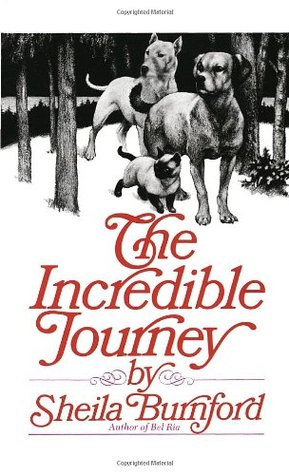
The Incredible Journey by Sheila Burnford (J)

The Incredible Journey

The Incredible Journey    

Sheila Burnford (Juvenile Fiction)

How far would you travel and what would you be willing to endure just to be home again?  Three animals—a Siamese cat, a bull terrier, and a Labrador retriever—travel nearly 300 miles across the Canadian wilderness and battle fatigue, hunger, wild animals, cold, and sickness in order to be reunited with their beloved family again.

Burnford gives us a story of loyalty, inclusivity, diversity, and empathy.  This is not a warm and fuzzy tale of three pets and their charming and delightful antics throughout the frontiers of Canada.  This is a harsh and brutally honest story of survival, death, pain, and endurance.  There is plenty of bone crunching and flesh tearing to remind young readers that this isn’t just another cutesy animal story, but this should not deter them in the slightest from reading this book.  The Incredible Journey is an exquisite story of love and friendship.  Each animal must depend on one another for survival while proving their own unique worth at pivotal parts of the story.

This is one of those rare books that is so captivating, you almost forget (and really don’t miss) the fact that a majority of the story lacks dialogue.  Through Burnford’s adept and masterful storytelling, we understand the language “spoken” between the three companions through their actions, reactions, hisses, and howls.  A flick of the tail or drawing down of the ears convey more emotion and drama under Burnford’s nuanced pen than pages and pages of dialogue ever could.  Serving as a brilliant complement to Burnford’s words are the beautiful and rich illustrations by Carl Burger.  The two combined give readers an emotional, exhilarating, unforgettable, and one incredible journey.

Rating: 5/5

* Book cover image attributed to www.goodreads.com 


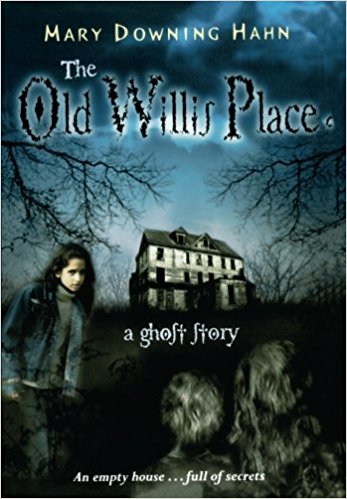
The Old Willis Place by Mary Downing Hahn (J)

The Old Willis Place

The Old Willis Place  

Mary Downing Hahn (Juvenile Fiction)

There are just two rules that siblings Diana and Georgie Eldridge have to follow: don’t let anyone see you and do not leave Oak Hill Manor.  But after the terrible thing happened, there would be many more rules to come.  All of these rules were easy enough to abide by until the new caretaker of the old Willis place arrived with his daughter.  Things would quickly get a lot more complicated.  Caretakers came and went (there were too many to count), but this one had a daughter—a daughter the same age as Diana.  Diana wanted a friend so badly, that she was willing to break any rule just to have one.  But at what cost?

This is a ghost story with some surprisingly heavy themes given that it is written for ages 7 to 12.  Besides dealing with theft, trespassing, and murder, we are given an older sister who, by selfishly putting her own wants and needs above all else, puts both herself and her younger brother in danger.  She lies to her sibling not once, but several times and flirts with severing the bond of trust that the two share.  Once trust is broken, can it ever be fully restored again?

This book is filled with plenty of action and suspense and, despite some scary and disturbing bits at the end, younger readers will become enthralled and immersed in this wonderfully spooky ghost story.  What I like most about this book is that Hahn delivers a powerful moral message that readers of any age can appreciate.  Despite suffering from separation, grief, loneliness, and fear, Hahn gives us two children who demonstrate the importance and value of extending mercy to the unworthy and offering forgiveness to the undeserving.  And that isn’t scary at all.

Rating: 4/5

* Book cover image attributed to http://www.goodreads.com


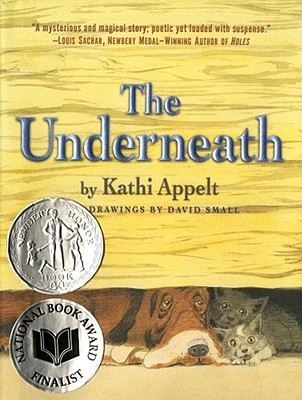
The Underneath by Kathi Appelt (J)

The Underneath

The Underneath  

Kathi Appelt (Juvenile Fiction)

This is a tale of two love stories separated by one thousand years.  The first is of a possessive, jealous, and cruel love.  It is about an enchantress, a king, and a family of three.  The second tale tells of a selfless, devoted, and pure love.  It is about a brave mother, a set of twins, and a gifted but abused blues singer.  But like so many tales, these two worlds eventually collide and when they do, which love will prove to be the strongest?

Appelt offers up a modern-day fairytale that gives readers heroes, villains, magic, mystery, and danger.  Like most fairytales, we can count on the villain getting his comeuppance, the misguided antagonist having a change of heart, and the power of true love winning in the end.  The book has very short chapters and makes for an easy read for younger readers (or an ideal bedtime book to be shared and read aloud).  The story has some instances of animal cruelty, so parents of sensitive readers should be warned.  Also, although Appelt gives us a truly suspenseful tale, it does stall near the middle and needlessly prolongs the action.  At just over 300 pages, this may frustrate some readers, but perseverance has its rewards and a satisfying ending awaits the patient reader.

Time and time again our little protagonists are told to “Stay in the Underneath.  You’ll be safe in the Underneath.”  And true enough, safely tucked underneath this dust jacket is a wonderful tale of devotion, friendship, family, and the importance of a promise kept.

Rating: 4/5

* Book cover image attributed to www.goodreads.com


The Decoding of Lana Morris by Laura & Tom McNeal (YA)

It’s Tween and Teen Tuesday where we review either a juvenile (J) or young adult (YA) book.

The Decoding of Lana Morris.jpg

The Decoding of Lana Morris  

Laura & Tom McNeal (Young Adult Fiction)

If you had one wish…just one…what would it be?

Sixteen-year old Lana Morris lives in a two-storied foster home that she shares with four special needs kids (Snicks for short) and her foster parents, Whit and Veronica.  Lana wishes for a different foster mother; she wishes to fit in with the cool kids; she wishes she didn’t have to live in Snick House; and she wishes she understood her feelings for Whit better.  Lana wishes for a lot of things and soon, after she visits Miss Hekkity’s Oddments & Antiques, she’ll have not just one wish, but 13.

First, I want to focus on the positive aspects of this book, which is the attention the McNeals devote to young people with special needs.  They give us insight into their daily lives and allow us to understand their challenges and individuality.  Too often society judges these amazing people by their outward appearance or behavior alone.  It is also heartwarming to see Lana’s role evolve from disparager to defender as she connects with her housemates and appreciates their uniqueness.

Unfortunately, the negative aspects of this book vastly outweigh the positives.  The McNeals make Veronica excessively cruel and evil for no apparent reason.  Her treatment of Lana is childish, snippy, and incredibly mean-spirited.  The authors provide no insight as to why this kind of person possesses such disdain and disregard for the children in her care.  We find out late in the book that she is unable to have children of her own.  So, are we then to assume that these children are somehow meant to fill a personal void or is she putting her own feelings aside and doing it out of selfless love for Whit?  Surely, she can’t be putting herself and these children through such torment for just a monthly stipend.

Additionally, and more disturbingly, is how the authors portray Whit.  Before Lana gains access to her “wishes”, Whit is a beloved, meek, and kind foster father.  The children adore him and Lana views him as a father (although her affections often overlap between familial and hormonal).  After her visit to Miss Hekkity’s, Whit inexplicably becomes increasingly salacious and lecherous toward Lana.  As a lonely teenage girl in want of a father figure, Lana is naturally drawn to Whit, but Whit’s reciprocation, and even encouragement, of her interest cross a very distinct line which is both disturbing and unsettling.  If the authors merely did this to shock their teen readers with provocative and edgy content, they handedly hit their mark.  What is supposedly a book about a teenage girl desperately trying to find love and acceptance dives abruptly into a world filled with infidelity, child exploitation, abuse, and neglect.

If I had one wish…just one…it would be that the McNeals had stayed a little truer to their book’s proposed purpose.  Unfortunately, the strong and encouraging themes of love, acceptance, and friendship are overshadowed by hate, jealousy, and lust and no amount of wishes can overcome that.

Rating: 2/5

* Book cover image attributed to http://www.goodreads.com


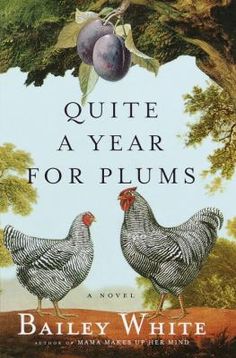
Quite A Year For Plums by Bailey White

Quite A Year For Plums

Quite A Year For Plums

Bailey White (Adult Fiction)

Roger is in love with a Yankee (although some of those people are just as nice as can be).  Louise arranges letters and numbers so that she can contact space aliens (who are really small by the way).  Della is having a devil of a time painting Dominique chickens (capturing their feet correctly is the hardest part) and has a penchant for labeling her garbage.  And then there’s Bruce who has nightmares about fonts (he’s a typographer and takes these things very seriously).  These and many more wonderfully odd characters live in a small southern town, and they laugh, love, and cry together…because that is what families do.

In the vein of Philip Gulley, Jan Karon, and Ann B. Ross, Bailey White gives us a humorous and heartfelt glimpse into rural America.  In White’s world, the boy doesn’t always get the girl and even the best intentions end in defeat, but she shows us that anything can be made just a little bit brighter and sweeter with just a jar of sweet pickles or a slice of homemade plum pie.

I adore Bailey White, but this novel came up a little short as I had a hard time sinking my teeth into it.  Rather than getting a rich and satisfying entrée, I was instead served several courses of appetizers.  White gives the reader many humorous and delightful vignettes, but when put together, they fail to form a complete and cohesive story.  Quite A Year For Plums is a quick read that doesn’t require a tremendous amount of emotional investment, but its quirky and lovable characters do make for an enjoyable book.  Almost as enjoyable as a jar of sweet pickles or a slice of homemade plum pie.  Almost.

Rating: 3/5

* Book cover image attributed to http://www.amazon.com


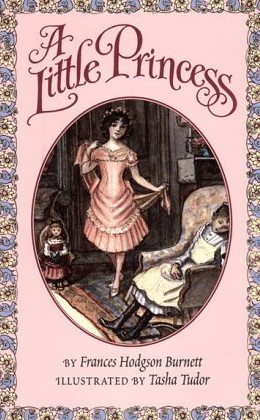
A Little Princess by Frances Hodgson Burnett (J)

A Little Princess

A Little Princess  

Frances Hodgson Burnett (Juvenile Fiction)

Sara Crewe is seven and always dreaming and thinking odd things.  But ever since arriving in London from India with her father, Captain Ralph Crewe, all she thinks about is “the place”—Miss Minchin’s Select Seminary for Young Ladies.  Her father’s affluence instantly propels Sara to star status within the school, but misfortune soon causes her to be penniless and at the mercy of jealous students, spiteful cooks, and a vindictive and cold-hearted headmistress.  Once an heiress and now a pauper, Sara relies on the friendship of a young servant, two foolish schoolgirls, and a rather amicable rat to help her cope with her new station in life.

Burnett delivers a charming and tender Cinderella-like story where our heroine is suddenly ripped from a life of comfort, joy, and love and thrown into a merciless world of coldness, hunger, and cruelty.  Unlike Cinderella, Sara is merely a child and the pain and suffering inflicted upon her is especially difficult to bear.  It also earns her tormentor, Miss Minchin, a dubious place amongst literature’s most despised and detested villains.

With A Little Princess, Burnett gives us a story about humility, grace, courage, hope, generosity, and kindness.  She also gives us a girl who is a beloved daughter, a show pupil, an adopted mother, a storyteller, a benefactor, a scullery maid, and a friend.  But most of all, Sara Crewe is, and always will be in the hearts of readers, a little princess.

Rating: 5/5

* Book cover image attributed to www.tvtropes.org


Breathing Water by T. Greenwood

Breathing Water

Breathing Water

T. Greenwood (Adult Fiction)

“Do not ask me for haunted.  Do not ever ask me for haunted, because I will give you haunted and you will never be the same.”

Effie Greer is living a fugitive life.  When you are a fugitive, you don’t sign leases, you don’t bother unpacking, and you don’t make any friends.  But after three years, she finally feels safe enough to return home to Lake Gormlaith, Vermont.  There, she refurbishes her grandmother’s lake house, reconnects with an old school friend, and develops an interest in a mysterious and kind artist.  Only time will tell if Effie can truly leave the past behind and begin anew.

Breathing Water jumps from the years 1991, 1994, and 1987 and deals with issues such as domestic violence and substance abuse.  Despite its strong and promising beginning, the story just seems to aimlessly float along with no real purpose or direction.  At times, the text seems overly flowery (“The rust-gold-orange-purple of the woods behind him blurred through the spray of the hose…”) and the transitions between time periods are awkward and require the reader a few moments to continually readjust.  Also, I found the main character to be a bit contradictory.  As a survivor of abuse, she is prone to keeping secrets although she eventually finds great relief and peace once she finally divulges her abusive past to friends and family.  Despite this, she finds it absolutely reasonable to keep secrets from her new love interest.  So, we are led to assume that some secrets are acceptable and absolution is purely discretionary.

All in all, not the worst novel I’ve ever read, but it was lacking on several fronts:  the characters were somewhat flat, the plot was thin, and finally reaching the end of the book was akin to treading water—there’s just not that much to hold onto.

Rating: 3/5

* Book cover image attributed to www.goodreads.com