
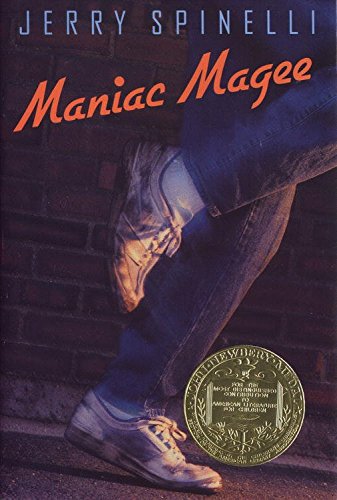
Maniac Magee by Jerry Spinelli (J Fiction)

They say Maniac Magee was born in a dump. They say his stomach was a cereal box and his heart a sofa spring. They say he kept an eight-inch cockroach on a leash and that rats stood guard over him while he slept. They say.

Maniac Magee

Jerry Spinelli (J Fiction)

They say Maniac Magee was born in a dump. They say his stomach was a cereal box and his heart a sofa spring. They say he kept an eight-inch cockroach on a leash and that rats stood guard over him while he slept. They say.

In a world where it’s hard to tell what’s real, slight exaggeration, or utter nonsense, one thing that’s undeniably true is that the boy known as Maniac is a straight-up legend. This scraggly orphan with the blown-out sneakers does more than just rescue Arnold Jones from Finsterwald’s backyard, runs along the steel rail of the railroad tracks, sleeps alongside a baby buffalo, and scores an inside-the-park homerun by bunting a frogball. No, sirree. This mythological marvel did what few would even think—nay—dare to do and that’s take on that foul and odious beast separating East End from West End in Two Mills, Pennsylvania. What beast would that be you ask? Racism.

It’s no wonder why Jerry Spinelli’s book received the highest honor in children’s literature—the John Newbery Medal. This heartwarming story of racial division, acceptance, family, and loyalty is as relevant and important today as it was when it was written in 1990. It tackles the ugliness and unfairness of racial prejudice head on with humor and heart and in a way that young readers can understand and absorb its important message of unity and understanding.

Maniac Magee tells the story of twelve-year-old Jeffrey Lionel “Maniac” Magee and his rise from runaway orphan to unforgettable legend. By performing impossible feats, he earns himself not only a spot in town folklore, but also in the hearts of just about everyone he meets. Yet despite his talents and charisma, there are still a few folks—on both sides of Hector Street—who have suffered so much pain and mistreatment in the past that they are unable to forgive, forget, and move on to face a different future.  

In his 1990 Boston Globe-Horn Book Award acceptance speech for Maniac Magee, Spinelli answered the question that so many of his fans and admirers have asked him over the years: “Were you Maniac?” And, in true Jerry Spinelli fashion, he responded, “I sure was. Weren’t we all?” Perhaps none of us will never experience the fame and notoriety of one Maniac Magee, but one thing’s for sure and that’s the world could certainly use a few more just like him right about now.

Rating: 5/5

NEW!! Want to share this book with your homeschooler or classroom? Download our study guide: https://www.teacherspayteachers.com/Product/Study-Guide-Maniac-Magee-by-Jerry-Spinelli-11348884
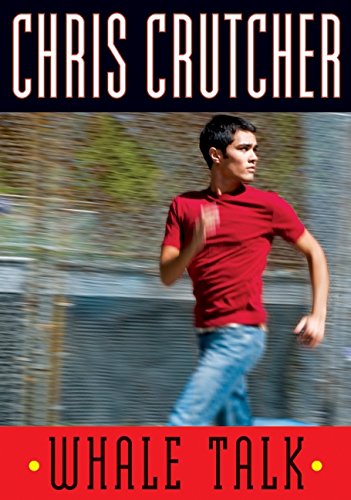
Whale Talk by Chris Crutcher (YA Fiction)

Whale Talk  

Chris Crutcher (YA Fiction)

It’s interesting being “of color” in a part of the country where Mark Fuhrman has his own radio talk show. My parents have always encouraged me to be loud when I run into racism, but I can’t count on racism being loud when it runs into me.

The Tao “T.J.” Jones is almost 18, adopted, and of mixed race (he’s black, Japanese, and white). He’s had to deal with racism early and often and isn’t much bothered by it anymore. What bothers him NOW is the elitism and exclusivity that the Cutter High School athletics department has placed on earning a letter jacket—an article of clothing he vehemently avoids acquiring. But after he’s recruited (rather academically coerced) into starting a swim team, he sets his sights on taking back his slice of the pie and assembles the unlikeliest group of misfits with the promise that each will earn a letter jacket of their own. Over the weeks, these young men not only begin to strengthen physically, but they start to heal emotionally and the lessons they learn in the water will stay with them long after the last swimmer touches the wall.

Crutcher’s Whale Talk was one of the American Library Association’s Top Five Most Challenged Books in 2005 and was removed from the Limestone County, Alabama school district’s five high school libraries for racism and offensive language. But the book also received countless honors and awards—all well deserved. Was the language spicy and derogatory? Sure was. There were also instances of physical abuse, bullying, child abuse, sexual assault, not to mention a little teacher-student blackmail, but instead the school board decided to focus on the “bad words” thus denying its students the opportunity to benefit from the many lessons contained in this exceptional book.

Whale Talk is my first introduction to Chris Crutcher and it won’t be my last. The story (think The Sandlot meets The Outsiders) is a feel-good story about a bunch of misfits who—led by a no-nonsense coach; a homeless, loyal assistant; and a talented, fearless team captain—band together to defy the odds and earn themselves a coveted prize. It’s a tale as old as time. Crutcher could have easily written a trite and predictable underdog story, but instead delivers a tale full of heart, hope, and forgiveness. These kids are diamonds in the rough and each is given an opportunity to shine and show their worth not only to their team, but to one another. These are principled young men who understand that they’re not fighting for a jacket with a fancy letter, but they’re standing up against stereotypes and proving that they are more than the label they’ve been assigned by their peers and society. These characters are steadfastly devoted to each other and you can’t help but cheer as each touches the wall and moves closer to achieving their goal. Crutcher is a master storyteller and truly taps into the high-school mindset with characters that are relatable, likeable, and you just can’t help but root for. With morally centered characters (including T.J.’s adoptive parents and especially his father who was given an incredibly heartbreaking backstory) and themes of acceptance, perseverance, and grace, Whale Talk should be moved from the banned books and instead placed on the required reading list.

Although T.J. may have started this journey with a questionable motive, he learned a lot about his teammates and himself along the way. There is a common theme of being able to project your own thoughts and feelings to the world so that everyone would instantly know your challenges, struggles, triumphs, and joys. T.J.’s therapist once told him that, “There is very little about humans that doesn’t have to do with connection.” Author Rachel Naomi Remen wrote, “The most basic and powerful way to connect to another person is to listen.” Imagine how many problems we could solve if we all just stopped being human for a moment and instead started acting a bit more like whales.

Rating: 5/5

* Book cover image attributed to: www.abebooks.com

We’re now posting videos of some of our book reviews! Follow us on Facebook at www.facebook.com/thedustyjacket or on Instagram @tdjreviews and join in on the fun!

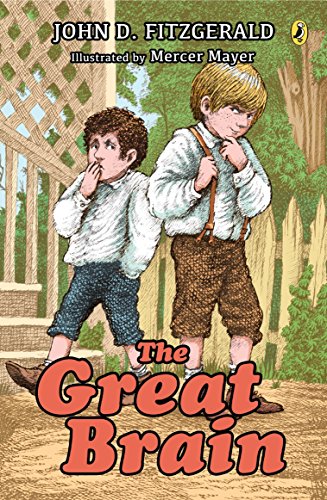
The Great Brain by John D. Fitzgerald (J Historical Fiction)

The Great Brain (Great Brain #1) 

John D. Fitzgerald (J Historical Fiction)

It’s 1896 and the territory of Utah officially became a state. But to the 2,500 residents in the town of Adenville, it was the year of The Great Brain’s reformation. Having The Great Brain as a brother has its ups and downs. Just ask his little brother J.D. It was nearly impossible to catch any sunlight while constantly in the shadow of such magnificence and brilliance. Expert eavesdropping, a perilous cave rescue, and the great whiskey raid were the works of one Tom Dennis Fitzgerald and his intellect was the stuff of legend. But, has The Great Brain finally changed his scheming ways? Why, that would be bigger news than the day Adenville got its very first water closet!

Published in 1967, The Great Brain is the first in an eight-book series and loosely based on author John D. Fitzgerald’s own childhood experiences. The story is narrated by the Fitzgerald’s youngest son John (J.D.) who is seven—going on eight. This is one of those books that I have equally strong feelings of delight and horror. With a publisher-recommended reading age of 8 and up, it is important to note that this is a 1967 book and times they did change (and boy, did they ever)!

Setting aside the starting reading age (which I would emphatically suggest bumping up to at least 12), this book deals with some heavy societal and political issues largely centering around ethnic prejudice and hatred. Fitzgerald details how Adenville’s first Greek immigrant family (their son in particular) was the object of brutal bullying and verbal assault. The author also goes into a multi-page diatribe regarding the treatment of Jews compared to other ethnicities within their community and how a “beloved” member of their town somehow slipped through the cracks with devastating consequences. This wasn’t just a matter of negligence or ignorance, it was apathy and this entire topic—and its importance and relevance—is sadly bound to go right over a young reader’s scope of understanding.

Also, Tom is really nothing more than an opportunistic schemer. Would a young reader delight in his antics and ability to always find a way to one-up his friends? It seems so since this book not only gave way to seven successors, but earned Fitzgerald The Young Reader’s Choice Award for children’s literature in both 1976 and 1978. Shows what I know. Tom’s ability to do good does benefit those around him who learn how to defend themselves and develop a sense of self-worth, but the fact that he always seeks an “angle” puts him one step above a sleezy snake oil salesman. The upside is that Tom truly does have his beneficiaries’ best interests in mind and eventually experiences a moral awakening, but we know it doesn’t last long and future books probably contain more of the same self-serving behavior.   

Perhaps THE most disturbing part of this book comes near the end when John is helping another boy end his life because he wants to prove himself to be a good pal. The various ways the boys plot and attempt to carry out this horrific act is beyond boyish hijinx and madcap mayhem. I can’t possibly think what was going on in the author’s head that he thought this would be appropriate material to print for a child of eight. I was a child of the 70s and I wouldn’t look at this entire passage as merely being slapstick fun (Oopsies! THAT didn’t work. Let’s try this!) I shudder to think just HOW much of this book falls into the “own childhood experience” category.

My overall impression is that this book didn’t age well and should be left for a much older and morally mature reader. And even though my brain is not-so-great, I know there are more appropriate books out there for young readers that teach the virtues of friendship, the value of community, the strength of family, and the satisfaction you get from doing good with the expectation of receiving absolutely nothing in return.

Rating: 3/5

* Book cover image attributed to: www.abebooks.com

We’re now posting videos of some of our book reviews! Follow us on Facebook at www.facebook.com/thedustyjacket or on Instagram @tdjreviews and join in on the fun!

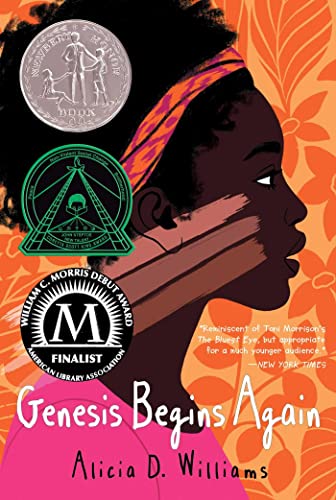
Genesis Begins Again by Alicia D. Williams (YA Fiction)

Genesis Begins Again

Alicia D. Williams (YA Fiction)

Thirteen-year-old Genesis Anderson hates moving (her family is on number four), broken promises (too many to count), her father’s hateful words when he’s had too much to drink (too painful to count), her hair, and staying with her grandmother. She also hates the darkness of her skin, which she’s tried to lighten using a variety of household products. But mostly, Genesis hates the list that was started back in sixth grade by two classmates who listed one hundred things (the stupid girls only listed sixty) they hated about her. The joke’s on them because Genesis has been adding to that list on her own and will probably make it to 100 in no time. There’s a lot of things Genesis hates, but a new school with new friends and new opportunities finally show Genesis that there are a lot of things to like. With things finally beginning to look up, you can bet that it won’t be long before something comes along to mess it all up. Genesis hates that.

Very few young adult books have grabbed me the way Genesis Begins Again has. Williams’s opening paragraph leads us into a false sense of security that is quickly and horribly stripped away in a matter of paragraphs. Williams snuffs out our girl’s light in one raw and shameful event that immediately shows us the obstacles that Genesis faces, the character of the “friends” she has, and the girl that she ultimately is. Behind all that self-loathing is a strong, loyal, fierce, and intelligent girl who is wise beyond her years and determined to make her fractured world whole again…no matter the cost. She is instantly a character that we root for and we find ourselves either wanting to take her by the shoulders to remind her that she’s better than she thinks or wrap our arms around her to reassure her that everything will be alright.

It’s hard to believe that this is Williams’s debut novel. It received the Newbery Honor award in 2020, as well as the John Steptoe Award for New Talent. Her book began as an autobiography but was soon revised to better reflect the present rather than the past. The themes of bullying and colorism play predominantly throughout the story and often emanate from surprising and unexpected sources. The characters are wonderfully developed, the prose is engaging and allows us to fully immerse ourselves within Genesis’s world, the conflicts and outcomes are realistic, and there’s enough drama and tension to keep the story moving at a wonderful pace.

Highlighting the important and influential role that teachers have on our children, Genesis is highly influenced by her music teacher, Mrs. Hill. It is she who introduces Genesis to Billie Holiday, Ella Fitzgerald, and Etta James who showed her that there is beauty in brokenness and joy beyond the pain. Music healed Genesis…it freed her…and proved to be a lifeline to those around her who needed it the most. Billie Holiday once said, “If I’m going to sing like someone else, then I don’t need to sing at all.” All through the story, Genesis was always trying to be someone else: lighter, braver, smarter, hipper, or more popular. It was only after she discovered and began to sing her own song, that she was truly able to begin again.

Rating: 5/5

* Book cover image attributed to: www.abebooks.com

We’re now posting videos of some of our book reviews! Follow us on Facebook at www.facebook.com/thedustyjacket or on Instagram @tdjreviews and join in on the fun!

The Boy with the Butterfly Mind by Victoria Williamson (J Fiction)

The Boy with the Butterfly Mind

Victoria Williamson (J Fiction)

Elin has never been in trouble for anything in her whole life. She is smart, respectful, and helpful. A perfect princess determined to get her divorced parents back together…even though her mother is in a relationship and her father is married. Elin has everything under control, but she doesn’t have any friends. After all, it’s lonely being so perfect all the time. Then there’s Jamie who seems to be a magnet for trouble. He has ADHD and is easily distracted, forgetful, and messy. His parents are also divorced and Jamie blames himself…as he often does for most things that go horribly wrong. It would be nice if he had a friend to talk to, but it’s lonely being bad all the time. When these two very lonely and different worlds collide, order and chaos not only meet, but they end up living together in a house that seems to grow smaller by the minute.

The Boy with the Butterfly Mind is told from the alternating viewpoints of Elin and Jamie—both eleven. Although you understand the internal and emotional struggles of both characters, it is far easier to be sympathetic towards Jamie. Although he is completely aware of his challenges and limitations, he still absorbs an unfair amount of guilt and blame while managing to maintain a trusting and forgiving attitude. His journey is a rollercoaster ride of emotions and just when we think his life is getting easier, the rug is mercilessly pulled out from him. With so much against him, we can’t help but cheer on this perpetual underdog.

Williamson is a primary school teacher with a Master’s Degree in special needs education. She’s worked with children requiring additional support needs and this real-world experience is evident in her writing. We see it as Jamie details his struggles and feelings and especially when he describes his interactions with his mother who is completely overwhelmed and emotionally drowning. These occurrences are raw and ugly and uncomfortably accurate. When Jamie hurts, we hurt, which makes this book all the more thought provoking and poignant.

By focusing on Jamie, I don’t mean to downplay Elin and her feelings. She, too, is struggling with her own demons as she feels that the only way to win her father back is to maintain a level of perfection that is both unrealistic and impossible. She puts undue pressure on herself and the introduction of an imperfect and unwanted addition to her family just adds to her burden. It’s a lose-lose situation for everyone and we can’t help but wince as we witness the walls around these people come tumbling down. However, the measures that Elin takes in her own personal “war” against these unwanted intruders are both cruel and dangerous and under these circumstances it is difficult to extend her any mercy or grace although she is keenly aware and witnesses the consequences of her actions.

Using data from 2016-2019, the Centers for Disease Control and Prevention estimated that 6 million children—between the ages of 3 to 17—were diagnosed with ADHD, which is why books like this one are so important and valuable. To show the bullying and isolation that children with this diagnosis experience is just the first of many steps that need to be taken to promote understanding, acceptance, and inclusion.

There’s a quote about friendship that I’ve used before in a review that’s from an anonymous source. It’s one of my favorites: A friend is one who overlooks your broken fence and admires the flowers in your garden. Although Jamie felt broken and just wanted to be “normal”, he was lucky enough to find such a friend who made him realize that you don’t have to be perfect in order to be a perfect friend. I think the world would be a much better place with more people like that in it and I’m glad that Elin eventually realized this, too.

Rating: 5/5

* Book cover image attributed to: www.abebooks.com

We’re now posting videos of some of our book reviews! Follow us on Facebook at www.facebook.com/thedustyjacket or on Instagram @tdjreviews and join in on the fun!

A Monster Calls by Patrick Ness (YA Fantasy)

A Monster Calls  

Patrick Ness (YA Fantasy)

The monster showed up just after midnight. As they do.

At thirteen, Conor was too old for monsters. Monsters were for babies and bedwetters and Conor was neither; however, here he was—night after night reliving the same images that made him wake up screaming into the darkness. But one night, another monster came to visit. Not the one from his nightmare, but a different one. One that would tell him three stories and would then require Conor to tell him the fourth. But the fourth wouldn’t be a story. The fourth would be the truth…Conor’s truth. A truth that he’s been avoiding for a very, very long time.

Do NOT judge this book by either its cover or its title! A Monster Calls is not a horror story, but rather an intensely moving and intellectually provocative read that examines death, bullying, and growing isolation. Patrick Ness’s story (inspired by an idea by the late Siobhan Dowd) and Jim Kay’s beautiful and macabre illustrations allow A Monster Calls to leap off the page, reach inside your chest, and put a death grip on your heart. The action and emotions intensify as the story unfolds and reaches the ultimate crescendo when the reader realizes the truth behind the monster and the meaning of Conor’s nightmare. It’s a painful and agonizing revelation and you can’t help but cry out as our young protagonist finally comes to terms with the grim reality he’s been desperately avoiding and denying. It’s a master class in storytelling and a final work that Siobhan Dowd surely would have been immensely proud of.

On one of their encounters, the monster told Conor about the importance of stories: “They can be more important than anything. If they carry the truth.” There are countless stories about how children deal with trauma—especially when it involves a loved one—but Ness’s approach cuts to the very heart of the loneliness, fear, and helplessness they feel and how these feelings manifest themselves into monsters and darkness and voids that suck the very air from your lungs. It’s a dark and empty feeling that’s scary and cold, but Ness reminds us that truth can cut through the darkest of places; that acceptance can be a way out of the deepest abyss; and that forgiveness can open the way to healing and peace.      

Rating: 5/5

* Book cover image attributed to: www.amazon.com

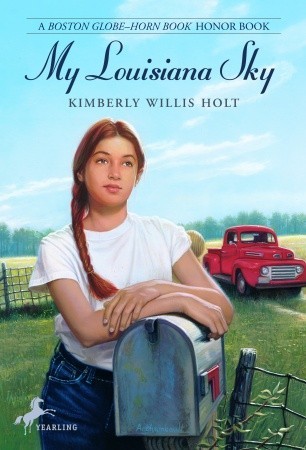
My Louisiana Sky by Kimberly Willis Holt (J Fiction)

My Louisiana Sky

Kimberly Willis Holt (J Fiction)

Tiger Ann Parker was six when she realized that her momma wasn’t like other mothers—acting more like a younger sibling than a parent—and her father was no better, often described as “slow” by the men he worked with at the nursery. Tiger hated to admit it, but she felt embarrassed by her parents and often wished that her mother was more like her stylish and independent Aunt Dorie Kay. If she was, then maybe Tiger could make friends with the girls in her class. Maybe Tiger could finally fit in. Tiger’s wish may be coming true when she’s given the chance to leave her small town of Saitter and begin a new life in Baton Rouge. But is starting over really the answer that Tiger is looking for?

This is the second book by Kimberly Willis Holt that I’ve read, the first being When Zachary Beaver Came to Town, and Holt again delighted me with a cast of unforgettable characters and an immersive story. My Louisiana Sky is another period book, but this one takes place during the 1950s when the country was divided by segregation and people with developmental disorders were often institutionalized. Mirroring Zachary, Holt’s down-home and folksy writing is front and center and instantly draws the reader to her characters and pulls you into their quaint and intimate world. The story is told from twelve-year-old Tiger’s point of view and what really compelled me—apart from its strong themes of acceptance and family—was how the script was flipped a bit. Most books that deal with the subject of developmental disabilities for this age often afflicts either a sibling or a friend of the main character. For Holt to strip Tiger’s familial stability by having not one but both of her parents dealing with varying degrees of mental challenges gives the story an entirely unique perspective and instills an overall sense of aloneness for Tiger. Combine that with her having to deal with the common adolescent fare of self-esteem, body issues, and self-confidence and you can’t really fault Tiger for wanting to leave everything she knows and loves behind for a chance to simply be a twelve-year old girl for a while.

There are so many positive lessons to be learned from this book, but the reader who is fighting against circumstances beyond their control and struggling to be accepted by their peers is going to feel the deep connection to Tiger Ann Parker. Most of us can remember wanting to be part of a clique and recalling the sting when confronted with rejection. We feel Tiger’s anguish when she cries out, “It’s not fair. I didn’t do anything to them,” and appreciate the wisdom of Granny’s words when she tells Tiger, “Perhaps those girls don’t deserve your friendship.” It’s true when they say that it’s not what we have in life, but who we have in our life that matters. For Tiger, all she needed was a best friend who loved baseball, a father who had a talent for listening to the earth, and a mother who loved to dance in between the sheets drying on the clothesline under a bright, blue Louisiana sky.

Rating: 5/5

* Book cover image attributed to: www.goodreads.com

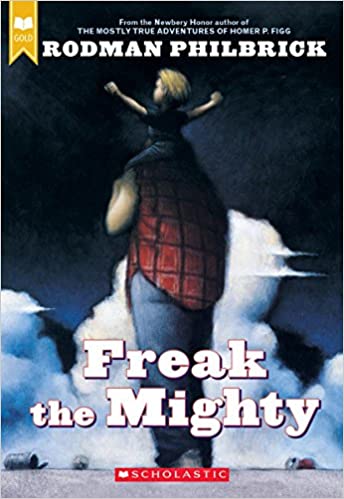
Freak the Mighty by Rodman Philbrick (YA Fiction)

Freak the Mighty

Rodman Philbrick (YA Fiction)

They were known as Freak and Kicker. Kevin Avery and Maxwell Kane had known each other since daycare and you’d think that given Kevin’s abnormal smallness, he would have been a pretty kickable target for Kicker. But maybe it was Kevin’s crutches or perhaps it was the shiny braces holding up his crooked legs. Whatever it was, he quickly captured Maxwell’s imagination…and possibly even his respect. When Kevin suddenly re-enters Maxwell’s life during the summer before eighth grade, the two form an unlikely friendship. Separately, they are Midget and Butthead, but together they’re Freak the Mighty and soon everyone would realize that you can’t always judge a book by its cover.

Rodman Philbrick warms your heart and then breaks it with this story of friendship, acceptance, and courage. Told from Maxwell’s point of view, Freak the Mighty shows us how two fractured halves come together to form one implausibly wonderful whole. Kevin is the yin to Maxwell’s yang and they prove that opposites not only attract, but they bond and strengthen. Through Kevin, Maxwell begins to realize his academic potential and starts to free himself from past ties that hold him back. In turn, Maxwell gives Kevin the ability to look for castles, hunt for buried treasure, help damsels in distress, and realize his dream of having a seat at the roundtable.

There seems to be a lot of disparity online regarding the appropriate reader age for this book. Freak the Mighty is recommended for sixth graders and up—although some websites suggest a reader age as young as ten. While it is an easy and fast read—which would clearly appeal to younger readers—there are many instances of violence and disturbing behavior throughout the book, not to mention that Maxwell’s father is far from Father-of-the-Year material. And while the themes of anti-bullying and pro-acceptance are important, there are more age-appropriate options available for younger readers (R. J. Palacio’s Wonder is just one example). All in all, I really loved this story, but it fell just a little short of completely winning me over. With the two main characters being such polar opposites, I feel the story could have benefitted from having alternating narrators—switching between Maxwell and Kevin. Having the opportunity to learn more about Kevin and being able to see the world through his eyes would have added another layer of depth and emotion to this story. Having Mighty without the Freak seems like a sadly missed opportunity.

They say that a friend is someone who looks beyond your broken fence and instead admires the flowers in your garden. Maxwell and Kevin certainly exemplify this through their quirky and unlikely friendship and demonstrate how brains and brawn are not competitors, but rather a wonderful symbiosis. Maxwell gave Kevin legs and Kevin gave Maxwell heart—their own mental and physical challenges replaced by adventure, possibility, and hope. Rare is the friendship that not only opens the door to life’s opportunities, but also lifts you up so that you won’t miss them when they finally arrive.

Rating: 4/5

* Book cover image attributed to: www.amazon.com

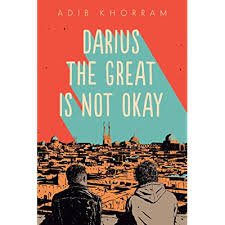
Darius the Great is Not Okay by Adib Khorram (YA)

Darius the Great is Not Okay

Adib Khorram (Young Adult Fiction)

Darius Kellner has some very big shoes to fill. After all, he was named after Darius the Great, one of the greatest rulers of the Achaemenid dynasty. Darius the Great was strong, smart, and brave, conquered lands and expanded the Persian Empire.  Darius Kellner is none of these things and has never really accomplished anything…although he can brew a mean pot of tea. For one thing, he’s only half Persian or a “Fractional Persian” as he refers to himself.  Also, he never stands up for himself. The school bullies (the Soulless Minions of Orthodoxy) keep him in his place, which makes life at Chapel Hill High School (Go Chargers!) a living nightmare. On top of all of that, the medication he takes for his depression causes weight gain, which only makes the target on his back that much easier to spot. But life is about to get a little more complicated as the family boards a plane to Iran to visit his sickly maternal grandfather. How can a shy, non-confrontational Fractional Persian with a penchant for The Hobbit and Star Trek: The Next Generation be able to live up to his namesake in his mother’s homeland? Darius doesn’t need to be great. What Darius needs is a miracle.

Author Adib Khorram, who himself suffers from depression, delivers a warm and realistic take on teenage life and the struggle with balancing family expectations with personal aspirations. What is refreshing about Darius the Great is Not Okay is that Khorram fills his book with characters who are not caricatures. It could have been easy to paint Darius as the hapless victim. The “typical” bullied teenager who is sullen and solitary. Instead, Khorram takes great care to give our main character heart and who experiences deep feelings of jealousy, resentment, humiliation, and gratitude without the need for a fall guy or martyr. When Darius is around his little sister, Laleh (an adorable and precocious second grader), we see his kindness, compassion, and various bits of exasperation peek through. As his friendship with Sohrab begins to evolve, we witness a more confident and joyful Darius emerging. Also, Khorram avoids depicting Darius’s intelligent, and charismatic father, Stephen, as the elitist, cold-hearted, and controlling patriarch. Through various situations, we understand that Stephen’s repeated criticisms of Darius are not cruel, but rather a father’s desire for his child to be accepted, appreciated, and happy. All of Khorram’s characters are perfectly imperfect and are so well developed, that we find ourselves laughing, crying, and cursing right alongside them.

Khorram’s story also gave me the opportunity to learn more about Iran and her people, culture, and history. Iran is truly a separate character in this book and although Khorram was born in Kansas City, Missouri, his father is Iranian and the love he has for his father’s birthplace is evident in every single page. As Darius experiences Iran for the first time, we too get to feel the dust on our skin, smell the savory teas brewing in their pots, taste the confectioners sugar on top of the qottab, and marvel at the magnificence of the Zoroastrian Towers of Silence and Persepolis. Darius the Great is Not Okay is not only an expertly told story about family, friendship and acceptance, but it is also a lavish feast for the senses and truly a trip worth taking.

Rating: 5/5

*Book cover image attributed to www.goodreads.com

**Want more?  Visit our Facebook page at www.facebook.com/thedustyjacket

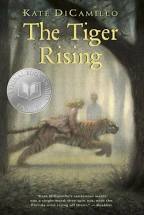
The Tiger Rising by Kate DiCamillo (J Fiction)

The Tiger Rising

Kate DiCamillo (Juvenile Fiction)

He took a breath. He opened his mouth and let the words fall out. “I know where there’s a tiger.” Sistine stood in the drizzly rain and stared at him, her eyes black and fierce. She didn’t say “A real one?” She didn’t say “Are you crazy?” She didn’t say “You’re a big old liar.” She said one word: “Where?” And Rob knew then that he had picked the right person to tell.

Rob Horton was the best no-crier in the world. That was due in large part to his way of not-thinking about things: his mother’s death, the bullies at school, or the continual rash on his legs. He kept those feelings, along with his no-wish things, locked up tight in a suitcase. As his father always reminded him, crying, worrying or wishing won’t change a thing. So Rob really wasn’t sure what to think when he found a caged tiger behind the old Beauchamp gas station building one day. He also wasn’t sure what to think about that new girl, Sistine, who showed up to school one day in her pink lacy dress since nobody wears pink lacy dresses to school. Suddenly Rob found himself trying to not-think about a whole lot of thinkable things and he wasn’t sure just how much more that old suitcase of his could hold.

It’s tricky being an adult reading a book targeted for younger readers. I feel it’s important to view these stories from their perspective and through their unique lens. With that in mind, I still found myself disappointed with this book. Kate DiCamillo is by far one of my favorite authors and a brilliant storyteller so I was surprised with feeling shortchanged with The Tiger Rising. Her characters seem shallow and could have been developed more fully.  Rob’s father, in particular, could have benefited the most from some kind of backstory. Without understanding his past, he came off as a hot-headed, unfeeling, and violent father who garners little to no sympathy from readers. Also, this story felt forced and rushed—as if DiCamillo is hurrying us across a self-imposed finish line rather than allowing us the opportunity to fully experience the thrill or the energy of the race.  The Tiger Rising feels more like a story pitch or outline rather than a fully fleshed out tale of loss and friendship.  Although the lessons of realizing the importance of grieving and the power of forgiveness are important, they get buried under the weight of too many loose ends that are left to simply dangle in the wind.

One of the most interesting and grounded characters in the book is Willie May, the housekeeper of the hotel that both Rob and his father live and work. Sistine refers to her as a “prophetess” as Willie May is always providing little nuggets of truth and wisdom.  When Willie May saw Rob and Sistine together, she said, “Ain’t that just like God throwing the two of you together?” It is a powerful thing when two seemingly opposite or contrary things find their way to one another and connect. I wish I could have connected with this story, but I feel the best parts of it are still locked away somewhere and is just awaiting the right key to set it free.

Rating: 3/5

*Book cover image attributed to www.thriftbooks.com

**Want more?  Visit our Facebook page at www.facebook.com/thedustyjacket