
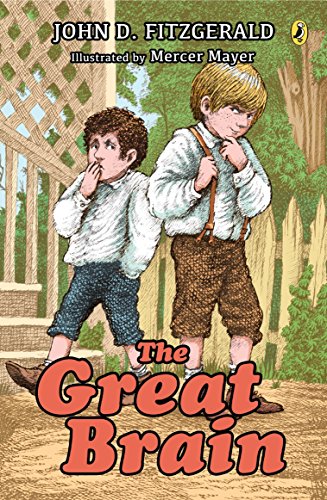
The Great Brain by John D. Fitzgerald (J Historical Fiction)

The Great Brain (Great Brain #1) 

John D. Fitzgerald (J Historical Fiction)

It’s 1896 and the territory of Utah officially became a state. But to the 2,500 residents in the town of Adenville, it was the year of The Great Brain’s reformation. Having The Great Brain as a brother has its ups and downs. Just ask his little brother J.D. It was nearly impossible to catch any sunlight while constantly in the shadow of such magnificence and brilliance. Expert eavesdropping, a perilous cave rescue, and the great whiskey raid were the works of one Tom Dennis Fitzgerald and his intellect was the stuff of legend. But, has The Great Brain finally changed his scheming ways? Why, that would be bigger news than the day Adenville got its very first water closet!

Published in 1967, The Great Brain is the first in an eight-book series and loosely based on author John D. Fitzgerald’s own childhood experiences. The story is narrated by the Fitzgerald’s youngest son John (J.D.) who is seven—going on eight. This is one of those books that I have equally strong feelings of delight and horror. With a publisher-recommended reading age of 8 and up, it is important to note that this is a 1967 book and times they did change (and boy, did they ever)!

Setting aside the starting reading age (which I would emphatically suggest bumping up to at least 12), this book deals with some heavy societal and political issues largely centering around ethnic prejudice and hatred. Fitzgerald details how Adenville’s first Greek immigrant family (their son in particular) was the object of brutal bullying and verbal assault. The author also goes into a multi-page diatribe regarding the treatment of Jews compared to other ethnicities within their community and how a “beloved” member of their town somehow slipped through the cracks with devastating consequences. This wasn’t just a matter of negligence or ignorance, it was apathy and this entire topic—and its importance and relevance—is sadly bound to go right over a young reader’s scope of understanding.

Also, Tom is really nothing more than an opportunistic schemer. Would a young reader delight in his antics and ability to always find a way to one-up his friends? It seems so since this book not only gave way to seven successors, but earned Fitzgerald The Young Reader’s Choice Award for children’s literature in both 1976 and 1978. Shows what I know. Tom’s ability to do good does benefit those around him who learn how to defend themselves and develop a sense of self-worth, but the fact that he always seeks an “angle” puts him one step above a sleezy snake oil salesman. The upside is that Tom truly does have his beneficiaries’ best interests in mind and eventually experiences a moral awakening, but we know it doesn’t last long and future books probably contain more of the same self-serving behavior.   

Perhaps THE most disturbing part of this book comes near the end when John is helping another boy end his life because he wants to prove himself to be a good pal. The various ways the boys plot and attempt to carry out this horrific act is beyond boyish hijinx and madcap mayhem. I can’t possibly think what was going on in the author’s head that he thought this would be appropriate material to print for a child of eight. I was a child of the 70s and I wouldn’t look at this entire passage as merely being slapstick fun (Oopsies! THAT didn’t work. Let’s try this!) I shudder to think just HOW much of this book falls into the “own childhood experience” category.

My overall impression is that this book didn’t age well and should be left for a much older and morally mature reader. And even though my brain is not-so-great, I know there are more appropriate books out there for young readers that teach the virtues of friendship, the value of community, the strength of family, and the satisfaction you get from doing good with the expectation of receiving absolutely nothing in return.

Rating: 3/5

* Book cover image attributed to: www.abebooks.com

We’re now posting videos of some of our book reviews! Follow us on Facebook at www.facebook.com/thedustyjacket or on Instagram @tdjreviews and join in on the fun!
The True Blue Scouts of Sugar Man Swamp (J)

The True Blue Scouts of Sugar Man Swamp

Kathi Appelt (Juvenile Fiction)

Raccoons have been the official scouts of Sugar Man Swamp for eons (and that’s a really long time). Brothers Bingo and J’miah aren’t just ordinary swamp scouts. No, no, no! They’re Information Officers, a highly specialized branch of the Scout system. On the rooftop of Information Headquarters (which happens to look an awful lot like a 1949 DeSoto Sportsman) on the banks of the Bayou Tourterelle, our brave scouts keep vigil over their beloved swamp and try their very best to make their parents proud and to respectfully serve the Sugar Man. Not far from Information Headquarters is twelve-year-old Chap Brayburn. Mourning the recent loss of his beloved grandfather, Chap is now the man of the house and uncomfortably in the crosshairs of one Sonny Boy Beaucoup, owner of Sugar Man Swamp. Sonny Boy wants to build a wrestling arena and theme park right smack dab in the middle of the swamp! No, no, no! Before long, the scouts and Chap find themselves in a race against time to save the swamp and everything they hold dear.

I loved Kathi Appelt’s Newbery Honor book The Underneath and was delighted that this book had the same warmth, charm, and appeal. Packed with plenty of action and adventure, young readers will relish this story filled with pirates, feral hogs, a giant rattlesnake, and a hairy giant as tall as a tree with hands as wide as palmettos. The short chapters, numerous say-out-loud sounds (how fun is it to pretend to be a snake by mimicking its rattle with a “chichichichichi” or to sssssssspeak like a ssssssssnake), and humorous side comments make this a ready-made bedtime story. Readers will thrill in the antics of Bingo and J’miah while parents will appreciate the valuable moral lessons repeated throughout the book. Although there is a bit of thievery in our story, can you really blame two hungry scouts when such delicious sugar pies are involved? No, no, no!

The True Blue Scouts of Sugar Man Swamp is about family, loyalty, and bravery. But at its core, this book is a love letter to Mother Nature and reminds us that no matter how slimy, scary, slippery, scaly, scummy, or scratchy some creatures, objects, or places might be, they each play an invaluable role in an ecosystem that is extremely complex, amazingly fragile, and so very precious and irreplaceable. As Chap’s grandfather, Audie, always told him, “Nosotros somos paisanos. We are fellow countrymen. We come from the same soil.” We could all benefit by following the Official Sugar Man Swamp Scout Orders: Keep your eyes open; Keep your ears to the ground; Keep your nose in the air; Be true and faithful to each other; In short, be good.

Rating: 4/5

*Book cover image attributed to www.amazon.com

**Want more?  Visit our Facebook page at www.facebook.com/thedustyjacket

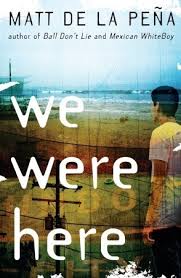
We Were Here by Matt de la Peña (YA)

We Were Here

We Were Here     

Matt de la Peña (Young Adult Fiction)

I can sometimes make stuff happen just by thinking about it.  I try not to do it too much because my head mostly gets stuck on bad stuff, but this time something good actually happened: the judge only gave me a year in a group home.  Said I had to write in a journal so some counselor could try to figure out how I think.  Dude didn’t know I was probably gonna write a book anyways.  Or that it’s hard as hell bein’ at home these days, after what happened.  So when he gave out my sentence it was almost like he didn’t give me a sentence at all.

Miguel Castañeda had a plan for getting through his one-year sentence in a group home: write in his journal, keep to himself, pretend to call his mom every Sunday, and read every book on the home’s bookshelves.  Just be a ghost—invisible and non-existent.  That plan was changed when he was assigned to share his room with Rondell, a big black kid that was once his cellmate in Juvi.  And then there was Mong, a skinny, tough, and silent Chinese dude with scars on his cheeks and a psycho smile.  Suddenly a year seemed a whole lot longer.  And then one night, Mong asked Miguel to escape with him to Mexico.  Maybe a new start away from California is just what he needed.  Maybe it’s the clean start he so wanted.

We Were Here was one of those books that I kept checking out and returning—always meaning to read it but getting distracted by something else.  Shame on me for not giving de la Peña’s work the attention it deserved.  We Were Here is gritty, raw, candid, bleak, and insightful.  It’s also a stark reminder to never judge a book by its cover.  The author introduces us to kids like Miguel, Mong, Rondell, and others who have found themselves on the wrong side of the law for one reason or another.  Each has their own story and shows us how one wrong decision or personal tragedy can set off a series of events that ultimately lands them in a group home, juvenile detention, or jail.  We get to meet these kids and understand that many are more than the sum of their parts and just need what Miguel so urgently desires—a second chance.

We Were Here is filled with heart, honesty, and hope.  The characters are realistically portrayed and de la Peña avoids simply making them ethnic caricatures by giving them depth, warmth, a deep vulnerability, and an underlying desire to make honorable and decent choices.  Narrated by Miguel through a series of personal journal entries, this story demonstrates just how far the bands of friendship can be stretched without breaking and the value of choosing loyalty over personal desire.

Matt de la Peña opened his book with an excerpt from Denis Johnson’s “From a Berkeley Notebook” and I thought it would be an appropriate way to close this review.  It beautifully depicts Miguel’s personal transformation and how events in our own lives can make each of us strangers to ourselves:  “One changes so much/ from moment to moment/ that when one hugs/ oneself against the chill/ air at the inception of spring, at night,/ knees drawn to chin,/ he finds himself in the arms/ of a total stranger,/ the arms of one he might move/ away from on the dark playground.”

Rating: 5/5

*Book cover image attributed to www.goodreads.com

**Want more?  Visit our Facebook page at www.facebook.com/thedustyjacket

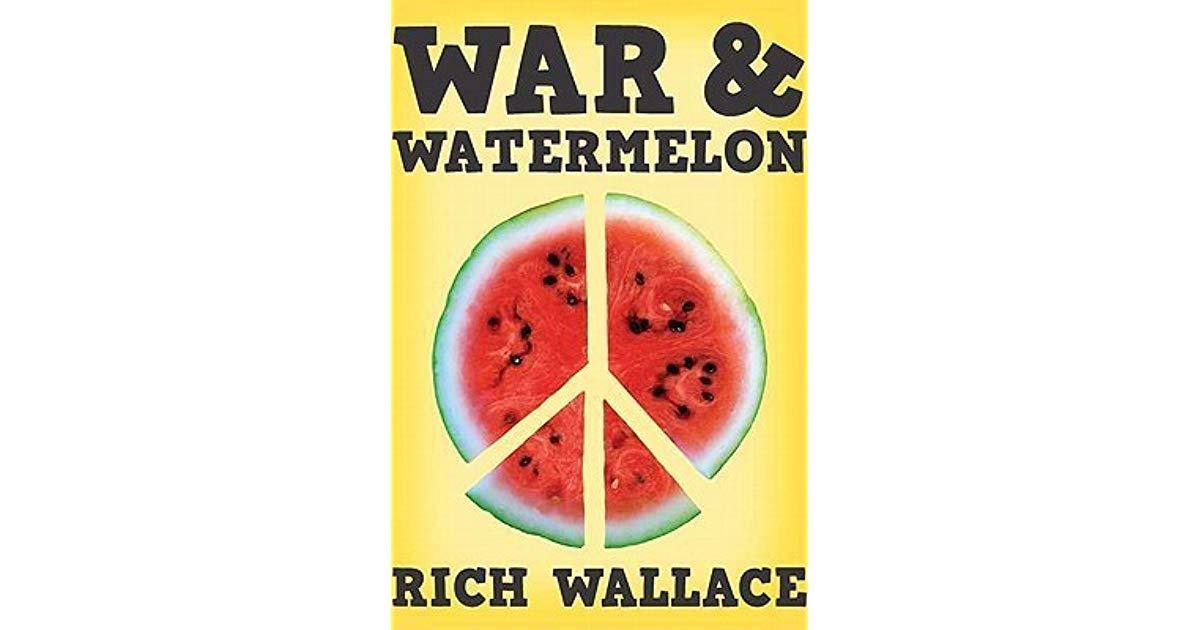
War & Watermelon by Rich Wallace (YA Historical Fiction)

It’s Tween & Teen Tuesday when we review either a Juvenile (J) or Young Adult (YA) book.

War and Watermelon

War & Watermelon    

Rich Wallace (Young Adult Historical Fiction)

If you were to rank boys based on “coolness”, Brody Winslow would be near the bottom…low-middle at best.  But things could be worse.  It’s August 1969 and his brother Ryan could STILL avoid the draft (if he just got off his butt), the New York Mets COULD win a game (if they just got off their butt), and Brody MIGHT be a starter on his football team (if he could just stay off his butt).  All in all, things are looking pretty good.  In less than a month, Brody will be starting junior high school and his brother has promised to take him to a farm in upstate New York for some hippie concert protesting the war in Vietnam.  That might be fun.  Big changes are coming and Brody is about to tackle them all…whether he’s ready or not.

Rich Wallace started his early writing career as a sports editor for various New Jersey newspapers and his talent shows in War & Watermelon where the football and baseball references abound.  But what’s really at the core of this tender and sentimental book is the special bond shared by brothers Ryan and Brody.  Unlike the competitive or jealous sibling relationships you find in some books, the Winslow boys are fiercely supportive, loyal, and kind to one another.  As Ryan’s 18th birthday approaches—along with his draft status—Brody senses his brother’s increasing anxiety and is not sure how to comfort him: “I should get to bed; we’ve got another game tomorrow night.  But I wouldn’t be sleeping anyway, so I’d rather stay here with Ryan.  He’d been there for me.  Teaching me how to shoot a basketball or cook a hot dog.  Taking me to the movies, even when he goes to the drive-in with Jenny.  Giving me things like a Giants jersey he got too big for, or a flashlight when I was four and scared that there was a monster in my closet.  Now he’s scared.  I’m scared, too.  We might as well sit here together.”  There’s also a tight-knit relationship between Ryan, Brody, and their father.  Nights sitting up cheering on their Mets while eating olives and saltines or laughing out loud to re-reruns of The Honeymooners are clearly enjoyed and treasured by all three.

War & Watermelon is a humorous and delightful book about one young man trying to make a difference and one boy trying to make it through the day.  It’s a little slice of Americana served with grape soda pop and a bag of pretzels in front of a black and white TV.  It isn’t dramatic, suspenseful, thrilling, or riddled with angst.  Some may even go so far as to call it trite or boring.  But as Brody Winslow once said, “We wander around for an hour, shoot some baskets, then go home.  Yeah, it was boring, but that’s life.  Boring isn’t always so bad”.  I would even venture to say that boring can be great…now pass the olives and turn on the TV!

Rating: 4/5

* Book cover image attributed to www.goodreads.com 

**Want more?  Visit our Facebook page at www.facebook.com/thedustyjacket