

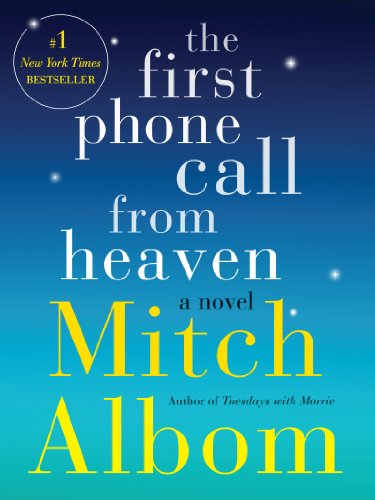
The First Phone Call from Heaven by Mitch Albom

The First Phone Call from Heaven

Mitch Albom (Adult Inspirational)

It was a rather ordinary day in the small, quiet town of Coldwater, Michigan. A day when a phone call would forever change the town—and soon the world—forever. The last time a phone call had such an impact was on March 10, 1876 when Alexander Graham Bell made the world’s first phone call to his assistant, Thomas Watson, and infamously uttered, “Mr. Watson—come here—I want to see you.” The phone call received by Tess Rafferty was just as improbable and consequential because this call came from Heaven. As more people came forward to share their own calls, one man remained skeptical and determined to prove this wonderful miracle was nothing more than a cruel and heartless hoax.

I fell in love with Mitch Albom after reading Tuesdays with Morrie and he has again presented me with another beautiful bouquet in the form of The First Phone Call from Heaven. He gives us several characters to follow as each receives a phone call from the afterlife, but he keeps us focused on three central individuals: Sully Harding, widowed father and newly released from prison who refuses to buy in to the religious narrative; Katherine Yellin, real estate broker who receives the second call but is the first to announce it publicly; and Police Chief Jack Sellers, divorced and father to a son lost in combat who must maintain law and order while trying to grapple with his own truth. Woven through all of these stories are historical facts and tidbits about Alexander Graham Bell, which I really enjoyed learning: stories about his mother and wife who were both hearing impaired, his close brush with obscurity, and the actual creator behind the standard telephone greeting “Hello” (hint: it wasn’t Bell who suggested “Ahoy!”). All of these references could have seemed forced and out of place, but Albom connects the past to the present as effortlessly as we are able to connect with one another today.

Albom’s faith is clearly the heart of this book as heavenly callers reassure their living recipients that they are well, happy, and that Heaven is indeed real. Sadly and realistically, we witness a beautiful event spiraling out of control as protestors seek a platform and news outlets realize the potential profit that faith and hope hold. It was Winston Churchill, working to form the United Nations after World War II, who said, “Never let a good crisis go to waste.” I’m sure it was a media mogul who might have been tempted to tack on “…or a miracle either.”

This is a wonderful story of faith challenged, hope questioned, and lives altered as the impossible becomes possible and the unknown is made clear. And whether you’re a believer, non-believer, or agnostic, one thing we can agree on—that remains as true today as it did in 1876—is that a single voice spoken through wires has the ability to change life forever.

Rating: 5/5

* Book cover image attributed to: www.abebooks.com

We’re now posting videos of some of our book reviews! Follow us on Facebook at www.facebook.com/thedustyjacket or on Instagram @tdjreviews and join in on the fun!
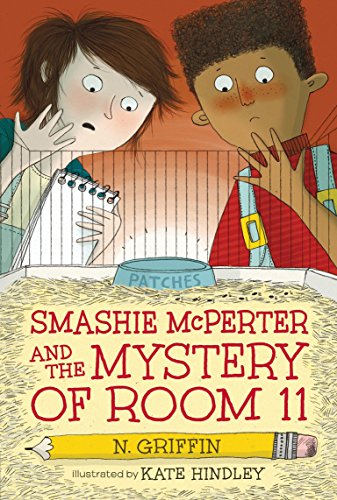
Smashie McPerter and the Mystery of Room 11 by N. Griffin (J Mystery)

Smashie McPerter and the Mystery of Room 11

N. Griffin (J Mystery)

The third-grade class in Room 11 at Rebecca Lee Crumpler Elementary School was NOT having a good day. Between a vain, mean substitute teacher, a missing class hamster, and a nasty, sticky prank it was enough to make Principal Armstrong SIMPLY ILL. I mean, ILL IN BED WITH AN IV DRIP kind of ill! No. This was NOT how the students of Room 11 behaved. On top of that, when Smashie’s public dislike for Patches the hamster makes her the prime suspect in his disappearance (just because she thinks hamsters are just mice with chicken feet), it’s up to her and her best friend Dontel to solve the case or else Room 11 may never be the same again.

This is a great book that not only teaches critical thinking and deductive reasoning skills, it also illustrates the importance of giving someone the benefit of the doubt, how it’s possible to do something wrong but for the right reason, and how difficult it is to earn trust while it’s very easy to lose it. Lots of wonderful lessons with two central characters who balance each other nicely. While Smashie is reactive, impulsive, and emotional, Dontel is logical, thoughtful, and realistic. And while it causes some angst on Smashie’s part when Dontel doesn’t agree with her, he proves to her that disagreeing doesn’t mean disloyalty because it takes a real friend to point out your mistakes and a better friend to admit when it’s true.

Griffin gives readers a cute and age-appropriate story that really picks up steam near the end. The only problem I had was with a few of the references: …frog-marching the hapless Mr. Carper downtown, …Smashie beat a loud tattoo on its door, …he schooled his features, and (this one is a doozy) I was throwing the poor thing a bone said by a male teacher to a female teacher in an attempt to excuse his failed flattery attempts. Not to mention Dontel telling Smashie to slap my hand with your hand rather than just saying, “High five!” or “Gimme five!” and I was wondering if these references would be lost on Griffin’s audience. Still, this is a fun and entertaining read that shows if you’re strong and stand up for what you know is right, everything will work out in the end…even if you still think hamsters are just mice with chicken feet.

Rating: 4/5

* Book cover image attributed to: www.abebooks.com

We’re now posting videos of some of our book reviews! Follow us on Facebook at www.facebook.com/thedustyjacket or on Instagram @tdjreviews and join in on the fun!
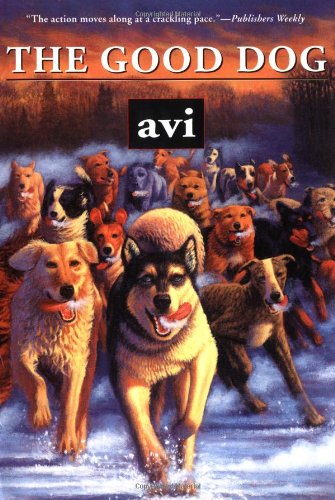
The Good Dog by Avi (J Fiction)

The Good Dog

Avi (J Fiction)

McKinley was a good dog who lived a good life. He was part of a caring family, loved by his human pup Jack, had lots of friends, and held the distinction of being head dog of the Steamboat pack. Yes, life for the malamute was very good until the day a she-wolf by the name of Lupin arrived. Her words of freedom and wild enticed McKinley as he began to feel the burden of taking care of both his pack and his pup. Lupin had him questioning his life as a bound dog…a slave to humans and their will. As McKinley begins to witness the cruelty that humans were capable of, would he submit to his wolf ancestry and join Lupin to live a life without rules and conditions? What would a good dog do?

Although this story was written in the third person, Avi delights readers with a story told from a dog’s perspective. He gives us street names like Most Cars Way, Pine Smell Way, and Elk Scat Way. Jack loves to look at his staring papers (a book) while his parents seem mesmerized by their glow box (TV) and during the day, all the pups go to their special house (school). Avi shows us McKinley constantly “marking” certain areas so that his pack will know his comings and goings, he goes through the ritual of when dogs meet each other, and even describes McKinley’s frustration while trying to convey a rather simple concept to Jack (humans can be SO thick at times).

Avi checks all the right boxes with The Good Dog: age appropriate, an engaging story, memorable characters, great moral lessons, plenty of action and suspense, a few detestable villains, a hero who questions his purpose, some surprising twists, and an ending that’s sure to please. This book shows readers the value of loyalty, honor, and courage and illustrates how bloodline doesn’t dictate who your family is or where your future lies. Countless times McKinley is always looking out for Jack or a member of his pack and although he reaps both the rewards and punishments of his actions, these selfless acts make it clear why he was chosen to be head dog.

Throughout the book, McKinley was a friend, a best friend, a companion, a nemesis, a hero, a champion, and a leader. At the end of the day though, McKinley was just a dog, but more than that, he was a good dog.

Rating: 5/5

* Book cover image attributed to: www.abebooks.com

We’re now posting videos of some of our book reviews! Follow us on Facebook at www.facebook.com/thedustyjacket or on Instagram @tdjreviews and join in on the fun!

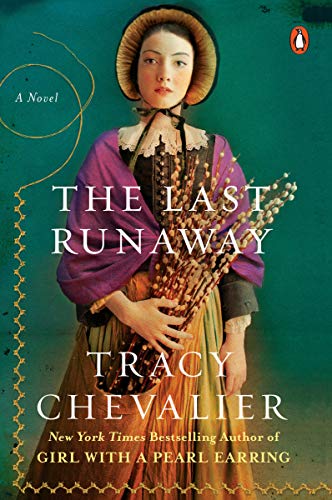
The Last Runaway by Tracy Chevalier (Adult Historical Fiction)

The Last Runaway

Tracy Chevalier (Adult Historical Fiction)

She had grown up with the understanding that slavery was wrong and must be opposed, but that had been all thoughts and words. Now she must actually do something though she did not yet know what.

Honor Bright left her family in Dorset, England to accompany her sister, Grace—set to marry a fellow Quaker—to America. It’s 1850 and the federal government is on the cusp of passing The Fugitive Slave Act, which would strengthen the rights of slave owners while threaten the rights of free blacks. Upon Honor’s arrival, tragedy forces her to solely navigate these new customs and laws…laws which conflict with her Quaker beliefs. When she befriends Belle Mills, a no-nonsense and generous milliner, and Mrs. Reed, a free black woman, Honor unwittingly becomes part of the Underground Railroad and will be forced to choose between her principles and her family.

This is the third book by Chevalier that I’ve read and her stories and characters never seem to disappoint. Alternating between third-person narration and first-person point-of-view through letters written by and to Honor, The Last Runaway is a thrilling story set in the harsh, untamed, yet beautiful backdrop of Ohio. Not only does Honor have to adjust to a new family and a harsh climate, she also has to navigate the unwanted attention from a would-be romantic interest, wariness from the locals, familial hostility, and a political environment that goes against everything she’s been taught. Rather than buckle under the weight of these challenges, Honor finds a way to acclimate and even discovers a unique way to protest and stand up for what she believes in.

Chevalier gives us several rich and multi-dimensional characters that keep the action and suspense going at a steady pace with a satisfying and unexpected climax at the end. The author provides necessary backstories so readers better understand her characters’ motivations to prevent false assumptions being made while allowing some amount of empathy to be extended to characters who might on the surface not deserve it.

Throughout the story, Honor is desperately searching for her place in the world…a “slot” in which her life was meant to fit. Bestselling author Robert G. Allen once wrote, “Everything you want is just outside your comfort zone.” Honor Bright abandoned her comfort zone by leaving her home, traveling across an ocean, braving blistering summers and unrelenting winters, learning to milk cows, and defying her family and community. By doing so, Honor did get everything she wanted and finally found a reason to stop running.

Rating: 5/5

* Book cover image attributed to: www.abebooks.com

We’re now posting videos of some of our book reviews! Follow us on Facebook at www.facebook.com/thedustyjacket or on Instagram @tdjreviews and join in on the fun!
The Boy with the Butterfly Mind by Victoria Williamson (J Fiction)

The Boy with the Butterfly Mind

Victoria Williamson (J Fiction)

Elin has never been in trouble for anything in her whole life. She is smart, respectful, and helpful. A perfect princess determined to get her divorced parents back together…even though her mother is in a relationship and her father is married. Elin has everything under control, but she doesn’t have any friends. After all, it’s lonely being so perfect all the time. Then there’s Jamie who seems to be a magnet for trouble. He has ADHD and is easily distracted, forgetful, and messy. His parents are also divorced and Jamie blames himself…as he often does for most things that go horribly wrong. It would be nice if he had a friend to talk to, but it’s lonely being bad all the time. When these two very lonely and different worlds collide, order and chaos not only meet, but they end up living together in a house that seems to grow smaller by the minute.

The Boy with the Butterfly Mind is told from the alternating viewpoints of Elin and Jamie—both eleven. Although you understand the internal and emotional struggles of both characters, it is far easier to be sympathetic towards Jamie. Although he is completely aware of his challenges and limitations, he still absorbs an unfair amount of guilt and blame while managing to maintain a trusting and forgiving attitude. His journey is a rollercoaster ride of emotions and just when we think his life is getting easier, the rug is mercilessly pulled out from him. With so much against him, we can’t help but cheer on this perpetual underdog.

Williamson is a primary school teacher with a Master’s Degree in special needs education. She’s worked with children requiring additional support needs and this real-world experience is evident in her writing. We see it as Jamie details his struggles and feelings and especially when he describes his interactions with his mother who is completely overwhelmed and emotionally drowning. These occurrences are raw and ugly and uncomfortably accurate. When Jamie hurts, we hurt, which makes this book all the more thought provoking and poignant.

By focusing on Jamie, I don’t mean to downplay Elin and her feelings. She, too, is struggling with her own demons as she feels that the only way to win her father back is to maintain a level of perfection that is both unrealistic and impossible. She puts undue pressure on herself and the introduction of an imperfect and unwanted addition to her family just adds to her burden. It’s a lose-lose situation for everyone and we can’t help but wince as we witness the walls around these people come tumbling down. However, the measures that Elin takes in her own personal “war” against these unwanted intruders are both cruel and dangerous and under these circumstances it is difficult to extend her any mercy or grace although she is keenly aware and witnesses the consequences of her actions.

Using data from 2016-2019, the Centers for Disease Control and Prevention estimated that 6 million children—between the ages of 3 to 17—were diagnosed with ADHD, which is why books like this one are so important and valuable. To show the bullying and isolation that children with this diagnosis experience is just the first of many steps that need to be taken to promote understanding, acceptance, and inclusion.

There’s a quote about friendship that I’ve used before in a review that’s from an anonymous source. It’s one of my favorites: A friend is one who overlooks your broken fence and admires the flowers in your garden. Although Jamie felt broken and just wanted to be “normal”, he was lucky enough to find such a friend who made him realize that you don’t have to be perfect in order to be a perfect friend. I think the world would be a much better place with more people like that in it and I’m glad that Elin eventually realized this, too.

Rating: 5/5

* Book cover image attributed to: www.abebooks.com

We’re now posting videos of some of our book reviews! Follow us on Facebook at www.facebook.com/thedustyjacket or on Instagram @tdjreviews and join in on the fun!

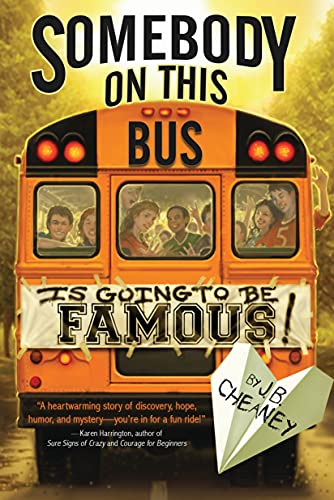
Somebody on This Bus is Going to Be Famous! by J.B. Cheaney (J Mystery)

Somebody on This Bus is Going to Be Famous!

J.B. Cheaney (J Mystery)

Somebody knows more than he or she should. That’s the link they’re missing, but they may have a way to find it.

The elementary school bus that serves Hidden Acres Subdivision has a motley assortment of students: the celebrity, bully, talker, innovator, the brain, adapter, jock, pleaser, and the new kid. Today was the start of the school year, but their driver took an expected turn onto Farm Road 152 and pulled alongside an empty bench. No one was waiting and no one boarded, yet day after day the bus took this same route to the same empty bench. And then things began appearing at the stop. Things that held a specific connection to certain kids on the bus. As questions about the mysterious stop lead to events that happened many years ago, unlikely alliances form to reveal answers that will surprise everyone…and make somebody on the bus famous.

Not since Ellen Raskin’s The Westing Game have I taken so many notes on a book (ten journal pages in case you’re wondering). With nine central characters and story lines to keep track of, not including the bus driver, it’s a lot to keep straight and remember. Luckily, Cheaney does an excellent job of giving each character their turn in the spotlight as we are introduced to their homelife and get to understand a little about what makes them tick. What the author eventually shows us is that you can’t always judge a book by its cover as these multi-dimensional characters are dealing with some very complex and complicated family issues—most of which seem to stem from absentee, apathetic, or annoying fathers. This book did have a surprising amount of daddy issues, although a lot of the moms don’t come across much better.

This book has a recommended reading age of 10 to 13 years, which is appropriate for the content. There are multiple innuendos regarding profanity; however, one character’s grandparent is suffering from dementia so some statements made are mildly lewd and inappropriate. While the subject matter is sobering, Cheaney handles it compassionately and realistically. And although there are a lot of moving parts to this story, it is an exhilarating ride that really picks up speed during the last fifty pages where all the dots begin to connect. Add to that a harrowing bus accident (which is where our story began) and you have non-stop action and suspense. The only complaint I had is at the very end of the book, the author mentions a bonus chapter and provides two different URLs to visit in order to see what happened to our gang of nine. When I accessed the links (I like closure), neither worked so let this be a warning to all authors: forego the marketing gimmicks and just put whatever you have to say in print. Technology is a fickle beast.

American television host and author Fred Rogers once said, “Fame is a four-letter word; and like tape or zoom or face or pain or life or love, what ultimately matters is what we do with it.” And although I won’t ever know what came next for the celebrity, bully, talker, innovator, the brain, adapter, jock, pleaser, and the new kid, I’d like to think that they each realized their own value and worth because to me that’s much better than being famous.  

Rating: 5/5

* Book cover image attributed to: www.abebooks.com

We’re now posting videos of some of our book reviews! Follow us on Facebook at www.facebook.com/thedustyjacket or on Instagram @tdjreviews and join in on the fun!
Island of the Blue Dolphins by Scott O’Dell (J Fiction)

Island of the Blue Dolphins

Scott O’Dell (J Fiction)

Twelve-year-old Karana loved her village of Ghalas-at where everyone had their place and knew their role. Life was good until the day the Aleut ship—with its two red sails—arrived at the Island of the Blue Dolphins to hunt otters. What should have been an amicable partnership turned into betrayal and bloodshed and would mark the beginning of a new life for Karana and her people. With most of their men dead, the villagers spot another ship, this one bearing white sails and wanting to take them all to somewhere safe. But fate intervened and Karana found herself abandoned and alone on her beloved island. As she awaits the ship’s return, Karana learns how to survive while avoiding danger both on and off the island. As the years pass, she continues to scour the water looking for the sails: white will reunite her with her family while red will surely bring her death.

Based on the true story of a Nicoleño woman who survived alone on San Nicolas Island for 18 years, Island of the Blue Dolphins is a story of courage, survival, and perseverance. With only herself to rely on, Karana quickly disregards the laws of her village which forbade women to make weapons. She also finds a safe place to sleep, stocks food, constructs a home, and secures her property. Only when she becomes injured does she truly understand the precarious position that she is in: if she is incapacitated, no one else will care for her and she will most certainly die. This new realization causes an awakening in Karana and we see her mature almost overnight.

It would have been easy and appropriate for O’Dell to allow Karana time to grieve and buckle under the weight of her predicament and tremendous responsibilities. Instead, he gives us a character who rises above her circumstances to forge a new life for herself while finding courage, compassion, and companionship along the way.

Although O’Dell gave us Karana in 1960, I hope that a new generation discovers her and finds a heroine who doesn’t need a wand or cape or superhuman abilities to prove her worth or to define who she is. Karana shows us that often times a great heroine is strong and brave and kind not because of who she is, but because life requires it of her and she fearlessly chooses to answer the call.

Rating: 5/5

* Book cover image attributed to: www.abebooks.com

We’re now posting videos of some of our book reviews! Follow us on Facebook at www.facebook.com/thedustyjacket or on Instagram @tdjreviews and join in on the fun!
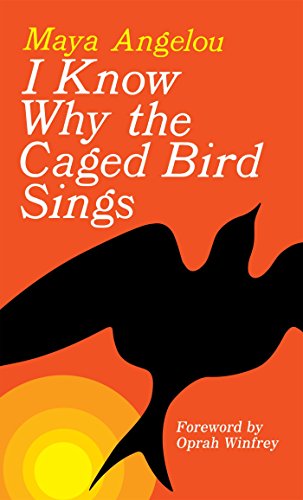
I Know Why the Caged Bird Sings by Maya Angelou (Adult Autobiography)

I Know Why the Caged Bird Sings

Maya Angelou (Adult Autobiography)

If growing up is painful for the Southern Black girl, being aware of her displacement is the rust on the razor that threatens the throat. It is an unnecessary insult.

Before she became Maya Angelou, she was Marguerite Johnson. When she was three, Marguerite—along with her four-year-old brother, Bailey—was shipped from Long Beach, California to Stamps, Arkansas bearing little more than an identification tag with instructions on her wrist. The pair was sent to live with their paternal grandmother and crippled uncle. It was here where young Marguerite would watch the poor Blacks picking cotton in the fields, fall in love with Shakespeare, experience prejudice and hate from people far poorer and less educated than herself, and learn her multiplication tables. In the years following, she would be shuffled back and forth between her mother, father, and grandmother while surviving rape at the age of eight, celebrating her first library card, getting her first job, and experiencing motherhood.   

Angelou’s autobiography, which details her life from age 3 to 17, spent two years on the New York Times paperback bestseller list, was nominated for a National Book Award, received the Literarian Award in 2013, and yet remains one of the most banned and/or challenged books in America for its violence, racism, sexuality, childhood rape, and teen pregnancy.

Banning Angelou’s work—set in the 1930s and 40s and told from the lens of a young Black girl—because of its violence and racism is akin to banning a book on war because it’s too bloody. To measure a book set in the past using today’s racial, moral, and ethical standards is unreasonable, unfair, and unrealistic. It’s a false equivalent and no historical work, person, or idea could ever pass such a litmus test. Yes, Angelou’s book contains everything that it was banned for, but chastising these honest and true observations, experiences, and thoughts through removal doesn’t make our schools or society any better for it. How can it?

I Know Why the Caged Bird Sings is gritty, sobering, shocking, and compelling while being uplifting, witty, honest, and hopeful. Angelou shares memories of her first Valentine, her 8th grade graduation, the stability a new stepfather brought to her family, her multiple scholarships to the California Labor School, the summer when she and her father took an unforgettable trip into Mexico, the month she lived in a junkyard, and being the first Black to work on the San Francisco streetcar system. At every turn, Angelou seemed to live her mother’s advice: Life is going to give you just what you put into it. And Angelou gave it her all.

Angelou’s title of her autobiography is a reference to Paul Laurence Dunbar’s poem “Sympathy”, which is filled with empathy for a bird longing and crying out for freedom. After reading Angelou’s early years, I felt that the caged bird sings because that was what it was born to do. Angelou is that bird and despite the limitations and bars placed around her, she refused to be a prisoner or a victim. She never stopped at finding a way to make the impossible possible and whenever she felt helpless or weakened, she rose above it all and sang because that was what she was born to do. Through her books and poetry, generations will continue to enjoy Maya Angelou’s song as long as we, as a society, are brave enough to keep the cage door open for all to hear.

Rating: 5/5

* Book cover image attributed to: www.abebooks.com

We’re now posting videos of some of our book reviews! Follow us on Facebook at www.facebook.com/thedustyjacket or on Instagram @tdjreviews and join in on the fun!
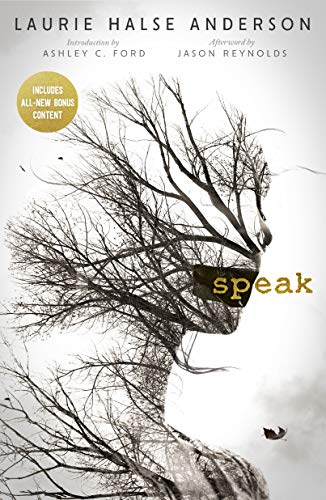
Speak by Laurie Halse Anderson (YA Fiction)

Speak

Laurie Halse Anderson (YA Fiction)

It’s Melinda Sordino’s first year at Merryweather High. A time of change and cliques, of fitting in or being left out, and lots of ups and downs and possibly even a few sideways. But for Melinda, her year is already beginning with a dark cloud hanging over her. While other teens are covering up their acne, Melinda is covering up her shame of being raped…and it’s not easy. Every fiber in her being wants to scream out and tell the world what happened to her, but why speak when nobody—not even your best friend—wants to listen?

Speak is the very reason why I immediately have to get my hands on a book as soon as it’s been challenged or banned. It’s like a bat signal that drones over and over again read me read me read me. Published in 1999, Speak was ranked 60th on the American Library Association’s list of Top 100 Banned/Challenged Book for 2000-2009 and 25th for 2010-2019 for its inclusion of rape and profanity, deemed biased against male students, and blasted for containing a political viewpoint. I am shaking my head so furiously right now that I’m awaiting our local meteorologist to report a 6.5 magnitude tremor for my area any minute now. The profanity is mild, a fellow student stands up to a teacher who is trying to stifle a class debate, the girls in the book come off WAY harsher than the boys, and the rape scene is as follows: …he smells like beer and mean and he hurts me hurts me hurts me and gets up and zips his jeans and smiles. Feel that? I think that tremor may have hit 6.8 by now.

This is a gritty, raw, painful, and ultimately inspiring book about a young girl desperately trying to piece her life and sanity back together after it was gutlessly and maliciously ripped apart—her innocence robbed one summer night on the wet, dark ground. Told from Melinda’s point of view adds another layer to this complex and haunting story that shouldn’t be banned, but instead handed out to every teenager on the planet. By banning this book, the “powers that be” are truly no different than Melinda’s friends who choose to excommunicate her as she brings light to an unfortunate truth…that some individuals are just bad, no matter how attractive the packaging might be. Anderson’s message is far too important to ban to a dark corner. They say light is the best disinfectant and this book needs to be on every bookshelf and in every hand and hopefully there is a teacher or parent or trusted advisor there to read alongside to offer insight, context, and comfort.

I’ve never pored through a book so quickly before and that’s simply because Anderson ensnares you from the very first page with her poem “Make Some Noise”. More chills await as you slowly understand the significance of the cover design as Melinda’s story begins to stretch and her truth desperately reaches upward toward the sun so that it may live rather than die in darkness. I hope this book finds the right hands and that any Melinda out there finds someone like Melinda’s art teacher, Mr. Freeman, who says, “You’re a good kid. I think you have a lot to say. I’d like to hear it” because then, maybe, that would open up the door for someone to speak.

Rating: 5/5

* Book cover image attributed to: www.abebooks.com

We’re now posting videos of some of our book reviews! Follow us on Facebook at www.facebook.com/thedustyjacket or on Instagram @tdjreviews and join in on the fun!

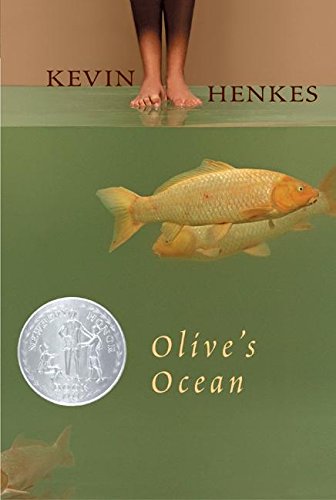
Olive’s Ocean by Kevin Henkes (J Fiction)

Olive’s Ocean

Kevin Henkes (J Fiction)

Twelve-year-old Martha Boyle and her family were leaving on their annual vacation to the Atlantic coast when a woman appeared on the Boyle’s doorstep. She introduced herself as Olive’s mother, one of Martha’s classmates who had recently been killed. She handed Martha a folded piece of paper from Olive’s journal. As Martha read the note written by a girl she barely knew, she was struck by just a few simple sentences: I hope that I get to know Martha Boyle next year (or this summer). I hope that we can be friends. That is my biggest hope. These kind words filled with expectation would alter Martha’s world view forever as she mourns a friendship that never was and never will be.

I raised my child on Kevin Henkes’ mouse books: Chester’s Way, Owen, Wemberly Worried, and others. Each helped me reinforce the value of friendship and the importance of acceptance, handling your emotions, self-reliance and many other life lessons. When I saw that Olive’s Ocean was a Newbery Honor book, I wasn’t really surprised. What DID surprise me was that it ranked 59th on the American Library Association’s list of the 100 Most Challenged Books from 2000 to 2009 for its offensive language and sexual explicitness. No wonder Wemberly worried!

Despite the ominous label it carries, Olive’s Ocean is a rather innocuous coming-of-age story about a girl dealing with the customary pre-teen fare: first love, awkwardness, rejection, humiliation, and the constant struggle of trying to figure out who she is and what she wants to be. Pretty safe stuff, but Henkes does nudge the boundaries ever so slightly causing those few, all-important feathers to be ruffled.

The “sexually explicit” reference is a brief explanation to Martha by her older brother of why their parents seem overly affectionate one morning. It seems they were exhibiting “Morning Sex Behavior” and “when they do it in the morning” they get a bit lovey-dovey. Regarding the “offensive language”, there are instances of mild profanity, but nothing too over-the-top for the publisher’s recommended reading age of 10 and up. So, the big questions are: Are EITHER of these inclusions necessary to further the story or develop the characters? No. Could they have been excluded with little to no impact on the overall message? Absolutely. Would Henkes have omitted them if he knew the wrath that awaited him? Maybe. Maybe not. There’s no question that having your book banned instantly puts you on a reader’s radar, but clearly this was not his intent. All in all, these infractions (as most references go) are tame, but clearly remain unforced errors and prompt me to up the recommended reading age by a few years just to be prudent.

As far as stories go, this was a quick read and had several important messages about inclusivity and realizing that the world doesn’t revolve around your own personal cares and needs; however, I would have liked more Olive in Olive’s Ocean and feel that this was an opportunity wasted. The apparent connection between Olive and Martha stated in the synopsis doesn’t quite materialize in the actual book, and it would have been far more interesting if Olive’s story had been developed more deeply to show Martha’s slow and eventual evolution. Still, the targeted audience will find a nice and relatable story, while I was hoping for something a little bit more moving with a deeper and lasting message. I guess if I’m looking for these, I need to go back to the mouse stories.

Rating: 3/5

* Book cover image attributed to: www.abebooks.com

We’re now posting videos of some of our book reviews! Follow us on Facebook at www.facebook.com/thedustyjacket or on Instagram @tdjreviews and join in on the fun!