
Heft by Liz Moore

Heft

Heft 

Liz Moore (Adult Fiction)

Arthur Opp hasn’t been weighed in years.  Back then, he was 480 pounds, but he’s probably between 500 and 600 pounds now.  He lives in isolation in an aging yet expensive brownstone in Brooklyn and hasn’t taught a college class in eighteen years.  Kel Keller is seventeen, athletic, and popular amongst his friends.  He’s a poor kid from Yonkers who attends an affluent school and dreams of playing professional baseball.  What these two very different people don’t realize is that they have something in common…a woman by the name of Charlene Turner.  Charlene is Kel’s mother and Arthur’s former student and she is about to alter both their lives when she decides to pick up the phone and ask Arthur for a simple favor.  Suddenly, Arthur is forced to open himself up to the outside world while Kel is forced to open his eyes to discover the girl his mother used to be.

I really enjoyed Heft and was impressed with Moore’s proficiency in writing as a middle-aged ex-professor struggling with obesity and isolation and then as a teenaged boy caught between the worlds of poverty and prosperity while dealing with his mother’s insecurities.  The story moved along at a nice pace and rarely lagged, even through multiple character flashbacks.  There were several supporting and interesting characters in the story, but the one that stood out to me was Arthur’s maid, Yolanda.  She’s a spitfire and truly the yin to Arthur’s yang.  We see a whole new side of Arthur when Yolanda is around and that was a pleasure to experience.  Despite the praise, I did have a few issues with this book that prevented me from giving it a full five-star rating.

The first problem I had (might not be as big a deal to others) was when Moore was writing as Arthur.  For his “voice”, she chose to flip back and forth between using an ampersand (&) and the word “and”.  At first, I thought maybe something slipped by copy editing, but when it happened repeatedly and then when she started a sentence with an ampersand (and she even began a paragraph with it), I just about popped.  This is a deliberate style choice that Moore made for this character, but it prevented me from totally immersing myself in Arthur’s story since I had to constantly decode such sentences as “I read it twice. & then I read it three more times.”  *pop*

Another problem was the last part of the book. Although Moore delivers a story that is touching, insightful, and uplifting, I felt that at the end of the book, there was something missing.  If I were to describe it (so as not to spoil the story), it would be like buttoning your shirt and realizing only when you got to the bottom that your shirt was uneven.  You’re going along button to hole, button to hole, button to hole, but despite everything going swimmingly, it doesn’t end up right.  Moore gives us a beautifully written story that seamlessly fits together but the end of the book seems a bit off and I ended up with more questions than answers.

Aside from those issues, I did love how Moore presented Arthur and Kel with such fearless honesty.  Both men are flawed, fractured, and burdened with regret and loneliness, but they are also proud despite their brokenness and willing to open up their hearts regardless of the risk that love often carries with it.  Usually when a book presents two different character threads, I find myself enjoying one more than the other, but with Liz Moore’s Heft, I enjoyed both Arthur and Kel equally and loved laughing and crying with each of them.

Heft is an enjoyable read offering up a message of hope, forgiveness, redemption, and second chances.  It also serves as a reminder to never underestimate the full impact of a seemingly simple act…like making a phone call or asking for help.  As the Dalai Lama once said, “Just as ripples spread out when a single pebble is dropped into water, the actions of individuals can have far-reaching effects.”

Rating: 4/5

*Book cover image attributed to www.amazon.com

**Want more?  Visit our Facebook page at www.facebook.com/thedustyjacket

Dead Boy by Laurel Gale (J)

Dead Boy

Dead Boy

Laurel Gale (Juvenile Fiction)

Being dead stank.  Literally.  With everything rotting, decaying, and decomposing, it really did stink.  And let’s not talk about the maggots and the skin falling off and the hair falling out.  Death was really the pits and eleven-year-old Crow Darlingson should know because Crow is dead.  Well, dead but somehow alive.  If you ask Crow what’s worse than being dead, he would tell you that it’s being alone.  Loneliness really stank.  But along came Melody Plympton, his new neighbor, who somehow accepted his deadness.  Just when things were looking up, Crow and Melody discover a terrifying and mysterious creature hiding in the park.  A monster that also grants wishes.  Could this same creature be the cause of Crow’s unusual existence?  Could Crow somehow wish himself a normal life?  Crow is willing to face whatever tests and dangers the monster throws at him.  After all, once you’re dead, what’s the worst that can happen?

Dead Boy is Laurel Gale’s debut novel and she sure delivers!  She delights and entertains readers with a creepy, ghoulish, sweet, and imaginative story that’s full of heart.  Although it’s labeled as a “horror” story and depicts scenes of maggots falling out of various body parts at inappropriate times (not that there’s an appropriate time), Dead Boy is really a story about a young boy wanting to be accepted and longing for a friend.  Anyone who’s ever wanted a friend who liked and accepted them for just the way they are will empathize with Crow and his unfortunate situation.

What I found refreshing about Crow was his ability to see the positive in any situation and to enjoy what little pleasure life might happen to toss his way.  Here’s a boy with no friends, unable to eat food, incapable of sleep, and whose entire existence is spent indoors surrounded by the safety of air conditioning (he lives in the desert of all places), yet he delights in the simple act of lying beneath the stars and gazing up at the night’s sky.  He’s selfless, understanding, intelligent, loyal, and a true friend in every sense of the word.  He’s probably one of the most unlikely protagonists that I’ve come upon in a long time and I certainly hope he won’t be the last.

Near the end of the book, when the dust has settled after all of his exploits and adventures, Crow realized something important that beautifully sums up the meaning of this book: “Maybe having friends wasn’t as important as having the right friends”.

Rating: 4/5

*Book cover image attributed to www.goodreads.com

**Want more?  Visit our Facebook page at www.facebook.com/thedustyjacket

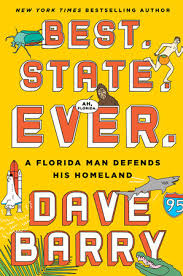
Best. State. Ever. A Florida Man Defends His Homeland by Dave Barry

Best State Ever

Best. State. Ever. A Florida Man Defends His Homeland

Dave Barry (Adult Non-Fiction)

Poor Florida.  A state that has become synonymous with all things weird, daft, looney, loco, nutty, and just plain one-beer-short-of-a-six-pack crazy.  Don’t believe me?  Just Google “Florida Man” along with your birth month and day and ten times out of ten (or REALLY close to it), a corresponding headline will pop up.  For example, on my birthday, this made the headlines: “Naked Florida man breaks into home, tries on woman’s clothes, police say”.  See?  Well let me tell you something.  Dave Barry is S-I-C-K of people wrongfully labeling his beloved state and he’s set out to defend the good name of his hometown by showing us the lighter and brighter (and not necessarily saner) side of “The Sunshine State”.  So, buckle up because you’re in for an interesting and unforgettable ride!

According to Cosmopolitan magazine, women are attracted to guys with a sense of humor.  If that’s the case, then Dave Barry is one of the sexiest men alive.  With Best. State. Ever. A Florida Man Defends His Homeland, Barry gives us Fodor’s on laughing gas.  His book contains countless (truly) laugh-out-loud moments that makes reading in public a somewhat perilous undertaking…unless you love awkward moments and getting suspicious side glances from complete strangers.  Barry lovingly introduces us to real-life, overlooked treasures and he does so with the warmth, adoration, and pride as a parent would present his first-born to the world.  Through wit and black and white photos, we meet Dave Shealy, operator of Skunk-Ape Research Headquarters in Ochopee; we delight in watching mermaids eat underwater (they get hungry, you know) and waving an American flag at Weeki Wachee Springs; and we get to know more than we ever thought imaginable at the Spongeorama in Tarpon Springs.  Using a Florida Tourist Attraction rating system of Out-of-Order Mold-A-Matics, Barry ranks these unsung heroes on a scale from one to five (five being the BEST…and he even rates one attraction a six, but you have to read the book to discover this hidden gem) and offers valuable insights that only a native can appreciate and share.

Read Best. State. Ever. and I promise (or at least hope) that you’ll laugh, you’ll cry (from laughing), and you’ll probably Google “Florida Man” and your birthday as soon as you finish reading this review.  But mostly, you’ll have fun gaining a whole new perspective and appreciation for a state that was not only known as the birthplace of the “hanging chad”, but is also chockful of anything and everything that is weird, daft, looney, loco, nutty, and just plain one-beer-short-of-a-six-pack crazy.

(Reviewer’s Note: If you love the gloriously quirky, kitschy, and sometimes tacky roadside attractions that are a part of our unique culture, then I highly recommend you continue your journey with Betsy Carter’s book entitled Swim to Me about the mermaids of Weeki Wachee.  I think Dave would approve.)

Rating: 5/5

*Book cover image attributed to www.penguinrandomhouse.com

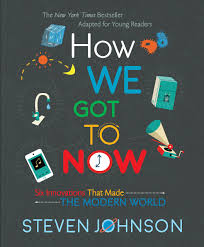
How We Got to Now by Steven Johnson (J Non-Fiction)

How We Got to Now

How We Got to Now: Six Innovations That Made the Modern World

Steven Johnson (Juvenile Non-Fiction Science)

Ever wonder how a plant in Syria could enable scientists to study galaxies and supernovas billions of light-years away?  Or how one man’s desire for a cold drink in the tropics would ultimately change the political map of America?  Or how a 19-year-old boy daydreaming in a church pew would lead to the ability to trace humans crossing into the Americas more than ten thousand years ago?  Well wonder no more as Steven Johnson shows readers how big ideas changed the world and how ordinary people were able to accomplish some rather extraordinary things.

Steven Johnson’s young reader adaption of his New York Times bestselling book has its own “How We Got to Now” story.  His non-fiction book was made into a television version for PBS and the BBC.  After several airings, Johnson began hearing from families (and later schools) who enjoyed watching the show with their children.  He was then approached by Penguin Random House with the idea of adapting his work for a middle grade audience.

How We Got to Now covers the topics of glass, cold, sound, clean, time, and light and Johnson presents each subject in a fascinating step-by-step, connect-the-dots-type story full of interesting facts and tidbits.  If you are familiar with James Burke and his television series Connections, this book follows a similar format so if you enjoy Burke, you’ll find Johnson to be an equally talented historian and storyteller.

How We Got to Now is an ode to the tinkerers, dreamers, inventors, hobbyists, scientists, and reformers who had an idea to make life easier or the desire to make something better.  Some achieved their goals through grueling trial and error while others stumbled upon greatness purely by accident.  Whether it’s a flat and filthy city, a thirsty businessman, or a bored teenager staring at the ceiling of a church, every problem leads to an idea and that idea—however outrageous, ludicrous, or preposterous—marks the beginning of an amazing, unpredictable, and never-ending journey.  To all the future scientists, inventors, innovators, and dreamers, here’s to your success and here’s to now.

Rating: 5/5

* Book cover image attributed to www.amazon.com 

**Want more?  Visit our Facebook page at www.facebook.com/thedustyjacket
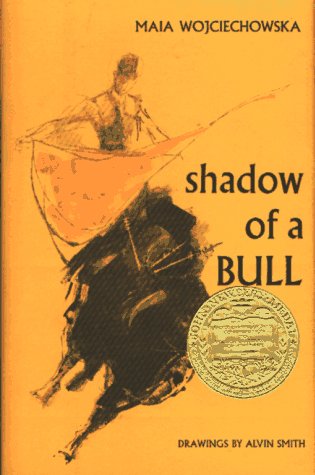
Shadow of a Bull by Maia Wojciechowska (J)

Shadow of a Bull

Shadow of a Bull    

Maia Wojciechowska (Juvenile Fiction)

When Manolo was nine he became aware of three important facts in his life.  First: the older he became, the more he looked like his father. Second: he, Manolo Olivar, was a coward.  Third: everyone in the town of Arcangel expected him to grow up to be a famous bullfighter, like his father.

To be a bullfighter was to be revered for a bullfighter was a hero, a magician, and a killer of death.  In Arcangel, death came in the form of a bull and to conquer death brought glory to yourself, your family, and your country.  Manolo was the son of Juan Olivar, the greatest bullfighter in Spain.  Ever since his father’s death, everyone anxiously awaited the day when Manolo would take his father’s place and Spain would once again have a hero.  But unlike his father, Manolo’s future was not prophesied for greatness and he worried that his heart would never allow him to live up to the expectations of his town or the legacy left by his father.

Maia Wojciechowska’s Shadow of a Bull (winner of the 1965 Newberry Award) is a book brimming with valuable lessons and important messages of self-worth, self-confidence, and self-importance.  She encourages the reader to question the idea of heroes and those we choose to idolize—the celebrated sports figure or the wizened town physician—and she shows us the emotional and physical price of sacrificing your own future in order to carry on someone else’s.  She writes of life versus death, bravery versus fear, and a dream versus destiny.  It’s a lot to take in, but Wojciechowska lays out all of these issues as smoothly as a matador works his cape.

Shadow of a Bull is rich in its history and detail regarding the art of bullfighting.  Readers will learn the training involved and will be introduced to several Spanish terms (pronunciation guide and definitions are included at the back of the book).   It’s an effective primer for the sport that may test the patience of a few readers, but proves interesting nonetheless.  Above all else, Wojciechowska doesn’t let us forget that the heart of this book is young Manolo, a boy wishing to bring honor to his family by fulfilling a future that is beyond his desire or control.  He carries the hopes and dreams of an entire country on his very small shoulders and we feel the weight of this burden grow heavier as the day of his testing nears.  It’s a beautifully told coming-of-age story of a boy trying to discover his place in the world.

Walter M. Schirra, Sr.—a fighter pilot during World War I and father of Wally Schirra, the only astronaut to fly in the Mercury, Gemini, and Apollo programs—once said, “You don’t raise heroes, you raise sons.  And if you treat them like sons, they’ll turn out to be heroes, even if it’s just in your own eyes.”  By being true to himself, Manolo found honor beyond the shadow of a bull and was able to become a hero in his own right.

Rating: 5/5

* Book cover image attributed to www.abebooks.com 

**Want more?  Visit our Facebook page at www.facebook.com/thedustyjacket

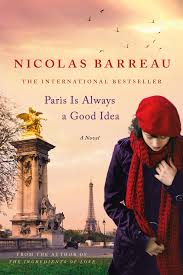
Paris Is Always a Good Idea by Nicolas Barreau

Paris Is Always a Good Idea

Paris Is Always a Good Idea

Nicolas Barreau (Adult Fiction)

“A few days later, on a springlike day in April, the story of the blue tiger entered Rosalie Laurent’s life and changed it forever.  Ultimately there is a story in every life that becomes the fulcrum about which it revolves—even if very few people recognize it at first.”

Rosalie Laurent is the owner of Luna Luna, a charming postcard shop in Saint-Germain.  She sells stationery, paperweights, beautiful pens, and wishing cards—beautiful and unique cards lovingly painted by Rosalie herself.  She is happy (her mother would rather she have a more “respectable” job) and content and although several of her own wishes have gone unanswered, she can’t imagine her life to be any more fulfilled until the day when celebrated children’s author Max Marchais walks—rather trips—into her shop and brings with him a book in need of an illustrator.  Just when Rosalie thinks that all of her wishes are beginning to come true, a handsome American literature professor enters her life with accusations of plagiarism.  So much for wishes.

Nicolas Barreau has written a book as light and sweet as a freshly baked croissant, as colorful and expressive as a Monet painting, and as beautiful and vibrant as the city of Paris itself.  It’s a delightful and charming story brimming with hope, loss, regret, and love…beaucoup d’amour! It’s endearing without being sappy and the relationship between Rosalie and Max shows us that love and compassion can bridge any age gap and provide two souls with the belief that each day is full of promise and possibility.

One of the sweetest aspects of this novel is the blue notebook that Rosalie writes in every night just before going to bed.  In it, she writes just two things: the worst moment of her day and the best.  If I had a blue notebook right now, I would write that the worst moment of the day would be reading the very last sentence of Nicolas Barreau’s lovely book and having to say goodbye to Rosalie, Max, Luna Luna, and the splendor that is Paris.  The best moment of the day would be knowing that there is another book out there with a story and characters who are waiting to touch my heart and brighten my day just like this book has.  After all, reading, just like Paris, is always a good idea.

Rating: 5/5

*Book cover image attributed to www.amazon.com

**Want more?  Visit our Facebook page at www.facebook.com/thedustyjacket
 

The Breaker Boys by Pat Hughes (J)

The Breaker Boys

The Breaker Boys

Pat Hughes (Juvenile Fiction)

Nate Tanner was born into privilege.  For several generations, his family has owned coal mines near Hazelton, Pennsylvania allowing Nate to have anything he desired: the best education, the finest clothes, and a bevy of servants to see to his every need.  What Nate didn’t have was a single friend.  Perhaps it was because of his temper or that he was spoiled or that he was always getting into trouble.  Maybe it was all three.  Like his teacher said, when you had so much, what was left to try for?  But then he met Johnny Bartelak, a Polish American boy who sorts coal in one of his family’s breakers.  Theirs was a friendship that started with a simple bike ride, but would slowly be built with lie upon lie.  How could Nate tell Johnny the truth about his family and how could he possibly tell his family about Johnny?  As the miners begin to talk of joining a labor union, Nate must make the ultimate choice between friendship and family.

The Breaker Boys is based on actual events that occurred on September 10, 1897 at the Lattimer mine near Hazelton, Pennsylvania.  Known as the Lattimer Massacre, nineteen striking immigrant coal miners were killed and thirty-nine others were wounded.  The miners were mostly of Polish, Slovak, Lithuanian, and German ethnicity and author Pat Hughes brings their story and struggles to life in this thoughtful and moving story about friendship, honor, forgiveness, and betrayal.  Although Hughes fills her novel with plenty of conflicts—rich versus poor, father versus son, labor versus management, immigrant versus native—the story never feels bogged down or overly preachy and the action and emotions slowly intensify as Nate’s secret becomes closer and closer to being discovered.

Hughes also takes her time in allowing the reader to get to know Nate Tanner—a spoiled, self-indulgent, self-centered, rude, and disrespectful twelve-year-old boy whose mother died while he was quite young and who has still not forgiven his father for marrying the family’s governess.  To her credit, Hughes made Nate very human and avoided giving him an Ebenezer Scrooge or Grinch moment where he sees the error of his ways and experiences a complete moral transformation.  Nate is, after all, a young boy with a lot of growing up to do and so we continue to see moments of selfishness, arrogance, and stubbornness throughout the book, which makes his character all the more relatable and sympathetic.

The Breaker Boys is gripping and insightful and offers readers a glimpse into American history while illustrating the importance of honesty, the value of friendship, and the gift of second chances.  American educator, author, and businessman Stephen Covey said, “Strength lies in differences, not in similarities” and Pat Hughes shows us that despite differences in class, ethnicity, and religion, two young boys found strength and friendship through something as simple as a bike ride.

Rating: 5/5

*Book cover image attributed to www.amazon.com

**Want more?  Visit our Facebook page at www.facebook.com/thedustyjacket
The Stinky Cheese Man and other Fairly Stupid Tales by Jon Scieszka (J)

The Stinky Cheese Man

The Stinky Cheese Man and other Fairly Stupid Tales

Jon Scieskza (Juvenile Fiction)

Meet Jack:  adventurer, trespasser, thief, giant agitator, and—for this particular occasion—narrator of our story.  But this isn’t just any story, but rather several stories.  Stories of a princess, a fibbing frog, a giant, a tortoise and a rather hairy hare, an athletic little girl, an obnoxious chicken, and yes, a stinky cheese man.  These stories will not only entertain, amuse, and delight, but they may—one day—just save your life!  Don’t believe me?  Just ask Jack.

The Stinky Cheese Man and other Fairly Stupid Tales is a wonderful read-out-loud book that will undoubtedly induce a few chuckles, giggles, guffaws and perhaps an eyeroll or two.  But make no mistake that the star of this book is not the stories, but rather the incredible, award-winning artwork of Lane Smith (who collaborated with Jon Scieszka again in creating The True Story of the Three Little Pigs!).  His over-the-top, dark, eclectic, multi-media illustrations earned Smith the 1993 Caldecott Medal Honor award and are the very vibrant and outlandish heart of this outrageously enchanting book.  Lacking any moral lessons whatsoever, unless you count “When in the presence of giants, it’s best to keep your mouth shut” or “Sometimes there is no happy ever after so get over it”, Scieszka encourages us to see the ridiculous side of life, to accept life for what it is, and to remind us that sometimes tales, even fairly stupid ones, can simply be enjoyed without having an ulterior motive.

Danish author Hans Christian Andersen, known for his own fairy tales, once said, “Life itself is the most wonderful fairy tale.”  Indeed, it is.  So, here’s to living life to its fullest, filling it with plenty of laughter and silliness, and creating your own happily ever after because if you don’t, you just might get eaten up by a giant.  The End.

Rating: 4/5

*Book cover image attributed to www.amazon.com

**Want more?  Visit our Facebook page at www.facebook.com/thedustyjacket
 

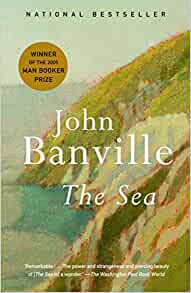
The Sea by John Banville

The Sea

The Sea

John Banville (Adult Fiction)

Recent widower Max Morden, looking for respite and solace from his grief, returns to the seaside town where he spent his summer holidays as a youth.  Once there, he rents a room in the Cedars, the same house where he met the affluent, affable, and alluring Grace family.  But memories can be both haunting and comforting and as Max begins to remember his first experiences with love and death, he understands just how fragile and unpredictable life can be.

The Sea was the 2005 winner of the Man Booker Prize and despite its bestseller status and numerous accolades, I was counting the pages to its completion (I don’t provide a review unless I finish a book in its entirety).  I agree with critics and reviewers that the writing is indeed superb, but I found it so over-the-top in its detail that I quickly became a victim of prosaic poisoning.  Here is an example of Max describing his mental haze before his wife, Anna, receives her fatal diagnosis: “In the ashen weeks of daytime dread and nightly terror before Anna was forced at last to acknowledge the inevitability of Mr. Todd and his prods and potions, I seemed to inhabit a twilit netherworld in which it was scarcely possible to distinguish dream from waking, since both waking and dreaming had the same penetrable, darkly velutinous texture, and in which I was wafted this way and that in a state of feverish lethargy, as if it were I and not Anna who was destined soon to be another one among the already so numerous shades.”  Again, simply beautiful in its artistry and imagery, but completely exhausting to absorb and resulted in more frustration than enjoyment on my part.

Another aspect of this book, which only added to its incredible weightiness, is that it lacked chapters and was only separated into Book I and II.  The Sea was simply paragraph after paragraph after paragraph with the occasional (and much welcomed) double-spaced separation.  It’s as if John Banville was feeding us a wonderfully delectable five-course meal and never giving us the opportunity to savor, swallow, and digest each bite.  We just keep getting spoonful upon spoonful and end up pushing ourselves away from the table for our own self-preservation—leaving a perfectly lovely meal unappreciated.

The downfall of writing a story where each word and phrase are so meticulously constructed is that you have characters that feel a bit one dimensional and lacking true warmth or vulnerability.  It’s like a room staged for an opulent magazine spread.  While it’s gorgeous and truly exquisite, you really can’t imagine living in it for it’s missing the heart and soul that allow you to connect with it.  That immersive feeling that wraps around you like a warm blanket or well-worn bathrobe.  But we’re not talking about a room or a home, but something majestic and vast and powerful and in the end, that is the problem with this book.  The problem is that we’re dealing with the sea.

Rating: 3/5

*Book cover image attributed to www.amazon.com

**Want more?  Visit our Facebook page at www.facebook.com/thedustyjacket


Nightjohn by Gary Paulsen (YA Fiction)

Nightjohn

Nightjohn

Gary Paulsen (Young Adult Fiction)

“It was in the flower bed that I first heard about Nightjohn.  Not by name, but by happening.”  Sarny remembers that moment well.  That and other moments—both horrible and hopeful—that has happened on Master Clel Waller’s plantation:  the beatings, the constant humiliation, the rapes, but also the songs and stories that provide some comfort to her and her fellow slaves.  But most precious of all were the moments spent with Nightjohn for he brought with him freedom.  Freedom that only knowledge could bring, and Nightjohn was bringing it to Sarny and anyone brave enough to accept this unique and powerful gift.

Gary Paulsen notes that the events written in Nightjohn (with the exception for variations in time and character identification and placement) are true and actually happened.  Knowing the atrocities, brutality, and savagery that happened during the period in American history where slavery was practiced and largely accepted, the story of Sarny and what she witnessed and experienced should come as no shock.  Unfortunately, it does for Paulsen is relentless in his detail and spares no sensibilities when it comes to depicting the treatment of slaves and the punishment ravaged upon those attempting escape.  The book is recommended for ages 12 and up and although the message is important and the details written are accurate, I would suggest a slightly higher starting age due to several highly graphic scenes and some mature subject matter.

I appreciated the theme of this book and the heroism shown by Nightjohn who had successfully acquired freedom in the north, but chose to return south so that he could teach slaves to read and write.  During one pivotal scene, Sarny’s “adoptive” mother, Mammy, asked Nightjohn why teaching the slaves to read and write mattered.  “They have to be able to write,” Nightjohn responded.  “They have to read and write.  We all have to read and write so we can write about this—what they doing to us.  It has to be written.”  The singular problem I had with Paulsen’s book was the overuse of violence.  Paulsen describes what runaways endured when the dogs finally caught up with them and he did so not once, not twice, but three times.  The reader understands the gruesomeness of this action and the utter deprave satisfaction the master gets in seeing a man or woman being literally torn to shreds, but to restate it numerous times was borderline gratuitous.

Nightjohn is a quick read (the hardback edition is ninety-two pages with large typeface and a narrow page width), but its characters and their unfailing faith, their struggle for dignity, and their fight for a better life will have a long-lasting impact on you and will forever change how you view the everyday things that are often taken for granted.  In that respect, Nightjohn has given each of us a very valuable lesson.

(Reviewer’s Note: In 1997, Paulsen wrote Sarny: A Life Remembered, a sequel to Nightjohn, which follows Sarny after she fled the Waller plantation in the last days of the Civil War.)

Rating: 4/5

*Book cover image attributed to www.amazon.com

**Want more?  Visit our Facebook page at www.facebook.com/thedustyjacket