
A Virtuous Woman by Kaye Gibbons

A Virtuous Woman

A Virtuous Woman  

Kaye Gibbons (Adult Fiction)

Blinking Jack Ernest Stokes is forty when he marries Ruby Pitt Woodrow.  Jack is twice Ruby’s age, skinny, and homely, but despite his drawbacks, he loves Ruby unconditionally and promises to take care of her.  After suffering a tormented marriage to a brutal drifter, Ruby longs for stability and security and accepts Jack’s proposal of marriage.  Such is the story of two very different people who transcend both economic worth and social status in order to make a marriage work.

Gibbons gives us a simple story about a man and a woman whose devotion for one another is uncomplicated, unwavering, and unbounded.  Jack and Ruby’s love is quiet and kind and both derive a satisfying and greatly needed comfort from their marriage.  A Virtuous Woman is a pleasant read and flows along at a relaxed pace—alternating narration between Jack and Ruby.  Sadly, this book barely breaks the surface and fails to give the reader an opportunity to emotionally bond with either the story or to its characters.  Gibbons succeeds in providing a big-picture view of a bittersweet relationship between two broken people, but the story could have been far richer had Gibbons further fleshed out the complicated feelings and effects associated with infertility, terminal illness, and bereavement.

Jack and Ruby’s unlikely relationship reminds us that love need not be complicated or blind.  Sometimes, just having someone there offering you acceptance, kindness, and peace is enough.

Rating: 3/5

* Book cover image attributed to http://www.amazon.com


Lost Horizon by James Hilton

It’s Throwback Thursday where we pick a random Thursday to review a Classic from literature.  We hope you enjoy this very dusty jacket.

Lost Horizon.jpg

Lost Horizon   

James Hilton (Adult Fiction)

It’s 1931 and the situation is dire in Baskul.  The country is in the midst of a revolution and all of the white residents are being evacuated to Peshawar.  Four passengers are loaded onto a plane lent by the Maharajah of Chandapore:  a British consul (Hugh Conway), his vice-consul (Captain Charles Mallinson), a missionary (Miss Roberta Brinklow), and an American (Henry Barnard).  After some time, all on board quickly realize that they have been kidnapped and being taken to an unknown destination.  Their plane soon crash lands in the harsh and unforgiving Tibetan mountains and, before he dies, their pilot instructs them to go to a place called Shangri-La.  With only the clothes on their backs, the small party begins their journey to a place thought only to exist in legend.

Hilton gives us a place that stands in stark contrast to the world Conway has experienced.  He has seen the ravages of war and its effects are still with him—even after a decade has passed.  During World War I, Conway has seen death, disease, and destruction.  At Shangri-La, he sees only tranquility, serenity, and beauty.  Because of his haunted past, he—more so than his fellow passengers—seems willing and anxious to embrace the charms and mystery of this newly discovered paradise.

Lost Horizon gives readers a wonderful and beautiful utopian lamasery where every care is met and every need satisfied.  It is truly paradise found and for those who stumble upon it, their lives will never be the same.  But this story also serves as a reminder that one man’s paradise may be another man’s prison and the only thing that may differentiate the two is freedom.  If you had to stay, would it really be paradise?  Conversely, if you could leave, would it really be prison?

I truly enjoyed this tale of a modern Garden of Eden and couldn’t help but ask myself this question as I turned the last page: “If I had ALL the time in the world, what would I do?”  What would you do?

Rating: 4/5

* Book cover image attributed to www.amazon.com


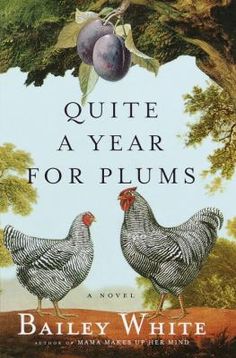
Quite A Year For Plums by Bailey White

Quite A Year For Plums

Quite A Year For Plums

Bailey White (Adult Fiction)

Roger is in love with a Yankee (although some of those people are just as nice as can be).  Louise arranges letters and numbers so that she can contact space aliens (who are really small by the way).  Della is having a devil of a time painting Dominique chickens (capturing their feet correctly is the hardest part) and has a penchant for labeling her garbage.  And then there’s Bruce who has nightmares about fonts (he’s a typographer and takes these things very seriously).  These and many more wonderfully odd characters live in a small southern town, and they laugh, love, and cry together…because that is what families do.

In the vein of Philip Gulley, Jan Karon, and Ann B. Ross, Bailey White gives us a humorous and heartfelt glimpse into rural America.  In White’s world, the boy doesn’t always get the girl and even the best intentions end in defeat, but she shows us that anything can be made just a little bit brighter and sweeter with just a jar of sweet pickles or a slice of homemade plum pie.

I adore Bailey White, but this novel came up a little short as I had a hard time sinking my teeth into it.  Rather than getting a rich and satisfying entrée, I was instead served several courses of appetizers.  White gives the reader many humorous and delightful vignettes, but when put together, they fail to form a complete and cohesive story.  Quite A Year For Plums is a quick read that doesn’t require a tremendous amount of emotional investment, but its quirky and lovable characters do make for an enjoyable book.  Almost as enjoyable as a jar of sweet pickles or a slice of homemade plum pie.  Almost.

Rating: 3/5

* Book cover image attributed to http://www.amazon.com
 

The Story of Land and Sea by Katy Simpson Smith

The Story of Land and Sea

The Story of Land and Sea  

Katy Simpson Smith (Adult Fiction)

Tabitha’s grandmother died in childbirth as did her own mother.  “Death only comes to mothers,” she thinks and a mother she’ll never be.  But when young Tabitha is suddenly struck with yellow fever, her now land-bound father, John, returns to the sea with Tab in an effort to save her life.  After all, it was the sea that once gave life to her mother, Helen, and John is convinced that the sea can cure Tab as well.  Land, he knows, only brings about death.

Smith breaks her story into three parts: the first part (set in 1793) introduces us to John and his daughter Tab and their life in Beaufort; the second part (1771-1782) gives us a young Helen and her servant Moll and shows us how Helen and John meet; and the final part (1793-1794) concentrates on Helen’s father, Asa, as well as an adult Moll and her son, Davy.  The story spans three generations and deals with issues of loss, loneliness, and grief.

This is probably, by far, one of the bleakest books I have ever read.  Although this book is beautifully written, it gives away the fates of several main characters much too early in the story, leaving readers with a lot of backstory and very little else to look forward to.  Smith also deals heavily in religion and so we expect some semblance of redemption or spiritual revelation.  Again, the reader is left empty-handed.  But what might be the most incomprehensible decision Smith makes is choosing to devote the last third of her novel to perhaps the most uninteresting and uninspiring character in the entire book.  I wish this book had finished as strongly as it started, but unfortunately The Story of Land and Sea is really just a story without point or purpose.

Rating: 3/5

* Book cover image attributed to www.amazon.com


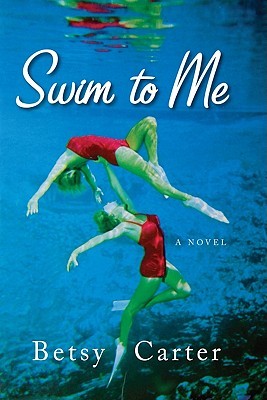
Swim to Me by Betsy Carter

Swim to Me

Swim to Me  

Betsy Carter (Adult Fiction)

Delores Walker can vividly recall the moment her mother dropped her into the shallow end of a lake.  She was just two, but she remembers the water’s temperature, plunging into its depths, and struggling to resurface.  It was heaven.  Twelve years later, she travels to Weeki Wachee Springs in Florida with her mother and father.  It’s 1970 and the mermaids of Weeki Wachee perform a tribute to Apollo 11.  They spin, twirl, dive, and glide, and Delores is fascinated and enthralled by these amazing creatures in the water.  Now at sixteen, she boards a Greyhound bus to Florida with a suitcase, a handful of silver dollars, a letter from Weeki Wachee, and a dream of being a mermaid.

This book is a loving tribute to those wonderfully glorious quirky, kitschy, and sometimes tacky roadside attractions that are a part of our rich and unique history and culture.  I totally immersed myself in this novel and loved reading about these aquatic darlings and their lives both in and out of the tank.  Carter ensures a well-rounded story by giving equal attention to Delores; her struggling and self-absorbed mother, Gail; and her absentee and apathetic father, Roy.  By offering readers a deeper insight into each of these characters separately, we gain a clearer understanding of their own personal thoughts, feelings, and struggles.

More than a loving wink and nod to days gone by, Swim to Me is a book about endings and new beginnings; about not being defined or confined by your present situation; and about taking what’s given to you and making the absolute most of it.

Rating: 4/5

* Book cover image attributed to http://www.goodreads.com


Breathing Water by T. Greenwood

Breathing Water

Breathing Water

T. Greenwood (Adult Fiction)

“Do not ask me for haunted.  Do not ever ask me for haunted, because I will give you haunted and you will never be the same.”

Effie Greer is living a fugitive life.  When you are a fugitive, you don’t sign leases, you don’t bother unpacking, and you don’t make any friends.  But after three years, she finally feels safe enough to return home to Lake Gormlaith, Vermont.  There, she refurbishes her grandmother’s lake house, reconnects with an old school friend, and develops an interest in a mysterious and kind artist.  Only time will tell if Effie can truly leave the past behind and begin anew.

Breathing Water jumps from the years 1991, 1994, and 1987 and deals with issues such as domestic violence and substance abuse.  Despite its strong and promising beginning, the story just seems to aimlessly float along with no real purpose or direction.  At times, the text seems overly flowery (“The rust-gold-orange-purple of the woods behind him blurred through the spray of the hose…”) and the transitions between time periods are awkward and require the reader a few moments to continually readjust.  Also, I found the main character to be a bit contradictory.  As a survivor of abuse, she is prone to keeping secrets although she eventually finds great relief and peace once she finally divulges her abusive past to friends and family.  Despite this, she finds it absolutely reasonable to keep secrets from her new love interest.  So, we are led to assume that some secrets are acceptable and absolution is purely discretionary.

All in all, not the worst novel I’ve ever read, but it was lacking on several fronts:  the characters were somewhat flat, the plot was thin, and finally reaching the end of the book was akin to treading water—there’s just not that much to hold onto.

Rating: 3/5

* Book cover image attributed to www.goodreads.com


The Little Paris Bookshop by Nina George

The Little Paris Bookshop

The Little Paris Bookshop  

Nina George (Adult Fiction)

“As the grandmother, mother and girl said their good-byes and went on their way, Perdu reflected that it was a common misconception that booksellers looked after books.  They look after people.”

From a single conversation, Monsieur Perdu can tell you what you need and what your soul lacks.  His father calls it transperception, the ability to see and hear through most people’s camouflage and detect all the things they worry and dream about.  He can transperceive just about anybody…except himself.  He spends his days operating a moored book barge called Literary Apothecary, where he prescribes books like medication to those who lack or seek confidence, hope, faith, or love.  His seemingly tranquil life is suddenly made turbulent when an unopened, twenty-year old letter, written by his ex-lover, is discovered.   Perdu suddenly finds himself on a journey to discover an author’s real identity, to seek forgiveness, and to find peace.

Like a rusty barge moored in port for a little too long, this book had a promising start, but then just sputtered and gasped along until the end of the book.  The details and descriptions that George provides of the ports along Paris and of the French countryside are vivid and meticulous; however, the story stalls mid-way through and just never seems to regain steam.  Reading this book was more like a job to finish rather than a journey to be enjoyed.  The Little Paris Bookshop was marketed as “a love letter to books”, but to readers, it feels more like a Dear John letter as we are left feeling forlorn and rather disappointed.

Rating: 3/5

* Book cover image attributed to www.penguinrandomhouse.com


Snow Flower and the Secret Fan by Lisa See

Snow Flower and the Secret Fan

Snow Flower and the Secret Fan 

Lisa See (Adult Fiction)

Lily Yi was born on the fifth day of the sixth month of the third year of Emperor Daoguang’s reign.  Her matchmaker took one look at her and knew she was special.  In fact, Lily was so special that she was given a laotong, an “old same”, instead of the traditional sworn sisters that most girls receive.  A laotong relationship in Chinese culture is between two girls from different villages who are eternally bound to be kindred sisters and devoted companions.  At the age of seven, Lily is matched with a girl from the highly regarded Lu clan.  Her name is Snow Flower.  For over twenty years, their friendship endures arranged marriages, childbearing, disease, and death.  Throughout these events, the two write to one another in a secret women’s language—nu shu—on the folds of a fan.  One day, Lily receives a message from Snow Flower that threatens to tear apart their bond, although it is said that not even death itself can sever a laotong.

See not only gives us an extraordinary novel, but also an informative and unforgettable glimpse into Chinese culture and the lives of women in the early part of the 19th century.  We read how women are kept separated and isolated from outside life.  Women hidden away within the walls of their upstairs women’s chambers where they spend their days cooking, sewing, and praying for sons—their only measure of worth.  See also describes the unimaginably cruel and painful practice of footbinding.  This tradition begins with girls at age six and See’s description of the binding process is unmerciful in its details.  The suffering these young girls endure is truly horrific and beyond human comprehension and through the author’s masterful storytelling, we find ourselves experiencing their pain and agony alongside them.  (Thankfully, this practice was outlawed in 1912.)

See gives her readers a beautifully told story of devotion, sacrifice, regret, love, and forgiveness. Lily and Snow Flower are strong, intelligent, and fearless women willing to break long-honored cultural barriers in order to remain together.  Snow Flower and the Secret Fan is a mesmerizing and heartbreaking novel whose story unfolds as effortlessly as the fan that Lily and Snow Flower share.

Rating: 5/5

* Book cover image attributed to http://www.goodreads.com


A Cup of Tea by Amy Ephron

A Cup of Tea

A Cup of Tea

Amy Ephron (Adult Fiction)

A Cup of Tea is based on the short story (of the same title) by Katherine Mansfield.  It is set in New York City during World War I and primarily centers around three characters: wealthy and privileged Rosemary Fell, her fiancée and self-made shipping mogul Philip Alsop, and homeless, penniless, and “astonishingly pretty” Eleanor Smith.  When Rosemary happens to see Eleanor huddled beneath a street light one rainy evening, she offers to take the destitute woman home for a cup of tea.  This seemingly innocuous and kind gesture sets events in motion that will have unintended and unimaginable effects on all three of their lives.

This book has good bones, but unfortunately there is little to no flesh and blood to go along with it.  The story lacks depth and feeling and so little attention is paid to the main characters’ development, that by the end of the book, I neither cared nor sympathized with any of them.  By skimping on details and providing no thoughtful backstory for Rosemary, Philip, or Eleanor, Ephron falls far short of delivering her readers the love story that this book professes to be.  Although this story had so much potential and possibility, this particular cup of tea did nothing more than leave me unsatisfied and wanting something else.

Rating: 3/5


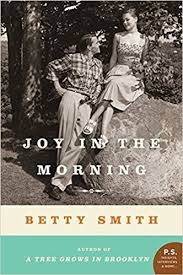
Joy in the Morning by Betty Smith

Joy in the Morning

Joy in the Morning

Betty Smith (Adult Fiction)

            “Weeping may endure for a night, but joy cometh in the morning.”

                                    —Psalm 30:5

 Carl Brown and Annie McGairy are young and deeply in love.  Just past her 18th birthday, Annie travels from her home in New York to the Midwest to join her beloved in marriage.  Much to their mutual surprise, Carl and Annie’s first year proves to be unexpectedly difficult.  Carl is attending the university studying law and holding down several jobs while Annie tries to adapt to her new surroundings without the security and familiarity of friends and family.  Together, through lean times and unforeseen events, they must rely on their faith and love to pull them through.

What I admire most about Smith is that she gives us a strong, witty, and self-assured female character without diminishing her male counterpart.  All too often we see one character being lowered for the sake of elevating the other.  Despite their differences in education and social standing, Carl and Annie view each other as equals and share a mutual respect and passionate devotion for one another.  This alone is refreshing to see in a novel.

Set in 1927, Smith presents us with a small university town populated with principled (albeit flawed) people who all share a strong work ethic, solid moral compass, and innate desire to be decent, kind, and fair to their fellow man.  Her stories are charming and heartwarming without being overly sentimental or trite. A truly uplifting book that focuses on the goodness of humanity rather than its faults and follies.

Rating: 4/5