

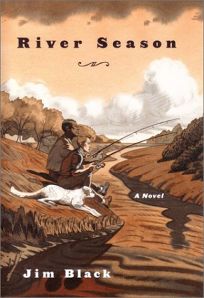
River Season by Jim Black

River Season

River Season

Jim Black (Adult Fiction)

I think my mom’s patience with Charles, Gary, and myself stemmed from years of working on the pediatric floor at Methodist Hospital in Lubbock.  Maybe seeing so many sick and dying kids makes you look at your own in a different light.  I don’t know.  I do know she was not overly protective or strict back then.  I really think she just wanted us to enjoy the privilege of being kids, and I’ve always loved her for that.  It was easier back then, too, because times were different.  In our small town, we really did sleep with doors unlocked and windows open.  I know now those were the best of times.

Jim Black was thirteen in the summer of 1966.  Growing up in Archer City, Texas with his two best friends, Gary Beesinger and Charles Luig, life was great.  This summer, Jim had big plans: playing baseball, mowing lawns, and hanging out with his friends.  What he didn’t plan on was meeting Samuel “Sam” Joseph Washington, an older black man from the other side of town.  This man, who decided to take up residency at his favorite fishing spot, would not only grow to be a father figure to Jim, but would also become his friend and would show Jim the value of acceptance, generosity, and love.

In an interview with Brothers Judd (brothersjudd.com), Jim Black explained that There’s a River Down in Texas (which, after the addition of fifty pages, would later become River Season) is largely autobiographical with the remainder being pure fiction.  River Season gives us a warm, sometimes bittersweet, and nostalgic look at growing up in small-town America during a time when the only things on a boy’s mind were baseball, pretty girls, hanging out with friends, and getting into just enough mischief to make life interesting but not enough to get you arrested.  It was a simpler time when you knew who your friends were and, more importantly, who your enemies were.  Bullies were never anonymous and disagreements were settled swiftly resulting in either an inflated ego or a black eye.

I picked up River Season at a secondhand book store and after visiting Black’s website (jimblackbooks.com), this may be the only way for interested readers to obtain copies of his books.  Black explains that all contracts with his publisher have been cancelled and his books are no longer being produced.  I hope lightning strikes twice and I am able to find his sequel Tracks so that I can follow a fifteen-year-old Jim as he tackles high school, bullies, and a broken heart.

Although River Season does touch upon the racial tensions that occurred in the 1960s South, Black is not overly preachy on the subject.  He could have easily made this the focal point of his story, but he instead concentrates on the friendship between himself, Charles, and Gary, as well the touching bond he shared with Sam.  American author and businessman, Arthur H. Glasow, once said, “A true friend never gets in your way unless you happen to be going down.”  Most of us would be fortunate to have just one friend like this.  Jim Black was blessed to have found three.

Rating: 5/5

*Book cover image attributed to www.publishersweekly.com

**Want more?  Visit our Facebook page at www.facebook.com/thedustyjacket


Mr. Timothy by Louis Bayard

Mr Timothy

Mr. Timothy

Louis Bayard (Adult Fiction)

Tiny Tim is tiny no longer.  The iron brace and crutch have long been replaced by an achy knee and slight limp…a mere lilt, really.  It is December 1860 and although Mr. Timothy Cratchit, now a man of twenty-three, lives off the monetary magnanimity of his “Uncle” Ebenezer Scrooge, he dredges the River Thames for treasure-yielding corpses and lives in a brothel where he tutors the Madam in reading.  It’s a satisfactory life, one in which Tim has grown used to until he comes upon one and then two dead girls, each with the letter “G” branded on her upper arm.  When Tim meets Philomela, a ten-year-old street orphan, he realizes that he must do everything he can in order to protect her for she, like the other two girls, bears the same “G” on her arm.

I must admit that it took me a while to connect with (and eventually enjoy) this book.  Charles Dickens’s classic A Christmas Carol is one of my favorite stories and so it was distressing to see the iconic and beloved character of Tiny Tim reduced to desecrating corpses and spending his days living off charity.  I don’t fault Louis Bayard for building a story off an already-established fictional character.  Many authors have done the same in the past and will continue to do so in the future as long as there is a willing and interested audience; however, Bayard’s choice of using a character as cherished, wholesome, and pure as Tiny Tim and then casting him into London’s dark and dreary underbelly seems almost sacrosanct and readers of this story, who adore Tim, may feel a little duped in the process.  Luckily, patience proves to be a virtue and readers can rest assured that Bayard eventually gives us the loyal, spirited, and resilient lad that we’ve come to know and love.

Billed as a “literary thriller”, Mr. Timothy does not disappoint in delivering danger, intrigue, and fast-paced drama.  The story is a bit slow out of the starting gate and seems to drift as multiple characters are introduced and a number of storylines play out.  At about the midway point, things seem to get their bearing and the action moves at a steady and satisfying pace until the end.  Although Dickens wouldn’t have imagined his young hero delving into police corruption, child trafficking, and prostitution, he would be gratified to know that his Tim is armed with a strong moral center, a kindly heart, and nerves of steel…not to mention a leg that makes for a quite dependable barometer.

In A Christmas Carol, Tiny Tim was known for saying, “God bless us, every one!”  This phrase was repeated at the end of the book to signify Scrooge’s change of heart.  Like Scrooge, I experienced my own change of heart and am grateful I decided to give this book a second chance.  At times, this wasn’t an easy thing to do for Bayard really puts poor Tim through the wringer, but I’m glad I stayed with Mr. Timothy and accompanied him to the very end of his adventure.  So in honor of second chances—which are indeed a rare and precious thing—I’ll end by simply saying, “God bless us, everyone one!”

Rating: 4/5

*Book cover image attributed to www.amazon.com

**Want more?  Visit our Facebook page at www.facebook.com/thedustyjacket

 

The Little Giant of Aberdeen County by Tiffany Baker

The Little Giant of Aberdeen County

The Little Giant of Aberdeen County 

Tiffany Baker (Adult Fiction)

The day I laid Robert Morgan to rest was remarkable for two reasons.  First, even though it was August, the sky overhead was as rough and cold as a January lake; and second, it was the day I started to shrink.

Truly Plaice was destined to be a big girl.  During her mother’s pregnancy, the town began to take bets as to what her final weight would be upon delivery.  Turns out, nobody in that town won.  No one came close.  Her school teacher called her a “little giant” and Truly became known for her massive size and build.  Where her sister, Serena Jane, was wispy and beautiful, Truly countered with her girth and homeliness.  But with so many things, Truly simply accepted this genetic disparity as fact and actually said the difference between the two was quite easy, “The reason the two of us were as opposite as sewage and spring water, I thought, was that pretty can’t exist without ugly.”  So, through her own eyes, Truly shares her story of wickedness and witchcraft, of poverty and prosperity, of life and death, and of a very big woman in a very small town.

Throughout this book, I wasn’t sure whether to feel pity or pride for Truly.  Here is a woman who has wholly resigned herself to her situation and although she feels the occasional stab of pity, jealousy, or regret, her unconditional surrender to her circumstances is both admirable and heartbreaking.  Her friend Amelia may have summed up Truly’s attitude perfectly one day when they were both walking home from school, “Things are what they are.  You can’t change them.”  Perhaps Truly realized this early on in life and found that she’d be much happier by choosing resignation over resistance.

Tiffany Baker does a nice job at keeping her story entertaining and engrossing by throwing in several plot turns and twists.  Although there is a lot going on with multiple characters and their individual story lines, Truly proves to be a capable storyteller and manages to keep everything orderly and fluid.  However, despite an engaging story and a unique main character, there was a big plot hole that kept my rating at a four versus a five.  I found that Truly’s need for a cure and her want of one were at constant odds.  The reasons she stated for not pursuing treatment are legitimate to her circumstances at the time save one…money.  You can’t claim poverty as an excuse when you constantly remind the reader that you have a suitcase full of money hidden under your bed.  This was clearly frustrating for me, but not enough to override the valuable lessons contained within The Little Giant of Aberdeen County:  love the skin you’re in, be courageous in accepting that which you cannot change, and never think that you are so full that there is not enough room to let anyone else in.

Rating: 4/5

*Book cover image attributed to www.amazon.com

**Want more?  Visit our Facebook page at www.facebook.com/thedustyjacket

The Wishing Trees by John Shors

The Wishing Trees

The Wishing Trees  

John Shors (Adult Fiction)

Kate McCray died ten months ago, but her absence remains as fresh and painful for her husband, Ian, and their ten-year-old daughter, Mattie as the day she slipped away from them.  Upon her death, Kate leaves a letter for Ian expressing her dying wish: “Be happy.  Learn to laugh again.  To joke.  To wrestle together like you once did.  Learn to be free again.”  To achieve these things, Kate wants Ian to take Mattie on the trip the two of them intended to make to celebrate their fifteenth anniversary.  A trip across Asia that would allow Mattie to experience what her parents once shared in so many diverse and wondrous countries: Japan, Nepal, Thailand, India, Hong Kong, and Vietnam.  But can Ian do it?  Can he revisit a past full of memories of his wife in order to forge a future without her?

John Shors delivers a touching and bittersweet story of a husband and daughter embarking on a journey of self-discovery, healing, and enlightenment.  Although deceased, Kate remains a prominent presence and central figure throughout the story.  She has left handwritten notes inside twelve film canisters—six each for Ian and Mattie—which are to be opened upon the pair’s arrival in each country.  Kate’s words of love and encouragement are a constant reminder of the tender and altruistic person so tragically torn from our main characters.  Her careful planning of this trip, despite her weakened state, and her desire for her family to move on without her is heartbreaking in its selflessness and hopeful in its intent.  What’s most striking is Kate’s constant encouragement for her loved ones to make a positive difference in the world.  In one of her letters to Mattie, Kate writes of Buddha, “Do you know what Buddha says about happiness?  He said, ‘Thousands of candles can be lighted from a single candle, and the life of the candle will not be shortened.  Happiness never decreases by being shared.’”  With each canister that is opened and with each note that is read, we can easily understand how indomitable a task it is for Ian and Mattie to emotionally recover from their loss.

The Wishing Trees is a beautifully written love letter to anyone who has ever lost a love and hungers for a sign—any sign—that they’re still with us.  That they still see us.  That they still remember us.   It’s also a story about the power of kindness and the extraordinary healing powers in doing good.  Numerous books have been written on research connecting helping others to health benefits or, simply stated, doing good is good for you.  Perhaps Kate knew this all the time or perhaps she remembered an Indian saying during her travels, “When you were born, you cried and the world rejoiced.  Live your life so that when you die, the world cries and you rejoice.”

Rating: 4/5

*Book cover image attributed to www.amazon.com

**Want more?  Visit our Facebook page at www.facebook.com/thedustyjacket

The Secret Scripture by Sebastian Barry

The Secret Scripture

The Secret Scripture

Sebastian Barry (Adult Fiction)

The Roscommon Regional Mental Hospital is scheduled for demolition.  All current patients are to be evaluated in order to determine whether they are mentally suitable for integration into the community.  This process goes fairly well until Dr. William Grene has to make a recommendation concerning Roseanne McNulty—a patient nearing her one hundredth year and who has spent over half of her life in hospitals.  Her original paperwork has long since vanished and the only history he has to go on are a combination of Roseanne’s memory of her past, the notes from a Catholic priest in her hometown of County Sligo, Ireland, and diary entries that she personally has made throughout her hospital commitment.  Can Dr. Grene put together enough of Roseanne’s past in order to safely and confidently determine her future?

The Secret Scripture was shortlisted for the Man Booker Prize, was the recipient of the Costa Book of the Year Award, and named a Best Book of the Year by Boston Globe and Economist.  For such a heralded book, it makes me wonder why I am seemingly in the minority for disliking it so much.  Firstly, this is one of those rare books that I was tempted—more than once—to discard and just move on to something else.  Although the writing was beautiful and the descriptions and details were vivid and elaborate, the stories of both Roseanne and Dr. Grene were boring and failed to capture either my imagination or interest.  Imagine being on a boat surrounded by beautiful sights, smells, and sounds and just when your anticipation for your upcoming excursion has reached its apex, you are kindly told to get out.  Of course, the obvious response would be, “But, we haven’t GONE anywhere yet.”  This is exactly what this story felt like…an abundance of artistry surrounding a journey to nowhere.  Secondly, I think Barry has built his entire story on a false premise.  Given the fact that Roseanne is nearing the century mark, her health is failing, she has spent almost sixty years in an infinitely convalescent state, and her mental capacity is such that neither she nor the evaluating psychiatrist can determine fact from fiction, why is this “evaluation” even taking place?  It’s clearly a nonstarter.

I finished this book with the singular purpose of providing an honest review, which I cannot do unless the entire book has been read.  After a very long two weeks, I am able to move on with life for this book is now done as is this review.  By my rating, this is clearly not the worst book that I’ve ever come across, but it certainly is far from being an award winner which is why I placed it squarely in the middle.  I wish I could have loved it as much as so many others undoubtedly did, but its draw and praises have left me as clouded and confused as the mind of our aged and sympathetic centenarian heroine.

Rating: 3/5

*Book cover image attributed to www.amazon.com

**Want more?  Visit our Facebook page at www.facebook.com/thedustyjacket
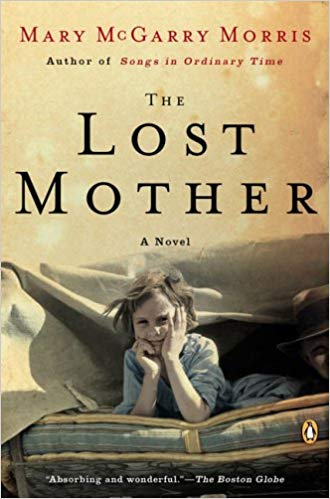
 

The Lost Mother by Mary McGarry Morris

The Lost Mother

The Lost Mother

Mary McGarry Morris (Adult Fiction)

It’s the Great Depression, and everything that Henry Talcott owns or is most precious to him is contained in a single tent—his knives, saws, and cleavers as well as his two young children, Thomas (12) and Margaret (8).  Henry slaughters animals for a living, but work is scarce and money is getting harder to come by.  His wife, Irene, abandoned the family years earlier and now Henry finds himself having to leave his children alone more often as he travels to find work.  When his wealthy neighbor, Phyllis Farley, begins to lure his children to her home as a means of providing companionship for her wheelchair-bound son, Henry’s firm hold on his family slowly begins to loosen.

The Lost Mother is an aching, somber, and dark novel about a father’s desperate attempt to keep his family together while two young siblings grapple with their own feelings of loyalty, love, and loathing toward one another.  Morris’s book overflows with passion and her multi-dimensional characters evoke myriad emotions from her readers: pity for a single father doing his best under the most hopeless of circumstances; disdain for the crooked shopkeeper who swindles an honest boy; sympathy for a little sister enduring endless verbal and emotional assaults from her brother; contempt for a wealthy neighbor and her disingenuous benevolence; and disgust for a beautiful mother who callously abandons her children for a better life.  Morris is able to successfully rein in all of our feelings while maintaining the story’s momentum by centering every action around a recurring theme of home, family, and togetherness.

In the song “You Always Hurt the One You Love”, there are lyrics that accurately describe several characters in this book:  You always hurt the one you love/ The one you shouldn’t hurt at all/ You always take the sweetest rose/ And crush it till the petals fall.  These characters love so deeply and wholly that they simply cannot recognize the negative impact that their behavior is having on those closest to them.  But despite these flawed characters, Morris gives us a ray of hope through Henry and his children.  Together, the three of them manage to rise above their circumstances and prove that they are much more than society has labeled them.  Henry, Thomas, and Margaret Talcott remind us that worth and security are not something that you hold in a wallet.  Instead, the greatest treasure is sometimes found in a pair of arms that are opened and are waiting for you…just for you.

Rating: 4/5

*Book cover image attributed to www.amazon.com


The Human Comedy by William Saroyan

The Human Comedy

The Human Comedy

William Saroyan (Adult Fiction)

In a small town in Ithaca, California, during World War II, there lived the Macauley family—Mrs. Macauley and her four children: Marcus, Bess, Homer, and Ulysses.  Marcus is serving in the army, Bess is attending college, Homer is determined to be the fastest telegraph messenger in the West, and young Ulysses, who at four years old, is enamored with everything in his very small world.  The Macauleys are workers, dreamers, and God-fearing folks who are living each day to its fullest while trying to find their own particular place in the world.  For Homer, it’s a time of hurdle races, playing catch, and riding his bike, but with the war and the grim news printed on each incoming telegram, he’s finding it increasingly difficult to put off manhood any longer.

This novel was billed as a coming-of-age story, but it truly is so much more.  With its short chapters—almost vignettes—The Human Comedy gives us a humorous and bittersweet peek into the lives of the citizens of Ithaca.  The elderly telegrapher fearing retirement, the son fighting in a war that he doesn’t understand, the town simpleton with a naïve heart of gold, a young boy with big dreams and ambitions, the teacher trying to impart a sense of civility and kindness into her students.  All of these wonderful characters’ stories are stitched together to form a tightknit community that mourns their fallen, cheers their heroes, comforts their sick, and opens their doors (and hearts) to strangers.

The Human Comedy is considered semi-autobiographical as many of the novel’s characters and situations are based on real-life people and events from Saroyan’s childhood.  Like Homer, Saroyan was a second-generation Armenian immigrant who lost a father quite early in life and worked as a telegraph messenger while a teenager.  Interestingly, The Human Comedy began as a screenplay written by Saroyan, but while Metro Goldwyn Mayer was filming the movie, Saroyan decided to turn his screenplay into what would become his first novel.

One of the novel’s youngest characters, Ulysses, gains great pleasure and satisfaction from the simplest things.  He often runs alongside the train as it travels through his town, waving to its occupants who always ignore our young man.  On one occasion however, a black man sees Ulysses and returns his wave while shouting, “Going home, boy—going back where I belong!”  The Human Comedy is a story of love, loss, decency, humanity, and kindness, but most of all, it is a story about home and the people we are blessed to call family.

Rating: 5/5

*Book cover image attributed to www.goodreads.com


Heading Out to Wonderful by Robert Goolrick

Heading Out to Wonderful

Heading Out to Wonderful

Robert Goolrick (Adult Fiction)

At thirty-nine years old, Charlie Beale arrived in the town of Brownsburg, Virginia (population 538) in a beat-up truck and toting two suitcases—one holding his clothes and a set of butcher knives and the other filled with cash.  Brownsburg is a town where prestige is measured by the size of your floral blooms and the yield of your vegetable garden, where no one divorced, schools let out in May so the children could help with the family’s planting, and everyone believed in God and The Book.  It’s 1948 and as soon as Charlie drove into Brownsburg, he knew he was home.  When he saw Sylvan Glass, the teenage bride of the town’s wealthiest resident, he knew that he was heading to something wonderful.  But Brownsburg is a small town and news—good, bad, and particularly scandalous—travels fast and Charlie is about to find out that wonderful comes with a very hefty price tag.

If I were to give half ratings, this book would lean more towards three-and-one-half stars, but I gave it a three simply because the last twenty pages of the book were so severe and such a drastic departure from the rest of the story that it left me feeling confused and a bit angry.  Goolrick is a wonderful storyteller and gives readers an idyllic town where folks sit on their front porch and gossip and the shop merchants know what you want before you cross their threshold.  Being a small town, we know that no good will come from Charlie and Sylvan’s illicit relationship and that it is doomed from the beginning; however, Goolrick’s handling of these star-crossed lovers is not only severe, it’s incomprehensible.  The last few pages are such a stark contrast to the rest of the story, that it begs one to question what could possibly have made Goolrick deviate so unbelievably from his story and characters?  It was almost as if he handed the remainder of his novel to someone else and said, “You take it from here.”

When Charlie entered Will Haislett’s butcher shop looking for a job, Will said to him, “Let me tell you something, son.  When you’re young, and you head out to wonderful, everything is fresh and bright as a brand new penny, but before you get to wonderful you’re going to have to pass through all right.  And when you get to all right, stop and take a good, long look, because that may be as far as you’re ever going to go.”  The problem with Heading Out to Wonderful, is that we started out in Wonderful and were able to happily hang out and enjoy the scenery for a bit, but somehow we missed a sign or drove too far or made a right instead of a left and suddenly found ourselves far away from Wonderful and instead somewhere between All Right and Okay.  Unfortunately, Charlie Beale didn’t have the luxury of GPS tracking in 1948.

Rating: 3/5

*Book cover image attributed to www.goodreads.com


Big Fish by Daniel Wallace

Big Fish

Big Fish

Daniel Wallace (Adult Fiction)

Edward Bloom was born in Ashland, Alabama during the driest summer in forty years.  Edward knew he was destined for greatness…at least that’s what he always imagined.  He was to be a big fish in a big pond.  After all, wasn’t it his birth that finally brought water to his town’s scorched ground?  Weren’t people and animals inexplicably drawn to him?  Throughout his life, Edward would be a sailor, a successful business owner, and a true man of the world who also bought an entire town down to the last square inch.  Edward was also a husband, a father, and a friend to all.  But most of all, Edward Bloom was a myth.  His son, William, longs to be close to a father whose past is as vast and complicated as the current space between the two.  With Edward on his deathbed, can William distinguish fact from fiction so that he can better understand his father?  Surely stories of a two-headed geisha, a giant, and a mermaid can’t possibly be true…can they?

Daniel Wallace gives us a quirky and lighthearted story showing us the complex and messy relationship between a father and son.  This book is a quick read so only lightly scratches the surface regarding Edward’s inability or unwillingness to emotionally connect with his son.  All attempts at intimacy by William yield little more than a humorous story and a punchline and the reader shares in his growing frustration and apathy.  Edward explains to William that his own father was rarely around, but this fact doesn’t make it any less painful for William who is constantly at odds with a pithy metaphor or a ready one-liner.

Fathers are so many things to their sons or daughters: superhero, knight, prince charming, mentor, teacher, coach, buddy.  Like Edward, our own dads seem invincible, immortal, and a tad mythical.  Edward measured greatness through deeds.  William merely wanted a father who was an active participant rather than an occasional onlooker. And although laughter is said to be the best medicine, perhaps laughter is not the medicine, but it merely makes the real medicine go down a little easier.

Edward once said to William, “Remembering a man’s stories makes his immortal, did you know that?”  I have many stories from my father’s past—stories made up of fact and fiction that intertwine and entangle themselves like vines on a trellis.  Over time, it becomes increasingly difficult to separate the truth from fantasy, but in the end, it doesn’t really matter because you realize that even though your dad didn’t own a town or rescue a mermaid, he’s still pretty great because he’s YOUR dad and that alone makes him a pretty big fish.

Rating: 4/5

*Book cover image attributed to www.goodreads.com

**Want more?  Visit our Facebook page at www.facebook.com/thedustyjacket
The Dogs of Babel by Carolyn Parkhurst

The Dogs of Babel

The Dogs of Babel

Carolyn Parkhurst (Adult Fiction)

“Here is what we know, those of us who can speak to tell a story: On the afternoon of October 24, my wife, Lexy Ransome, climbed to the top of the apple tree in our backyard and fell to her death.  There were no witnesses, save our dog, Lorelei.”

Paul Iverson is desperate to understand how his young, beautiful, and artistic wife died.  Judging by her injuries and how her body landed, the police conclude that she didn’t jump.  There are so many things that Paul is just discovering like there are two ways of falling and that each one tells a story.  That on the day she died, Lexy rearranged the books on their bookshelf and cooked an entire steak just for Lorelei.  The books, the steak, and the apple tree all tell Paul that the day Lexy died wasn’t a usual day.  There are so many questions and the only one who can answer them can’t even speak…yet.

Carolyn Parkhurst delivers a novel that is a thriller wrapped around a mystery and enclosed within an endearing and heartbreaking love story.  Paul is our narrator and shares with us the moment he heard of Lexy’s death and then rewinds to show us how his and Lexy’s story began with their initial meeting and subsequent first date.  His voice is rich in detail and overflows with the love he feels for his wife and the loss he experiences by a life cut tragically short.  Every marriage has its ups and downs and Paul and Lexy’s marriage is no different; however, she was the yin to his yang and their union was symbiotic albeit sometimes tempestuous.

The Dogs of Babel is a beautiful, painful, thoughtful, and at times humorous story, but at its very core is a man grieving and desperate for answers.  His obsession of finding out the truth from his dog is futile and ridiculous.  We know it, his friends and colleagues know it, and even Paul himself knows it, but when you’re drowning, you’ll grasp for anything that can serve as a lifeline.  In this case, his lifeline is Lorelei.  Parkhurst gives us a memorable and stirring novel about the ones left behind when a sudden and untimely tragedy occurs.  The ones left with questions, loneliness, and oftentimes guilt and whose daily goals are measured by mere breaths.

Paul Iverson was a linguist by profession, and he often made a game of seeing how many words he could make out of a name.  He felt that these newly formed words somehow gave insight into the person themselves.  With The Dogs of Babel, I see the words blood, desolate, loathe, and death, but I also see self, glee, holdfast, and heals.  In the Bible, The Tower of Babel signified the beginning of the division of mankind through the infliction of diverse languages—punishment for man’s desire to reach the heavens for “godlike” status.  But Parkhurst reminds us that grief and love are universal and transcend the written word or spoken language.  They unite us in our healing and help us find a way to move forward…one breath at a time.

Rating: 5/5

*Book cover image attributed to www.goodreads.com