

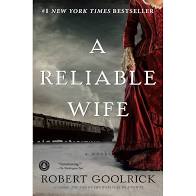
A Reliable Wife by Robert Goolrick

A Reliable Wife

A Reliable Wife

Robert Goolrick (Adult Fiction)

Ralph Truitt was fifty-four years old, rich, and alone.  He had been alone for twenty years and if the loneliness didn’t kill him, then another year in a bleak and barren Wisconsin winter might.  So, he placed an ad in the Chicago paper: “Country businessman seeks reliable wife.  Compelled by practical, not romantic reasons.  Reply by letter.”  He received many responses, but it was Catherine Land’s letter that he would choose.  He had read it so many times, he knew it by heart.  It was the first sentence that piqued his interest: “I am a simple honest woman.”  But letters can be deceiving and all this “simple honest woman” wanted—ever wanted—was to acquire both love and money.  Catherine would not live without some portion of both and Ralph Truitt was the ticket to her dream.  With a beautiful face and a sympathetic backstory, she was well on her way of inheriting a vast fortune…unless Ralph Truitt had other plans.

A Reliable Wife is one of those books that if you don’t stick with it, you would simply give up on it and unapologetically mark it as “Did Not Finish”.  With its foreboding and depressing backdrop of a 1907 Wisconsin winter, to its flawed and morally corrupt characters, to its underlying themes of lust and sexual fantasies, it really takes a herculean effort to weed through all of the debauchery and depression.  Thankfully, a nice story twist about midway through the book rewards those who stick it out and marks the beginning of several plot turns that will keep the reader’s interest and make the remaining scenes of lust and unrequited passion a little more forgivable.

The story centers on three main characters: Ralph Truitt, Catherine Lane, and Tony Moretti (Ralph’s illegitimate son).  All three do their fair share of whining and complaining and mourning a past that is lost and hating themselves for who they might have been.  Interestingly, I found Tony’s character the most sympathetic of the three, although Goolrick paints him as the antagonist.  He is the only one who truly deserves to feel betrayed and abandoned and can safely shroud himself in the term “victim”.  Don’t get me wrong, all three have their reasons to mope and feel wronged by life, but only one trophy can be awarded and I don’t give out participation ribbons so Tony gets the prize.

Robert Goolrick gives us a tale of regret and remorse and poses the question of how far would someone go in order to make a person love them?  I enjoyed this work far more than his book Heading Out to Wonderful, which I only gave 3/5 stars.  Unlike the latter, A Reliable Wife felt consistent all the way to the end and proved to be a suspenseful and compelling read.

I’ll end this review with four important takeways that I learned from A Reliable Wife: 1) If you live in Wisconsin, get out of Dodge before the first snowflake falls.  Winter marks the beginning of crazy season and you’re apt to either kill yourself, kill your family, kill yourself and your family (not in that order), or maim yourself (and possibly your family); 2) If your mother is a fanatical religious zealot, chances are you are going to grow up to be a hot mess; 3) A promise is a promise.  No matter how ridiculous, immoral, unethical, or illegal the promise is, you have to keep it.  No backing out.; and 4) Money doesn’t bring you happiness.  No matter how good looking you are, well educated, worldly, well-spoken.  It doesn’t matter.  You are going to be miserable so just pin that badge to your chest and wear it proudly.  So take a lesson from Ralph, Catherine, and Tony, just live a poor life in the tropics with a good therapist and don’t ever, EVER, make any promises.  You can thank me later.

Rating: 4/5

*Book cover image attributed to www.target.com

**Want more?  Visit our Facebook page at www.facebook.com/thedustyjacket


Tracks by Jim Black

Tracks

Tracks

Jim Black (Adult Fiction)

It’s 1968 in the small town of Archer City, Texas.  Fifteen-year-old Jim and his friends, Charles and Gary, are freshmen in high school and the world is suddenly full of hope and possibility…and broken hearts, broken noses, and a few bruised egos.  Yes, life is good until strange things begin to happen.  There are reports of livestock being found mutilated just outside of town and rumors of satanic cults and aliens begin swirling around faster than a Texas dust storm.  Every nerve in town is raw and on edge and that could only mean one thing: the time is absolutely ripe for Jim, Charles, and Gary to pull off a prank worthy of the ages.

Tracks is the sequel to Jim Black’s delightful and humorous semi-autobiographical River Season.  I was gifted my copy of Tracks by the author himself (who also kindly signed it) who mailed it to me after reading my review of his first book and noting that I was looking for a copy of his sequel.  I must say, I was a bit apprehensive when I started reading Tracks.  Would it capture the same magic and nostalgia as its predecessor?  What if I didn’t like it?  How can I tell an author, who personally sent me a copy of his book, that it fell a little flat and then afterwards, how would I be able to fake my own death?  I shouldn’t have worried because Tracks captures the same heart, soul, and humanity that originally endeared me to three teenaged lads in a small Texas town.

Like Black, I grew up in a small, southern town.  During the 1970s, my town had a population of only 646 and I remember the barbershop with the lighted barber’s pole, the diner, the hardware store, post office, service station, bank, library, and courthouse that stood along Main Street.  Black’s novel isn’t just a story about the special bond of friendship and how family goes way beyond blood, it’s a sentimental and tender journey back to a time when after a fight or a bad date, all it took to set the world right again was a fried fruit pie and a flavored Coke with your best friends sitting beside you in the corner booth.  A time when you walked into the diner and all you had to be asked was, “The usual?”  A time when your mom served you Malt-O-Meal for breakfast, you played Parcheesi with your grandmother on Sunday, and you sat around the television set watching Bonanza at night.  It was a time when friendship meant that someone always had your back and was ready to offer up a hand or a shoulder when needed.  It’s a story about life and everything that goes with it: humor and heartbreak, hope and disappointment, pitfalls and promises.  It’s the uncertainty and the adventure that makes life worth living and a story that each of us writes for ourselves with every breath we take.

I will never be able to thank Jim Black enough for his kindness and generosity for sending me Tracks (he sent me a second book which I will be reading and reviewing in the very near future).  I read because I love getting lost in a story and I write because it is what God gifted me to do.  When the two meet and happen to come across an appreciative eye, it makes life all the more sweet.

Ben Franklin once said, “If you would not be forgotten as soon as you are dead, either write something worth reading or do something worth writing.”  With the help of his two best friends in the world, Jim Black was able to accomplish both.

Rating: 5/5

*Book cover image attributed to www.amazon.com

**Want more?  Visit our Facebook page at www.facebook.com/thedustyjacket
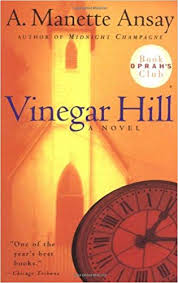
 

Vinegar Hill by A. Manette Ansay

Vinegar Hill

Vinegar Hill

A. Manette Ansay (Adult Fiction)

There are many ways to describe Ellen Grier: wife, mother, daughter, daughter-in-law, sister, caregiver, teacher.  All of these different roles and yet Ellen still feels incomplete…invisible almost.  She had been happy in Illinois in their rented house, but after her husband lost his job, she and her family are back in their hometown of Holly’s Field, Wisconsin and living with her in-laws at 512 Vinegar Hill—a harsh, loveless, and cold home filled with secrets.  She wants to be happy, but finds herself drowning under a sea of hopelessness and despair.  Can Ellen save herself and the ones she loves before Vinegar Hill consumes them all?

Vinegar Hill is an Oprah’s Book Club selection.  I’ve read several of her recommendations and often found them to be “hit” or “miss”.  This book is clearly a “miss”.  On the back cover, a review from Washington Post Book World calls it “Sweet, tender, and chilling.”  After reading this and several other critics’ comments printed on the book, I’m wondering if I actually read the same novel that they did.  Sweet?  Tender?  Vinegar Hill is the type of book that would make Edgar Allan Poe pause and say, “Wow!  Now THAT’S dark!”  This is a depressing, depraved, and disturbing story devoid of purpose, value, or meaning.  We’re introduced to several generations of individuals whose intolerance, callousness, cruelty, meanness and spite are clearly hereditary.  It’s an endless cycle of verbal and physical abuse with a skosh of religious hallucinations and psychological delusions thrown in for interest.  Ellen’s daughter, Amy, “buries” her “dead” dolls in shoeboxes; her husband, James, sees his children as the personification of Halloween with their skeletal hands and sunken ghostly eyes; and her elderly and bitter mother-in-law, Mary-Margaret, has dreams of her deceased twin infants growing back inside of her.  THIS is sweet and tender?  The Chicago Tribune even called Vinegar Hill “one of the year’s best books.”  I’m absolutely speechless.  I found the characters unpleasant and unsympathetic, religious judgements are frivolously tossed out as if they were beads at Mardi Gras, intelligence is scorned and vilified, and helplessness is encouraged and celebrated.

When Ellen sought advice from her fellow co-worker, she was told, “No one gets used to anything, they just get numb.”  After a while, with the constant derisions and disparagements, I too became numb and found myself eagerly counting down the pages until I could finally close the covers of this book and walk—or actually run—away from Vinegar Hill and all of its inhabitants…never to look back again.

Rating: 2/5

*Book cover image attributed to www.amazon.com

**Want more?  Visit our Facebook page at www.facebook.com/thedustyjacket
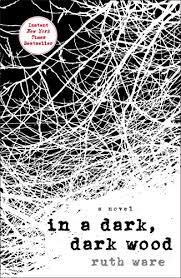
In a Dark, Dark Wood by Ruth Ware

In a Dark Dark Wood

In a Dark, Dark Wood  

Ruth Ware (Adult Fiction)

Twenty-six-year-old crime writer Leonora “Nora” Shaw lives alone…and she loves it.  When you’re alone, you’re in control and she likes it that way.  So when she gets an e-mail from a stranger inviting her to a bachelorette party for Clare Cavendish, Nora’s world unexpectedly is turned upside down.  She hasn’t spoken to Clare in ten years so the invitation is obviously unsettling.  Why her?  Why now?  But it’s only for the weekend and perhaps it would be nice to see Clare again.  After all, they had been best friends.  But since she’s arrived at the “glass house” in the middle of the woods, Nora only seems to be accumulating more questions than answers, and when you’re in a dark, dark wood, it’s so very hard to see any light of what is real or true.

I admit that I am sometimes influenced by the marketing blurbs that appear on the front and back covers of a book.  Some excerpts for In a Dark, Dark Wood include “Prepared to be scared” or “Read it…with all the lights on” or “An unsettling thriller”.  I have found, much to my disappointment, that all of these are a far cry from what you are actually given.  It’s certainly not the fault of Ware that expectations are set so incredibly high, but when you have Reese Witherspoon on the cover of your book promising a frightfest of epic proportions (she’s the one who warns readers to prepare for a scare), I have to wonder if my fear-o-meter is just insanely high or if Ms. Witherspoon is just a little scaredy-cat.

Without pitting Ruth Ware against Ruth Ware, I did find her second novel, The Woman in Cabin 10, to be a more satisfying and suspenseful read with the twist ending that I thought In a Dark, Dark, Wood would have.  To be fair, this book did have a lot of energy and some unexpected moments, but the end really did just fall apart.  I found it to be a bit predictable largely due to the generous amounts of clues that the author provides throughout the book.  Also, our heroine and narrator, Nora (who goes by several names), makes some really dim decisions and –for her being such an accomplished crime author—doesn’t seem able to think logically or rationally when it would benefit her the most.  Lastly, there are several gaping plot holes (we’re left questioning several characters’ intentions and motivations) and we really have to suspend any sense of logic in order to digest the series of events that happen at the end of the book.

For a quick read that you can read at night, by yourself, during a storm, in a spooky house, feel free to pick up In a Dark, Dark, Wood.  For a suspenseful and thrilling book that will leave you guessing until the end, I invite you to leave the wood and go toward the water with Ware’s The Woman in Cabin 10—unless you’re Reese Witherspoon and then you should definitely stay away…or at least turn on the lights.

Rating: 3/5

*Book cover image attributed to www.amazon.com

**Want more?  Visit our Facebook page at www.facebook.com/thedustyjacket


Heft by Liz Moore

Heft

Heft 

Liz Moore (Adult Fiction)

Arthur Opp hasn’t been weighed in years.  Back then, he was 480 pounds, but he’s probably between 500 and 600 pounds now.  He lives in isolation in an aging yet expensive brownstone in Brooklyn and hasn’t taught a college class in eighteen years.  Kel Keller is seventeen, athletic, and popular amongst his friends.  He’s a poor kid from Yonkers who attends an affluent school and dreams of playing professional baseball.  What these two very different people don’t realize is that they have something in common…a woman by the name of Charlene Turner.  Charlene is Kel’s mother and Arthur’s former student and she is about to alter both their lives when she decides to pick up the phone and ask Arthur for a simple favor.  Suddenly, Arthur is forced to open himself up to the outside world while Kel is forced to open his eyes to discover the girl his mother used to be.

I really enjoyed Heft and was impressed with Moore’s proficiency in writing as a middle-aged ex-professor struggling with obesity and isolation and then as a teenaged boy caught between the worlds of poverty and prosperity while dealing with his mother’s insecurities.  The story moved along at a nice pace and rarely lagged, even through multiple character flashbacks.  There were several supporting and interesting characters in the story, but the one that stood out to me was Arthur’s maid, Yolanda.  She’s a spitfire and truly the yin to Arthur’s yang.  We see a whole new side of Arthur when Yolanda is around and that was a pleasure to experience.  Despite the praise, I did have a few issues with this book that prevented me from giving it a full five-star rating.

The first problem I had (might not be as big a deal to others) was when Moore was writing as Arthur.  For his “voice”, she chose to flip back and forth between using an ampersand (&) and the word “and”.  At first, I thought maybe something slipped by copy editing, but when it happened repeatedly and then when she started a sentence with an ampersand (and she even began a paragraph with it), I just about popped.  This is a deliberate style choice that Moore made for this character, but it prevented me from totally immersing myself in Arthur’s story since I had to constantly decode such sentences as “I read it twice. & then I read it three more times.”  *pop*

Another problem was the last part of the book. Although Moore delivers a story that is touching, insightful, and uplifting, I felt that at the end of the book, there was something missing.  If I were to describe it (so as not to spoil the story), it would be like buttoning your shirt and realizing only when you got to the bottom that your shirt was uneven.  You’re going along button to hole, button to hole, button to hole, but despite everything going swimmingly, it doesn’t end up right.  Moore gives us a beautifully written story that seamlessly fits together but the end of the book seems a bit off and I ended up with more questions than answers.

Aside from those issues, I did love how Moore presented Arthur and Kel with such fearless honesty.  Both men are flawed, fractured, and burdened with regret and loneliness, but they are also proud despite their brokenness and willing to open up their hearts regardless of the risk that love often carries with it.  Usually when a book presents two different character threads, I find myself enjoying one more than the other, but with Liz Moore’s Heft, I enjoyed both Arthur and Kel equally and loved laughing and crying with each of them.

Heft is an enjoyable read offering up a message of hope, forgiveness, redemption, and second chances.  It also serves as a reminder to never underestimate the full impact of a seemingly simple act…like making a phone call or asking for help.  As the Dalai Lama once said, “Just as ripples spread out when a single pebble is dropped into water, the actions of individuals can have far-reaching effects.”

Rating: 4/5

*Book cover image attributed to www.amazon.com

**Want more?  Visit our Facebook page at www.facebook.com/thedustyjacket
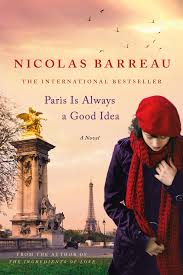
Paris Is Always a Good Idea by Nicolas Barreau

Paris Is Always a Good Idea

Paris Is Always a Good Idea

Nicolas Barreau (Adult Fiction)

“A few days later, on a springlike day in April, the story of the blue tiger entered Rosalie Laurent’s life and changed it forever.  Ultimately there is a story in every life that becomes the fulcrum about which it revolves—even if very few people recognize it at first.”

Rosalie Laurent is the owner of Luna Luna, a charming postcard shop in Saint-Germain.  She sells stationery, paperweights, beautiful pens, and wishing cards—beautiful and unique cards lovingly painted by Rosalie herself.  She is happy (her mother would rather she have a more “respectable” job) and content and although several of her own wishes have gone unanswered, she can’t imagine her life to be any more fulfilled until the day when celebrated children’s author Max Marchais walks—rather trips—into her shop and brings with him a book in need of an illustrator.  Just when Rosalie thinks that all of her wishes are beginning to come true, a handsome American literature professor enters her life with accusations of plagiarism.  So much for wishes.

Nicolas Barreau has written a book as light and sweet as a freshly baked croissant, as colorful and expressive as a Monet painting, and as beautiful and vibrant as the city of Paris itself.  It’s a delightful and charming story brimming with hope, loss, regret, and love…beaucoup d’amour! It’s endearing without being sappy and the relationship between Rosalie and Max shows us that love and compassion can bridge any age gap and provide two souls with the belief that each day is full of promise and possibility.

One of the sweetest aspects of this novel is the blue notebook that Rosalie writes in every night just before going to bed.  In it, she writes just two things: the worst moment of her day and the best.  If I had a blue notebook right now, I would write that the worst moment of the day would be reading the very last sentence of Nicolas Barreau’s lovely book and having to say goodbye to Rosalie, Max, Luna Luna, and the splendor that is Paris.  The best moment of the day would be knowing that there is another book out there with a story and characters who are waiting to touch my heart and brighten my day just like this book has.  After all, reading, just like Paris, is always a good idea.

Rating: 5/5

*Book cover image attributed to www.amazon.com

**Want more?  Visit our Facebook page at www.facebook.com/thedustyjacket
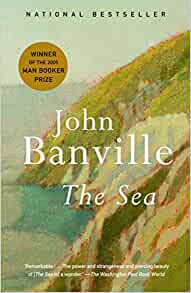
 

The Sea by John Banville

The Sea

The Sea

John Banville (Adult Fiction)

Recent widower Max Morden, looking for respite and solace from his grief, returns to the seaside town where he spent his summer holidays as a youth.  Once there, he rents a room in the Cedars, the same house where he met the affluent, affable, and alluring Grace family.  But memories can be both haunting and comforting and as Max begins to remember his first experiences with love and death, he understands just how fragile and unpredictable life can be.

The Sea was the 2005 winner of the Man Booker Prize and despite its bestseller status and numerous accolades, I was counting the pages to its completion (I don’t provide a review unless I finish a book in its entirety).  I agree with critics and reviewers that the writing is indeed superb, but I found it so over-the-top in its detail that I quickly became a victim of prosaic poisoning.  Here is an example of Max describing his mental haze before his wife, Anna, receives her fatal diagnosis: “In the ashen weeks of daytime dread and nightly terror before Anna was forced at last to acknowledge the inevitability of Mr. Todd and his prods and potions, I seemed to inhabit a twilit netherworld in which it was scarcely possible to distinguish dream from waking, since both waking and dreaming had the same penetrable, darkly velutinous texture, and in which I was wafted this way and that in a state of feverish lethargy, as if it were I and not Anna who was destined soon to be another one among the already so numerous shades.”  Again, simply beautiful in its artistry and imagery, but completely exhausting to absorb and resulted in more frustration than enjoyment on my part.

Another aspect of this book, which only added to its incredible weightiness, is that it lacked chapters and was only separated into Book I and II.  The Sea was simply paragraph after paragraph after paragraph with the occasional (and much welcomed) double-spaced separation.  It’s as if John Banville was feeding us a wonderfully delectable five-course meal and never giving us the opportunity to savor, swallow, and digest each bite.  We just keep getting spoonful upon spoonful and end up pushing ourselves away from the table for our own self-preservation—leaving a perfectly lovely meal unappreciated.

The downfall of writing a story where each word and phrase are so meticulously constructed is that you have characters that feel a bit one dimensional and lacking true warmth or vulnerability.  It’s like a room staged for an opulent magazine spread.  While it’s gorgeous and truly exquisite, you really can’t imagine living in it for it’s missing the heart and soul that allow you to connect with it.  That immersive feeling that wraps around you like a warm blanket or well-worn bathrobe.  But we’re not talking about a room or a home, but something majestic and vast and powerful and in the end, that is the problem with this book.  The problem is that we’re dealing with the sea.

Rating: 3/5

*Book cover image attributed to www.amazon.com

**Want more?  Visit our Facebook page at www.facebook.com/thedustyjacket


Jewel by Bret Lott

Jewel

Jewel

Bret Lott (Adult Fiction)

“I say unto you that the baby you be carrying be yo’ hardship, be yo’ test in this world.  This be my prophesying unto you, Miss Jewel…The Lord smiling down on you this way.”  This is what Jewel Chandler Hilburn was told about her unborn child—her sixth and last.  It was 1943 and she had already been blessed abundantly with a good marriage to a loving man, five beautiful children, and a comfortable life in the woods of Mississippi.  With this child, Jewel just wanted a living, breathing baby with ten fingers and ten toes.  Certainly, that couldn’t be too much to ask?  But life can change in an instant and Jewel soon finds herself with a baby who is both a blessing and a burden and who will forever change the way she views life and love.

Bret Lott delivers a poignant and touching story about a mother’s relationship with her special needs daughter.  Jewel is a woman who has lived a thousand lives and has seen hardship and tenderness, cruelty and kindness, but the heart of this story is the bond she shares with her daughter, Brenda Kay.  Lott brings to the surface the gut-wrenching and life-altering moment when a mother looks upon her precious child—when heart and head finally reach mutual agreement—and says the words, “Something’s wrong”.  We feel the heartbreak as Jewel mourns the future that she has imagined for her daughter that will never be and we see her burdened with the regret of not being there for her other children or her husband.  Life is no longer measured in minutes or months, but in milestones and Jewel is there to celebrate each and every one of Brenda Kay’s.  She even organizes a family picnic when Brenda Kay takes her first step at age five.

Jewel is a celebration of the love between a mother and child.  Bret Lott reminds us of the tremendous gift that our children give us.  As each day brings with it some amount of pain, joy, frustration, heartache, sadness, and love, we are also reminded that it is one day less that we have with them all to ourselves for the job of a parent is to love our children, protect them, guide them, and then let them go so that they can make lives of their own.  It is a bittersweet role that we take on willingly and relinquish reluctantly.  Our legacy is often measured through our children.  They carry on our hopes, our dreams, our stories, and a bit of ourselves.  As Jewel said, “My life would never end, I saw, not even in my own Brenda Kay, because of those eyes turned to me and asking what to do, the only true victory any mother could ever hope for: the looking of a child…to you for what wisdom you could give away before you left for whatever reckoning you had with the God who’d given you that wisdom in the first place.”  Our children are indeed a blessing and a burden, but through their words, actions, and deeds, we too are able to see the Lord smiling down at us.

Rating: 5/5

*Book cover image attributed to www.amazon.com

**Want more?  Visit our Facebook page at www.facebook.com/thedustyjacket

The Girl in the Red Coat by Kate Hamer

The Girl in the Red Coat

The Girl in the Red Coat

Kate Hamer (Adult Fiction)

“We took the train that day.  I wanted it to be special for Carmel and taking a train rather than the usual bus was a treat.”  That is how the day started for newly single mom Beth and her daughter, Carmel.  A day that Beth would look back on as Day 1.  A day brimming with excitement and anticipation, but ending with every parent’s worst nightmare.  On Day 1, Carmel disappeared during an outdoor festival.  You wouldn’t think that an eight-year-old girl wearing a red coat could be so easily overlooked.  Could so easily vanish.  But a heavy mist had settled on the grounds, visibility was deteriorating, and just like that, Day 1 had started.  While Beth begins an exhaustive search for her missing daughter, Carmel starts her own harrowing journey into a religious sect with a man she must trust to survive.  As days turn into weeks and then months, will Beth ever see her little girl in the red coat again?

I have yet to read a modern British author’s work that I didn’t enjoy and Kate Hamer’s The Girl in the Red Coat is surely no exception.   Hamer—born in Plymouth and raised in Pembrokeshire (she’s says she feels Welsh)—gives readers a thrilling story that alternates between the points of view of Beth and Carmel.  As a parent myself, I’m not sure which of the two stories was more disturbing to read:  a mother helpless and tormented by guilt over losing her child or a child being emotionally manipulated and fearful of losing her identity.  Both stories keep the reader breathlessly captivated and drawn into a nightmare scenario that no one should have to bear.  Hamer delves into the subtleties of loss, grief, and shame as Beth seeks personal absolution for Carmel’s disappearance.  We feel her guilt when she completes an errand or leaves the house and only realizes later that she didn’t think of or search for Carmel during that time.  Her stages of grief are excruciating and Hamer boldly lays it out so that we may process and endure it with Beth.  In turn, she allows us equal time to share in Carmel’s isolation, confusion, and fear as she is ripped from everything she knows and loves and is forced to accept a new way life with a stranger whom she feels obligated to trust.  Both Beth and Carmel feel an overwhelming amount of guilt and regret over their actions, yet they desperately cling to the smallest modicum of hope that they will once again be reunited.

The color red is used liberally throughout this book and represents different things.  This story has a strong religious component so for Christians, red symbolizes atonement and sacrifice.  Red is also an intense color representing extreme emotions such as hate, jealousy, and anger which we see through certain members of Carmel’s “surrogate” family.  It’s the color of danger and Carmel’s beautifully unique coat unfortunately turns into a beacon for an unscrupulous stranger.  For Carmel, it serves as an interesting color choice.  She is fiercely drawn to this color whose main purpose is to make the wearer stand out, yet Carmel is desperate to break loose from her overprotective mother and often seeks out dark, far-off spaces to hide.  For someone wanting to disappear, red wouldn’t be an obvious fashion option.  But it would be this same color that would serve as Carmel’s anchor to holding on to her identity.  Red would remind her that she is Carmel Wakeford and that red, above all else, is the color of strength, heart, and love.

Rating: 5/5

*Book cover image attributed to www.amazon.com

**Want more?  Visit our Facebook page at www.facebook.com/thedustyjacket

Top 10 Picks for 2019

Top

Below is our annual Top 10 Picks for 2019.  This year, we’ve added an Honorable Mention list since there were SO many great books for younger readers, we simply couldn’t leave these little gems out.  We hope you find this list is helpful in choosing some books to read in 2020 and look forward to sharing more great dusty jackets in the upcoming year.  Happy reading!

The Dusty Jacket’s Top 10 Picks for 2019*

Adult Fiction/Biography

  1. Anne of Green Gables, My Daughter & Me (Memoir) by Lorilee Craker (reviewed January 2019)
  2. The Bell Jar by Sylvia Plath (reviewed January 2019)
  3. The Kitchen Boy: A Novel of the Last Tsar by Robert Alexander (reviewed January 2019)
  4. Memoirs of an Invisible Friend by Matthew Dicks (reviewed February 2019)
  5. Chosen By a Horse (Memoir) by Susan Richards (reviewed March 2019)
  6. The Dogs of Babel by Carolyn Parkhurst (reviewed April 2019)
  7. The Human Comedy by William Saroyan (reviewed May 2019)
  8. The Art of Racing in the Rain by Garth Stein (reviewed June 2019)
  9. Mr. Timothy by Louis Bayard (reviewed October 2019)
  10. Saints at the River by Ron Rash (reviewed December 2019)

Juvenile/Young Adult

  1. I Don’t Know How the Story Ends (YA Historical Fiction) by J. B. Cheaney (reviewed January 2019)
  2. Alchemy and Meggy Swann (YA Historical Fiction) by Karen Cushman (reviewed January 2019)
  3. Bud, Not Buddy (J) by Christopher Paul Curtis (reviewed March 2019)
  4. An Elephant in the Garden (YA Historical Fiction) by Michael Morpurgo (reviewed March 2019)
  5. The Wheel on the School (J) by Meindert DeJong (reviewed April 2019)
  6. The Lightning Dreamer (YA Historical Fiction) by Margarita Engle (reviewed April 2019)
  7. King of the Wind (J Historical Fiction) by Marguerite Henry (reviewed May 2019)
  8. Return to the Willows (J) by Jacqueline Kelly (reviewed June 2019)
  9. The Hundred Dresses (J) by Eleanor Estes (reviewed August 2019)
  10. The Boy Who Harnessed the Wind (J Biography) by William Kamkwamba (reviewed September 2019)

Honorable Mention

Silent to the Bone (YA) by E. L. Konigsburg (reviewed February 2019)

The Birchbark House (J) by Louise Eldrich (reviewed February 2019)

Abel’s Island (J) by William Steig (reviewed March 2019)

Bed-Knob and Broomstick (J) by Mary Norton (reviewed April 2019)

Bluefish (YA) by Pat Schmatz (reviewed July 2019)

Adam of the Road (J) by Elizabeth Janet Gray (reviewed August 2019)


*List contains selections reviewed in 2019