
Current Book Review

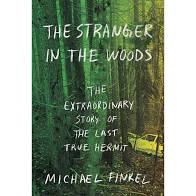
The Stranger in the Woods: The Extraordinary Story of the Last True Hermit by Michael Finkel (Biography)

The Stranger in the Woods: The Extraordinary Story of the Last True Hermit 

Michael Finkel (Adult Biography)

There are three general groups that hermits can be divided into to explain why they seek isolation: protesters (those who detest what the world has become), pilgrims (often referred to as religious hermits), and pursuers (those seeking alone time for artistic reasons, scientific insight, or self-understanding).  Twenty-year-old Christopher Knight didn’t fit into any of these categories.  In 1986, for reasons unknown, he simply turned his back on the world and disappeared into the Maine woods for twenty-seven years—nearly 10,000 days.  By all accounts, Chris Knight was the most solitary-known person in all of human history and journalist Michael Finkel was about to share his unimaginable story with the world.

According to John Donne, “No man is an island, entire of itself; every man is a piece of the continent.”  The same held true for Chris Knight.  He sought detachment, but needed essentials to survive and those essentials belonged to other people.  He was an island desperately needing food, clothing, and materials to ensure his survival in the harshest of elements and so Knight resorted to stealing from his fellow man.  To avoid detection for so long, he adhered to a strict set of rules: strike only after midnight, travel from rock to root or on ice to avoid leaving footprints, don’t steal from permanent residents, and take only pre-packaged or canned goods to avoid possible poisoning.  Aside from thievery, Knight held himself to a strict moral code and avoided personal contact at all costs.  But in life, nothing is certain except change and death and Knight’s idyllic world would soon come to a close without either incident or fanfare.

Because Knight kept no written account of his life, Michael Finkel’s The Stranger in the Woods is an extensive compilation of conversations with Knight (nine one-hour sessions over the course of two months); insights from psychologists, neuroscientists, and experts on autism; books on isolation, hermits, and solitude; and interviews with Knight’s family, neighbors, victims, and local law enforcement.  It is an exhaustive, profound, and gripping account of one man’s desire to be alone, yet was never lonely.  A man whose defiance to live according to societal norms brought him admiration from survivalists, condemnation from the violated, and contempt from the hermit community.  It’s ironic that a man determined to walk invisibly for so many years managed to leave such a large imprint on so many when all was said and done. 

History views banishment, solitary confinement, and marooning as the most severe forms of punishment.  For Chris Knight, he not only sought these conditions, he thrived in them.  Henry David Thoreau wrote, “I love to be alone. I never found the companion that was so companionable as solitude.” In his twenty-seven years alone in the Maine wilderness, Chris Knight managed to say only one audible word.  Looking back now, I’m sure he feels that that single word was one word too many.  

Rating: 4/5

*Book cover image attributed to www.amazon.com

**Want more?  Visit our Facebook page at www.facebook.com/thedustyjacket
It’s Kind of a Funny Story by Ned Vizzini (YA)

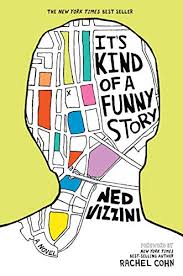
It’s Kind of a Funny Story 

Ned Vizzini (Young Adult Fiction)

“I didn’t want to wake up. I was having a much better time asleep. And that’s really sad. It was almost like a reverse nightmare, like when you wake up from a nightmare you’re so relieved. I woke up into a nightmare.” “And what is that nightmare, Craig?” “Life.” “Life is a nightmare.” “Yes.”

Fifteen-year-old Craig Gilner is living his best life. He has cool friends, a loving family, and he’s just been accepted into the coveted Executive Pre-Professional High School. This is where it all begins: a great high school leads to a prestigious college which allows for a lucrative job which paves the way for a big house, nice car, ideal family, and dream life. Or does it? Craig doesn’t realize that the happiest day of life would trigger a series of events that would ultimately lead him to voluntarily check himself into a psychiatric facility in Brooklyn. What can a bunch of “crazy” people teach Craig about life? Well…it’s kind of a funny story.

Ned Vizzini long struggled with severe clinical depression, which is why this book is so raw, real, and personal. We see Vizzini’s struggles, defeats, and triumphs through Craig and get a first-hand view of depression, the value of life, and the gift of hope. In a heartbreaking example of life imitating art, Vizzini succumbed to his own demons seven years after the publication of this book. While his untimely and premature death is unimaginably tragic, he left us with an unforgettable story full of hope, promise, and second chances. We see the incredible worth of friendship and the importance of a strong support system. 

Vizzini could have focused this story on Craig’s illness and the havoc it wreaks on himself, his family, and his friends.  Instead, It’s Kind of a Funny Story is a journey centered around healing, self-discovery, and re-discovery. It’s a lesson on re-evaluating the things that we surround ourselves with and not being afraid to redefine ourselves by letting go of possessions, people, or habits that no longer bring us happiness or offer fulfillment. It’s a story that reinforces the idea that sometimes we are bravest at our most vulnerable moment. Craig wasn’t afraid to live, he was afraid to fail and his journey back from the brink is enlightening, encouraging, inspiring, and…well…it really is kind of a funny story.

*Reviewer’s note: Ned Vizzini was a fervent advocate for mental health and suicide awareness.  Help is available through the National Hopeline Network for people contemplating suicide: 1-800-SUICIDE / 1-800-784-2433.

Rating: 5/5

*Book cover image attributed to www.amazon.com

**Want more?  Visit our Facebook page at www.facebook.com/thedustyjacket
The Mysterious Disappearance of Leon (I Mean Noel) by Ellen Raskin (J Mystery)

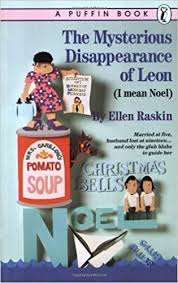
The Mysterious Disappearance of Leon (I Mean Noel)

Ellen Raskin (Juvenile Mystery)

It’s a funny thing about names.  Some are long, some are short; some mean something, others don’t; but everyone and everything has one, or two or three.

Caroline “Little Dumpling” Fish Carillon has quite the backstory for someone so young.  She was married at five years old (business is business, after all), orphaned at twelve, and widowed (maybe…no one is quite sure) at nineteen.  Throw in twins, an unfortunate incarceration, a cross-country manhunt, and a watery clue that seems practically insolvable and you have a mystery for the ages!  With the help of the glub blubs, Mrs. Carillon is quite sure that she’ll be able to find Leon (I mean Noel).

The Mysterious Disappearance of Leon (I Mean Noel) is the perfect read for any young detective.  Raskin provides readers with plenty of clues along our heroine’s journey of finding her lost love.  While her Newberry Medal mystery The Westing Game can easily be enjoyed by older readers, this book is clearly written for a younger audience.  The Mysterious Disappearance of Leon (I Mean Noel) provides pages and pages of slapstick fun and silly good humor.  It’s delightful in its utter absurdity and endearing in its over-the-top implausibility.  Readers are encouraged to sleuth along with Mrs. Carillon and her twins—Tina and Tony—and are helpful tips and hints make for a totally immersive reading experience.

Throughout Raskin’s book, Mrs. Carillon is forever searching for what she thought she wanted.  Endlessly chasing an idea that she thought she needed.  American author Meg Cabot—best known for The Princess Diaries—wrote “Sometimes what you want is right in front of you. All you have to do is open your eyes and see it.”  Ironically, it was only after Mrs. Carillon stopped chasing a dream that she was able to find her heart.

Rating: 4/5

*Book cover image attributed to www.amazon.com

**Want more?  Visit our Facebook page at www.facebook.com/thedustyjacket
The Ghost of the Mary Celeste by Valerie Martin

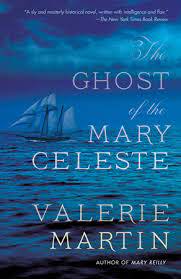
The Ghost of the Mary Celeste

Valerie Martin (Adult Historical Fiction)

A medical doctor and creator of the world-renowned detective Sherlock Holmes.  A journalist who describes herself as a seeker of frauds and spiritualist debunker.  A shy and gifted clairvoyant of extraordinary powers who many claim to be the genuine article.  All of these people are connected—it seems—by the merchant vessel Mary Celeste that was discovered adrift off the coast of Spain devoid of crew, but replete with questions…many, many questions.  Will the ghosts of the Mary Celeste ever find peace and will these three individuals play a part in their healing?

The Ghost of the Mary Celeste, from its onset, attempted a rather difficult feat by building an entire story around an unsolvable mystery.  Much like the Lost Colony of Roanoke, the only things that one can add to this ancient enigma are theories, speculations, hypotheses, and suppositions.  With that said, Martin gives us a story that is held together by the sheerest veil of it being about the doomed ghost ship.  Instead, readers are presented with multiple storylines that fail to reach any kind of reasonable conclusion and tend to spawn more questions than the Mary Celeste herself.  There are several scenes when the action takes place on the sea and the sailing vessel is enveloped in a thick shroud of fog.  That is how Martin’s story seemed to be—blindly inching along with no real direction and hoping for a break in the clouds to offer some semblance of light and order.

With its abrupt story shifts, numerous plot holes, and a tale that really doesn’t seem to have a point, The Ghost of the Mary Celeste seems doomed to aimlessly drift along while seeking solid ground—much like its namesake.  One could only imagine what this story would have been like if Martin chose to highlight Arthur Conan Doyle rather than spiritualism.  To look at this mystery through the eyes of one Sherlock Holmes—who famously said, “How often have I said to you that when you have eliminated the impossible, whatever remains, however improbable, must be the truth?”—we can probably assume that Mr. Holmes would not only have handily solved this case, but would have done so with enough time to make afternoon tea and biscuits.

Rating: 3/5

*Book cover image attributed to www.penguinrandomhouse.com

**Want more?  Visit our Facebook page at www.facebook.com/thedustyjacket

All the Bright Places by Jennifer Niven (YA)

All the Bright Places

All the Bright Places

Jennifer Niven (Young Adult Fiction)

“Is today a good day to die?”  Theodore Finch asks himself this question in the morning, during third period, and at supper.  He also counts the days that he is Awake.  Awake is good and safe and where he needs to be.  Violet Markey counts the days until graduation.  When she can begin a new life away from Bartlett, Indiana and the pain she feels every day since her sister died.  Both Finch and Violet are counting, but what they didn’t count on was meeting on the ledge at the top of the high school bell tower.  They didn’t count on wandering around their state discovering out-of-the-way landmarks and attractions.  Most of all, they didn’t count on falling in love.

All the Bright Places gives readers a gritty and honest look into bipolar disorder.  Told in alternating narratives by Finch and Violet, we experience bullying, loss, domestic abuse, suicide, and mental illness.  With so many disturbing and difficult topics, it is a testament to Niven that readers are given a story filled with laughter, love, and hope.  Through two fractured and flawed main characters, we see teenagers struggling to understand their place in the world and determined—despite all odds—to make their mark within it.

Young Adult Me liked the star-crossed relationship between Finch and Violet.  He was the Yin to her Yang and the two complemented one another well.  Finch’s fearlessness in approaching Violet about her loss enabled her to break free from her psychological prison and regain her independence.  Violet, in turn, acted as a compass giving Finch direction and much-needed stability.  However, Adult Me really had a problem with Finch’s family and how they chose to deal with his manic depression.  It seemed too easy and convenient to chalk up his behavior as quirky and weird and, “Oh, that’s just Finch.”  When he disappears for days, they dismiss it as, “He does that sometimes.”  This cavalier attitude seems a bit apathetic for a family already put through the wringer with divorce…and a nasty one at that.  During weekly visits with the Finch patriarch, it’s obvious that Finch’s condition is hereditary and one would think that his mother would be hesitant to turn a blind eye a second time around.  But in the end, Young Adult Me just told Adult Me to stop overthinking things and enjoy the story…so I did.

Niven gives us a raw and poignant story about two teens drowning in their own pools of mental anguish and personal guilt.  Whether by luck or fate, they find each other and extend the healing lifelines of forgiveness, acceptance, and love to each other.  Through them, we see that it is possible for life to go on no matter how impossible or improbable it may seem at the time.  Throughout their story, Finch and Violet express their need to feel relevant, their desire to matter, and their wish to be remembered.  By seeking out the hidden treasures within their own state (a backyard roller coaster, a shoe tree, or a book mobile park), the two begin to uncover their own self-worth that eventually allows a violet to bloom and a finch to fly.

Rating: 5/5

*Book cover image attributed to www.target.com

**Want more?  Visit our Facebook page at www.facebook.com/thedustyjacket


The One and Only Ivan by Katherine Applegate (J)

The One and Only Ivan

The One and Only Ivan

Katherine Applegate (Juvenile Fiction)

“I just thought of a story,” I say.  “Is it a made-up story or a true one?” Ruby asks.  “True,” I say.  “I hope.”  Ruby leans against the bars.  Her eyes hold the pale moon in them, the way a still pond holds stars.  “Once upon a time,” I say, “there was a baby elephant.  She was smart and brave, and she needed to go to a place called a zoo.”  “What’s a zoo?” Ruby asks.  “A zoo, Ruby, is a place where humans make amends.  A good zoo is a place where humans care for animals and keep them safe.”  “Did the baby elephant get to the zoo?” Ruby asks softly.  I don’t answer right away.  “Yes,” I say at last.  “How did she get there?” Ruby asks.  “She had a friend,” I say.  “A friend who made a promise.”

Ivan is known by many names that humans have given him: The Freeway Gorilla, The Ape at Exit 8, Mighty Silverback, and The One and Only Ivan.  But really, Ivan isn’t any of those.  He’s just Ivan who spends his days (9,876 and counting) at the Exit 8 Big Top Mall and Video Arcade.  Ivan is great at counting, but the thing he loves to do more than anything else is draw.  His drawings sell for $20 in the gift shop ($25 framed) and so he spends his days drawing, counting, and observing until a baby elephant named Ruby joins the Big Top Mall.  Ruby is shy and scared and Ivan soon realizes that he must make good on a promise he made to a friend in order to keep Ruby safe.  A promise that he’s not sure how he’ll keep, but he knows he must find a way.  Whatever that might be.

Winner of the 2013 Newbery Medal, The One and Only Ivan was inspired by a real gorilla named Ivan who spent almost three decades in a circus-themed mall in Washington state before his eventual relocation to Zoo Atlanta.  In this heartwarming and touching story, Applegate gives us a hero who is kind, strong, and loyal.  Despite being four-hundred pounds of pure power, Ivan is a main character full of self-doubt, humility, and opinions…lots and lots of opinions:  poodles are parasites, humans speak too much, and there is absolutely no excuse for chimps.

Throughout her story, Applegate gives us glimpses of kindness, cruelty, desperation, remorse, selflessness, hope, and love.  It is a tale of loyalty, bravery, and ingenuity and shows us how far we are willing to go in order to keep a promise to a friend.  Narrated by Ivan and written in simple, concise sentences that manage to convey a wide range of thoughts and feelings, we get to experience the lonely and isolated world of caged animals and their longing to see the sky, touch the grass, feel the wind, and taste a bit of freedom.  After reading this book, I can pretty much guarantee that you’ll never look at a circus (with animals) in the same way again.  At least I hope so.

The One and Only Ivan has so many valuable lessons to share with readers young and old alike: the honor of keeping your word, the importance of finding your inner strength, and the impact that a small act of kindness possesses.  Above all, this book shows us that you don’t have to have much in common with someone in order to extend a bit of comfort and hope.  Ivan shows us this through his friendship with Stella, an elderly elephant.  “We don’t have much in common, but we have enough.  We are huge and alone, and we both love yogurt raisins.”  Author, speaker, and businessman Stephen Covey once said, “Strength lies in differences, not in similarities.”  How wonderful life could be if we were able to take a lesson from an opinionated silverback and an aged pachyderm.

Rating: 5/5

*Book cover image attributed to www.goodreads.com

**Want more?  Visit our Facebook page at www.facebook.com/thedustyjacket

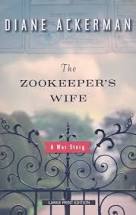
The Zookeeper’s Wife by Diane Ackerman

The Zookeepers Wife

The Zookeeper’s Wife

Diane Ackerman (Adult Non-Fiction)

Jan and Antonina Żabiński were Christian zookeepers horrified by Nazi racism, who capitalized on the Nazis’ obsession with rare animals in order to save over three hundred doomed people.  Their story has fallen between the seams of history, as radically compassionate acts sometimes do.  But in wartime Poland, when even handing a thirsty Jew a cup of water was punishable by death, their heroism stands out as all the more startling.

The Zookeeper’s Wife takes place in Poland from the summer of 1935 to January 1945 with an Aftermath provided by the author.  Ackerman’s exhaustive and extensive research on the Żabińskis was compiled through letters, interviews, diary entries, articles, memoirs, testimonies, Antonina’s autobiographical children’s books, and numerous other sources.  It should be noted that The Zookeeper’s Wife is not historical fiction or anywhere close to it.  Those disappointed in the story’s disjointedness need only remember that this is an in-depth non-fiction about Poland, its population, and the ravages endured during World War II.  Ackerman’s research is comprehensive and immersive and her book should not be compared to a reader’s preconceived expectations—or worse—the movie version.

With that said, the book does go off on numerous tangents.  In addition to the Żabiński’s story, Ackerman delves into such topics as weaning, Greek mythology, the Ice Age, the migration patterns of birds, animal psychology, and Polish folklore.  Needless to say, the author covers the gamut in subject matter.  If this were a road trip, the Żabińskis would be the main freeway.  Every time they come in contact with a new individual—German, Russian, Polish, or Jewish—our story veers off on a side road where we learn about that person’s background, history, hobbies, talents, etc.  Our journey experiences many of these off-road adventures which may thoroughly exhaust some readers while intriguing others.  If you go into this book with realistic and accurate expectations, you’ll discover how the roads of a pair of Christian zookeepers, a German zoologist with an obsession of reviving extinct species, an ill-fated zoo, and a primeval forest in northeastern Poland all converge to save countless lives—both animal and human.

Jan Żabiński once said, “I don’t understand all the fuss.  If any creature is in danger, you save it, human or animal.”  This is the heart of The Zookeeper’s Wife and represents a sentiment that we should never find ourselves keeping hidden away or caged.

Rating: 5/5

*Book cover image attributed to www.thriftbooks.com

**Want more?  Visit our Facebook page at www.facebook.com/thedustyjacket


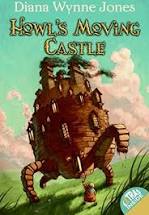
Howl’s Moving Castle by Diana Wynne Jones (YA Fantasy)

Howls Moving Castle

Howl’s Moving Castle

Diana Wynne Jones (Young Adult Fantasy)

In the land of Ingary, where such things as seven-league boots and cloaks of invisibility really exist, it is quite a misfortune to be born the eldest of three.  Everyone knows you are the one who will fail first, and worst, if the three of you set out to seek your fortunes.

Sophie Hatter was a born blunderer.  Being the eldest of three daughters, it was simply inevitable and Sophie accepted her fate with as much dignity and resignation that she could muster.  She was well read, a talented seamstress, and abundantly aware that life—at least for her—held no interesting or exciting prospects.  But things certainly took an unexpected turn when Sophie found herself on the wrong end of a curse from the Witch of the Waste.  Suddenly, Sophie is now an old lady whose life is brimming with a stalking scarecrow, an enchanted fire, an arrogant wizard, and a magical, moving castle.  And here Sophie thought that her life would never hold any interesting or exciting prospects!

Howl’s Moving Castle is the first of three books by Diana Wynne Jones in the Howl’s Series.  In this novel, Jones takes readers on a thrilling and magical adventure full of charms and curses, mystery and mistaken identity, and frights and delights while our heroine goes on her own adventure of self-discovery and acceptance.  Eleven years before J. K. Rowling enchanted the world with a boy wizard, Jones gave readers another character who felt exploited and unhappy with their place in the world.  A person who longed for adventure and always knew that there was a world far beyond their little nook.  An unassuming hero defined and confined by societal views, but capable of so much more than meets the eye.  Characters like Harry Potter and Sophie Hatter are the very reason why we cheer for the underdog, mourn their failures, and celebrate their successes as if they were our own.  They reaffirm our hope that nice guys don’t finish last and our faith that love does conquer all.

Author C. S. Lewis once wrote, “We are who we believe we are.”  For a long time, Sophie believed herself to be unattractive, undeserving, and unimportant.  Like so many beloved characters in literature, it took a twist a fate to show Sophie that the beauty, strength, and courage she thought she lacked was inside her all along and proved once again that a curse can sometimes be a true blessing in disguise.

Rating: 5/5

*Book cover image attributed to www.amazon.com

**Want more?  Visit our Facebook page at www.facebook.com/thedustyjacket
 

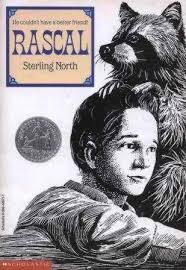
Rascal by Sterling North (J Biography)

Rascal

Rascal

Sterling North (Juvenile Biography)

One pleasant afternoon in 1918, eleven-year-old Sterling North, along with his Saint Bernard, Wowser, and friend, Oscar Sunderland, were in Wentworth’s woods.  There, in the hollow base of a rotten stump, hid a mother raccoon and her litter of four kits.  Angered and frightened by Wowser’s intrusive digging, mother and kits darted to safety, but not before Oscar was able to capture one of the kits in his knit cap.  On that May 15th day, young Sterling had no idea that this incident would mark the beginning a very unusual and special friendship.  A friendship filled with irresistibly shiny things, strawberry pop, sweet corn, music, crayfish, and a no-good rotten bully by the name of Slammy Stillman.  The next twelve months would be a year that young Sterling would never forget.

Rascal received a Newbery Honor in 1964 and is Sterling North’s memories of growing up in southern Wisconsin from May 1918 to April 1919.  It would be a time marked with his brother, Herschel, serving in World War I, Armistice Day, and the Spanish influenza, which claimed more lives in his beloved town of Edgerton (referred to as Brailsford Junction in this book) than the war.  North was the youngest of four children.  His father was a successful landowner and his mother died when North was only seven.  In Rascal, North describes a time when front doors were never locked, neighbors looked after one another, family and good health were your most prized possessions, and all it took to make young Sterling North the happiest boy in the world were his bike, his pet raccoon sitting in the front basket, and the wind in your face as you barrel down a hill at top speed.

Some reviewers of North’s biography call it a story about friendship while others say it is a journey dealing with loss.  I found it to be more a love letter written to two mothers:  Sterling’s own beloved mother, Sarah, and Mother Nature herself.  North is exactingly detailed when he describes the beauty and splendor of wildlife, the complexities of the various plants, and the science behind selecting the perfect bait when fishing.  Younger readers may find these sections a bit tedious (as they’re probably more anxious to read about Rascal than river trout), but it is a clear reflection of the awe and respect that North has for the world around him and how these observations directly connect him with a mother that he barely had time to know.  He sees his mother in every bud and hears her voice with every new discovery.  Mother Nature is, in effect, his own mother reaching out and embracing him and these moments are truly heartwarming and comforting.

During the Christmas of 1918, Sterling’s Aunt Lillie asked him what profession he was thinking about pursuing.  After discounting his desire to become a doctor, his aunt suggested that a writer might be a more suitable choice, as his mother might have wished this vocation for him.  After Sterling questioned her about it, she explained, “And then you could put it all down…the way it is now…case weather, the fog, the lantern light…and the voices of the men—hear them—coming in for breakfast.  You could keep it just like this forever.”  Lucky for us, young Sterling listened to his aunt and by doing so, allowed readers to keep him, Rascal, and Brailsford Junction, just like this, forever as well.

Rating: 5/5

*Book cover image attributed to www.goodreads.com

**Want more?  Visit our Facebook page at www.facebook.com/thedustyjacket
 

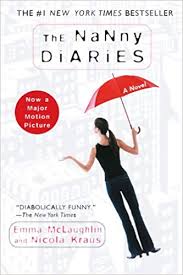
The Nanny Diaries by Emma McLaughlin & Nicola Kraus

The Nanny Diaries

The Nanny Diaries

Emma McLaughlin & Nicola Kraus (Adult Fiction)

“There are essentially three types of nanny gigs.  Type A, I provide ‘couple time’ a few nights a week for people who work all day and parent most nights.  Type B, I provide ‘sanity time’ a few afternoons a week to a woman who mothers most days and nights.  Type C, I’m brought in as one of a cast of many to collectively provide twenty-four/seven ‘me time’ to a woman who neither works nor mothers.  And her days remain a mystery to us all.”  Nan would categorize Mrs. X as definitely a Type C.  In her final year at NYU, Nan is juggling school, her roommate’s obnoxious and hairy boyfriend, a self-absorbed boss, a promising romance, and a precocious four-year old by the name of Grayer.  As Mrs. X becomes increasingly more demanding—while blurring the lines between hired help and servant—Nan begins to wonder how much she can possibly bear for the sake of a single child.

Authors Emma McLaughlin and Nicola Kraus have worked for over thirty New York City families and claim that their story of Mrs. X and her family is entirely fictional and not based on an actual family.  Let’s all breathe a collective sigh of relief and hope that’s true.  To imagine such a cold, disconnected, passive-aggressive, self-entitled woman and an equally despicable, philandering, and narcissistic man actually being parents that possess such a profound and everlasting effect on another human being is beyond the pale and frightening to think about.  As loathsome characters go, let’s not leave out our poor and hapless Nanny…Nan for short.  Although she has a genuine regard for Grayer and clearly has his welfare in mind, one cannot overlook her obvious lack of a spine, as well as dignity and self-respect.  One of my biggest pet peeves is a person—either real or imaginary—who complains constantly about his or her current circumstances, but does not a single, solitary thing to remedy it (Kathy Nicolo from House of Sand and Fog by Andre Dubus III quickly comes to mind).  Nan hates her employer and despises her current living situation yet she refuses to quit or move.  Either she’s unimaginably loyal or really likes being miserable.  Unfortunately, when Nan is miserable, she shares her misery with us and then WE become miserable and unless you’re Job, being subjected to perpetual pain and suffering is not all that it’s cracked up to be.

Don’t get me wrong.  The Nanny Diaries isn’t the worst book I’ve ever read and it does contain some self-deprecating humor, but the deplorable supporting characters and a whiny main character make this an overall annoying read resulting in an unpleasant (and yes, miserable) experience.  The only character with heart who deserves any semblance of sympathy is Grayer who represents any child who was conceived to be nothing more than an accessory worn on the arm versus a being to be held in your heart.

If you want an insight into the world of high-priced fashion designers and luxury brand names (Chanel, Prada, Judith Leiber, Lalique, Ferragamo, Armani, Gucci), then this is the book for you.  If you are looking for a heartwarming and feel-good story about nannies and the children in their care, amble down the children’s section of your local library or bookseller and check out the adventures of Mary Poppins or Nurse Matilda.  You’ll find nary a Hermès bag or Manolo Blahnik pump in these stories, but you might feel a little better about the world and those among us who have more money than manners…unless you like feeling miserable and then the Book of Job is right up your alley.

Rating: 3/5

*Book cover image attributed to www.amazon.com

**Want more?  Visit our Facebook page at www.facebook.com/thedustyjacket