
Current Book Review

The Sign of the Beaver by Elizabeth George Speare (J Fiction)

The Sign of the Beaver  

Elizabeth George Speare (J Fiction)

“Dance,” Attean commanded. He seized Matt’s arm and pulled him into the moving line. The men near him cheered him on, laughing at Matt’s stumbling attempts. Once he caught his breath, Matt found it simple to follow the step. His confidence swelled as the rhythm throbbed through his body, loosening his tight muscles. He was suddenly filled with excitement and happiness. His own heels pounded against the hard ground. He was one of them.

It was the summer of 1769 when twelve-year-old Matt Hallowell’s father left him alone in Maine to protect the family’s cabin and corn field while he returned to Massachusetts to bring back his mother and two siblings. His father told him to make seven notches in a stick (a notch a day) and by the time that he was on the seventh, he’d be back and they’d once again be a family. Bad luck seemed to follow Matt soon after and when he found himself the target of some angry bees, a Penobscot chief and his grandson jumped in to save his life. Wanting his grandson to learn the language of the white man, the chief made a treaty with Matt: teach his grandson, Attean, to read in exchange for food. Eventually, the two boys formed an unlikely friendship and as more sticks began to pile up, Matt was faced with having to choose between joining the tribe and heading north or waiting for a family that may never come.  

A Newbery Honor Book recipient in 1984, The Sign of the Beaver is really a love letter to the Penobscot, an Indigenous people in North America and a federally recognized tribe in Maine. Speare gives her readers insights into tribal culture and customs and exposes their devotion and respect for nature, wildlife, and boundaries of the surrounding tribes. Time and again Matt questions Attean’s actions and every time his response centers on recognizing the value and worth of the land they walk, the animals they’ve killed, and  the life they’ve been given. By learning Attean’s ways, Matt begins to realize that he is just a very small part of a very big picture and as his confidence as a hunter grows, so does his world view and his new understanding of why the white man is so despised and mistrusted by these native peoples.

The Sign of the Beaver isn’t just a story about one boy’s resilience, bravery, and sense of duty, it’s also a lesson in how we should never take more than we are given, that we should appreciate differences and look for commonalities, and that empathy and kindness can do more for bridging a gap and forging a relationship than signed treaties and firm handshakes. This is a great story for young readers and a fascinating look into the Indian way of life. Although there are a few scenes of animal cruelty and suffering, Speare sticks to keeping this book authentic by not avoiding the uncomfortable thus making this book a valuable read. Although it has plenty of action and the characters are well developed, the story seems to lose a bit of steam near the end and tended to drag.

As a way of showing the chief his gratitude, Matt offered him his one prized possession—his beloved Robinson Crusoe. It was from this book that Matt read passages to Attean and where he discovered that Attean was just as passionate about storytelling as he was proving once again that a beautifully told story not only has the ability to draw us in, but it can also connect us as well.

Rating: 4/5

* Book cover image attributed to: www.goodreads.com

We’re now posting videos of some of our book reviews! Follow us on Facebook at www.facebook.com/thedustyjacket or on Instagram @tdjreviews and join in on the fun!
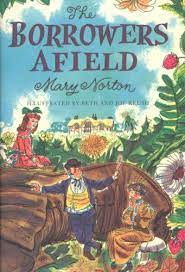
The Borrowers Afield by Mary Norton (J Fantasy)

The Borrowers Afield

Mary Norton (J Fantasy)

It had been a year since Mrs. May told young Kate the story of the borrowers. Since that time, Kate had completely pushed their memory to the farthest corner of her mind until one early spring day when Mrs. May slipped her a letter and said, “This will interest you, Kate, I think.” And indeed it had since that letter had to do with Leighton Buzzard. Leighton Buzzard, as you might recall, was the country town where Great Aunt Sophy’s house was and it was in that house, as you might remember, where underneath the kitchen floorboards lived the Clocks: Pod, Homily, and Arrietty. But whatever happened to those poor Clocks? Last time we saw them, they had been smoked out of their comfortable home and left fleeing for their lives—never to be seen or heard from again. But worry not for there is one soul who knows exactly what happened to our dear friends and it is that very same person that Mrs. May and Kate—quite by chance—are about to meet.

Three years after writing The Borrowers in 1952, Mary Norton picks right up where she left off with The Borrowers Afield where our favorite trio are tirelessly trekking from Firbank to Perkin’s Beck in search of the badger’s set, home to the Hendrearies. In this book, Arrietty finally realizes her dream of living outdoors and becoming a true borrower; Homily begins to toughen up a bit, although required to become a vegetarian; and Pod continues to hold his family together while keeping an even temper and maintaining loving order. Their journey has them finding an unexpected abode, meeting several troublesome insects, and encountering a very helpful yet mysterious stranger.

Norton does not fail to live up to the expectations she established for her readers with her first book in the beloved Borrowers’ series. This next chapter is filled with adventure and ample amounts of danger, disappointment, and discovery. Through their ups and downs, the Clock family begin to not only learn more about themselves and their own capabilities, but they also learn more about one another, which results in a deeper appreciation for one another.

This book stresses family much more than the first as it truly is the Clocks vs the World. In doing so, our little troupe form a tighter bond and realize that if you’re with family, you’re already home. The Borrowers Afield is truly a fun frolic with plenty of action and suspense and every bit worthy of its predecessor.

Rating: 5/5

* Book cover image attributed to: www.amazon.com

We’re now posting videos of some of our book reviews! Follow us on Facebook at www.facebook.com/thedustyjacket or on Instagram @tdjreviews and join in on the fun!

Yesterday’s Sun by Amanda Brooke (Adult Fiction)

Yesterday’s Sun

Amanda Brooke (Adult Fiction)

Tom and Holly Corrigan had only been married for two years when they moved into the gatehouse that sat at the entrance of the once majestic Hardmonton Hall. Holly—an artist—instantly fell in love with the residence despite its many years of abandonment and neglect and finds that she has plenty of free time to make it a home since Tom’s job requires a lot of travel. Their lives, like the gatehouse, is full of possibility and promise. One day while renovating, Holly uncovers a wooden box that contains a beautiful glass ball and soon discovers that it is the missing top of the moondial that sits in their garden. When Holly places the orb on the pedestal on a full-moon night, she realizes that she has unwittingly activated a timepiece that shows her a future full of life and loss…a daughter and a death. When she shares her vision with Jocelyn, her new friend and the previous owner of the gatehouse, Holly soon learns the extensive truth behind the moondial’s power and realizes the terrible decision that she must now make that will not only affect her, but everyone she loves.

Give me a book that begins with a partial peek at the ending and I’m instantly invested in the characters and story. That is what Amanda Brooke does in her Prologue as we see Holly in bed, gently stroking her swollen belly, as she looks at her sleeping husband and whispers, “You’ll be angry with me for leaving you both, but eventually you’ll understand. One day, you’ll look at our daughter and you’ll know what I know. You’ll know that she was worth the sacrifice.” It’s a deeply emotional, intimate, and heartbreaking moment that immediately connects you with Holly and her story that’s just beginning to unfold for us. We know the journey with Holly won’t be easy given the fact that we most-likely know how her story will end, but we’re fully committed now and determined to see this through with her to the end…no matter how painful.

Holly is a fractured and imperfect protagonist. Yes, her waffling between questions of “Should I” or “Shouldn’t I” become a little tedious, but given her sudden and callous abandonment by her mother…HER MOTHER…you can understand the doubts and reservations she has about her own maternal abilities. If you lead by example, then Holly is doomed. Because Brooke takes her time in unpackaging Holly’s history, we clearly give her a pass when it comes to her indecisiveness and it’s why we stay loyal to her as she painfully struggles between self-preservation and self-sacrifice.

Without spoiling any of the story, I do want to comment on the verbiage written on the cover of the book: How can she choose between her child and herself? Oh, gentle reader. If only it were that easy, because as you start to discover and understand the power of the moondial, this goes so much deeper than “well…I just won’t do that and everything will be fine. Right?” When Jocelyn tells Holly that the moondial can be cruel, she isn’t  joking.

Yesterday’s Sun is a suspenseful, thoughtful, and poignant read that will keep you engrossed, guessing, and second guessing until the end. It’s a satisfying story that reminds us how we shouldn’t take anything for granted and how important it is to live in the now. American actor James Dean, who was only 24-years old when he died suddenly and tragically, said, “Dream as if you’ll live forever, live as if you’ll die today.” Holly eventually understood this and hopefully all of us won’t need a moondial to realize this as well.

Rating: 5/5

* Book cover image attributed to: www.amazon.com

A Monster Calls by Patrick Ness (YA Fantasy)

A Monster Calls  

Patrick Ness (YA Fantasy)

The monster showed up just after midnight. As they do.

At thirteen, Conor was too old for monsters. Monsters were for babies and bedwetters and Conor was neither; however, here he was—night after night reliving the same images that made him wake up screaming into the darkness. But one night, another monster came to visit. Not the one from his nightmare, but a different one. One that would tell him three stories and would then require Conor to tell him the fourth. But the fourth wouldn’t be a story. The fourth would be the truth…Conor’s truth. A truth that he’s been avoiding for a very, very long time.

Do NOT judge this book by either its cover or its title! A Monster Calls is not a horror story, but rather an intensely moving and intellectually provocative read that examines death, bullying, and growing isolation. Patrick Ness’s story (inspired by an idea by the late Siobhan Dowd) and Jim Kay’s beautiful and macabre illustrations allow A Monster Calls to leap off the page, reach inside your chest, and put a death grip on your heart. The action and emotions intensify as the story unfolds and reaches the ultimate crescendo when the reader realizes the truth behind the monster and the meaning of Conor’s nightmare. It’s a painful and agonizing revelation and you can’t help but cry out as our young protagonist finally comes to terms with the grim reality he’s been desperately avoiding and denying. It’s a master class in storytelling and a final work that Siobhan Dowd surely would have been immensely proud of.

On one of their encounters, the monster told Conor about the importance of stories: “They can be more important than anything. If they carry the truth.” There are countless stories about how children deal with trauma—especially when it involves a loved one—but Ness’s approach cuts to the very heart of the loneliness, fear, and helplessness they feel and how these feelings manifest themselves into monsters and darkness and voids that suck the very air from your lungs. It’s a dark and empty feeling that’s scary and cold, but Ness reminds us that truth can cut through the darkest of places; that acceptance can be a way out of the deepest abyss; and that forgiveness can open the way to healing and peace.      

Rating: 5/5

* Book cover image attributed to: www.amazon.com

The Pushcart War by Jean Merrill (J Fiction)

The Pushcart War  

Jean Merrill (J Fiction)

Imagine if Morris the Florist hadn’t been blocking the curb and if Mack hadn’t been in such a hurry to deliver his load of piano stools and if Marvin Seely hadn’t taken a picture with a camera that he had just gotten for his birthday and if Emily Wisser hadn’t cut out that same picture from the newspaper for her scrapbook and if Emily Wisser hadn’t shown that same clipping to her husband, Buddy Wisser, a newspaper editor…well, we might not ever have had the Pushcart War. Now, imagine THAT!

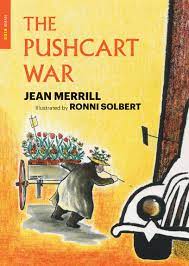
I read The Pushcart War in elementary school, so it had been out for a little over ten years by the time I laid my grubby little hands on it. I’m not sure what drew me to this particular book. Most likely it was the funny little drawing on the cover of a man in a black overcoat wearing a ridiculous flower hat who was right in the middle of shooting a pin at a big truck that caught my eye and imagination (ten-year-olds were much easier to amuse back then!). That book quickly became a long-lost memory until I came across it sitting innocently enough on a library shelf. I pulled it out and there he was! That same funny little man with his ridiculous hat STILL waging war against that massive truck some 40+ years later. After reading it with fresh eyes and a greater understanding of the world, I’m unclear why this book made such an impression on my ten-year-old self, but my much older self is chuckling while shaking my head after realizing that nothing much has changed since its publication.

The Pushcart War is packed with humor, hijinks, and heart. It is the quintessential David-versus-Goliath story of a pack of pushcart vendors who wage war against mighty mammoth trucks in hopes of maintaining their little slice of the free enterprise capitalist pie. Written in 1964, set in 2036, and taking place in 2026 (you got that?), Merrill’s story resonates just as true today as it did in the 60s: demonstrating the virtues and vices of speaking out for what is right; displaying the corruption of those in power who abuse their platform for personal gain by bowing to the desires of special interest groups; illustrating how the media can be a driving force behind shaping public opinion; and proving the unfortunate influence that money ultimately has on morality. Sound familiar? You might think that such weighty topics would never be able to hold the attention of a young reader, but Merrill’s Rube-Goldbergesque approach to storytelling—where one act sets off a series of complex events—keeps readers engaged and enthralled. I mean, who could have imagined that a simple tax on tacks could touch off a possible war with England? Jean Merrill, that’s who. It’s this kind of utterly improbable and highly outrageous scenario that keeps us entertained and cheering for the little guys…no matter how hopeless or hapless their situation may be.

Author Karen Traviss wrote, “I don’t know who the good guys are anymore. But I do know what the enemy is. It’s the compromise of principles. You lose the war when you lose your principles. And the first principle is to look out for your comrades.” Aside from their dried peas and little pea shooters, the people who sold hot dogs or flowers or knick-knacks from their little carts all shared a common purpose: a desire to be seen and to be counted and to be respected. They wanted a place in the world—free from bullying and intimidation and eradication. More than that, they didn’t want someone else to assign them value or worth. The pushcarts knew talking was better than fighting and believed in their cause so much that they were willing to sacrifice themselves for the greater good. They knew that their cause was bigger than just one or two carts and together, they were a force to be reckoned with. Together, they could elicit change. I imagine that the world might be a better place if we just had a few more pushcarts.

Rating: 5/5

* Book cover image attributed to: www.amazon.com

Tender at the Bone: Growing Up at the Table by Ruth Reichl (Biography)

Tender at the Bone: Growing Up at the Table

Ruth Reichl (Adult Biography)

I learned early that the most important thing in life is a good story.

Ruth Reichl knows how to tell a good story and her storytelling skills are likely the product of having parents who could transform the most mundane event into an exotic adventure. Her cooking skills however, were born from sheer survival judging from the title of her first chapter: “The Queen of Mold”. Most mothers teach their daughters to be wary of strangers or always carry enough money to cover a taxi ride home. In Miriam Reichl’s case, she taught her daughter that food could be dangerous.

Tender at the Bone delights readers with Ruth Reichl’s memories of growing up in a New York City apartment, spending summers in Connecticut, going to college, working in a collectively-owned restaurant, and living in a commune. She talks about interracial friendships during the 60s, marriage, trying to please an impossible-to-please mother, and her journey to becoming a food critic. Most of all, Reichl teases us with stories about food, food, and more food. The only (small) complaint I had with her book was that she failed to provide any details about her wedding whereas she is very open about other details in her life. Although she included three photos of her nuptials at the end of her book, I was left with many questions: where and how did Doug propose, who cooked on her special day, what was served, and—most importantly—did her mother poison anyone? Although this omission was disappointing, Reichl more than made up for it by sharing such recipes as Claritha’s Fried Chicken, Coconut Bread, Oléro Berry Tart, and Artpark Brownies. I forgive you, Ruth.

Near the end of her book, Reichl wrote about meeting renowned chef, author, and TV host James Beard. Their brief encounter was far from memorable (at least for Beard) and even Reichl admitted that she was clearly out of her depth, but little did she know that she and Beard were more alike than she realized. Beard once wrote, “Food is our common ground, a universal experience.” Food is remarkable in that it can manage to overcome religious, cultural, or political differences while forming a bridge that connects us through aroma, flavor, and texture. Food welcomes and comforts and unites us. Our memories are often formed around food and it is food that we seek in times of mourning, celebration, friendship, and love. With that, I’ll end this review with the Reichl customary toast as I raise an imaginary glass to Ernst, Miriam, and Ruth and say, “Cheerio and have a nice day.”

Rating: 4/5

* Book cover image attributed to: www.amazon.com

The Borrowers by Mary Norton (J Fantasy)

The Borrowers

Mary Norton (J Fantasy)

It is said that there are people who were so frightened, that each generation grew smaller and smaller and became more and more hidden. They’re often found in quiet, old houses that are deep in the country. They became known as the “little people” and one nine-year-old boy actually met some of these people who he came to know as the Clocks: Pod, Homily, and Arrietty. They were real. Absolutely real. He swears by it, but he is just a little boy and quite prone to fantasy and make believe. Or is he?
Buckle up because Mary Norton gives readers plenty of action, adventure, and danger along with some rather devious villains (isn’t Crampfurl just the perfect name for a baddy?) and one unassuming and unsuspecting hero. For underneath the kitchen floor is a world that captures the imagination and delights the senses. A world where matchboxes are dressers, postage stamps are works of art, and blotting paper makes for a rather smart rug. It’s the world of the Borrowers and it’s been captivating readers since its publication in 1952.

It’s easy to see how The Borrowers has become a classic and why Norton followed this book with four successors. Although I liked its themes of family, friendship, and trust, I truly appreciated that Norton didn’t shy away from making her main characters flawed and, at times, unlikeable. Afterall, it was not their discovery by the “human beans” that led to their ultimate downfall, but rather it was their own pride and greed. Albert Einstein once said, “Three great forces rule the world: stupidity, fear, and greed.” Perhaps Homily Clock could have benefitted from these words.

The Borrowers has everything that a young reader would enjoy…except for the ambiguous ending. Just when you think Norton has everything buttoned up, she throws in one final sentence—just four little words—that turns the entire story on its ear. Now, if I had been a reader in 1952 and had just read the last page of this wonderful story, I might be a little miffed at our Mrs. Mary Norton for leaving me high and dry. Thankfully, this isn’t 1952 and I know that not one but FOUR sequels await me, which means that the dear Clocks were not only real, but that they did in fact survive their hopeless fate. But perhaps Norton predicted what her readers’ reaction would be and tried to offer them some bit of solace and hope when she had Mrs. Kay say to young Kate, “…stories never really end. They can go on and on and on. It’s just that sometimes, at a certain point, one stops telling them.” Thankfully, the Clocks’ story does go on and it will continue to go on as long as there are readers who keep telling and sharing it.  

Rating: 5/5

* Book cover image attributed to: www.amazon.com

Thimble Summer by Elizabeth Enright (J Newbery Medal)

Thimble Summer

Elizabeth Enright (J Newbery Award)

It was the hottest day in the entire history of the world. At least it felt like it to Garnet Linden as she looked out over her family’s dying crops. Where was the rain? If it didn’t come soon, they would have to harvest their oats for hay and wouldn’t have enough money to pay their mounting bills. On top of all that, her father needed a new barn. Her family not only needed rain, they needed a miracle, but all Garnet had was a small silver thimble that she’d found in the damp, sandy flats of the river. What possible good could that ever do?

Elizabeth Enright’s Thimble Summer received the Newbery Medal in 1939. Her book is a culmination of her grandmother’s childhood stories, her mother’s school days, her own experiences, and various memories of her friends and relatives. All told, Enright gives us a nine-year-old’s memorable summer filled with a high-speed bus ride, runaway chickens, a blue ribbon, a new sibling, and an unexpected sleepover in the town library. Thimble Summer is charming, engaging, and the ideal read for a young reader looking for adventure and suspense without any of the tragedy. It highlights the kindness of strangers and reminds us that family is so much more than blood. Although this story wouldn’t translate well today (as a nine-year old hitchhiking to another town would elicit a call from both local law enforcement and child protective services), readers still have to admire Garnet’s hutzpah when it comes to showing her older brother that she isn’t a total failure while looking good doing it!

In her Newbery Medal acceptance speech, Enright noted the joy she gleaned from writing about children for children since “a child sees everything sharp and radiant; each object with its shadow beside it. Happiness is more truly happiness than it will ever be again, and is caused by such little things.” I think through Garnet Linden, Elizabeth Enright is encouraging all of us to hold onto the magic of delighting in the little things that life has to offer so that we too can experience our very own thimble summer.

Rating: 5/5

* Book cover image attributed to: www.amazon.com

George Müller: The Guardian of Bristol’s Orphans by Janet & Geoff Benge

George Müller: The Guardian of Bristol’s Orphans

Janet & Geoff Benge (Adult Christian)

Later that day, as George sat in the stagecoach rumbling back towards Halle, he felt strangely relieved. The sense of looming confrontation he’d felt on the journey home had been replaced with a sense of expectation. He had been given no choice but to cut ties with his earthly father. Now all he had was his heavenly Father to provide for him. As the villages and fields slipped by, George wondered how it would all work out.

George Müller was caught stealing at the age of ten. By twelve, he was sneaking away from boarding school at night and attending parties filled with beer and card games. His father wanted him to be a Lutheran pastor and earn a steady income, but drinking and gambling proved to be the stronger lure for the young man from Kroppenstaedt, Prussia. But one November afternoon in 1825 changed George Müller’s course forever. On that day, he attended his first Bible meeting and his world—along with his world view—would never be the same.

Janet and Geoff Benge give readers a remarkable story of faith, hope, and complete surrender. George Müller was miraculously transformed from an arrogant and self-indulgent college student to a man who relied solely on the grace and generosity of God to provide for him, his family, and the thousands of orphans he clothed, fed, housed, and educated. George died at the ripe old age of 92 and during his expansive lifetime, he had traveled over 200,000 miles, visited 42 countries, and met with British royalty, countless dignitaries, an American president, and the author Charles Dickens. Despite being the steward of over £1 million, he meticulously kept track of every pound and shilling and ensured that every donation was used solely for its intended purpose. He was as dutiful in his bookkeeping as he was in his prayers and George, despite countless obstacles, hardships, and impossible odds, remained steadfast in his faith and trust in God.

There was one moment in George’s life where he was staring at an empty table and looking into the eyes of dozens of hungry orphans who were anxiously awaiting their breakfast. George—never one to despair or doubt—simply told those around him to wait for the miracle to happen for even though the pantry was bare and the milk jugs empty, he knew that a higher power was in charge and that He would be faithful in fulfilling His promises.

George Müller left this world far richer and wiser than he was when he lived with his wealthy father or attended his prestigious schools. Through his daily actions, he became the father to 10,000 orphans and epitomized the words in Luke 1:37 that says, “For with God nothing shall be impossible.”

Rating: 4/5

* Book cover image attributed to: www.amazon.com

The Day of the Pelican by Katherine Paterson (J Historical Fiction)

The Day of the Pelican

Katherine Paterson (J Historical Fiction)

Terrible things should never happen in springtime, and it was almost spring.

Meli Lleshi and her family lived a comfortable life in Dukagjin. Her father came from a farm village so although her classmates didn’t look down on her like the Gypsies or hated her like the Serbs, she was still treated differently. She didn’t understand why the Serbs hated the Albanians so much…although most Albanians hated the Serbs equally. Baba, Meli’s father, had always taught his family to respect and not to hate, and so Meli did as she was told until the day her brother, Mehmet, disappeared. Now, with her country no longer safe, Meli will need to hold on tight to her family as they fight to survive and look for a way to escape their beloved Kosovo.

The Day of the Pelican is based on an actual Kosovar refugee family who was sponsored by Katherine Paterson’s own church in 1999. This is a harrowing, gritty, and brutal account of the war in Kosovo, which was the direct result of Slobodan Milošević’s decade-long oppression of the ethnic Albanian people. The book is recommended for ages 12 and above and its subject matter of ethnic cleansing and racial prejudice is worthy of in-depth discussions, making it an ideal book for a middle or high school social studies class. As far as it being an independent read, I—as an adult—found it to be a bit dry and often struggled to maintain interest in the story, so a younger reader with far less tenacity may give up on this book entirely. I think the primary reason for my detachment is that it’s written in the third person. Had Paterson chosen to use alternating, first-person points of view between Meli and Mehmet, I would have felt Meli’s fear for her brother, as well as better understand the reason behind Mehmet’s slow and painful separation from his father and family. As it is, the story lies just above the surface and never fully allows the reader to connect with this amazing family.

I appreciate any book that teaches history to young readers and especially love a book that shows the strength of the human spirit and the power of hope. The Day of the Pelican accomplishes both, while being deeply rooted in faith, courage, and family.

Throughout the book, Baba was always counting heads to make sure everyone in his family was accounted for. He kept repeating to Meli the importance of staying together: We must hold onto each other. Even in the chaos of fleeing their burning homeland, Meli kept reminding herself that they were all together and that was the important thing. Throughout his family’s struggles, Baba knew that villages may crumble, governments may fall, and possessions may be lost forever, but if you have family, you have everything you’ll ever need: Inshallah. God willing.

Rating: 4/5

* Book cover image attributed to: www.amazon.com