

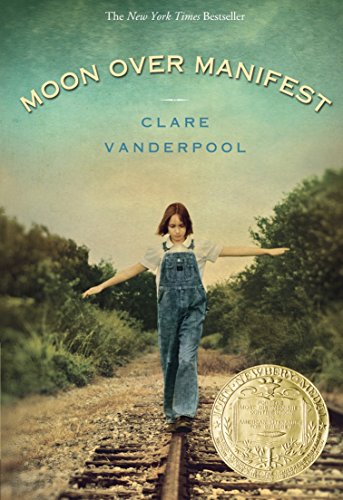
Moon Over Manifest by Clare Vanderpool (J Historical Fiction)

“To write a good story, one must watch and listen.”

Moon Over Manifest

Clare Vanderpool (J Historical Fiction)

Every story has a beginning, middle, and an end, but Abilene Tucker’s story seemed to be nothing but middle. It’s 1936 and while her father, Gideon, works a railroad job in Iowa, she is sent to the town where he grew up…Manifest, Kansas. She’s to spend the summer with her father’s old friend, Pastor Shady Howard, whose home is a combination saloon, church, and carpenter’s shop. While upstairs in her father’s old room, Abilene discovers an old cigar box with various trinkets, as well as some handwritten letters addressed to a boy named Jinx. Could these items—a cork, fishhook, silver dollar, key, and a little wooden doll—help Abilene uncover the mystery of her father’s past? With the help of two new friends, Abilene embarks on a hunt for a possible spy and meets a diviner who helps her uncover a few things about her father and herself.

This book covers two periods of time: 1936 (present day narrated by Abilene) and 1918 (told in third person). Although this book makes multiple time jumps involving several characters, Vanderpool does a terrific job at making sure young readers stay engaged by keeping the two storylines separate and straightforward. Our diviner, Sadie, eases readers into the past as she reveals Manifest’s history that involves several actual events including World War I, orphan trains, and the Spanish influenza. Moon Over Manifest does deal with some disturbing content such as racism, murder, alcohol use, and the ugliness of war, but in doing so gives readers an honest and rare opportunity to learn about important periods in American history through the unique lenses of a twelve-year-old hardworking and fearless girl and a thirteen-year-old runaway conman. Together, these two protagonists teach us that everyone deserves a do-over, things are not always what they seem, and perhaps there’s nothing more dangerous than hope.

Vanderpool packs so many wonderful takeaways and lessons into this book but overall, Moon Over Manifest is a celebration of immigrants and the richness and vibrancy they add to the American fabric. Manifest is a community represented by Scotland, Poland, Greece, Norway, Italy, Germany, Hungary, and Russia. These people—from very different countries and cultures—all unite behind a young con artist and collectively take a leap of faith to not only save their town, but to save their way of life and themselves. U.S. President Lyndon B. Johnson said on October 3, 1965 at the Statue of Liberty, “The land flourished because it was fed from so many sources—because it was nourished by so many cultures and traditions and peoples.” Although Manifest was a town torn apart by racism and stricken with war and an epidemic, its community flourished because of the strength and uniqueness of its people…people who were all lucky enough to call Manifest home.

Rating: 5/5

* Book cover image attributed to: www.abebooks.com

We’re now posting videos of some of our book reviews! Follow us on Facebook at www.facebook.com/thedustyjacket or on Instagram @tdjreviews and join in on the fun!
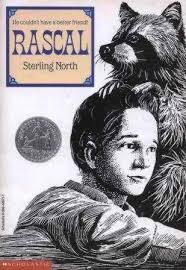
Rascal by Sterling North (J Biography)

Rascal

Rascal

Sterling North (Juvenile Biography)

One pleasant afternoon in 1918, eleven-year-old Sterling North, along with his Saint Bernard, Wowser, and friend, Oscar Sunderland, were in Wentworth’s woods.  There, in the hollow base of a rotten stump, hid a mother raccoon and her litter of four kits.  Angered and frightened by Wowser’s intrusive digging, mother and kits darted to safety, but not before Oscar was able to capture one of the kits in his knit cap.  On that May 15th day, young Sterling had no idea that this incident would mark the beginning a very unusual and special friendship.  A friendship filled with irresistibly shiny things, strawberry pop, sweet corn, music, crayfish, and a no-good rotten bully by the name of Slammy Stillman.  The next twelve months would be a year that young Sterling would never forget.

Rascal received a Newbery Honor in 1964 and is Sterling North’s memories of growing up in southern Wisconsin from May 1918 to April 1919.  It would be a time marked with his brother, Herschel, serving in World War I, Armistice Day, and the Spanish influenza, which claimed more lives in his beloved town of Edgerton (referred to as Brailsford Junction in this book) than the war.  North was the youngest of four children.  His father was a successful landowner and his mother died when North was only seven.  In Rascal, North describes a time when front doors were never locked, neighbors looked after one another, family and good health were your most prized possessions, and all it took to make young Sterling North the happiest boy in the world were his bike, his pet raccoon sitting in the front basket, and the wind in your face as you barrel down a hill at top speed.

Some reviewers of North’s biography call it a story about friendship while others say it is a journey dealing with loss.  I found it to be more a love letter written to two mothers:  Sterling’s own beloved mother, Sarah, and Mother Nature herself.  North is exactingly detailed when he describes the beauty and splendor of wildlife, the complexities of the various plants, and the science behind selecting the perfect bait when fishing.  Younger readers may find these sections a bit tedious (as they’re probably more anxious to read about Rascal than river trout), but it is a clear reflection of the awe and respect that North has for the world around him and how these observations directly connect him with a mother that he barely had time to know.  He sees his mother in every bud and hears her voice with every new discovery.  Mother Nature is, in effect, his own mother reaching out and embracing him and these moments are truly heartwarming and comforting.

During the Christmas of 1918, Sterling’s Aunt Lillie asked him what profession he was thinking about pursuing.  After discounting his desire to become a doctor, his aunt suggested that a writer might be a more suitable choice, as his mother might have wished this vocation for him.  After Sterling questioned her about it, she explained, “And then you could put it all down…the way it is now…case weather, the fog, the lantern light…and the voices of the men—hear them—coming in for breakfast.  You could keep it just like this forever.”  Lucky for us, young Sterling listened to his aunt and by doing so, allowed readers to keep him, Rascal, and Brailsford Junction, just like this, forever as well.

Rating: 5/5

*Book cover image attributed to www.goodreads.com

**Want more?  Visit our Facebook page at www.facebook.com/thedustyjacket


A Medal for Leroy by Michael Morpurgo (J Historical Fiction)

A Medal for Leroy

A Medal for Leroy   

Michael Morpurgo (Juvenile Historical Fiction)

Michael has no father, brothers, or sisters.  Just his mother, Maman, and two aunts:  Auntie Pish and Auntie Snowdrop.  It is 1940s London and right after the war.  Michael’s friends call him “Poodle” because of his frizzy hair and French ancestry.  But Michael doesn’t mind much.  In fact, he likes being different, being special.  Regarding his father, Michael knows only what his mother has told him:  his father’s name was Roy, he was a Spitfire pilot, and he was killed in the war.  But when Michael’s aunt passes away, she leaves behind a clue that will not only shed light on his past, but also finally reveal who he is.

A Medal for Leroy was inspired by the true story of Walter Tull, the first black person to serve as an officer in the British Army.  Like his fictional counterpart in this story (Michael’s grandfather, Leroy), Tull grew up in an orphanage, played soccer, served heroically in battle, and has no known grave.  Both Tull and Leroy deserved a medal for bravery, but were denied because of the color of their skin.  Morpurgo is a master storyteller (author of the spectacular novel War Horse) and provides his characters with a surprising amount of depth given that his book is only 130 pages.  He delicately tackles the ugliness of racial intolerance and inequality while showing young readers the value of having dignity in the face of disgrace and showing love without reservations or conditions.

In a world that still seems divided by so many factors, it is worth looking at the words that Michael’s aunt, who served as a nurse during the First World War, wrote to Michael: “It was while I was with those poor wounded soldiers that I first understood, Michael, that when all’s said and done, it’s what we all want and need most: to love and to be loved.”  Words lovingly passed along to a beloved nephew that would serve us all to remember today and always.

Rating: 4/5

* Book cover image attributed to www.goodreads.com


Hattie Big Sky by Kirby Larson (YA)

Hattie Big Sky

Hattie Big Sky  

Kirby Larson (Young Adult Fiction)

Hattie Inez Brooks refers to herself as Hattie Here-and-There.  Orphaned before she had lost her baby teeth, she spends her years being shuffled here and there amongst various relatives’ homes.  At 16, everything changes when she is left 320 acres and a house in Montana by her deceased mother’s brother, Uncle Chester.  With the only thing to look forward to in Arlington, Iowa is a job at a boardinghouse, Hattie writes back, “I’ll come.”  But to make her uncle’s claim her own, she has to cultivate 40 acres and lay 480 rods of fence…and she has less than a year to do it. With a strong faith and help from neighbors, can Hattie make her deepest wish a reality—to find a place to belong.

Hattie Big Sky is based on the life of Larson’s great-grandmother, Hattie Inez Brooks Wright, who herself had homesteaded as a young woman in eastern Montana.  Because most of the story takes place in 1918, we see more references to automobiles than covered wagons.  The United States was also embroiled in World War I and many German-born immigrants were subjected to a litany of anti-German persecution.  Larson weaves all of these facts, along with the countless struggles faced by homesteaders, into a beautifully-told story of hardship, bravery, and old-fashioned grit.

Hattie is pleasantly surprised to find that a paper in Iowa is willing to pay her a monthly fee for her homesteading stories.  In one such submission, she writes, “…the lesson this life has planted in my heart pertain more to caring than to crops, more to Golden Rule than gold, more to the proper choice than to popular choice.”  Hattie’s lesson is one we should all strive to implant upon our own heart.

Rating: 4/5

* Book cover image attributed to www.scholastic.com