

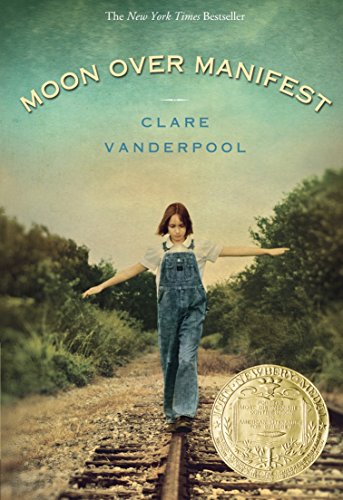
Moon Over Manifest by Clare Vanderpool (J Historical Fiction)

“To write a good story, one must watch and listen.”

Moon Over Manifest

Clare Vanderpool (J Historical Fiction)

Every story has a beginning, middle, and an end, but Abilene Tucker’s story seemed to be nothing but middle. It’s 1936 and while her father, Gideon, works a railroad job in Iowa, she is sent to the town where he grew up…Manifest, Kansas. She’s to spend the summer with her father’s old friend, Pastor Shady Howard, whose home is a combination saloon, church, and carpenter’s shop. While upstairs in her father’s old room, Abilene discovers an old cigar box with various trinkets, as well as some handwritten letters addressed to a boy named Jinx. Could these items—a cork, fishhook, silver dollar, key, and a little wooden doll—help Abilene uncover the mystery of her father’s past? With the help of two new friends, Abilene embarks on a hunt for a possible spy and meets a diviner who helps her uncover a few things about her father and herself.

This book covers two periods of time: 1936 (present day narrated by Abilene) and 1918 (told in third person). Although this book makes multiple time jumps involving several characters, Vanderpool does a terrific job at making sure young readers stay engaged by keeping the two storylines separate and straightforward. Our diviner, Sadie, eases readers into the past as she reveals Manifest’s history that involves several actual events including World War I, orphan trains, and the Spanish influenza. Moon Over Manifest does deal with some disturbing content such as racism, murder, alcohol use, and the ugliness of war, but in doing so gives readers an honest and rare opportunity to learn about important periods in American history through the unique lenses of a twelve-year-old hardworking and fearless girl and a thirteen-year-old runaway conman. Together, these two protagonists teach us that everyone deserves a do-over, things are not always what they seem, and perhaps there’s nothing more dangerous than hope.

Vanderpool packs so many wonderful takeaways and lessons into this book but overall, Moon Over Manifest is a celebration of immigrants and the richness and vibrancy they add to the American fabric. Manifest is a community represented by Scotland, Poland, Greece, Norway, Italy, Germany, Hungary, and Russia. These people—from very different countries and cultures—all unite behind a young con artist and collectively take a leap of faith to not only save their town, but to save their way of life and themselves. U.S. President Lyndon B. Johnson said on October 3, 1965 at the Statue of Liberty, “The land flourished because it was fed from so many sources—because it was nourished by so many cultures and traditions and peoples.” Although Manifest was a town torn apart by racism and stricken with war and an epidemic, its community flourished because of the strength and uniqueness of its people…people who were all lucky enough to call Manifest home.

Rating: 5/5

* Book cover image attributed to: www.abebooks.com

We’re now posting videos of some of our book reviews! Follow us on Facebook at www.facebook.com/thedustyjacket or on Instagram @tdjreviews and join in on the fun!
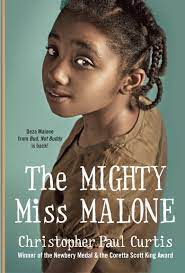
The Mighty Miss Malone by Christopher Paul Curtis (J Historical Fiction)

The Mighty Miss Malone

Christopher Paul Curtis (Juvenile Historical Fiction)

The best-laid schemes o’ mice an’ men/Gang aft a-gley

And leave us nought but grief and pain/For promised joy.

Her teacher told her that it was from a poem by Robert Burns called “To a Mouse”. Deza didn’t quite understand what those words meant—especially the “gang aft a-gley” part—but Mrs. Needham said that it just meant that even the most carefully planned out things could go wrong. Deza knew about this since a lot of the Malone family plans haven’t been quite working out lately. But if there’s one thing that the Malones do well it’s sticking together. After all, their motto was “We are a family on a journey to a place called Wonderful”. Before the Malones could get to Wonderful however, Deza and her family would have to travel through a whole lot of awful first.

Set against the backdrop of the Great Depression, homeless camps, speakeasies, and the much-hyped 1936 boxing match between Joe Louis and Max Schmeling, Curtis gives us yet another story centered around a tough-as-nails, plucky, and absolutely endearing main character. At twelve, Deza Malone is the smartest in her class and destined for something special. With a dictionary in one hand and a thesaurus in the other, she’s more than ready to take on the world one adjective and adverb at a time. Deza is charming, loyal, fiercely protective of her family—especially of her older brother, Jimmie—and principled to a fault. Deza is not a girl who’s afraid to take matters into her own hands in order to set things right…even if it means a little forgery or rule breaking now and then. Struggling to make something of herself while fighting racial prejudice, financial hardship, and social injustice may prove to be formidable challenges for some, but not for the mighty Miss Malone.

The Mighty Miss Malone is the second book by Curtis that I’ve read (the first being Bud, Not Buddy). In both stories, he gives us a main character who rises above their circumstances with grace, dignity, and integrity. His stories are built around the strength of family, the importance of hope, and the resilience of the human spirit. Through Deza Malone, Curtis reminds us that even though plans “gang aft a-gley”, tomorrow is always a brand-new day that brings with it another opportunity to get a little bit closer to a place called Wonderful.

Rating: 5/5

* Book cover image attributed to www.amazon.com

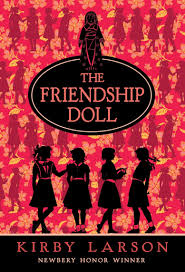
The Friendship Doll by Kirby Larson (J Historical Fiction)

The Friendship Doll

The Friendship Doll

Kirby Lawson (Juvenile Historical Fiction)

Miss Kanagawa was the last doll that master dollmaker Tatsuhiko would ever make.  She was a doll like no other and was to be Master Tatsuhiko’s masterpiece.  Miss Kanagawa, along with her fifty-seven sisters, were being sent to the children of the United States by the children of Japan as a gesture of friendship.  These fifty-eight ambassadors of peace and goodwill carried with them the assurance that Japan was indeed a friend of America.  But Master Tatsuhiko wanted his prized creation to be more than just a messenger and wished that she would discover her true purpose as a doll: “to be awakened by the heart of a child”.  Sadly, Miss Kanagawa was as callous as she was beautiful and she was very certain that a doll with a samurai spirit such as hers would never have a need for a child.

The Friendship Doll is based on the actual arrival of fifty-eight dolls from Japan to the United States in November 1927.  In her book, Kirby Larson takes us from 1927 to the present day and introduces readers to such events as the Great Depression, the Chicago World’s Fair, and the attack on Pearl Harbor.  Through Miss Kanagawa, we meet a hopeful orator, an aspiring pilot, a voracious reader, and a devoted writer—each with her own remarkable story and each changed by a chance encounter with a unique and proud doll.

While reading The Friendship Doll, I couldn’t help but notice several similarities between it and Kate DiCamillo’s The Miraculous Journey of Edward Tulane (one of my favorite books).  Both stories revolve around an exquisite doll with an overly-high opinion of itself who imparts something of value with those it meets while simultaneously discovering the joy that comes from being wanted and loved.  While Edward is a silent presence, Miss Kanagawa somehow speaks directly to her visitor’s subconscious.  Young readers won’t be bothered by this, but those of us old enough to remember The Twilight Zone episode entitled “Living Doll” featuring Talking Tina might be overly susceptible to the heebie-jeebies.  Still, if you liked Edward, you’re sure to enjoy Miss Kanagawa as well.

Although this book does touch upon the sensitive subjects of death and dementia, its historical insights offer readers a valuable glimpse at a few events from our nation’s past.  It also serves as a reminder that it is often the smallest of things that can bring about the greatest change within ourselves and there is nothing heebie or jeebie about that.

Rating: 5/5

*Book cover image attributed to www.amazon.com

**Want more?  Visit our Facebook page at www.facebook.com/thedustyjacket


Bud, Not Buddy by Christopher Paul Curtis (J)

Bud Not Buddy

Bud, Not Buddy    

Christopher Paul Curtis (Juvenile Fiction)

“Here we go again.”  Bud (not Buddy) Caldwell is growing up during the Great Depression in Flint, Michigan.  He is ten-years old, currently on his third foster home, and presently being rightly pummeled by his current foster family’s son.  But Bud is determined that this will be his last foster family, as well as his last night in Flint because woop, zoop, sloop, just 120 miles away in Grand Rapids is his father, the famous jazz musician Herman E. Calloway.  At least he THINKS this is his father.  His mother wasn’t very specific about his father’s identity before she passed away, but he does have a cardboard suitcase full of clues and a heart full of hope.  But before he reaches his destination, Bud will have to confront a vampire, closet monsters, fear, and hunger.  Woop, zoop, sloop!  This is going to be the adventure of a lifetime!

Christopher Paul Curtis delights and engages readers with a charming boy who is not only an aspiring musician, but also the author of Bud Caldwell’s Rules and Things for Having a Funner Life and Making a Better Liar Out of Yourself.  Bud’s many rules give readers practical and humorous pointers on how to navigate life’s unexpected twists and turns.  For example, Rules and Things Number 3: “If You Got to Tell a Lie, Make Sure It’s Simple and Easy to Remember.” or Number 83: “If a Adult Tell You Not to Worry, and You Weren’t Worried Before, You Better Hurry Up and Start ‘Cause You’re Already Running Late.”  Although Bud was orphaned at the age of six, his mother would have been proud at the young man he has become: always saying “sir” and “ma’am”, “please” and “thank you”, and lying ONLY when absolutely necessary.  He’s brave, determined, resourceful, and fiercely optimistic during a time when hope and promise are a scarcity.

Throughout the book, Bud is always reminding people that his name is Bud, not Buddy.  His mother named him Bud after a flower bud…a flower-in-waiting.  “Waiting for just the right warmth and care to open up.  It’s a little fist of love waiting to unfold and be seen by the world,” his mother would often say to him.  We’ll never know if the name made the boy or the boy made the name, but one thing we can be sure about is that Bud, not Buddy, has plenty of love to share and enough spirit and pride to make his own warmth and to shine his own light.  Woop, zoop, sloop.

Rating: 5/5

* Book cover image attributed to www.walmart.com