

The Time Keeper by Mitch Albom (Adult Inspirational)

The Time Keeper

Mitch Albom (Adult Inspirational Fiction)

Before he was Father Time, he had been just another human: a boy who loved to run and had best friends; a young man in love with a passion for measuring things; and a man who had a wife and children. His name was Dor and he was different…and God had noticed for God realized how one different child could change the world. But Dor had angered God and would endure thousands of years of isolation before being released back to the world where he must help two souls: a troubled teen with too much time and a wealthy businessman with too little. To finally finish what he had started, Dor must now teach these two very different people the value of time and to understand the reason why God limits man’s days.

This is the third book by Albom that I’ve read and his words continue to enlighten, encourage, and inspire me. Albom relays how precious time is through Dor, teenaged Sarah Lemon, and elderly Victor Delmonte. The Time Keeper’s short chapters and sparse prose may give readers a false sense that this will be a “quick read”. On the contrary, Albom’s measured words give his story weight and substance that allow readers the opportunity to absorb and ruminate the messages he conveys spiritually, intellectually, and emotionally. Albom is clearly a man of faith, but his words of encouragement and hope appeal to people across all faiths or who are in varying stages of their own religious journey.

Albom adequately develops both Sarah’s and Victor’s characters so that we understand their situation and the reason behind their actions; however, Sarah is by far the more sympathetic of the two given her naivete, background, and age. Her circumstance is more relatable to the vast majority of readers since most have experienced the sting and humiliation of being spurned by a first love while few know what it’s like to live a lifestyle where money truly is no object. Although we may be more emotionally drawn to one character than the other, we share in their common desire to either make any promise or strike any bargain in order to have more power over time.  

Although Albom peppers his book with countless memorable quotes, I’m compelled to end this review with a quote from John Lennon who said, “Life is what happens when you’re busy making other plans.” Dor, Sarah, and Vincent all spent their precious days planning, calculating, predicting, and formulating circumstances or situations to their individual benefit. Whether trying to control time, start a romance, or stop an illness, all were missing out on the now and failed to realize the effect their obsessions were having on the ones that loved them most. And although time does indeed fly, we should all take a little comfort in knowing that not only are we in charge of our own course, but also with whom we choose to soar.

Rating: 5/5

* Book cover image attributed to: www.abebooks.com

We’re now posting videos of some of our book reviews! Follow us on Facebook at www.facebook.com/thedustyjacket or on Instagram @tdjreviews and join in on the fun!

Amal Unbound by Aisha Saeed (Juvenile Fiction)

Amal Unbound

Aisha Saeed (Juvenile Fiction)

Twelve-year-old Amal belongs to one of the more prosperous families in her Punjabi village in Pakistan and dreams of becoming a teacher. She vividly remembers that particular afternoon: the smell of the chalkboard, the students chattering outside the door, and talking poetry with her teacher, Miss Sadia. Little did she know that that would be her last day at school. While at the market, Amal encounters and challenges the son of the village’s powerful landlord—a slight that would have unimaginable consequences. She is forced to pay off her family’s debt by working on the Khan estate where she begins to realize the full extent of the family’s vast wealth and power. Amal must summon all her strength and courage to change the status quo because if everyone decided that nothing could ever change, then nothing ever would.

Amal Unbound is a captivating read and its short chapters allow readers to absorb the important messages and lessons that fill each page. The societal and cultural limitations that Amal brings to light accurately reflect her life and the obstacles that she faces. The idea of “fairness” is a major theme throughout the book and she constantly recalls her father’s words of life’s unfairness whenever she is at a crossroads. This is a hard thing to reconcile given the number of things totally out of her control: her sex (Maybe then I would not have learned that they thought being a girl was such a bad thing.), her birth order (Why did this random chance [being the eldest] have to dictate so much of my destiny?), and political power (How many lives had this man upended? Why did no one stop him?).

Saeed delivers a story about an ordinary girl who does an extraordinary thing…she has the audacity to speak out for change. Amal quickly realizes that life comes down to a series of choices. Choices that she doesn’t want to make or feels that she lacks the courage to do so. But her teacher at the literacy center reminds her, “Making choices even when they scare you because you know it’s the right thing to do—that’s bravery.”

In her Author’s Note, Saeed shares the story of Malala Yousafzai who was shot at point-blank range by the Taliban for advocating education for girls. Her life was also a series of choices, and her courageous advocacy led her to become the youngest recipient of the Nobel Peace Prize. Malala once said, “We were scared, but our fear was not as strong as our courage.” Amal was also scared, but sacrificed her own safety to bring about justice. In the end, she proved just how powerful a servant girl could be once she freed herself from the ties that bound her.  

Rating: 5/5

* Book cover image attributed to: www.abebooks.com

We’re now posting videos of some of our book reviews! Follow us on Facebook at www.facebook.com/thedustyjacket or on Instagram @tdjreviews and join in on the fun!
The Lone Ranger and Tonto Fistfight in Heaven by Sherman Alexie (Adult Fiction)

The Lone Ranger and Tonto Fistfight in Heaven

Sherman Alexie (Adult Fiction)

Sherman Alexie’s The Lone Ranger and Tonto Fistfight in Heaven received the PEN/Hemingway Award for the best first book of fiction and its short story “This is What it Means to Say Phoenix, Arizona” was the inspiration for the 1998 film Smoke Signals, whose screenplay was written by Alexie. This is a collection of short stories which can best be described as autobiographical fiction as Alexie himself admits in the Introduction of the 20th Anniversary Edition, “This book is a thinly disguised memoir.”

Alexie’s novel contains twenty-two short stories (my anniversary edition had two bonus stories: “Flight” and “Junior Polatkin’s Wild West Show”) that detail the dark, hopeless, sometimes comedic, and harsh reality of life on the Spokane Indian Reservation during the 1960s-70s—a period when relations between Native Americans and the federal government were “strained” at best. Alexie acknowledges the push back he received with this stereotypical portrayal of Indians as drunks, recovering drunks, potential drunks, or being six degrees separated from a drunk and matter-of-factly responded to critics with a mere Yeah, but it’s true attitude…and he of all people should know and has more than earned the right to write about it.

All in all, I wish I had connected more with these stories. Maybe it’s just the very nature of short stories that prevented me from bonding with the characters. The stories and its players allowed me to dip my toe into the water when what I really wanted was to totally immerse myself in their world. Just when I thought I was going to be allowed to plunge headfirst into the inviting water, someone would blow the warning whistle reminding me that diving wasn’t allowed, the story was over, and it was time to move on. Denied yet again.

I did enjoy a few of his stories: “The Only Traffic Signal on the Reservation Doesn’t Flash Red Anymore” depicts the futility of trying to escape a preordained future (It’s hard to be optimistic on the reservation.); “This is What It Means to Say Phoenix, Arizona” (easy to see why this was the basis for a feature film), which has Victor Joseph going to Phoenix to retrieve his father’s ashes with storyteller Thomas Builds-the-Fire (Take care of each other is what my dreams were saying. Take care of each other.); “A Good Story” is a story within a story where Junior Polatkin’s mother encourages him to write a story about something good, a real good story (Because people should know that good things always happen to Indians, too.); and “Witnesses, Secret and Not” where the narrator and his father drive into Spokane to answer questions about a man who went missing ten years ago. On their way home, they see an acquaintance on the cusp of full intoxication and decide to give him some money with no strings attached (That’s how it is. One Indian doesn’t tell another what to do. We just watch things happen and then make comments.)

It is obvious that Sherman Alexie is a gifted storyteller and I will definitely be reading The Absolutely True Diary of a Part-Time Indian, which has been on my To Be Read stack for far too long now. And although this particular work didn’t resonate with me (it’s the magic and mystery of books, folks), it is an important work that explores the hopelessness, possibilities, and reality of life on an Indian reservation told through a witty, authentic, and compassionate lens. In the end, I would like to think that the Lone Ranger and Tonto actually hugged it out after their fistfight, but Alexie would probably just shake his head, call me a hopeless idiot, and then tell me one of his stories about how life actually works. I guess there’s nothing wrong with that as long as he lets me dive in afterwards.

Rating: 3/5

* Book cover image attributed to: www.abebooks.com

We’re now posting videos of some of our book reviews! Follow us on Facebook at www.facebook.com/thedustyjacket or on Instagram @tdjreviews and join in on the fun!
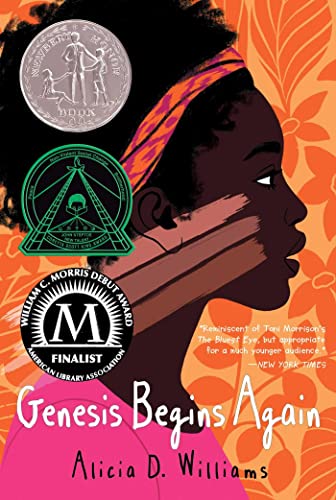
Genesis Begins Again by Alicia D. Williams (YA Fiction)

Genesis Begins Again

Alicia D. Williams (YA Fiction)

Thirteen-year-old Genesis Anderson hates moving (her family is on number four), broken promises (too many to count), her father’s hateful words when he’s had too much to drink (too painful to count), her hair, and staying with her grandmother. She also hates the darkness of her skin, which she’s tried to lighten using a variety of household products. But mostly, Genesis hates the list that was started back in sixth grade by two classmates who listed one hundred things (the stupid girls only listed sixty) they hated about her. The joke’s on them because Genesis has been adding to that list on her own and will probably make it to 100 in no time. There’s a lot of things Genesis hates, but a new school with new friends and new opportunities finally show Genesis that there are a lot of things to like. With things finally beginning to look up, you can bet that it won’t be long before something comes along to mess it all up. Genesis hates that.

Very few young adult books have grabbed me the way Genesis Begins Again has. Williams’s opening paragraph leads us into a false sense of security that is quickly and horribly stripped away in a matter of paragraphs. Williams snuffs out our girl’s light in one raw and shameful event that immediately shows us the obstacles that Genesis faces, the character of the “friends” she has, and the girl that she ultimately is. Behind all that self-loathing is a strong, loyal, fierce, and intelligent girl who is wise beyond her years and determined to make her fractured world whole again…no matter the cost. She is instantly a character that we root for and we find ourselves either wanting to take her by the shoulders to remind her that she’s better than she thinks or wrap our arms around her to reassure her that everything will be alright.

It’s hard to believe that this is Williams’s debut novel. It received the Newbery Honor award in 2020, as well as the John Steptoe Award for New Talent. Her book began as an autobiography but was soon revised to better reflect the present rather than the past. The themes of bullying and colorism play predominantly throughout the story and often emanate from surprising and unexpected sources. The characters are wonderfully developed, the prose is engaging and allows us to fully immerse ourselves within Genesis’s world, the conflicts and outcomes are realistic, and there’s enough drama and tension to keep the story moving at a wonderful pace.

Highlighting the important and influential role that teachers have on our children, Genesis is highly influenced by her music teacher, Mrs. Hill. It is she who introduces Genesis to Billie Holiday, Ella Fitzgerald, and Etta James who showed her that there is beauty in brokenness and joy beyond the pain. Music healed Genesis…it freed her…and proved to be a lifeline to those around her who needed it the most. Billie Holiday once said, “If I’m going to sing like someone else, then I don’t need to sing at all.” All through the story, Genesis was always trying to be someone else: lighter, braver, smarter, hipper, or more popular. It was only after she discovered and began to sing her own song, that she was truly able to begin again.

Rating: 5/5

* Book cover image attributed to: www.abebooks.com

We’re now posting videos of some of our book reviews! Follow us on Facebook at www.facebook.com/thedustyjacket or on Instagram @tdjreviews and join in on the fun!
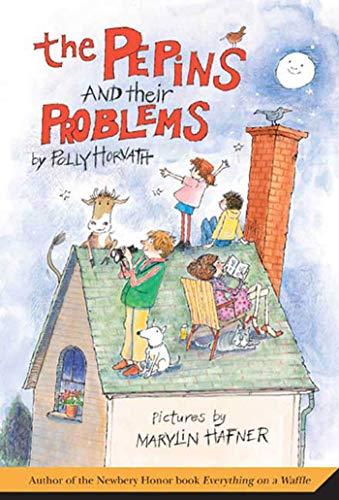
The Pepins and Their Problems by Polly Horvath (J Fiction)

The Pepins and Their Problems

Polly Horvath (J Fiction)

Being a fairly small family, the Pepins seem to have a rather large amount of problems. From frogs in their shoes to a cow that is suddenly producing lemonade to missing cutlery (where did all the forks go???), there doesn’t appear to be an end to the number of problems the Pepins have. But with the help of a telepathically gifted author and projected suggestions from readers from Pottsville, Pennsylvania to Hughes, Alaska and everywhere in between, there seems to be no problem too big that the Pepins can’t solve. That is until a long-lost Pepin arrives who promises to solve ALL of their problems himself. Could this finally be the end to the Pepins’s problems?

This book is outrageous, outlandish, and out and out ridiculous as Polly Horvath delights readers with a story filled with a cow who takes French and algebra lessons, a dog and cat who not only talk, but have been known to fly about in a motorless aircraft, a very fine neighbor, and a not-so very fine neighbor. We see scarf dances, an elaborate neighbor test, an awkward infatuation with a barbershop pole, and a laboratory that would make even Willy Wonka jealous.

The Pepins and Their Problems has a recommended reading age of 8-12, but I fear that a reader over the age of ten will find this book to be too silly and very frustrating at times since some of the problems the Pepins have can easily be solved with a simple question or plain old common sense. This book would be in its element if read out loud allowing young readers to think over and offer up their own solutions.

The thing I love most about Horvath is that she does not write down to her audience (which I seem to say every time I review one of her books) and this is obvious as she tosses out words such as loquaciousness, perspicacious, ruminatively, progeniture, and amalgamation. Definitely have a dictionary close by…you’re going to need it!

Whether they’re stuck on the roof or dealing with a relative who sucks up breadcrumbs through their nose, the Pepins are ever a loving and close-knit family who look upon their problems as blessings in disguise and realize that a happy family already has as many riches as anyone can hope for. Now who, dear reader, could possibly have a problem with that?

Rating: 4/5

* Book cover image attributed to: www.abebooks.com

We’re now posting videos of some of our book reviews! Follow us on Facebook at www.facebook.com/thedustyjacket or on Instagram @tdjreviews and join in on the fun!
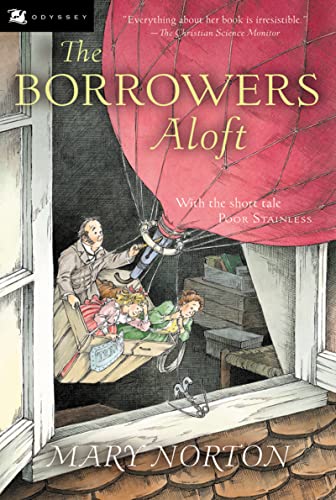
The Borrowers Aloft (The Borrowers #4) by Mary Norton (J Fantasy)

The Borrowers Aloft (The Borrowers #4)

Mary Norton (J Fantasy)

Pod, Homily, and Arrietty Clock have been through a lot, but with the help of Spinner, they are finally headed to their new home in Little Fordham. Developed and managed by Mr. Abel Pott, this miniature railway village attracts plenty of humans and humans—as all Borrowers know—always can be counted on to leave behind lots of things worth borrowing. But Little Fordham has also attracted the attention of Mr. and Mrs. Platter, a greedy couple who know a good opportunity when they see it. They set on building a similar village called Ballyhoggin and just when they think they’ve one-upped their competition, they discover something in Little Fordham that could make them rich—real little people! Soon, the Clocks find themselves kidnapped and will soon be a permanent Ballyhoggin attraction. They’ve pulled off narrow escapes before, but could our favorite Borrowers have finally met their match?

The Borrowers Aloft is the fourth book in The Borrowers series and Norton continues to thrill and excite readers with new characters, challenges, and lessons to be learned. We meet the kind Mr. Pott, the amiable Miss Menzies who befriends Arrietty, and the opportunistic and scheming Platters who imprison our heroes and plan to exhibit them like animals in a zoo. This book truly tests the patience, strength, and unity of our heroes as they must rely on their ingenuity, wit, and each other in order to regain their freedom.  

Four books in and Norton still manages to keep the Clock’s journey fresh and exciting with new faces, obstacles, and challenges: Arrietty has grown tremendously but her trusting nature once again puts her family at risk; Homily is realizing that her little girl is growing up soon will be looking to build a life of her own; and Pod is faced with making some tough decisions of his own as he weighs his wife’s comfort, his daughter’s longing, and his desire to remain true to his Borrower nature.

Homily asks Pod a question that she’s heard herself ask a number of times, “Where are we going to?” to which Pod responds, “To where we belong.” Spanish athlete Bojan Krkic once said, “It is important to find a place where you feel trust, you feel belonging and stability.” Based on this, it seems that Pod, Homily, and Arrietty may be closer to finding their perfect place than even they realize.

Rating: 5/5

* Book cover image attributed to: www.abebooks.com

We’re now posting videos of some of our book reviews! Follow us on Facebook at www.facebook.com/thedustyjacket or on Instagram @tdjreviews and join in on the fun!
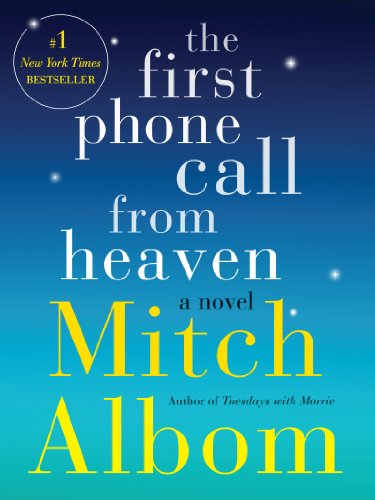
The First Phone Call from Heaven by Mitch Albom

The First Phone Call from Heaven

Mitch Albom (Adult Inspirational)

It was a rather ordinary day in the small, quiet town of Coldwater, Michigan. A day when a phone call would forever change the town—and soon the world—forever. The last time a phone call had such an impact was on March 10, 1876 when Alexander Graham Bell made the world’s first phone call to his assistant, Thomas Watson, and infamously uttered, “Mr. Watson—come here—I want to see you.” The phone call received by Tess Rafferty was just as improbable and consequential because this call came from Heaven. As more people came forward to share their own calls, one man remained skeptical and determined to prove this wonderful miracle was nothing more than a cruel and heartless hoax.

I fell in love with Mitch Albom after reading Tuesdays with Morrie and he has again presented me with another beautiful bouquet in the form of The First Phone Call from Heaven. He gives us several characters to follow as each receives a phone call from the afterlife, but he keeps us focused on three central individuals: Sully Harding, widowed father and newly released from prison who refuses to buy in to the religious narrative; Katherine Yellin, real estate broker who receives the second call but is the first to announce it publicly; and Police Chief Jack Sellers, divorced and father to a son lost in combat who must maintain law and order while trying to grapple with his own truth. Woven through all of these stories are historical facts and tidbits about Alexander Graham Bell, which I really enjoyed learning: stories about his mother and wife who were both hearing impaired, his close brush with obscurity, and the actual creator behind the standard telephone greeting “Hello” (hint: it wasn’t Bell who suggested “Ahoy!”). All of these references could have seemed forced and out of place, but Albom connects the past to the present as effortlessly as we are able to connect with one another today.

Albom’s faith is clearly the heart of this book as heavenly callers reassure their living recipients that they are well, happy, and that Heaven is indeed real. Sadly and realistically, we witness a beautiful event spiraling out of control as protestors seek a platform and news outlets realize the potential profit that faith and hope hold. It was Winston Churchill, working to form the United Nations after World War II, who said, “Never let a good crisis go to waste.” I’m sure it was a media mogul who might have been tempted to tack on “…or a miracle either.”

This is a wonderful story of faith challenged, hope questioned, and lives altered as the impossible becomes possible and the unknown is made clear. And whether you’re a believer, non-believer, or agnostic, one thing we can agree on—that remains as true today as it did in 1876—is that a single voice spoken through wires has the ability to change life forever.

Rating: 5/5

* Book cover image attributed to: www.abebooks.com

We’re now posting videos of some of our book reviews! Follow us on Facebook at www.facebook.com/thedustyjacket or on Instagram @tdjreviews and join in on the fun!

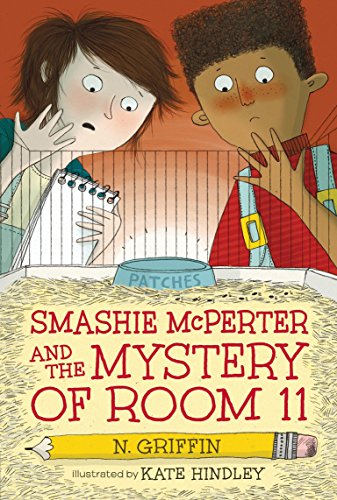
Smashie McPerter and the Mystery of Room 11 by N. Griffin (J Mystery)

Smashie McPerter and the Mystery of Room 11

N. Griffin (J Mystery)

The third-grade class in Room 11 at Rebecca Lee Crumpler Elementary School was NOT having a good day. Between a vain, mean substitute teacher, a missing class hamster, and a nasty, sticky prank it was enough to make Principal Armstrong SIMPLY ILL. I mean, ILL IN BED WITH AN IV DRIP kind of ill! No. This was NOT how the students of Room 11 behaved. On top of that, when Smashie’s public dislike for Patches the hamster makes her the prime suspect in his disappearance (just because she thinks hamsters are just mice with chicken feet), it’s up to her and her best friend Dontel to solve the case or else Room 11 may never be the same again.

This is a great book that not only teaches critical thinking and deductive reasoning skills, it also illustrates the importance of giving someone the benefit of the doubt, how it’s possible to do something wrong but for the right reason, and how difficult it is to earn trust while it’s very easy to lose it. Lots of wonderful lessons with two central characters who balance each other nicely. While Smashie is reactive, impulsive, and emotional, Dontel is logical, thoughtful, and realistic. And while it causes some angst on Smashie’s part when Dontel doesn’t agree with her, he proves to her that disagreeing doesn’t mean disloyalty because it takes a real friend to point out your mistakes and a better friend to admit when it’s true.

Griffin gives readers a cute and age-appropriate story that really picks up steam near the end. The only problem I had was with a few of the references: …frog-marching the hapless Mr. Carper downtown, …Smashie beat a loud tattoo on its door, …he schooled his features, and (this one is a doozy) I was throwing the poor thing a bone said by a male teacher to a female teacher in an attempt to excuse his failed flattery attempts. Not to mention Dontel telling Smashie to slap my hand with your hand rather than just saying, “High five!” or “Gimme five!” and I was wondering if these references would be lost on Griffin’s audience. Still, this is a fun and entertaining read that shows if you’re strong and stand up for what you know is right, everything will work out in the end…even if you still think hamsters are just mice with chicken feet.

Rating: 4/5

* Book cover image attributed to: www.abebooks.com

We’re now posting videos of some of our book reviews! Follow us on Facebook at www.facebook.com/thedustyjacket or on Instagram @tdjreviews and join in on the fun!
The Good Dog by Avi (J Fiction)

The Good Dog

Avi (J Fiction)

McKinley was a good dog who lived a good life. He was part of a caring family, loved by his human pup Jack, had lots of friends, and held the distinction of being head dog of the Steamboat pack. Yes, life for the malamute was very good until the day a she-wolf by the name of Lupin arrived. Her words of freedom and wild enticed McKinley as he began to feel the burden of taking care of both his pack and his pup. Lupin had him questioning his life as a bound dog…a slave to humans and their will. As McKinley begins to witness the cruelty that humans were capable of, would he submit to his wolf ancestry and join Lupin to live a life without rules and conditions? What would a good dog do?

Although this story was written in the third person, Avi delights readers with a story told from a dog’s perspective. He gives us street names like Most Cars Way, Pine Smell Way, and Elk Scat Way. Jack loves to look at his staring papers (a book) while his parents seem mesmerized by their glow box (TV) and during the day, all the pups go to their special house (school). Avi shows us McKinley constantly “marking” certain areas so that his pack will know his comings and goings, he goes through the ritual of when dogs meet each other, and even describes McKinley’s frustration while trying to convey a rather simple concept to Jack (humans can be SO thick at times).

Avi checks all the right boxes with The Good Dog: age appropriate, an engaging story, memorable characters, great moral lessons, plenty of action and suspense, a few detestable villains, a hero who questions his purpose, some surprising twists, and an ending that’s sure to please. This book shows readers the value of loyalty, honor, and courage and illustrates how bloodline doesn’t dictate who your family is or where your future lies. Countless times McKinley is always looking out for Jack or a member of his pack and although he reaps both the rewards and punishments of his actions, these selfless acts make it clear why he was chosen to be head dog.

Throughout the book, McKinley was a friend, a best friend, a companion, a nemesis, a hero, a champion, and a leader. At the end of the day though, McKinley was just a dog, but more than that, he was a good dog.

Rating: 5/5

* Book cover image attributed to: www.abebooks.com

We’re now posting videos of some of our book reviews! Follow us on Facebook at www.facebook.com/thedustyjacket or on Instagram @tdjreviews and join in on the fun!

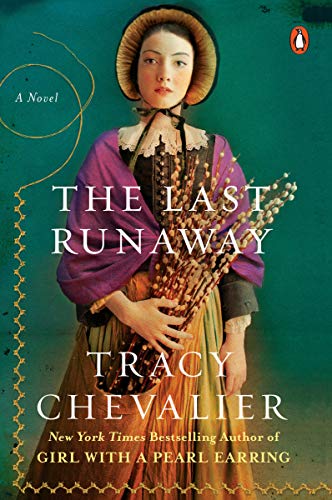
The Last Runaway by Tracy Chevalier (Adult Historical Fiction)

The Last Runaway

Tracy Chevalier (Adult Historical Fiction)

She had grown up with the understanding that slavery was wrong and must be opposed, but that had been all thoughts and words. Now she must actually do something though she did not yet know what.

Honor Bright left her family in Dorset, England to accompany her sister, Grace—set to marry a fellow Quaker—to America. It’s 1850 and the federal government is on the cusp of passing The Fugitive Slave Act, which would strengthen the rights of slave owners while threaten the rights of free blacks. Upon Honor’s arrival, tragedy forces her to solely navigate these new customs and laws…laws which conflict with her Quaker beliefs. When she befriends Belle Mills, a no-nonsense and generous milliner, and Mrs. Reed, a free black woman, Honor unwittingly becomes part of the Underground Railroad and will be forced to choose between her principles and her family.

This is the third book by Chevalier that I’ve read and her stories and characters never seem to disappoint. Alternating between third-person narration and first-person point-of-view through letters written by and to Honor, The Last Runaway is a thrilling story set in the harsh, untamed, yet beautiful backdrop of Ohio. Not only does Honor have to adjust to a new family and a harsh climate, she also has to navigate the unwanted attention from a would-be romantic interest, wariness from the locals, familial hostility, and a political environment that goes against everything she’s been taught. Rather than buckle under the weight of these challenges, Honor finds a way to acclimate and even discovers a unique way to protest and stand up for what she believes in.

Chevalier gives us several rich and multi-dimensional characters that keep the action and suspense going at a steady pace with a satisfying and unexpected climax at the end. The author provides necessary backstories so readers better understand her characters’ motivations to prevent false assumptions being made while allowing some amount of empathy to be extended to characters who might on the surface not deserve it.

Throughout the story, Honor is desperately searching for her place in the world…a “slot” in which her life was meant to fit. Bestselling author Robert G. Allen once wrote, “Everything you want is just outside your comfort zone.” Honor Bright abandoned her comfort zone by leaving her home, traveling across an ocean, braving blistering summers and unrelenting winters, learning to milk cows, and defying her family and community. By doing so, Honor did get everything she wanted and finally found a reason to stop running.

Rating: 5/5

* Book cover image attributed to: www.abebooks.com

We’re now posting videos of some of our book reviews! Follow us on Facebook at www.facebook.com/thedustyjacket or on Instagram @tdjreviews and join in on the fun!