
Mr. Ives’ Christmas by Oscar Hijuelos

Mr Ives Christmas

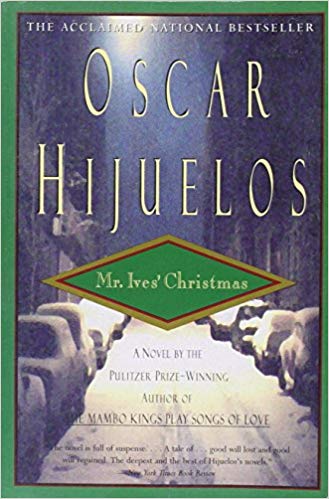
Mr. Ives’ Christmas    

Oscar Hijuelos (Adult Fiction)

It was around Christmas when a young foundling named Edward was given a home, a family, and a last name.  His adoptive father, Mr. Ives Senior (a foundling himself), managed a printing plant and gave his new son two brothers and a sister, provided him with a good amount of encouragement, and—most importantly—taught him how to pray.  While growing up, Edward basked in the cultural richness that surrounded him in New York during the 20s and 30s.  By the 1950s, his creativity landed him in a Madison Avenue ad agency where he worked, thrived, and would eventually retire.  His simple and humble life would involve marriage, children, delight and despair and through it all, Edward will come to realize that the life he imagined for himself is very different from the life that he’s been given.

Oscar Hijuelos delivers a beautifully written novel that is vividly detailed and rich in historical insights and context, yet I found myself disappointed and wishing that I had enjoyed this book more.  First, it was difficult connecting with the main character.  Hijuelos often interjects various characters’ backstories throughout the book.  This was helpful in creating history and perspective, but the constant interruptions ultimately sacrificed intimacy for insight and greatly hampered the flow of the story, which leads to the second point.  It was extremely challenging to stay immersed in the story.  Rather than focus on a central theme, this book read more like a series of random thoughts, insights, and memories.  Hijuelos simply went off on one tangent too many and the book becomes a regrettable product of information overload.

This book mainly centers on New York and spans over several decades.  In that respect, it was interesting to see a city in constant transformation and evolution during the cultural, political, and social movements of the 50s, 60s, and 70s.  I also appreciated the spiritual issues that Hijuelos covered without being overtly religious.  We see Edward’s struggle to reconcile his religion with his faith and the eventual effect it has on his physical and mental health.  But through life’s tragedies and triumphs, Mr. Edward Ives remains a sentimental, kind, and honorable man, father, husband, and friend who realizes that Christmas isn’t his story, but it’s His story—the babe born in a manger who would die on a cross.  Although Edward often finds himself grappling with a life full of uncertainty and anguish, through his faith and belief, Mr. Ives finds peace in knowing that his afterlife is secured and in good hands.  Merry Christmas, Mr. Ives.

Rating: 3/5

* Book cover image attributed to www.amazon.com


A Christmas Memory by Truman Capote (J)

A Christmas Memory

A Christmas Memory     

Truman Capote (Juvenile Fiction)

There was something special about that late November morning: the air lacked the songs of birds; the courthouse bell sounded cold and clear; and the once-empty hearth boasted a blazing fire.  All of these meant only one thing—it was fruitcake weather!

A Christmas Memory is Truman Capote’s earliest memories of his life in a small rural Alabama town.  Up until the age of ten, he lived there with a family of distant and elderly cousins.  One cousin, in particular, he was especially fond of and considered her to be his best friend.  She called him “Buddy”, after her former best friend who died in the 1880’s, and he referred to her as simply “my friend”.  Capote’s book is filled with his personal heartwarming memories of Christmas—beginning with the inaugural baking of the fruitcakes (which includes a charming visit to one Mr. Haha Jones) and followed by searching for the perfect tree, hanging wreaths on all the front windows, and making gifts for the family.  Capote’s vivid descriptions and eloquent prose allow us to smell the fruitcakes baking in the oven and luxuriate in the warmth emanating from the home’s stone fireplace.

On Christmas Eve night, “my friend” confesses to Buddy her desperate desire to give him a bicycle for Christmas, but her inability to do so for lack of money.  “It’s bad enough in life to do without something you want,” she laments, “but confound it, what gets my goat is not being able to give somebody something you want them to have.”  During this time of year, we seem to be inundated with an endless barrage of commercials, movies, and television shows that all seek to remind us about the true meaning of Christmas through animated animals, complicated romantic triangles, or splashy musicals.  I’m grateful for Mr. Capote for sharing his personal Christmas memory and for showing us in a loving, compassionate, and quiet way that we should be thankful not for the gifts that lie under our tree, but rather for those who gather around it.

Rating: 5/5

* Book cover image attributed to www.goodreads.com 


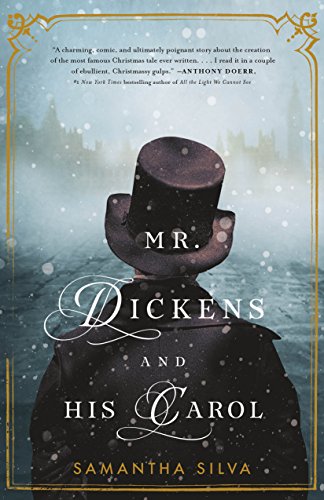
Mr. Dickens and His Carol by Samantha Silva

All during the month of December, we’re reviewing books that celebrate the season.  Enjoy!

Mr Dickens and His Carol

Mr. Dickens and His Carol    

Samantha Silva (Adult Fiction)

Throughout history, authors have credited some of their most famous works to muses: Dante had Beatrice Portinari; F. Scott Fitzgerald had his wife, Zelda Sayre; and Charles Dickens has a poor seamstress by the name of Eleanor Lovejoy.

Dickens leads an abundantly blessed and expensive lifestyle, and between his growing household, numerous philanthropic endeavors, and covering the debts of relatives, the coffers are quickly running low.  Despite past successes, Dickens’ newest book is selling poorly and the fast-approaching Christmas holiday is proving to be not so merry or bright.  Threatening to withhold future pay, his publisher insists Dickens write a “Christmas book” in just a matter of weeks.  Overwhelmed, under pressure, and fresh out of ideas, it’s enough to make even the great Boz Dickens say, “Bah, humbug.”

Weaving bits of facts with threads of fancy, Samantha Silva gives readers a wonderful behind-the-scenes look into one of the world’s most beloved Christmas tales.  The origins of Ebenezer Scrooge, Jacob Marley, Bob Cratchit, and Tiny Tim are all so plausible, that you forget this is a work of fiction and instead allow yourself to be dropped into this charming story like a cinnamon stick into a bowl of wassail punch.  As you read, you can begin to imagine and appreciate the mounting pressures and expectations placed upon a man so highly heralded yet so hopelessly human.  As Scrooge was cursed with malevolence, Dickens was equally cursed with benevolence and when life proved to be too much, he sought serenity, solitude, and anonymity.  Silva tells us that Dickens dabbled in magic and, at one point in her story, he noted that behind every illusion, fiction, and lie, was our great desire to believe.  This leads us to reconsider the idea that perhaps even a character as detestable as Ebenezer Scrooge wanted desperately to believe in something or someone but simply lacked the energy or the will to do so.  Like his creator, perhaps Ebenezer Scrooge was a man eventually beaten down by the burdens of life.

Near the end of the book, Dickens is in his darkest hour and Eleanor attempts to remind him about the importance of his books and what Christmas is truly all about: “And the colder it was, the nearer we were to each other, and to the truth of Christmas.  The truth of your books…That despite what is cold and dark in the world, perhaps it is a loving place after all.”  It’s easy to see why Silva’s book is more fiction than fact, for with words like these, a muse like Eleanor Lovejoy would indeed be difficult to find…even by the great Charles Dickens.

Rating: 4/5

* Book cover image attributed to www.amazon.com