

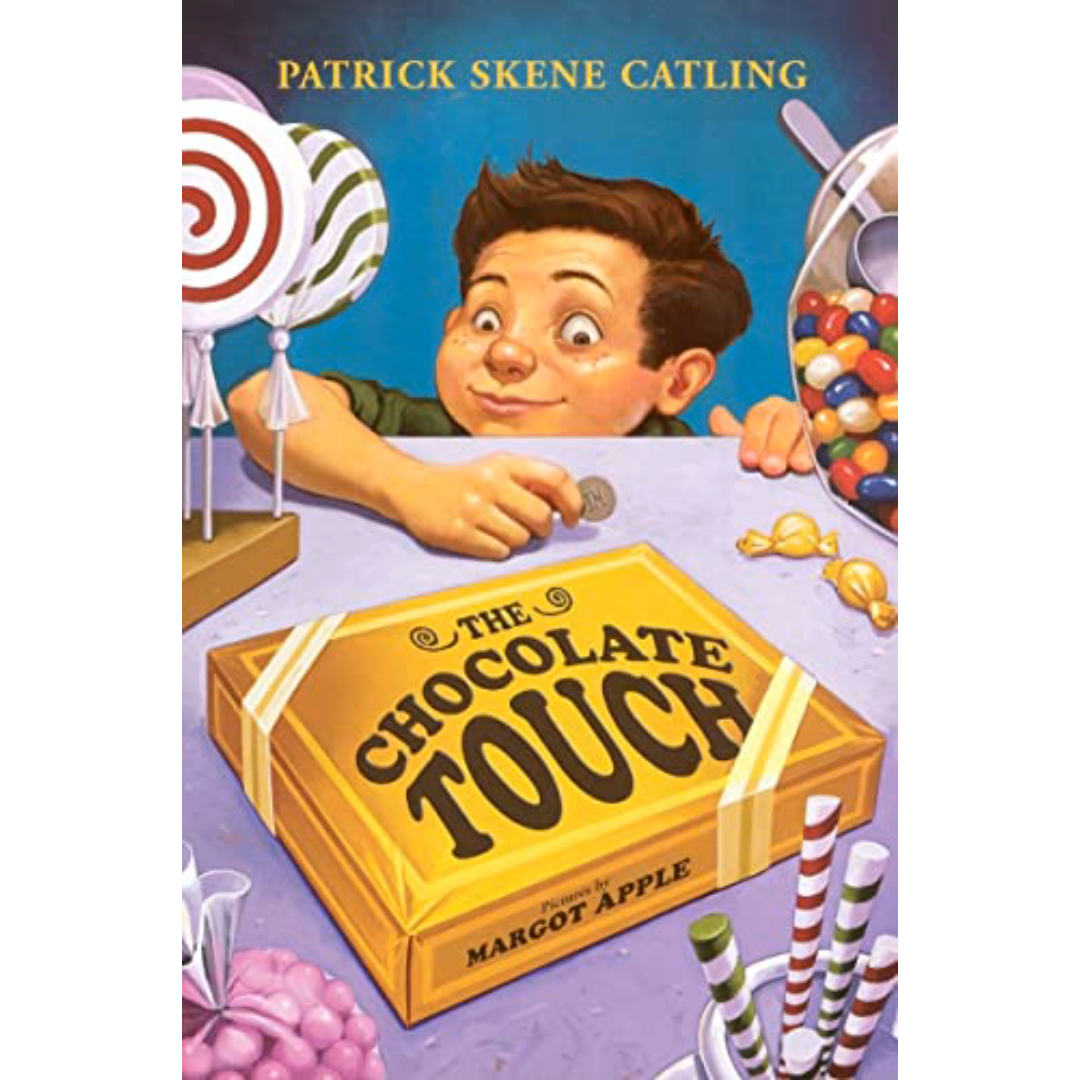
The Chocolate Touch by Patrick Skene Catling

Most of the time John Midas was a very nice boy. Every now and then, of course, he broke a rule…

The Chocolate Touch

Patrick Skene Catling (J Fiction)

Most of the time John Midas was a very nice boy. Every now and then, of course, he broke a rule…

John Midas loves candy. He especially loves chocolate. In fact, John is candy mad, but worse is that John doesn’t share. Not one little bit. Not with his parents or with his little sister or even with his best friend, Susan Buttercup. Yep. John was greedy and he’s about to learn a very bittersweet lesson when he finds a strange coin on the sidewalk. A coin that unlocks John’s secret wish of wanting to eat chocolate all day, every day. A coin that would have John questioning whether you CAN have too much of a good thing.

Patrick Skene Catling gives readers a cautionary twist of the classic tale of King Midas and his golden touch. In this story, a selfish and greedy boy is suddenly given the ability to turn anything that goes into his mouth to chocolate. Toothpaste, tonic, eggs, orange juice, and eggs are suddenly chocolatey treats that easily and willingly go down his throat—much to the delight of his overly concerned mother who thinks that John is finally making good food choices. But John soon realizes the downside of his powers when the things most precious to him fall victim to his chocolate touch.

The Chocolate Touch is an excellent read-aloud book ideal for either classroom discussion or a shared bedtime story. Valuable lessons such as being careful what you wish for and happiness is not always found through material gain will be recognized by readers who will most likely predict what will happen next as John continues his chocolate transformations. There are plenty of opportunities to talk about actions and consequences, accepting responsibility, and placing someone else’s needs above your own to make this a funny and effective learning tool.

Author Thomas Harris wrote, “Nothing makes us more vulnerable than loneliness except greed.” John realized this lesson as his greed began to isolate him and ultimately cost him his dignity, health, friends, and even his beloved mother. Lucky for him, a good dose of humility—which may have been more unappetizing to digest than his daily tonic—ultimately saves him from a life that even Willy Wonka may have declined.

Rating: 4/5

Bring The Chocolate Touch to your class with our study guide: https://www.teacherspayteachers.com/Product/Study-Guide-The-Chocolate-Touch-by-Patrick-Skene-Catling-12313062
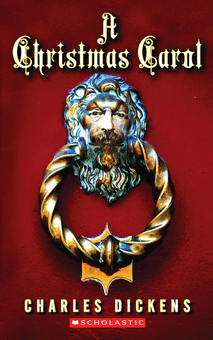
A Christmas Carol by Charles Dickens

It’s Throwback Thursday and we’re reviewing one of literature’s classics!  During the month of December, we’re reviewing books that celebrate the season.  Enjoy!

A Christmas Carol

A Christmas Carol    

Charles Dickens (Adult Fiction)

How does one go about describing Ebenezer Scrooge?  Perhaps our story’s narrator says it best: “Oh!  But he was a tightfisted hand at the grindstone, Scrooge!  a squeezing, wrenching, grasping, scraping, clutching, covetous old sinner!  Hard and sharp as flint, from which no steel had ever struck out generous fire, secret, and self-contained, and solitary as an oyster.  The cold within him froze his old features, nipped his pointed nose, shriveled his cheek, stiffened his gait, made his eyes red, his thin lips blue, and spoke out shrewdly in his grating voice.”  Yes.  That will do nicely.  But no matter how vile Scrooge is, he has an equal by the name of Jacob Marley, his business partner that’s been dead seven years to the day.  This very night, Marley will pay a spectral visit to Scrooge in hopes of salvaging his former colleague’s soul and thus sparing him from an afterlife laden with rusty chains and regret.

A Christmas Carol is Dickens’ beloved and cherished Christmas song to the world.  First published in 1843, this classic story is divided into staves (or staffs) rather than chapters where every character is a note, every ghostly visit is a movement, and every revelation is a crescendo that builds to the climax when Scrooge realizes the dire consequences of his avarice and malevolence.

There are more than two dozen film adaptations of A Christmas Carol, but nothing quite compares to reading and absorbing Dickens’ original words, which contain a few subtleties that are otherwise lost when presented visually.  One example is that prior to Marley’s visit, the characters of Bob Cratchit and Fred are nameless and simply given titles such “clerk in the tank” or “Scrooge’s nephew”.  This omission would lead the reader to conclude that these characters are inconsequential; however, it is only later in the book when we realize what an important part these individuals will eventually play in Ebenezer Scrooge’s road to redemption.

I love the many moral and spiritual lessons we can glean from A Christmas Carol: “In order to fully realize life, one must love and be loved in return”; “Learning begins with listening”; “It’s important to learn from the mistakes of others”; or, if you’re a businessowner, “Treat your employees nicely”.  My personal favorite is taken from Marley’s visit with Scrooge where the former says, “I am here tonight to warn you that you have yet a chance and hope of escaping my fate.”  In an uncertain world where, despite careful planning or our best intentions, life doesn’t always go the way we wish, and it is therefore important to remember that if there is a chance—no matter how slight or remote—then there is still hope.

Rating: 5/5

* Book cover image attributed to www.scholastic.com