

The House on Mango Street by Sandra Cisneros (Adult Fiction)

The House on Mango Street   

Sandra Cisneros (Adult Fiction)

The house on Mango Street wasn’t what Papa had talked about when he held up a lottery ticket or what Mama had dreamed up for our bedtime stories. Instead, it was small and red with crumbling bricks and no front yard. Even a nun, who was passing by the house one day, couldn’t believe that it was actually the home of little Esperanza. It was at that moment that Esperanza knew that she had to have a house. One with stairs on the inside and a front yard with grass. One that was filled with quiet. Quiet like snow. A home all her own.

Published in 1984, Cisneros’s celebrated The House on Mango Street is a coming-of-age story about 12-year-old Esperanza Cordero, a Chicana girl growing up in the Hispanic quarter of Chicago. Comprising of 44 vignettes and being just a squeak above a novelette, Cisneros introduces us to several memorable characters who are the color, texture, and fabric that make up Mango Street. We meet the rotten Vargas kids, Alicia who studies to avoid a life in a factory or behind a rolling pin, Darius the philosopher, Sally with the Cleopatra eyes, and Geraldo who was so much more than a shiny shirt and green pants. But as is the nature of vignettes, our knowledge and connection with these and other characters are superficial and barely scratch the surface. Like a movie trailer, we get the highlights, but not the heart.

In her introduction—which I loved and wished that the rest of the book had been this immersive and rooted—Cisneros wrote that she wanted to write a book “that can be opened at any page and will still make sense to the reader who doesn’t know what came before or what comes after.” I think that was the biggest barrier for me to overcome. While accomplishing her goal, Cisneros sacrificed a connectedness that would have given readers more than just a superficial glance at characters who did have a before and, more importantly, an after. I wanted to know Sally’s after, who married to be free yet ultimately found herself in a different prison. I wanted to understand Geraldo’s before in hopes that someone would miss this charismatic young man who loved to dance.

Although I miss the richness of the novel that could have been, I can’t deny the beautiful and artful way Cisneros evokes raw emotion and vivid images with just a few well-placed words. She describes a family who enters a garden area between her building and a brick wall as “a family who speak like guitars”, equates the entry into womanhood by describing the sudden development of hips as “One day you wake up and they are there. Ready and waiting like a new Buick with the keys in the ignition. Ready to take you where?”, and recalls meeting her three aunts as “one with laughter like tin and one with eyes of a cat and one with hands like porcelain.”

Jørgen Vig Knudstorp, a Danish businessman and the former CEO of the Lego Group, said, “Any creative people are finding that creativity doesn’t grow in abundance, it grows from scarcity.” Now, he was talking about Legos and how having more doesn’t necessarily equate to more creativity, but it does show how a novella, not quite 18,000 words, is beautiful and creative because of its scarcity rather than in spite of it.

Rating: 4/5

* Book cover image attributed to: www.abebooks.com

We’re now posting videos of some of our book reviews! Follow us on Facebook at www.facebook.com/thedustyjacket or on Instagram @tdjreviews and join in on the fun!
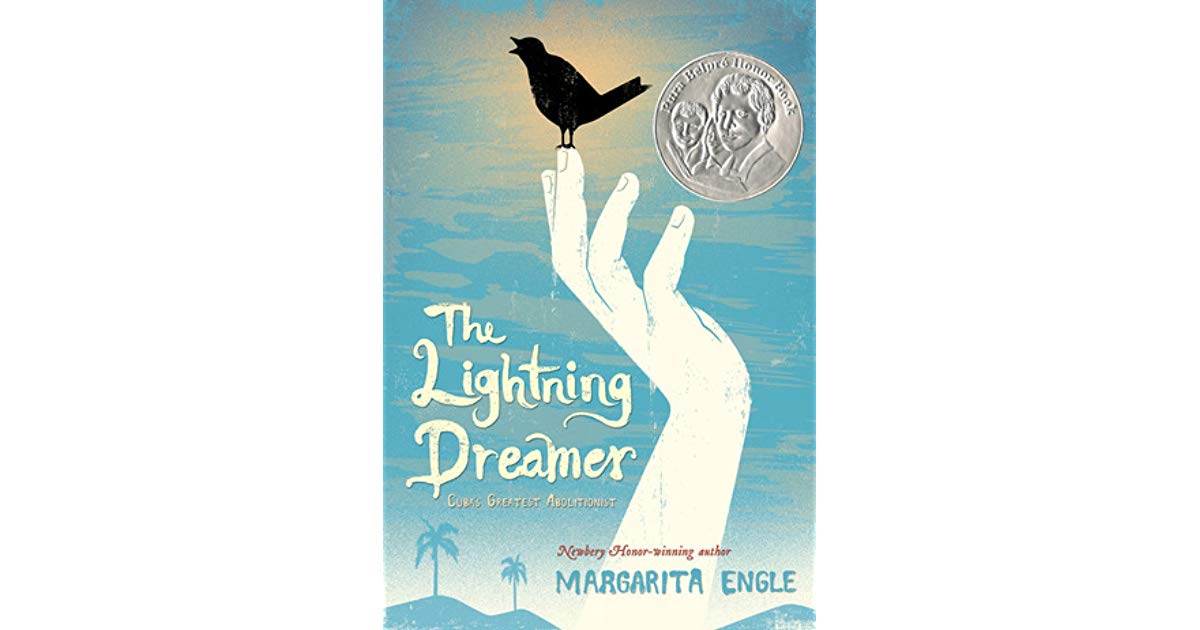
The Lightning Dreamer by Margarita Engle (YA Historical Fiction)

The Lightning Dreamer

The Lightning Dreamer    

Margarita Engle (Young Adult Historical Fiction)

In a country where both men and words are closely guarded, it is the poet who proved to be the boldest and most daring abolitionist.  Gertrudis G mez de Avellaneda (nicknamed Tula) is thirteen and enjoying her last year of personal freedom in Cuba.  When she turns fourteen, she will be sold into matrimony to the highest bidder and her mother will use the proceeds from her marriage to buy more slaves.  Tula abhors slavery and often feels enslaved herself by a society that denies her an education, the right to vote, or the freedom to choose when and whom she will marry.  But Tula suddenly finds light in her dark world when she discovers the convent’s library.  Here, in a dusty corner, lies forbidden words of hope, rebellion, and the promise of freedom from a rebel-poet by the name of Jos  Mari  Heredia.

The Lightning Dreamer is a work of historical fiction and is based on the life of Gertrudis G mez de Avellaneda, a poet and playwright known as one of the world’s most influential female writers.  Written entirely in free verse, this story switches between numerous points of view to allow the reader to see firsthand the profound and unimagined impact that poetry has on its audience.  Engle’s work is stunningly vibrant and beautiful and conveys an expansive range of emotions with just a few carefully chosen words.  For example, we experience Tula’s heartbreak as she finally resigns herself to a life devoid of freedom and choices: “During those times,/ I find it easy to forget/ that I’m just a girl who is expected/ to live/ without thoughts.”  The nuns at the convent see Tula torn between two worlds and offer her the only comfort they can: “In a mother’s eyes,/ she can be only/ a monster of defiance/ or an angel of obedience,/ nothing/ in between.//So, we send her to the library,/ a safe place to heal/ and dream…”

During her lifetime, Avellaneda fought for racial and gender equality and although her ideas were considered shocking at the time, her vision was eventually accepted and Cuban slaves gained their freedom, schools became integrated, and young girls were able to enter into marriage voluntarily and for love.  Tula once said, “Books are door-shaped portals carrying me across oceans and centuries, helping me feel less alone.”  Engle reminds us of the power behind the written word and the hope, promise, and escape those words offer when nestled between the covers of a book.

Rating: 5/5

* Book cover image attributed to www.goodreads.com 


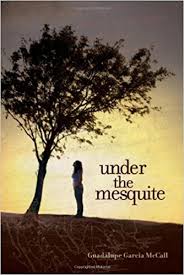
Under the Mesquite by Guadalupe Garcia McCall (YA)

Under the Mesquite

Under the Mesquite  

Guadalupe Garcia McCall (Young Adult Fiction)

Lupita knows that her Mami has a secret that she is hiding from her and her seven siblings.  She hears her talking with her comadres in their hushed words and sees their furtive glances.  Something is different.  Something is wrong.  Then Lupita hears the word that Mami keeps tucked behind closed doors…”cancer”.  Suddenly, Lupita has to deal with her mother’s chemo treatments, her best friend’s sudden ridicule, and her upcoming 15th birthday.  Through it all, she has her writing.  For a brief moment, Lupita is able to block out the world and find solace as she pours out her feelings under the sanctuary of her family’s mesquite tree.

McCall gives us inspiration through tragedy as she delivers a compelling story written entirely in free verse.  Although this is a quick read (a slow read is encouraged), the author provides an enormous amount of depth, detail, and emotion by using just a few words proving that less is indeed more.

I enjoyed seeing Lupita go between her homeland of Mexico and her current home in the United States.  McCall’s use of Spanish words throughout the book gives the story a richness that allows us to totally immerse ourselves in Lupita’s culture and world.  These two halves of her life are very different, but somehow fit seamlessly to give us a whole girl who is headstrong, caring, and mature beyond her years.

In the beginning of the story, a mesquite tree unexpectedly grows in the middle of Mami’s prized rose garden.  But over time, this intrusion is a welcomed and comforting presence.  Through pruning, the tree has grown to be quite lovely, but it is not its beauty that strikes Lupita.

“I envy the mesquite

its undaunted spirit, its ability to turn

even a disabling pruning

into an unexpected opportunity

to veer in a different direction,

flourishing more profusely than before”.

It would be wonderful if we were all just a little bit more like the mesquite tree:  growing stronger after being weakened, finding new opportunities through loss, and thriving wherever planted.

Rating: 5/5

* Book cover image attributed to www.amazon.com