
The Bears on Hemlock Mountain by Alice Dalgliesh (J Fiction)

There are no bears on Hemlock Mountain, no bears at all. There are no bears on Hemlock Mountain, no bears, no bears, no bears, no bears at all.

The Bears on Hemlock Mountain

Alice Dalgliesh (J Fiction)

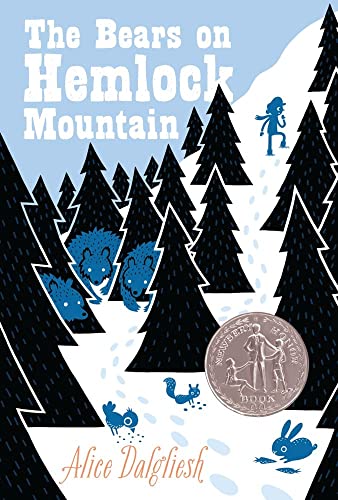
Everybody knows that there are no bears on Hemlock Mountain, no bears at all. There are no bears on Hemlock Mountain, no bears, no bears, no bears, no bears at all. Under this well-known belief, Jonathan’s mother sends him across the mountain alone to bring back an iron pot from his Aunt Emma. As Jonathan crunch, crunch, crunches his way across the snowy ground, he hopes upon all hope that there really ARE no bears on Hemlock Mountain because if there are, what would one, lonely eight-year-old boy possibly do?

Recipient of the Newbery Honor Book award in 1953, The Bears on Hemlock Mountain is a quick read full of fun, repetitive phrases such as crunch, crunch, crunch and tick-tock, tick-tock, which makes this an ideal read-aloud book. Helen Sewell’s pen and ink illustrations give the story a genuine folklore feel and wonderfully complements this story based on a Pennsylvanian tall tale. This book is recommended for readers ages 5 to 9 and grade levels 1 to 4.

The story of Jonathan’s journey to his aunt’s home and back teaches the importance having courage, facing your fears, and following through on your commitments. At the end of the book, there is an inference about a bear (or bears) being shot and killed, which is fairly unexpected as Dalgliesh takes great care in establishing Jonathan’s love of animals and the respect he has for them. This last-minute act of violence may be disturbing to sensitive readers.

While I was researching quotes about courage and perseverance to use in this review, I came upon one by Japanese author Haruki Murakami that perfectly encapsulates what happens to our young hero: “When you come out of a storm you won’t be the same person that walked in. That’s what the storm is all about.” Jonathan’s mother would have never let her young son make the trek across Hemlock Mountain if she was certain there were bears (or we would hope so). Jonathan himself was worried about bears, although he’s not fully convinced that there are any either. But when the time comes for Jonathan to face his fears, he’s rational and clever and, as a result, finds that the boy who went up the mountain is very, very different from the young man who returned home.

Rating: 5/5

* Book cover image attributed to: www.abebooks.com

NEW!! Want to discuss this book with your homeschooler or classroom? There’s a FREE study guide available. Visit www.teacherspayteachers.com/store/The-Dusty-Jacket and download your free copy today!
Hatchet by Gary Paulsen (J Fiction)

My name is Brian Robeson and I am thirteen years old and I am alone in the north woods of Canada.

Hatchet  

Gary Paulsen (J Fiction)

My name is Brian Robeson and I am thirteen years old and I am alone in the north woods of Canada.

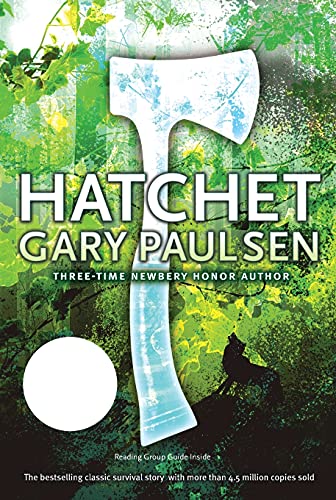
Brian Robeson’s mother and father recently divorced. Nothing much was said about it, but Brian knew the reason because he knew the Secret. He lives in New York with his mother, but is headed to Canada to spend the summer with his father. He boards the Cessna 406 and makes his way north with his belongings in a suitcase and a hatchet hooked in his belt—a present given to him by his mother on the ride to the airport. This last-minute gift would tip the scales between almost-certain death and survival as Brian’s plane goes down in the Canadian wilderness and this city boy faces decisions that he never imagined he would be making.

This Newbery Honor book was challenged for its graphic descriptions of trauma and injury and removed from school libraries in Tennessee for its sexual content and violent imagery. Hatchet has a recommended reading age of nine to twelve so it was banned from elementary school libraries. As this story deals with survival, some portions of this book are graphic (especially the scene describing the pilot’s death), but nothing that would tremendously affect a typical fourth grader who hungrily clamors for the next installation in the Marvel Cinematic Universe. Also, the “sexual content” reference refers to Brian witnessing his mother sitting in a car and kissing a man who is NOT his father so don’t let this be a major red flag if your youngster reaches for this book.

I liked how Paulsen uses repetition in his writing to build suspense (He was stopped. Inside he was stopped. He could not think past what he saw, what he felt. All was stopped.) or to reinforce urgency (He had to fly somehow. Had to fly the plane. He had to help himself. The pilot was gone, beyond anything he could do. He had to try and fly the plane.). This is incredibly effective—especially with this age group—and although he incorporates it often throughout the book, it never becomes tedious or loses its impact. Also, Brian’s learning curve is inline with someone of his age. Although raised in the city, he pulls lessons he’s either learned in school or seen on the screen and these allow him to adapt to his situation and surroundings. He quickly realizes that self-pity and panic are only liabilities and quickly discounts them as useful reactions to his predicament. He systematically and logically approaches his obstacles and begins to understand the importance and necessity of not merely surviving day by day, but also preparing for the future. The reader witnesses Brian’s evolution and although we mourn the innocence that he’s lost, we applaud him for the bigger lessons that he’s learned about life and what’s truly important and necessary.

Gary Paulsen died in 2021 and during his lifetime—having written over 200 books throughout his career—was one of the most challenged authors of the 21st century according to the American Library Association. Because several of his books were banned because his writing was just “too realistic” speaks volumes to just how gifted a storyteller Paulsen was and why he continues to amass such a large and loyal fan base. Just as Brian changes throughout the story, I hope that we too continue to evolve and begin to realize just how important stories like Paulsen’s are in showing young readers the importance of believing in yourself, the downside of underestimating your abilities, and the courage it takes to wake up each morning with a renewed sense of determination and hope. How can anyone think of banning a book such as this?

Rating: 5/5

* Book cover image attributed to: www.abebooks.com

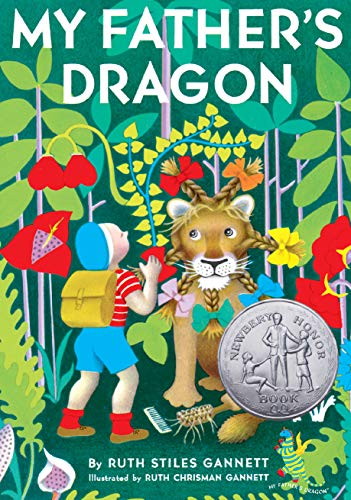
My Father’s Dragon by Ruth Stiles Gannett (Juvenile Fantasy)

My Father’s Dragon (The Tales of My Father’s Dragon Series #1)  

Ruth Stiles Gannett (Juvenile Fantasy)

Elmer Elevator wants to fly more than anything in the world and will do whatever it takes to have that chance. He soon gets his wish when a wet alley cat tells him of an imprisoned baby dragon held on Wild Island. Soon, Elmer has packed his knapsack and secretly stowed away on a ship headed to the Island of Tangerina. But Wild Island is dangerous and no one has ever come back alive from it. No one except for a wet alley cat. Loaded up with some lollipops, hair ribbons, rubber bands, an empty grain sack, and a few other inconsequential items, Elmer is off on the adventure of a lifetime, but can he survive the dangers of Wild Island AND rescue the dragon? For a chance to fly, it’s a risk he’s willing to take.

My Father’s Dragon is the first in The Tales of My Father’s Dragon series by Ruth Stiles Gannett. It’s a short and fanciful story showcasing the cleverness and ingenuity of a young boy that is retold by his son. At seventy-four pages, it’s a fast read full of slapstick scenarios and delightful dilemmas. The book has a recommended reading age of 8 to 12, but if it’s read aloud, younger readers can enjoy Elmer’s antics as well—which I highly encourage. Although Elmer does encounter tigers, a lion, crocodiles, a gorilla, and wild boars that are ALL trying to eat him, these incidents are silly rather than scary and children will revel in how Elmer manages to slip out of one precarious predicament after another.

The only things better than the story are the wonderful illustrations by Gannett’s stepmother, Ruth Chrisman Gannett. Her black-and-white, grease-crayon drawings are a wonderful complement to her stepdaughter’s words and give life to Elmer and the inhabitants of Wild Island. What I loved most was the map included at the beginning of the book. It not only labels the islands and ports, but it also shows readers where Elmer slept, met the fisherman, stopped to talk to tortoises, and other events that happened along his journey. This added attention to detail truly allows readers to become a part of Gannett’s world as they follow Elmer’s path in his quest to find and rescue the dragon.

One of my favorite quotes on bravery is this one by American journalist Franklin P. Jones: Bravery is being the only one who knows you’re afraid. And although this is a whimsical and silly fantasy book, it gives us a valuable lesson of how a young boy pushed aside his fear and used wit rather than weapons to outsmart his foes and help a fellow creature in need. On second thought, there’s nothing really silly about that after all.

Rating: 5/5

* Book cover image attributed to: www.abebooks.com

We’re now posting videos of some of our book reviews! Follow us on Facebook at www.facebook.com/thedustyjacket or on Instagram @tdjreviews and join in on the fun!

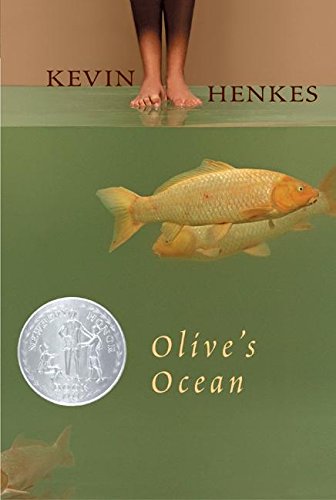
Olive’s Ocean by Kevin Henkes (J Fiction)

Olive’s Ocean

Kevin Henkes (J Fiction)

Twelve-year-old Martha Boyle and her family were leaving on their annual vacation to the Atlantic coast when a woman appeared on the Boyle’s doorstep. She introduced herself as Olive’s mother, one of Martha’s classmates who had recently been killed. She handed Martha a folded piece of paper from Olive’s journal. As Martha read the note written by a girl she barely knew, she was struck by just a few simple sentences: I hope that I get to know Martha Boyle next year (or this summer). I hope that we can be friends. That is my biggest hope. These kind words filled with expectation would alter Martha’s world view forever as she mourns a friendship that never was and never will be.

I raised my child on Kevin Henkes’ mouse books: Chester’s Way, Owen, Wemberly Worried, and others. Each helped me reinforce the value of friendship and the importance of acceptance, handling your emotions, self-reliance and many other life lessons. When I saw that Olive’s Ocean was a Newbery Honor book, I wasn’t really surprised. What DID surprise me was that it ranked 59th on the American Library Association’s list of the 100 Most Challenged Books from 2000 to 2009 for its offensive language and sexual explicitness. No wonder Wemberly worried!

Despite the ominous label it carries, Olive’s Ocean is a rather innocuous coming-of-age story about a girl dealing with the customary pre-teen fare: first love, awkwardness, rejection, humiliation, and the constant struggle of trying to figure out who she is and what she wants to be. Pretty safe stuff, but Henkes does nudge the boundaries ever so slightly causing those few, all-important feathers to be ruffled.

The “sexually explicit” reference is a brief explanation to Martha by her older brother of why their parents seem overly affectionate one morning. It seems they were exhibiting “Morning Sex Behavior” and “when they do it in the morning” they get a bit lovey-dovey. Regarding the “offensive language”, there are instances of mild profanity, but nothing too over-the-top for the publisher’s recommended reading age of 10 and up. So, the big questions are: Are EITHER of these inclusions necessary to further the story or develop the characters? No. Could they have been excluded with little to no impact on the overall message? Absolutely. Would Henkes have omitted them if he knew the wrath that awaited him? Maybe. Maybe not. There’s no question that having your book banned instantly puts you on a reader’s radar, but clearly this was not his intent. All in all, these infractions (as most references go) are tame, but clearly remain unforced errors and prompt me to up the recommended reading age by a few years just to be prudent.

As far as stories go, this was a quick read and had several important messages about inclusivity and realizing that the world doesn’t revolve around your own personal cares and needs; however, I would have liked more Olive in Olive’s Ocean and feel that this was an opportunity wasted. The apparent connection between Olive and Martha stated in the synopsis doesn’t quite materialize in the actual book, and it would have been far more interesting if Olive’s story had been developed more deeply to show Martha’s slow and eventual evolution. Still, the targeted audience will find a nice and relatable story, while I was hoping for something a little bit more moving with a deeper and lasting message. I guess if I’m looking for these, I need to go back to the mouse stories.

Rating: 3/5

* Book cover image attributed to: www.abebooks.com

We’re now posting videos of some of our book reviews! Follow us on Facebook at www.facebook.com/thedustyjacket or on Instagram @tdjreviews and join in on the fun!

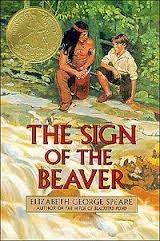
The Sign of the Beaver by Elizabeth George Speare (J Fiction)

The Sign of the Beaver  

Elizabeth George Speare (J Fiction)

“Dance,” Attean commanded. He seized Matt’s arm and pulled him into the moving line. The men near him cheered him on, laughing at Matt’s stumbling attempts. Once he caught his breath, Matt found it simple to follow the step. His confidence swelled as the rhythm throbbed through his body, loosening his tight muscles. He was suddenly filled with excitement and happiness. His own heels pounded against the hard ground. He was one of them.

It was the summer of 1769 when twelve-year-old Matt Hallowell’s father left him alone in Maine to protect the family’s cabin and corn field while he returned to Massachusetts to bring back his mother and two siblings. His father told him to make seven notches in a stick (a notch a day) and by the time that he was on the seventh, he’d be back and they’d once again be a family. Bad luck seemed to follow Matt soon after and when he found himself the target of some angry bees, a Penobscot chief and his grandson jumped in to save his life. Wanting his grandson to learn the language of the white man, the chief made a treaty with Matt: teach his grandson, Attean, to read in exchange for food. Eventually, the two boys formed an unlikely friendship and as more sticks began to pile up, Matt was faced with having to choose between joining the tribe and heading north or waiting for a family that may never come.  

A Newbery Honor Book recipient in 1984, The Sign of the Beaver is really a love letter to the Penobscot, an Indigenous people in North America and a federally recognized tribe in Maine. Speare gives her readers insights into tribal culture and customs and exposes their devotion and respect for nature, wildlife, and boundaries of the surrounding tribes. Time and again Matt questions Attean’s actions and every time his response centers on recognizing the value and worth of the land they walk, the animals they’ve killed, and  the life they’ve been given. By learning Attean’s ways, Matt begins to realize that he is just a very small part of a very big picture and as his confidence as a hunter grows, so does his world view and his new understanding of why the white man is so despised and mistrusted by these native peoples.

The Sign of the Beaver isn’t just a story about one boy’s resilience, bravery, and sense of duty, it’s also a lesson in how we should never take more than we are given, that we should appreciate differences and look for commonalities, and that empathy and kindness can do more for bridging a gap and forging a relationship than signed treaties and firm handshakes. This is a great story for young readers and a fascinating look into the Indian way of life. Although there are a few scenes of animal cruelty and suffering, Speare sticks to keeping this book authentic by not avoiding the uncomfortable thus making this book a valuable read. Although it has plenty of action and the characters are well developed, the story seems to lose a bit of steam near the end and tended to drag.

As a way of showing the chief his gratitude, Matt offered him his one prized possession—his beloved Robinson Crusoe. It was from this book that Matt read passages to Attean and where he discovered that Attean was just as passionate about storytelling as he was proving once again that a beautifully told story not only has the ability to draw us in, but it can also connect us as well.

Rating: 4/5

* Book cover image attributed to: www.goodreads.com

We’re now posting videos of some of our book reviews! Follow us on Facebook at www.facebook.com/thedustyjacket or on Instagram @tdjreviews and join in on the fun!

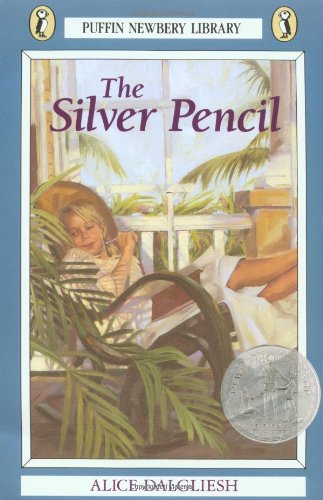
The Silver Pencil by Alice Dalgliesh (YA Fiction)

The Silver Pencil

Alice Dalgliesh (YA Fiction Newbery Honor)

The silver pencil was a miracle. It was handsome to look at, delightful to use because it never needed sharpening. One had only to change the lead. Janet was sure that she could write almost anything with it. Confidently she sat down at her small table, with clean sheets of paper in front of her and the shining pencil in her hand. To her surprise, exactly nothing happened.

Nine-year-old Janet Laidlaw was a British citizen living on the tropical island of Trinidad. She loved her life in the House on the Hill, but things quickly changed following the sudden death of her beloved father. At thirteen—when most Colonials went off to school—Janet traveled to her mother’s birthplace of England where her world suddenly got a lot bigger. With the promise of new friends and adventures, perhaps her silver pencil wouldn’t be silent for much longer.

Newbery books have always been my “go to” reads. Whether I’m looking for an excellent story for myself or I need a solid recommendation for a young reader, that silver- or gold-foiled sticker always let me know that I had picked out a winner. Unfortunately for me, The Silver Pencil fell short of this assumption. Awarded the Newbery Honor Book distinction in 1945, Alice Dalgliesh’s coming-of-age (and semi-autobiographical) book is about a young girl who travels from Trinidad to England and then to New York while pursuing a career in teaching before ultimately stumbling upon success as a children’s author. This book is meant to mirror Louisa May Alcott’s Little Women, which was Janet’s first introduction to America. Unfortunately, Dalgliesh’s tale didn’t quite rise to the level of its literary inspiration and probably won’t have the same appeal with a young adult audience.

Published in 1944, the beginning of The Silver Pencil is full of racially insensitive and inappropriate cultural references. These obviously didn’t cause a ripple back then, but would clearly result in a tsunami today. Also, Janet’s favorite book is The Story of Little Black Sambo, which she shares repeatedly with youngsters that are in need of fast and effective entertainment. Although the story’s text and illustrations have undergone numerous revisions over the decades, its very title still conjures up negative feelings and emotions. With that being said, the remainder of the book is pretty safe although I felt no attachment to the story and had zero connection to its characters. Despite it being a beautifully written book, the words just hung there and felt lifeless—lacking any sense of warmth or feeling. Even when Janet was dealing with the death of her father, I didn’t feel her pain and loss although she was obviously experiencing it. Her experiences felt more like a list to be checked rather than a life that was lived.

Despite the low rating, I loved how Dalgliesh used stories and storytelling to bridge the gap between cultures and class, to calm the rowdy and connect the displaced, and to bring people together to make the world seem a little bit smaller. They say that the pen is mightier than the sword, but Janet Laidlaw and Alice Dalgliesh showed us that a silver pencil could be just as mighty…if not more.

Rating: 3/5

* Book cover image attributed to www.amazon.com

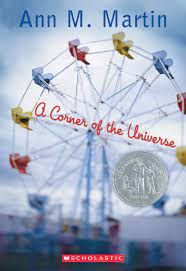
A Corner of the Universe by Ann M. Martin (YA)

A Corner of the Universe

Ann M. Martin (YA Fiction)

Hattie Owen lives in the third largest house in the small town of Millerton. Her grandparents live in the second largest. But unlike her Nana and Papa’s house, Hattie’s house isn’t filled with fancy furniture. It’s filled with boarders. Hattie doesn’t mind living with people who aren’t her family. What she does mind is living with secrets—one big secret especially. Hattie is about to find out that her mother has a younger brother, which means that she has another uncle. An uncle who, until recently, had been attending a “school” for the mentally disabled, but will now be moving back to Millerton to live with Nana and Papa.  Even though Hattie’s Uncle Adam is family, she realizes that she knows more about her parents’ boarders than her own flesh and blood, which begs the question, “If a person is kept a secret, is he real?” Hattie Owen is about to find out.

A 2003 Newbery Honor book, A Corner of the Universe covers so many complex and complicated topics, it’s really difficult to choose where to begin. Based on events in her own life, Ann M. Martin explores mental illness and the effects it has on both the individual and those around them. Twenty-year-old Adam Mercer, displaying symptoms of autism and schizophrenia, is seen as quirky, unpredictable, temperamental, and largely high-spirited by his twelve-year-old niece. However, as is the case with diseases of the brain, it only takes a minor deviation from a structured routine or an ill-delivered repudiation or rejection to set off a downward spiral of uncontrollable outbursts and dangerous reactions. Through Hattie’s lens, Adam is a person being denied fun and freedom by her controlling and rigid grandmother. Through Nana’s eyes, Adam is a child who requires constant supervision and well-defined boundaries. In reality, Adam is a little of both.

A Corner of the Universe is recommended for grades 5-8, and I certainly would not recommend this book to any reader younger than this. With topics of mental illness and suicide, as well as a few sexually implicit situations and some mild profanity, this is clearly meant for young adult readers—although the themes of acceptance, tolerance, inclusion, and kindness transcend all age groups. Martin gives us a perfect look into an imperfect world and shows us the devastation of living with guilt and regret, as well as the unintended consequences that follow seemingly good yet naïve intentions.

Hattie often said that she and her Uncle Adam had a lot in common. That they both felt like outsiders—always on the outside looking in. Hattie once told her uncle that she felt like she was a visiting alien to which Adam replied, “And aliens don’t belong anywhere except in their own little corners of the universe.” Sadly, it’s so easy to misjudge people who don’t fit into a preconceived category or check a certain box. What’s even sadder is the ease with which we tend to discount these same people—forgetting that they too have thoughts, feelings, hopes, and dreams. Although both Hattie and Adam often felt unwanted and out of place, both were able to find an unexpected friend in one another and for a brief moment, they were able to turn their corner of the universe into a very accepting, forgiving, and happy place.

Rating: 5/5

*Book cover image attributed to www.amazon.com

**Want more?  Visit our Facebook page at www.facebook.com/thedustyjacket

Princess Academy by Shannon Hale (J Fantasy)

Princess Academy

Shannon Hale (J Fantasy)

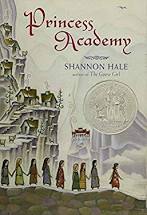
It was the last trading of the season and Miri was ready. At fourteen, she was very small for her age and not allowed to do the one thing she wished to do—work in the quarry. But one way or another, she would make her father proud and would get that stingy lowlander to give up more than he wanted. That would bring a smile to her father’s face and being useful would bring a smile to hers. But along with the traders came a painted blue carriage that carried word from the king—a prophecy that the future princess of Danland resided in Miri’s own Mount Eskel. All girls aged twelve to seventeen would go to an academy for one year’s training before the prince would select his bride and young Miri was to be among them. Could little Miri, too useless to even work in the quarry alongside her fellow mountain folk, EVER be considered worthy of a prince? She’ll have a year to find out.

Hale delivers a masterful and brilliant story of class and privilege and explores the problems associated with stereotypes and prejudices. Set against the backdrop of a chiseled mountainscape and a secret language stored deep inside the mountain’s linder stone, Princess Academy is the story of a young girl’s desire for acceptance while remaining true to herself and all that she holds dear. Recipient of the 2006 Newbery Honor Book award, Princess Academy shows us courage and the consequences that come with standing up to unfairness and protecting the most vulnerable among us.

There are so many valuable lessons in this book, especially for young girls who feel unnecessarily driven to be wittier or prettier or smarter than their peers. Miri understood the toxicity behind this kind of competition when she said, “I don’t like the feeling in competition with everybody to be seen and liked by Prince Steffan.” And it was Miri’s friend, Esa, who so wisely suggested, “We should make a pact. We’ll be happy for whomever he chooses, no jealousy or meanness.” Although written in 2005, these lessons still hold true today. There are so many empowering quotes about lifting each other up without tearing one another down or how a candle loses nothing by lighting another candle. Hale, through a “useless” girl who had very modest dreams, shows us the power for standing up for what is right and never turning your back on a friend.

I love Miri Larendaughter and have added her to my growing list of favorite fictional heroines. Besides her tenacity and courage and goodness, I believe it is her ability to lighten even the darkest places or the direst of circumstances that stands out the most to me. Prince Steffan said it best during his conversation with Miri when he said, “I would pay a deal of gold to have your talent of making other people smile.” In this age of competing for likes and followers, attention and approval, I hope we all remember how much value a simple act of kindness—especially a smile—is worth.

Rating: 5/5

*Book cover image attributed to www.betterworldbooks.com

**Want more?  Visit our Facebook page at www.facebook.com/thedustyjacket

Rascal by Sterling North (J Biography)

Rascal

Rascal

Sterling North (Juvenile Biography)

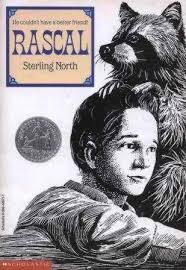
One pleasant afternoon in 1918, eleven-year-old Sterling North, along with his Saint Bernard, Wowser, and friend, Oscar Sunderland, were in Wentworth’s woods.  There, in the hollow base of a rotten stump, hid a mother raccoon and her litter of four kits.  Angered and frightened by Wowser’s intrusive digging, mother and kits darted to safety, but not before Oscar was able to capture one of the kits in his knit cap.  On that May 15th day, young Sterling had no idea that this incident would mark the beginning a very unusual and special friendship.  A friendship filled with irresistibly shiny things, strawberry pop, sweet corn, music, crayfish, and a no-good rotten bully by the name of Slammy Stillman.  The next twelve months would be a year that young Sterling would never forget.

Rascal received a Newbery Honor in 1964 and is Sterling North’s memories of growing up in southern Wisconsin from May 1918 to April 1919.  It would be a time marked with his brother, Herschel, serving in World War I, Armistice Day, and the Spanish influenza, which claimed more lives in his beloved town of Edgerton (referred to as Brailsford Junction in this book) than the war.  North was the youngest of four children.  His father was a successful landowner and his mother died when North was only seven.  In Rascal, North describes a time when front doors were never locked, neighbors looked after one another, family and good health were your most prized possessions, and all it took to make young Sterling North the happiest boy in the world were his bike, his pet raccoon sitting in the front basket, and the wind in your face as you barrel down a hill at top speed.

Some reviewers of North’s biography call it a story about friendship while others say it is a journey dealing with loss.  I found it to be more a love letter written to two mothers:  Sterling’s own beloved mother, Sarah, and Mother Nature herself.  North is exactingly detailed when he describes the beauty and splendor of wildlife, the complexities of the various plants, and the science behind selecting the perfect bait when fishing.  Younger readers may find these sections a bit tedious (as they’re probably more anxious to read about Rascal than river trout), but it is a clear reflection of the awe and respect that North has for the world around him and how these observations directly connect him with a mother that he barely had time to know.  He sees his mother in every bud and hears her voice with every new discovery.  Mother Nature is, in effect, his own mother reaching out and embracing him and these moments are truly heartwarming and comforting.

During the Christmas of 1918, Sterling’s Aunt Lillie asked him what profession he was thinking about pursuing.  After discounting his desire to become a doctor, his aunt suggested that a writer might be a more suitable choice, as his mother might have wished this vocation for him.  After Sterling questioned her about it, she explained, “And then you could put it all down…the way it is now…case weather, the fog, the lantern light…and the voices of the men—hear them—coming in for breakfast.  You could keep it just like this forever.”  Lucky for us, young Sterling listened to his aunt and by doing so, allowed readers to keep him, Rascal, and Brailsford Junction, just like this, forever as well.

Rating: 5/5

*Book cover image attributed to www.goodreads.com

**Want more?  Visit our Facebook page at www.facebook.com/thedustyjacket


Hoot by Carl Hiaasen (J)

Hoot

Hoot

Carl Hiaasen (Juvenile Fiction)

It’s tough always being “the new kid”.  It’s even tougher when there is a bully involved, but the day that Dana Matherson mashed Roy Eberhardt’s face against the school bus window was perhaps the greatest stroke of luck since Alexander Graham Bell spilled acid on his leg.  For it was at that exact moment that Roy saw the mysterious running boy bolting past the bus.  He was wearing no shoes and carrying no backpack or books.  What was he running from?  Where was he going?  And why wasn’t he wearing any shoes?  Turns out, that wasn’t the only mystery in the sleepy little town of Coconut Cove, Florida.  Someone is trying to prevent the newest Mother Paula’s All-American Pancake House from being built.  Between burrowing owls, alligators, sparkly-tailed snakes, fake farts, and nightly pranks, perhaps Coconut Cove isn’t so sleepy after all.

Carl Hiaasen’s Hoot was awarded a Newbery Honor in 2003.  He gives us two mysteries in one: a strange running boy and a vandal thwarting the efforts of a big-time corporation.  The story is witty, fast-paced, and full of heart.  Our hero, Roy, is likeable and full of moxie.  For a kid who just wants to get through the school day unnoticed, he makes it a point to stand out from the crowd.  From taking on the school bully to striking up an unusual friendship with Beatrice Leep, an elite soccer star, Roy quickly makes a name for himself and becomes the unlikeliest of heroes.

Hoot is more than just a story about friendship and courage.  It is a David-versus-Goliath story as environmentalism goes head-to-head with capitalism.  It’s burrowing owls against big bucks and a group of average kids willing to go to great lengths in order to protect something far more valuable than a building or a brand.  In addition, we are introduced to a rather unseemly group of adults: an opportunistic officer, a nasty vice-principal, crooked politicians, a vile stepmother, greedy corporate heads, and so on.  Luckily, there are a few adults in the book who haven’t sold their soul to the devil, but the spotlight is really on Roy, Beatrice, and our mysterious running boy, which proves that good things do come in small packages.

American writer and poet Suzy Kassem wrote, “Stand up for what is right, even if you stand alone.”  Carl Hiaasen gives readers a story about defending the weakest among us—the helpless and vulnerable who either lack the voice to speak up or the courage to stand up.  He provides instances showing people doing good in order to curry favor or to get ahead, but it’s the instances where good is done simply because it is the right thing to do that proves to be the truest measure of a person.  Hiaasen illustrates this through a new kid, a mysterious running boy, and a soccer star—three unlikely friends who wouldn’t give up despite the odds and showed that every life is precious and worth preserving.  That, dear friends, is something we should all give a hoot about.

Rating: 4/5

*Book cover image attributed to www.target.com

**Want more?  Visit our Facebook page at www.facebook.com/thedustyjacket