

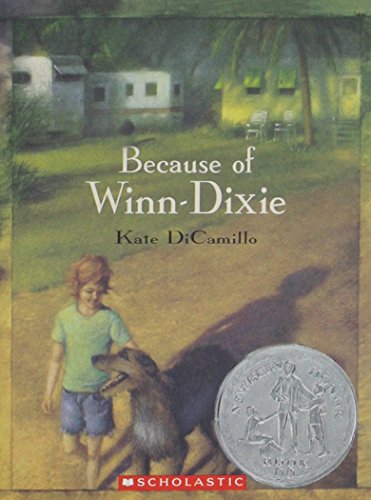
Because of Winn-Dixie by Kate DiCamillo (J Fiction)

Because of Winn-Dixie

Kate DiCamillo (J Fiction)

Opal knows ten things about her mother, but the one that sticks out most is that she hated being a preacher’s wife. Perhaps that’s why she left and never came back. When Opal’s father is given the chance to minister at a converted Pick-It-Quick store, the two leave the bad memories of Watley and move to a fresh start in Naomi, Florida. However, Opal’s lonely life changes when a stray dog she names Winn-Dixie enters her life. Because of Winn-Dixie, she meets the town’s librarian who once loaned a book to a bear, a reclusive witch with a ghost tree in her backyard, an animal-serenading ex-convict, a bald-headed baby, and a pinch-faced know-it-all. Soon, these strange individuals begin to fill the empty spot in Opal’s life and because of Winn-Dixie, maybe life in Naomi won’t be so lonely after all.

Recipient of the 2001 Newbery Honor Book award, Kate DiCamillo’s Because of Winn-Dixie is a warm and tender book about misjudging people, dealing with loneliness and loss, and the power that a simple act of kindness can have. Through a goofy dog with a penchant for smiling and a possessing a remarkably good judge of character, Winn-Dixie shows Opal that looks can be deceiving, labels are best left on soup cans, and anyone who offers you a peanut butter sandwich can’t be all that bad. With a “surrogate” mother in the form of Gloria Dump (who deals with her own demons in a unique and beautiful way), Opal begins to understand the importance of courtesy and the value of giving everyone a second chance. Although this story dabbles into some complex issues involving parental abandonment and alcohol abuse, its sweet and tender message of belonging and being true to yourself makes it a delightful and enjoyable book for readers of all ages.

Walt Whitman once wrote, “Be curious, not judgmental.” Because of Winn-Dixie, Opal learned to look beyond a person’s past actions, ugly words, or sour disposition and instead began to ask questions and listen to their stories. By using her ears rather than her eyes, she discovered what Winn-Dixie knew all along…that anyone who shows kindness, warmth, and compassion to a scraggly dog with a toothy smile can’t really be all that bad. How can they be?

Rating: 5/5

NEW!! Want to share this book with your homeschooler or classroom? Download our affordable study guide: https://www.teacherspayteachers.com/Product/Study-Guide-Because-of-Winn-Dixie-by-Kate-DiCamillo-11472615?st=76e1919aea895123a78e657eb644391f

The Hundred Penny Box by Sharon Bell Mathis (J Fiction)

The Hundred Penny Box

Sharon Bell Mathis (J Fiction)

Michael loves counting the pennies in his great-great Aunt Dew’s old wooden box. There’s one hundred in total—each one representing a year of her life and more importantly, a memory. Aunt Dew may forget a lot of things, but she remembers every milestone that each penny represents, and Michael enjoys hearing her tell these stories over and over again. But Michael’s mother wants to get rid of the box. She says it’s old and gets underfoot. Aunt Dew has lost so much already, Michael can’t allow her to lose her beloved box as well. How can he make his mother understand its importance when all she sees is an ugly old box?

Recipient of the Newbery Honor Book award in 1976, The Hundred Penny Box is a compassionate and heartfelt book that depicts aging and caring for the aged in a realistic and thoughtful manner. It’s a moving, multi-generational story of a young boy and his beloved great-great aunt and the simple pleasures they share while counting old coins and reliving cherished memories. While their relationship is sweet, Mathis also depicts the challenges of caring for the elderly as she places all of the stress and anxiety of daily care squarely on the shoulders of Michael’s mother, Ruth. Readers will most certainly view her as the story’s villain and who can blame them when even Michael apologizes to Aunt Dew for his mother’s mean behavior.

At 47 pages—including the beautiful watercolor illustrations by Leo and Diane Dillon—this book is probably one of the shortest (if not the shortest) books to win a Newbery; however, its brevity should not be confused with simplicity for its complex themes of empathy, respect, compassion, and love make this a book that needs to be read slowly and savored. Author Tia Walker wrote, “To care for those who once cared for us is one of the highest honors.” The pennies in Aunt Dew’s box may have only added up to a dollar, but Aunt Dew was a woman whose warmth and faith made her a priceless treasure that no box could contain and whose worth could never be measured.

Rating: 5/5

NEW!! Want to share this book with your homeschooler or classroom? Download our FREE study guide: https://www.teacherspayteachers.com/Product/Study-Guide-The-Hundred-Penny-Box-by-Sharon-Bell-Mathis-11285435

Island of the Blue Dolphins by Scott O’Dell (J Fiction)

Island of the Blue Dolphins

Scott O’Dell (J Fiction)

Twelve-year-old Karana loved her village of Ghalas-at where everyone had their place and knew their role. Life was good until the day the Aleut ship—with its two red sails—arrived at the Island of the Blue Dolphins to hunt otters. What should have been an amicable partnership turned into betrayal and bloodshed and would mark the beginning of a new life for Karana and her people. With most of their men dead, the villagers spot another ship, this one bearing white sails and wanting to take them all to somewhere safe. But fate intervened and Karana found herself abandoned and alone on her beloved island. As she awaits the ship’s return, Karana learns how to survive while avoiding danger both on and off the island. As the years pass, she continues to scour the water looking for the sails: white will reunite her with her family while red will surely bring her death.

Based on the true story of a Nicoleño woman who survived alone on San Nicolas Island for 18 years, Island of the Blue Dolphins is a story of courage, survival, and perseverance. With only herself to rely on, Karana quickly disregards the laws of her village which forbade women to make weapons. She also finds a safe place to sleep, stocks food, constructs a home, and secures her property. Only when she becomes injured does she truly understand the precarious position that she is in: if she is incapacitated, no one else will care for her and she will most certainly die. This new realization causes an awakening in Karana and we see her mature almost overnight.

It would have been easy and appropriate for O’Dell to allow Karana time to grieve and buckle under the weight of her predicament and tremendous responsibilities. Instead, he gives us a character who rises above her circumstances to forge a new life for herself while finding courage, compassion, and companionship along the way.

Although O’Dell gave us Karana in 1960, I hope that a new generation discovers her and finds a heroine who doesn’t need a wand or cape or superhuman abilities to prove her worth or to define who she is. Karana shows us that often times a great heroine is strong and brave and kind not because of who she is, but because life requires it of her and she fearlessly chooses to answer the call.

Rating: 5/5

* Book cover image attributed to: www.abebooks.com

We’re now posting videos of some of our book reviews! Follow us on Facebook at www.facebook.com/thedustyjacket or on Instagram @tdjreviews and join in on the fun!