

The House on Mango Street by Sandra Cisneros (Adult Fiction)

The House on Mango Street   

Sandra Cisneros (Adult Fiction)

The house on Mango Street wasn’t what Papa had talked about when he held up a lottery ticket or what Mama had dreamed up for our bedtime stories. Instead, it was small and red with crumbling bricks and no front yard. Even a nun, who was passing by the house one day, couldn’t believe that it was actually the home of little Esperanza. It was at that moment that Esperanza knew that she had to have a house. One with stairs on the inside and a front yard with grass. One that was filled with quiet. Quiet like snow. A home all her own.

Published in 1984, Cisneros’s celebrated The House on Mango Street is a coming-of-age story about 12-year-old Esperanza Cordero, a Chicana girl growing up in the Hispanic quarter of Chicago. Comprising of 44 vignettes and being just a squeak above a novelette, Cisneros introduces us to several memorable characters who are the color, texture, and fabric that make up Mango Street. We meet the rotten Vargas kids, Alicia who studies to avoid a life in a factory or behind a rolling pin, Darius the philosopher, Sally with the Cleopatra eyes, and Geraldo who was so much more than a shiny shirt and green pants. But as is the nature of vignettes, our knowledge and connection with these and other characters are superficial and barely scratch the surface. Like a movie trailer, we get the highlights, but not the heart.

In her introduction—which I loved and wished that the rest of the book had been this immersive and rooted—Cisneros wrote that she wanted to write a book “that can be opened at any page and will still make sense to the reader who doesn’t know what came before or what comes after.” I think that was the biggest barrier for me to overcome. While accomplishing her goal, Cisneros sacrificed a connectedness that would have given readers more than just a superficial glance at characters who did have a before and, more importantly, an after. I wanted to know Sally’s after, who married to be free yet ultimately found herself in a different prison. I wanted to understand Geraldo’s before in hopes that someone would miss this charismatic young man who loved to dance.

Although I miss the richness of the novel that could have been, I can’t deny the beautiful and artful way Cisneros evokes raw emotion and vivid images with just a few well-placed words. She describes a family who enters a garden area between her building and a brick wall as “a family who speak like guitars”, equates the entry into womanhood by describing the sudden development of hips as “One day you wake up and they are there. Ready and waiting like a new Buick with the keys in the ignition. Ready to take you where?”, and recalls meeting her three aunts as “one with laughter like tin and one with eyes of a cat and one with hands like porcelain.”

Jørgen Vig Knudstorp, a Danish businessman and the former CEO of the Lego Group, said, “Any creative people are finding that creativity doesn’t grow in abundance, it grows from scarcity.” Now, he was talking about Legos and how having more doesn’t necessarily equate to more creativity, but it does show how a novella, not quite 18,000 words, is beautiful and creative because of its scarcity rather than in spite of it.

Rating: 4/5

* Book cover image attributed to: www.abebooks.com

We’re now posting videos of some of our book reviews! Follow us on Facebook at www.facebook.com/thedustyjacket or on Instagram @tdjreviews and join in on the fun!
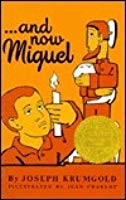
…and now Miguel by Joseph Krumgold (J)

And Now Miguel

…and now Miguel    

Joseph Krumgold (Juvenile Fiction)

“I am Miguel.  For most people it does not make so much difference that I am Miguel.  But for me, often, it is a very great trouble.”

Twelve-year-old Miguel is a Chavez and in the Chavez family there is always one thing—sheep.  To raise sheep is the work of the family.  Wherever you find a Chavez man, you’ll find a flock of sheep.  Miguel lives near Taos, New Mexico and is straddled between two brothers who have it easy: little Pedro is small and has all that he wants and big brother Gabriel is old enough that anything he wants he can get.  But being Miguel is not so easy.  What he wants, what he truly desires, is to go to the Sangre de Cristo mountains where the Chavez men take the sheep to graze each summer.  But year after year, Miguel is left behind.  How can he prove to his father that he is finally ready for this responsibility?  But since he is only Miguel, he knows that this will not be an easy thing to do.

…and now Miguel is based on actual people whom Krumgold spent time with and got to know.  Hearing him tell Miguel’s story and his desire to prove himself worthy to a father he adores and respects is intimate and personal.  The reader deeply connects with Miguel as he attempts to be needed and longs to make a difference.  Miguel’s biggest obstacle is not his will or desire, but simply time.  As his mother once said to him, “To become something different from what you are, it takes more than being strong.  Even a little time is needed as well.”  How often do we find ourselves pursuing opportunities that we know we aren’t ready for?

This story has so many positive messages and relatable situations for young readers (aged ten and above).  Unfortunately, it does lag quite a bit near the end when Miguel and Gabriel discuss the strengths and weaknesses of making a wish, which is actually the two coming into their own spiritual awakening through the recognition of Devine intervention and providence.  This was a weighty and lengthy dialogue between the two that could have been greatly condensed and had the same effect.  Although this is a pivotal moment for the two brothers, the momentum of the story ultimately suffered and was never able to fully recover.

Miguel reminds us that things don’t always go the way we wish or plan for life always seems to get in the way somehow.  Big surprises or unexpected announcements are never delivered or received in the way in which we hope.  Miguel is a deeply devoted boy who, in the end, realizes that his life—his fate—is not in his control.  He must rely on his faith in knowing that everything will work out as it should.  His mother and father understand this, Gabriel understands this…and now Miguel will understand this and will realize that by him just being Miguel has already made a great difference.

Rating: 4/5

* Book cover image attributed to www.goodreads.com 


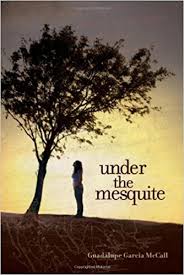
Under the Mesquite by Guadalupe Garcia McCall (YA)

Under the Mesquite

Under the Mesquite  

Guadalupe Garcia McCall (Young Adult Fiction)

Lupita knows that her Mami has a secret that she is hiding from her and her seven siblings.  She hears her talking with her comadres in their hushed words and sees their furtive glances.  Something is different.  Something is wrong.  Then Lupita hears the word that Mami keeps tucked behind closed doors…”cancer”.  Suddenly, Lupita has to deal with her mother’s chemo treatments, her best friend’s sudden ridicule, and her upcoming 15th birthday.  Through it all, she has her writing.  For a brief moment, Lupita is able to block out the world and find solace as she pours out her feelings under the sanctuary of her family’s mesquite tree.

McCall gives us inspiration through tragedy as she delivers a compelling story written entirely in free verse.  Although this is a quick read (a slow read is encouraged), the author provides an enormous amount of depth, detail, and emotion by using just a few words proving that less is indeed more.

I enjoyed seeing Lupita go between her homeland of Mexico and her current home in the United States.  McCall’s use of Spanish words throughout the book gives the story a richness that allows us to totally immerse ourselves in Lupita’s culture and world.  These two halves of her life are very different, but somehow fit seamlessly to give us a whole girl who is headstrong, caring, and mature beyond her years.

In the beginning of the story, a mesquite tree unexpectedly grows in the middle of Mami’s prized rose garden.  But over time, this intrusion is a welcomed and comforting presence.  Through pruning, the tree has grown to be quite lovely, but it is not its beauty that strikes Lupita.

“I envy the mesquite

its undaunted spirit, its ability to turn

even a disabling pruning

into an unexpected opportunity

to veer in a different direction,

flourishing more profusely than before”.

It would be wonderful if we were all just a little bit more like the mesquite tree:  growing stronger after being weakened, finding new opportunities through loss, and thriving wherever planted.

Rating: 5/5

* Book cover image attributed to www.amazon.com