

Dead Boy by Laurel Gale (J)

Dead Boy

Dead Boy

Laurel Gale (Juvenile Fiction)

Being dead stank.  Literally.  With everything rotting, decaying, and decomposing, it really did stink.  And let’s not talk about the maggots and the skin falling off and the hair falling out.  Death was really the pits and eleven-year-old Crow Darlingson should know because Crow is dead.  Well, dead but somehow alive.  If you ask Crow what’s worse than being dead, he would tell you that it’s being alone.  Loneliness really stank.  But along came Melody Plympton, his new neighbor, who somehow accepted his deadness.  Just when things were looking up, Crow and Melody discover a terrifying and mysterious creature hiding in the park.  A monster that also grants wishes.  Could this same creature be the cause of Crow’s unusual existence?  Could Crow somehow wish himself a normal life?  Crow is willing to face whatever tests and dangers the monster throws at him.  After all, once you’re dead, what’s the worst that can happen?

Dead Boy is Laurel Gale’s debut novel and she sure delivers!  She delights and entertains readers with a creepy, ghoulish, sweet, and imaginative story that’s full of heart.  Although it’s labeled as a “horror” story and depicts scenes of maggots falling out of various body parts at inappropriate times (not that there’s an appropriate time), Dead Boy is really a story about a young boy wanting to be accepted and longing for a friend.  Anyone who’s ever wanted a friend who liked and accepted them for just the way they are will empathize with Crow and his unfortunate situation.

What I found refreshing about Crow was his ability to see the positive in any situation and to enjoy what little pleasure life might happen to toss his way.  Here’s a boy with no friends, unable to eat food, incapable of sleep, and whose entire existence is spent indoors surrounded by the safety of air conditioning (he lives in the desert of all places), yet he delights in the simple act of lying beneath the stars and gazing up at the night’s sky.  He’s selfless, understanding, intelligent, loyal, and a true friend in every sense of the word.  He’s probably one of the most unlikely protagonists that I’ve come upon in a long time and I certainly hope he won’t be the last.

Near the end of the book, when the dust has settled after all of his exploits and adventures, Crow realized something important that beautifully sums up the meaning of this book: “Maybe having friends wasn’t as important as having the right friends”.

Rating: 4/5

*Book cover image attributed to www.goodreads.com

**Want more?  Visit our Facebook page at www.facebook.com/thedustyjacket
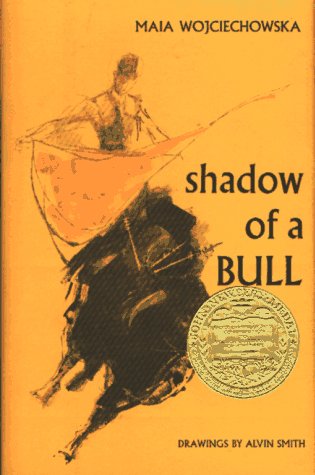
Shadow of a Bull by Maia Wojciechowska (J)

Shadow of a Bull

Shadow of a Bull    

Maia Wojciechowska (Juvenile Fiction)

When Manolo was nine he became aware of three important facts in his life.  First: the older he became, the more he looked like his father. Second: he, Manolo Olivar, was a coward.  Third: everyone in the town of Arcangel expected him to grow up to be a famous bullfighter, like his father.

To be a bullfighter was to be revered for a bullfighter was a hero, a magician, and a killer of death.  In Arcangel, death came in the form of a bull and to conquer death brought glory to yourself, your family, and your country.  Manolo was the son of Juan Olivar, the greatest bullfighter in Spain.  Ever since his father’s death, everyone anxiously awaited the day when Manolo would take his father’s place and Spain would once again have a hero.  But unlike his father, Manolo’s future was not prophesied for greatness and he worried that his heart would never allow him to live up to the expectations of his town or the legacy left by his father.

Maia Wojciechowska’s Shadow of a Bull (winner of the 1965 Newberry Award) is a book brimming with valuable lessons and important messages of self-worth, self-confidence, and self-importance.  She encourages the reader to question the idea of heroes and those we choose to idolize—the celebrated sports figure or the wizened town physician—and she shows us the emotional and physical price of sacrificing your own future in order to carry on someone else’s.  She writes of life versus death, bravery versus fear, and a dream versus destiny.  It’s a lot to take in, but Wojciechowska lays out all of these issues as smoothly as a matador works his cape.

Shadow of a Bull is rich in its history and detail regarding the art of bullfighting.  Readers will learn the training involved and will be introduced to several Spanish terms (pronunciation guide and definitions are included at the back of the book).   It’s an effective primer for the sport that may test the patience of a few readers, but proves interesting nonetheless.  Above all else, Wojciechowska doesn’t let us forget that the heart of this book is young Manolo, a boy wishing to bring honor to his family by fulfilling a future that is beyond his desire or control.  He carries the hopes and dreams of an entire country on his very small shoulders and we feel the weight of this burden grow heavier as the day of his testing nears.  It’s a beautifully told coming-of-age story of a boy trying to discover his place in the world.

Walter M. Schirra, Sr.—a fighter pilot during World War I and father of Wally Schirra, the only astronaut to fly in the Mercury, Gemini, and Apollo programs—once said, “You don’t raise heroes, you raise sons.  And if you treat them like sons, they’ll turn out to be heroes, even if it’s just in your own eyes.”  By being true to himself, Manolo found honor beyond the shadow of a bull and was able to become a hero in his own right.

Rating: 5/5

* Book cover image attributed to www.abebooks.com 

**Want more?  Visit our Facebook page at www.facebook.com/thedustyjacket
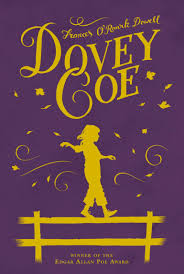
Dovey Coe by Frances O’Roark Dowell (YA)

Dovey Coe

Dovey Coe

Frances O’Roark Dowell (Young Adult Fiction)

“My name is Dovey Coe, and I reckon it don’t matter if you like me or not. I’m here to lay the record straight to let you know them folks saying I done a terrible thing are liars. I aim to prove it too. I hated Parnell Caraway as much as the next person, but I didn’t kill him.”

The youngest of the three Coe children, twelve-year-old Dovey would just as soon carry around a pocketknife than a pocketbook.  She’s wasn’t a skilled tracker like her brother Amos and she certainly wasn’t pretty and charming like her sister Caroline, but Dovey was loyal and honest and had a mind of her own.  You never had to guess what Dovey Coe was thinking because she would tell you exactly what was on her mind…whether you cared to hear it or not.  As you can imagine, this resulted in a few awkward situations and quite a number of bruised egos.  Such was the case with Parnell Caraway.  Son to the richest family in town, Parnell always got whatever he set his eyes on and at the present moment, his eyes were set on Caroline Coe.  No other girl in Indian Creek, NC deserved his arm more, but Caroline was set on going to college in Boone.  Covey was certainly not going to let the likes of Parnell Caraway tear her family apart, but would she resort to murder to keep her family together?

I am an absolute and unashamed pushover for plucky and feisty heroines: Anne Shirley (Anne of Green Gables), Francie Nolan (A Tree Grows in Brooklyn), Matilda Wormwood (Matilda), and Fern Arable (Charlotte’s Web) to name a few.  Dovey Coe handily earns a spot among these lovable, irrepressible, undaunted, and spirited young ladies.  Whether she’s confronting a school bully or the son of the man who owns half the town, Dovey is righteous in her convictions and uncowering in the face of injustice, unfairness, or just plain meanness.  No matter how few nickels she had to rub together, Dovey never considered herself or her family poor.  Her life was simple and satisfying and when something got her down, it wasn’t anything that a slice of her MeMaw’s chocolate cake or hammering a few nails into a two by four wouldn’t make right again.  Failure was not only not an option for Dovey, it simply wasn’t in her vocabulary.

Dovey Coe was shelved under the Young Adult section in my local library; however, the book is listed for ages nine to twelve and I highly recommend younger readers seizing the opportunity to meet Dovey and her entire family.  Older readers may feel the writing style is a bit simplistic, but the lessons Frances O’Roark Dowell lays out for her readers are ageless.  Loving who you are, standing up for what is right, defending the weakest among you, and finding joy in life’s smallest pleasures are things we should all aspire to do.  I think Dovey summed it up best when she said, “The way I seen things, us Coes had everything we needed in this world.  Some might see us as poor, but that was their problem.”

Rating: 5/5

*Book cover image attributed to www.amazon.com

**Want more?  Visit our Facebook page at www.facebook.com/thedustyjacket
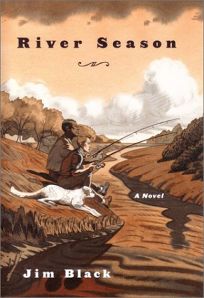
River Season by Jim Black

River Season

River Season

Jim Black (Adult Fiction)

I think my mom’s patience with Charles, Gary, and myself stemmed from years of working on the pediatric floor at Methodist Hospital in Lubbock.  Maybe seeing so many sick and dying kids makes you look at your own in a different light.  I don’t know.  I do know she was not overly protective or strict back then.  I really think she just wanted us to enjoy the privilege of being kids, and I’ve always loved her for that.  It was easier back then, too, because times were different.  In our small town, we really did sleep with doors unlocked and windows open.  I know now those were the best of times.

Jim Black was thirteen in the summer of 1966.  Growing up in Archer City, Texas with his two best friends, Gary Beesinger and Charles Luig, life was great.  This summer, Jim had big plans: playing baseball, mowing lawns, and hanging out with his friends.  What he didn’t plan on was meeting Samuel “Sam” Joseph Washington, an older black man from the other side of town.  This man, who decided to take up residency at his favorite fishing spot, would not only grow to be a father figure to Jim, but would also become his friend and would show Jim the value of acceptance, generosity, and love.

In an interview with Brothers Judd (brothersjudd.com), Jim Black explained that There’s a River Down in Texas (which, after the addition of fifty pages, would later become River Season) is largely autobiographical with the remainder being pure fiction.  River Season gives us a warm, sometimes bittersweet, and nostalgic look at growing up in small-town America during a time when the only things on a boy’s mind were baseball, pretty girls, hanging out with friends, and getting into just enough mischief to make life interesting but not enough to get you arrested.  It was a simpler time when you knew who your friends were and, more importantly, who your enemies were.  Bullies were never anonymous and disagreements were settled swiftly resulting in either an inflated ego or a black eye.

I picked up River Season at a secondhand book store and after visiting Black’s website (jimblackbooks.com), this may be the only way for interested readers to obtain copies of his books.  Black explains that all contracts with his publisher have been cancelled and his books are no longer being produced.  I hope lightning strikes twice and I am able to find his sequel Tracks so that I can follow a fifteen-year-old Jim as he tackles high school, bullies, and a broken heart.

Although River Season does touch upon the racial tensions that occurred in the 1960s South, Black is not overly preachy on the subject.  He could have easily made this the focal point of his story, but he instead concentrates on the friendship between himself, Charles, and Gary, as well the touching bond he shared with Sam.  American author and businessman, Arthur H. Glasow, once said, “A true friend never gets in your way unless you happen to be going down.”  Most of us would be fortunate to have just one friend like this.  Jim Black was blessed to have found three.

Rating: 5/5

*Book cover image attributed to www.publishersweekly.com

**Want more?  Visit our Facebook page at www.facebook.com/thedustyjacket


The Friendship Doll by Kirby Larson (J Historical Fiction)

The Friendship Doll

The Friendship Doll

Kirby Lawson (Juvenile Historical Fiction)

Miss Kanagawa was the last doll that master dollmaker Tatsuhiko would ever make.  She was a doll like no other and was to be Master Tatsuhiko’s masterpiece.  Miss Kanagawa, along with her fifty-seven sisters, were being sent to the children of the United States by the children of Japan as a gesture of friendship.  These fifty-eight ambassadors of peace and goodwill carried with them the assurance that Japan was indeed a friend of America.  But Master Tatsuhiko wanted his prized creation to be more than just a messenger and wished that she would discover her true purpose as a doll: “to be awakened by the heart of a child”.  Sadly, Miss Kanagawa was as callous as she was beautiful and she was very certain that a doll with a samurai spirit such as hers would never have a need for a child.

The Friendship Doll is based on the actual arrival of fifty-eight dolls from Japan to the United States in November 1927.  In her book, Kirby Larson takes us from 1927 to the present day and introduces readers to such events as the Great Depression, the Chicago World’s Fair, and the attack on Pearl Harbor.  Through Miss Kanagawa, we meet a hopeful orator, an aspiring pilot, a voracious reader, and a devoted writer—each with her own remarkable story and each changed by a chance encounter with a unique and proud doll.

While reading The Friendship Doll, I couldn’t help but notice several similarities between it and Kate DiCamillo’s The Miraculous Journey of Edward Tulane (one of my favorite books).  Both stories revolve around an exquisite doll with an overly-high opinion of itself who imparts something of value with those it meets while simultaneously discovering the joy that comes from being wanted and loved.  While Edward is a silent presence, Miss Kanagawa somehow speaks directly to her visitor’s subconscious.  Young readers won’t be bothered by this, but those of us old enough to remember The Twilight Zone episode entitled “Living Doll” featuring Talking Tina might be overly susceptible to the heebie-jeebies.  Still, if you liked Edward, you’re sure to enjoy Miss Kanagawa as well.

Although this book does touch upon the sensitive subjects of death and dementia, its historical insights offer readers a valuable glimpse at a few events from our nation’s past.  It also serves as a reminder that it is often the smallest of things that can bring about the greatest change within ourselves and there is nothing heebie or jeebie about that.

Rating: 5/5

*Book cover image attributed to www.amazon.com

**Want more?  Visit our Facebook page at www.facebook.com/thedustyjacket
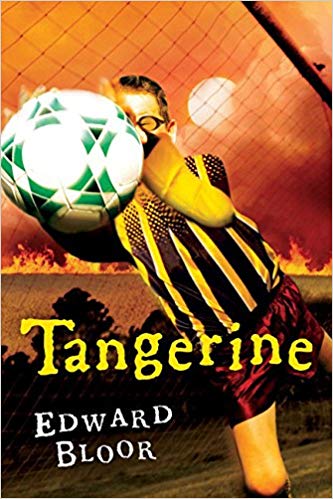


Tangerine by Edward Bloor (YA)

Tangerine

Tangerine

Edward Bloor (Young Adult Fiction)

The Fisher family—Dad, Mom, and sons Erik and Paul—are moving from Texas to Florida.  Their new home is in the prestigious Lake Windsor Downs subdivision located in Tangerine County.  Despite their new location, the family continues to move forward with the Erik Fisher Football Dream…dad’s favorite topic.  However, no such dream exists for Paul whose IEP lists him as legally blind.  But you don’t have to be blind to see all the strange things happening in Tangerine: the never-ending muck fires, disappearing koi, a giant school-swallowing sink hole, and lightning that strikes at the same time every day.  Things are definitely different in Tangerine and they’re about to get even more strange as Paul begins to piece together memories about a dark, family secret as fuzzy as his own eyesight.

I’m having a difficult time writing this review as the adult in me desperately wants to rip the title of “parent” from both Mr. and Mrs. Fisher.  In 1670, John Ray cited as a proverb, “Hell is paved with good intentions” and the Fisher parents embody this beautifully.  They have failed both of their sons dismally, and I can only hope that the audience this book was written for (young adults) realize this and understand the difference between parenting and passivity.  With that said, I shall cast aside my adultness and say that Tangerine does provide teens with some spot-on insights into the messy, harsh, and unforgiving world of middle and high school.  Edward Bloor gives us a story about the Haves and the Have Nots, where opportunity seems to favor those with money over those with moxie.  He shows us how a bunch of ragtag soccer players can be more of a family than your own kin.  And, he warns us of the danger of placing glory above goodness and confusing apathy with care.

Despite the flagrant shortcomings of some of the adults in this book, Bloor does give readers a modern-day hero in the likes of Paul Fisher—an underdog who pursues his dreams with relentless courage and moral conviction.  Never one to fall victim to his impairment, Paul proves himself to be a loyal, fearless, and worthy friend and shows everyone in Tangerine—including his own family—that he is more than just the sum of his parts.  From an early age, Paul realizes that life is often unfair and cruel, but by living in Tangerine where lightning does in fact strike twice, he understands that anything is possible and that even a kid labeled as legally blind can still see the good in people.

Rating: 4/5

*Book cover image attributed to www.amazon.com

**Want more?  Visit our Facebook page at www.facebook.com/thedustyjacket
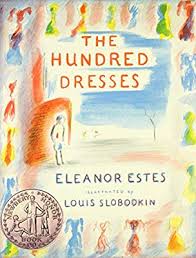
 

The Hundred Dresses by Eleanor Estes (J)

The Hundred Dresses

The Hundred Dresses

Eleanor Estes (Juvenile Fiction)

How did it all start?  Maddie wasn’t quite sure, but then she remembers.  It started with a girl, Wanda Petronski, who lives on Boggins Heights with her dad and brother.  Wanda comes to school every day in the same faded blue dress that doesn’t seem to hang right.  She’s quiet and sits in the far corner of the classroom.  Nobody seems to pay her much mind, except that her last name is silly and hard to pronounce.  She’s practically invisible until that one day when Wanda wanted so desperately to be a part of the group.  So hungry for companionship and inclusion.  That one day when the other girls were talking about dresses and Wanda said, “I got a hundred dresses home.”  Who knew that that one single sentence would have such an effect…not just on Wanda, but on so many more.

Oftentimes, a book or story acts as a balm—more for the author than the reader.  It is a last-ditch effort of making things right…of righting a wrong.  R.J. Palacio accomplished this through her wonderful and poignant book The Wonder, a novel about a boy with Treacher Collins Syndrome (TCS) where bones and facial tissues develop abnormally.  She says that the inspiration for her book came after a chance encounter with a little girl in an ice cream store.  In “A Letter to Readers”, Estes’s daughter, Helena, says that her mother’s inspiration came from a classmate who was much like Wanda.  An immigrant shunned by her peers and longing to fit in and be liked.  Her mother, like Maddie, realized too late that complacency is just as bad as participation and that popularity should never be achieved at the expense of another.

The Hundred Dresses won a Newberry Honor in 1945 and has never been out of print since.  There is a very good reason for this.  Although it is a mere 80 pages, Eleanor Estes makes every sentence reverberate within our very heart and soul and Louis Slobodkin’s beautiful illustrations give this heartfelt story a vibrant beauty and grace.  This is a story that should be shared and discussed with readers of all ages.  It reminds us of the power of words and the heart’s amazing capacity to find and offer forgiveness.  Children find it difficult to remove the target from someone else’s back for they know all too well that there is a very good chance that the target will find a new home upon their own.  It takes a tremendous amount of courage to stand up for what is right.  Only later in life do we realize that sometimes the only thing worse than living with shame, is living with regret.  In this age of bullying and intolerance, the lessons learned from The Hundred Dresses are still as relevant and important today as they were in 1944.  Gratefully, we have Wanda and Maddie who remind us that it is never too late to say, “I’m sorry” and more importantly, “I forgive you.”

Rating: 5/5

*Book cover image attributed to www.amazon.com

**Want more?  Visit our Facebook page at www.facebook.com/thedustyjacket

The Little Giant of Aberdeen County by Tiffany Baker

The Little Giant of Aberdeen County

The Little Giant of Aberdeen County 

Tiffany Baker (Adult Fiction)

The day I laid Robert Morgan to rest was remarkable for two reasons.  First, even though it was August, the sky overhead was as rough and cold as a January lake; and second, it was the day I started to shrink.

Truly Plaice was destined to be a big girl.  During her mother’s pregnancy, the town began to take bets as to what her final weight would be upon delivery.  Turns out, nobody in that town won.  No one came close.  Her school teacher called her a “little giant” and Truly became known for her massive size and build.  Where her sister, Serena Jane, was wispy and beautiful, Truly countered with her girth and homeliness.  But with so many things, Truly simply accepted this genetic disparity as fact and actually said the difference between the two was quite easy, “The reason the two of us were as opposite as sewage and spring water, I thought, was that pretty can’t exist without ugly.”  So, through her own eyes, Truly shares her story of wickedness and witchcraft, of poverty and prosperity, of life and death, and of a very big woman in a very small town.

Throughout this book, I wasn’t sure whether to feel pity or pride for Truly.  Here is a woman who has wholly resigned herself to her situation and although she feels the occasional stab of pity, jealousy, or regret, her unconditional surrender to her circumstances is both admirable and heartbreaking.  Her friend Amelia may have summed up Truly’s attitude perfectly one day when they were both walking home from school, “Things are what they are.  You can’t change them.”  Perhaps Truly realized this early on in life and found that she’d be much happier by choosing resignation over resistance.

Tiffany Baker does a nice job at keeping her story entertaining and engrossing by throwing in several plot turns and twists.  Although there is a lot going on with multiple characters and their individual story lines, Truly proves to be a capable storyteller and manages to keep everything orderly and fluid.  However, despite an engaging story and a unique main character, there was a big plot hole that kept my rating at a four versus a five.  I found that Truly’s need for a cure and her want of one were at constant odds.  The reasons she stated for not pursuing treatment are legitimate to her circumstances at the time save one…money.  You can’t claim poverty as an excuse when you constantly remind the reader that you have a suitcase full of money hidden under your bed.  This was clearly frustrating for me, but not enough to override the valuable lessons contained within The Little Giant of Aberdeen County:  love the skin you’re in, be courageous in accepting that which you cannot change, and never think that you are so full that there is not enough room to let anyone else in.

Rating: 4/5

*Book cover image attributed to www.amazon.com

**Want more?  Visit our Facebook page at www.facebook.com/thedustyjacket
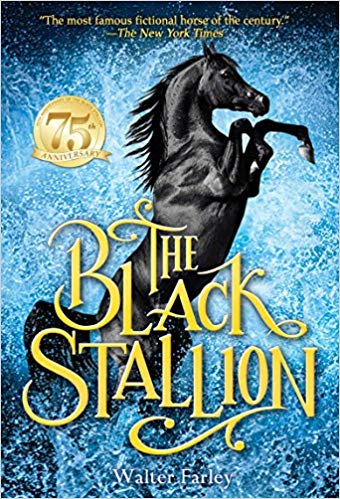
The Black Stallion by Walter Farley (J)

The Black Stallion

The Black Stallion

Walter Farley (Juvenile Fiction)

The tramp steamer Drake—loaded with coffee, rice, tea, oil seeds, and jute—was pushing its way from India and heading to New York City.  Aboard was young Alexander (Alec) Ramsay, who had just spent two months in India with his uncle.  Also on board was a wild black stallion picked up in an Arabian port.  Alec knew enough about horses to be intrigued by the magnificent beast, but also wary.  This was not an animal to be underestimated.  But one night, the Drake encountered a fierce storm which would ultimately spare only two passengers:  Alec and the stallion whom he called “the Black”.  Can these two possibly form an alliance in order to survive their harsh and uninhabited island home?

The Black Stallion, published in 1941, is the first of twenty books in The Black Stallion series written by Walter Farley.  The twenty-first book, The Young Black Stallion, was co-authored with Farley’s son, Steven, and published shortly after the author’s death.  At the time of the book’s publication, the news was dominated by the war in Europe and so this book not only served as a respite from the ensuing turmoil, but was also a reminder of the good still inherent in humans.  The Black Stallion is a wonderful story about the importance of trust, loyalty, and devotion to each other during the most trying of circumstances.  Today’s young readers may find this story’s text to be a bit hokey given its multiple uses of the words “gee” and “swell”, but this book is an excellent example of how far someone can go when they not only have faith in themselves, but they have the unified support of those closest to them.  Alec is surrounded by loving and encouraging adults who do not treat him as an idealistic child, but rather as a competent and trustworthy peer.  Modern juvenile fiction often pits the young protagonist against skeptical parents, jealous schoolmates, or crotchety neighbors—anything that presents an obstacle that our young hero or heroine must overcome.  The Black Stallion instead focuses on positive relationships and the rewards that come with perseverance and good old-fashioned hard work.

The unlikely relationship between Alec and the Black garnered much awe and attention from all who witnessed it.  One such observation came from a ship’s captain and his first-mate, Pat.  After the captain marveled at how gentle the Black was in the presence of Alec, Pat replied, “Yes, sir,” he said, “one of the strangest things I’ve ever seen.  I wonder where it’ll take them?”  Lucky for us, it took them on many, many unforgettable adventures that would span twenty-one books and an incredible forty-eight years.  Enjoy.

Rating: 5/5

*Book cover image attributed to www.amazon.com

**Want more?  Visit our Facebook page at www.facebook.com/thedustyjacket
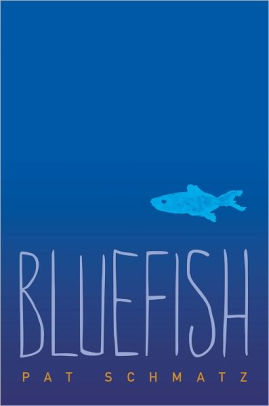
Bluefish by Pat Schmatz (YA)

Bluefish

Bluefish

Pat Schmatz (Young Adult Fiction)

“One fish, two fish, red fish, blue fish.”  Might as well be, “One fish, two fish, Travis is a stupid fish.”  At least that’s what they all say…well, what one person says, but he is a VERY influential person.  Travis Roberts is the new kid in the eighth grade.  The only thing keeping him in school was his dog, Rosco, and now that he’s gone, what’s the point?  He’ll always be stupid.  He’ll always be a bluefish.  But then Travis meets Vida (her public calls her “Velveeta”) and Bradley Whistler (who is THE smartest kid EVER) and Mr. McQueen, his reading teacher.  Up until this point, everything that Travis cared about was gone.  Maybe now he has a reason to begin caring again…even if he is just a bluefish.

Pat Schmatz serves up an awkwardly accurate and often humorous portrayal of adolescence through three flawed and endearing misfits—all longing to fit in and wanting to be a part of something bigger than themselves.  Our three protagonists are no longer a child and not quite an adult, and Bluefish shows us the mask each wears to cover up their insecurities and shortcomings.  From the brainiac to the class clown to the strong, silent type, Schmatz successfully encapsulates the complicated world of teenagers and the tangled and convoluted roadmap that directs their everyday lives and dictates their emotions.

Bluefish is more than a story of friendship and middle school survival, it’s a story of how one person has the power to change the very course of our life:  a kid who finds and hands back your stolen shoe; a girl who invites you to sit with her at lunch; or a teacher who volunteers his or her time to tutor you before school.  Thank you, Ms. Schmatz, for reminding us of the importance of not giving up on our friends, and—more importantly—not giving up on ourselves.  You have shown us that being a bluefish really isn’t so bad and can actually be a rather remarkable thing after all.

Rating: 5/5

*Book cover image attributed to www.barnesandnoble.com

**Want more?  Visit our Facebook page at www.facebook.com/thedustyjacket