
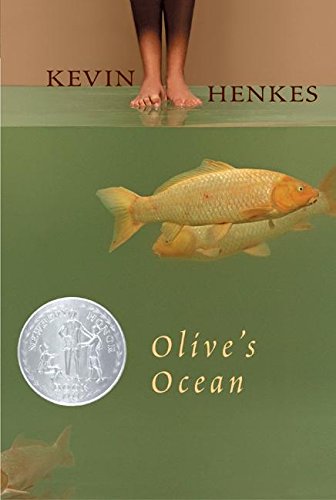
Olive’s Ocean
Kevin Henkes (J Fiction)
Twelve-year-old Martha Boyle and her family were leaving on their annual vacation to the Atlantic coast when a woman appeared on the Boyle’s doorstep. She introduced herself as Olive’s mother, one of Martha’s classmates who had recently been killed. She handed Martha a folded piece of paper from Olive’s journal. As Martha read the note written by a girl she barely knew, she was struck by just a few simple sentences: I hope that I get to know Martha Boyle next year (or this summer). I hope that we can be friends. That is my biggest hope. These kind words filled with expectation would alter Martha’s world view forever as she mourns a friendship that never was and never will be.
I raised my child on Kevin Henkes’ mouse books: Chester’s Way, Owen, Wemberly Worried, and others. Each helped me reinforce the value of friendship and the importance of acceptance, handling your emotions, self-reliance and many other life lessons. When I saw that Olive’s Ocean was a Newbery Honor book, I wasn’t really surprised. What DID surprise me was that it ranked 59th on the American Library Association’s list of the 100 Most Challenged Books from 2000 to 2009 for its offensive language and sexual explicitness. No wonder Wemberly worried!
Despite the ominous label it carries, Olive’s Ocean is a rather innocuous coming-of-age story about a girl dealing with the customary pre-teen fare: first love, awkwardness, rejection, humiliation, and the constant struggle of trying to figure out who she is and what she wants to be. Pretty safe stuff, but Henkes does nudge the boundaries ever so slightly causing those few, all-important feathers to be ruffled.
The “sexually explicit” reference is a brief explanation to Martha by her older brother of why their parents seem overly affectionate one morning. It seems they were exhibiting “Morning Sex Behavior” and “when they do it in the morning” they get a bit lovey-dovey. Regarding the “offensive language”, there are instances of mild profanity, but nothing too over-the-top for the publisher’s recommended reading age of 10 and up. So, the big questions are: Are EITHER of these inclusions necessary to further the story or develop the characters? No. Could they have been excluded with little to no impact on the overall message? Absolutely. Would Henkes have omitted them if he knew the wrath that awaited him? Maybe. Maybe not. There’s no question that having your book banned instantly puts you on a reader’s radar, but clearly this was not his intent. All in all, these infractions (as most references go) are tame, but clearly remain unforced errors and prompt me to up the recommended reading age by a few years just to be prudent.
As far as stories go, this was a quick read and had several important messages about inclusivity and realizing that the world doesn’t revolve around your own personal cares and needs; however, I would have liked more Olive in Olive’s Ocean and feel that this was an opportunity wasted. The apparent connection between Olive and Martha stated in the synopsis doesn’t quite materialize in the actual book, and it would have been far more interesting if Olive’s story had been developed more deeply to show Martha’s slow and eventual evolution. Still, the targeted audience will find a nice and relatable story, while I was hoping for something a little bit more moving with a deeper and lasting message. I guess if I’m looking for these, I need to go back to the mouse stories.
Rating: 3/5
* Book cover image attributed to: www.abebooks.com
We’re now posting videos of some of our book reviews! Follow us on Facebook at www.facebook.com/thedustyjacket or on Instagram @tdjreviews and join in on the fun!
 The Dusty Jacket