

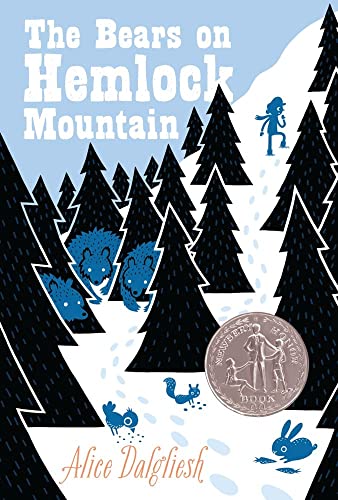
The Bears on Hemlock Mountain by Alice Dalgliesh (J Fiction)

There are no bears on Hemlock Mountain, no bears at all. There are no bears on Hemlock Mountain, no bears, no bears, no bears, no bears at all.

The Bears on Hemlock Mountain

Alice Dalgliesh (J Fiction)

Everybody knows that there are no bears on Hemlock Mountain, no bears at all. There are no bears on Hemlock Mountain, no bears, no bears, no bears, no bears at all. Under this well-known belief, Jonathan’s mother sends him across the mountain alone to bring back an iron pot from his Aunt Emma. As Jonathan crunch, crunch, crunches his way across the snowy ground, he hopes upon all hope that there really ARE no bears on Hemlock Mountain because if there are, what would one, lonely eight-year-old boy possibly do?

Recipient of the Newbery Honor Book award in 1953, The Bears on Hemlock Mountain is a quick read full of fun, repetitive phrases such as crunch, crunch, crunch and tick-tock, tick-tock, which makes this an ideal read-aloud book. Helen Sewell’s pen and ink illustrations give the story a genuine folklore feel and wonderfully complements this story based on a Pennsylvanian tall tale. This book is recommended for readers ages 5 to 9 and grade levels 1 to 4.

The story of Jonathan’s journey to his aunt’s home and back teaches the importance having courage, facing your fears, and following through on your commitments. At the end of the book, there is an inference about a bear (or bears) being shot and killed, which is fairly unexpected as Dalgliesh takes great care in establishing Jonathan’s love of animals and the respect he has for them. This last-minute act of violence may be disturbing to sensitive readers.

While I was researching quotes about courage and perseverance to use in this review, I came upon one by Japanese author Haruki Murakami that perfectly encapsulates what happens to our young hero: “When you come out of a storm you won’t be the same person that walked in. That’s what the storm is all about.” Jonathan’s mother would have never let her young son make the trek across Hemlock Mountain if she was certain there were bears (or we would hope so). Jonathan himself was worried about bears, although he’s not fully convinced that there are any either. But when the time comes for Jonathan to face his fears, he’s rational and clever and, as a result, finds that the boy who went up the mountain is very, very different from the young man who returned home.

Rating: 5/5

* Book cover image attributed to: www.abebooks.com

NEW!! Want to discuss this book with your homeschooler or classroom? There’s a FREE study guide available. Visit www.teacherspayteachers.com/store/The-Dusty-Jacket and download your free copy today!
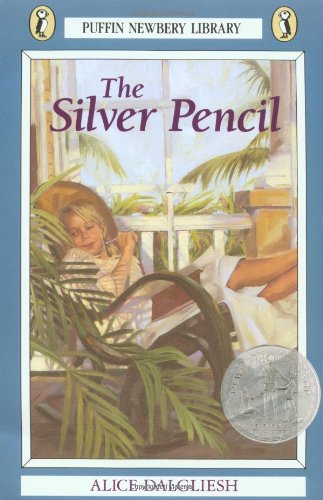
The Silver Pencil by Alice Dalgliesh (YA Fiction)

The Silver Pencil

Alice Dalgliesh (YA Fiction Newbery Honor)

The silver pencil was a miracle. It was handsome to look at, delightful to use because it never needed sharpening. One had only to change the lead. Janet was sure that she could write almost anything with it. Confidently she sat down at her small table, with clean sheets of paper in front of her and the shining pencil in her hand. To her surprise, exactly nothing happened.

Nine-year-old Janet Laidlaw was a British citizen living on the tropical island of Trinidad. She loved her life in the House on the Hill, but things quickly changed following the sudden death of her beloved father. At thirteen—when most Colonials went off to school—Janet traveled to her mother’s birthplace of England where her world suddenly got a lot bigger. With the promise of new friends and adventures, perhaps her silver pencil wouldn’t be silent for much longer.

Newbery books have always been my “go to” reads. Whether I’m looking for an excellent story for myself or I need a solid recommendation for a young reader, that silver- or gold-foiled sticker always let me know that I had picked out a winner. Unfortunately for me, The Silver Pencil fell short of this assumption. Awarded the Newbery Honor Book distinction in 1945, Alice Dalgliesh’s coming-of-age (and semi-autobiographical) book is about a young girl who travels from Trinidad to England and then to New York while pursuing a career in teaching before ultimately stumbling upon success as a children’s author. This book is meant to mirror Louisa May Alcott’s Little Women, which was Janet’s first introduction to America. Unfortunately, Dalgliesh’s tale didn’t quite rise to the level of its literary inspiration and probably won’t have the same appeal with a young adult audience.

Published in 1944, the beginning of The Silver Pencil is full of racially insensitive and inappropriate cultural references. These obviously didn’t cause a ripple back then, but would clearly result in a tsunami today. Also, Janet’s favorite book is The Story of Little Black Sambo, which she shares repeatedly with youngsters that are in need of fast and effective entertainment. Although the story’s text and illustrations have undergone numerous revisions over the decades, its very title still conjures up negative feelings and emotions. With that being said, the remainder of the book is pretty safe although I felt no attachment to the story and had zero connection to its characters. Despite it being a beautifully written book, the words just hung there and felt lifeless—lacking any sense of warmth or feeling. Even when Janet was dealing with the death of her father, I didn’t feel her pain and loss although she was obviously experiencing it. Her experiences felt more like a list to be checked rather than a life that was lived.

Despite the low rating, I loved how Dalgliesh used stories and storytelling to bridge the gap between cultures and class, to calm the rowdy and connect the displaced, and to bring people together to make the world seem a little bit smaller. They say that the pen is mightier than the sword, but Janet Laidlaw and Alice Dalgliesh showed us that a silver pencil could be just as mighty…if not more.

Rating: 3/5

* Book cover image attributed to www.amazon.com