


Moon Over Manifest by Clare Vanderpool (J Historical Fiction)

“To write a good story, one must watch and listen.”

Moon Over Manifest

Clare Vanderpool (J Historical Fiction)

Every story has a beginning, middle, and an end, but Abilene Tucker’s story seemed to be nothing but middle. It’s 1936 and while her father, Gideon, works a railroad job in Iowa, she is sent to the town where he grew up…Manifest, Kansas. She’s to spend the summer with her father’s old friend, Pastor Shady Howard, whose home is a combination saloon, church, and carpenter’s shop. While upstairs in her father’s old room, Abilene discovers an old cigar box with various trinkets, as well as some handwritten letters addressed to a boy named Jinx. Could these items—a cork, fishhook, silver dollar, key, and a little wooden doll—help Abilene uncover the mystery of her father’s past? With the help of two new friends, Abilene embarks on a hunt for a possible spy and meets a diviner who helps her uncover a few things about her father and herself.

This book covers two periods of time: 1936 (present day narrated by Abilene) and 1918 (told in third person). Although this book makes multiple time jumps involving several characters, Vanderpool does a terrific job at making sure young readers stay engaged by keeping the two storylines separate and straightforward. Our diviner, Sadie, eases readers into the past as she reveals Manifest’s history that involves several actual events including World War I, orphan trains, and the Spanish influenza. Moon Over Manifest does deal with some disturbing content such as racism, murder, alcohol use, and the ugliness of war, but in doing so gives readers an honest and rare opportunity to learn about important periods in American history through the unique lenses of a twelve-year-old hardworking and fearless girl and a thirteen-year-old runaway conman. Together, these two protagonists teach us that everyone deserves a do-over, things are not always what they seem, and perhaps there’s nothing more dangerous than hope.

Vanderpool packs so many wonderful takeaways and lessons into this book but overall, Moon Over Manifest is a celebration of immigrants and the richness and vibrancy they add to the American fabric. Manifest is a community represented by Scotland, Poland, Greece, Norway, Italy, Germany, Hungary, and Russia. These people—from very different countries and cultures—all unite behind a young con artist and collectively take a leap of faith to not only save their town, but to save their way of life and themselves. U.S. President Lyndon B. Johnson said on October 3, 1965 at the Statue of Liberty, “The land flourished because it was fed from so many sources—because it was nourished by so many cultures and traditions and peoples.” Although Manifest was a town torn apart by racism and stricken with war and an epidemic, its community flourished because of the strength and uniqueness of its people…people who were all lucky enough to call Manifest home.

Rating: 5/5

* Book cover image attributed to: www.abebooks.com

We’re now posting videos of some of our book reviews! Follow us on Facebook at www.facebook.com/thedustyjacket or on Instagram @tdjreviews and join in on the fun!
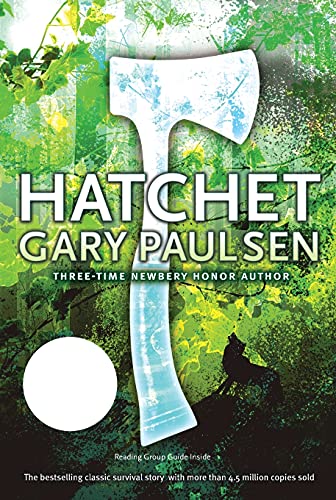
Hatchet by Gary Paulsen (J Fiction)

My name is Brian Robeson and I am thirteen years old and I am alone in the north woods of Canada.

Hatchet  

Gary Paulsen (J Fiction)

My name is Brian Robeson and I am thirteen years old and I am alone in the north woods of Canada.

Brian Robeson’s mother and father recently divorced. Nothing much was said about it, but Brian knew the reason because he knew the Secret. He lives in New York with his mother, but is headed to Canada to spend the summer with his father. He boards the Cessna 406 and makes his way north with his belongings in a suitcase and a hatchet hooked in his belt—a present given to him by his mother on the ride to the airport. This last-minute gift would tip the scales between almost-certain death and survival as Brian’s plane goes down in the Canadian wilderness and this city boy faces decisions that he never imagined he would be making.

This Newbery Honor book was challenged for its graphic descriptions of trauma and injury and removed from school libraries in Tennessee for its sexual content and violent imagery. Hatchet has a recommended reading age of nine to twelve so it was banned from elementary school libraries. As this story deals with survival, some portions of this book are graphic (especially the scene describing the pilot’s death), but nothing that would tremendously affect a typical fourth grader who hungrily clamors for the next installation in the Marvel Cinematic Universe. Also, the “sexual content” reference refers to Brian witnessing his mother sitting in a car and kissing a man who is NOT his father so don’t let this be a major red flag if your youngster reaches for this book.

I liked how Paulsen uses repetition in his writing to build suspense (He was stopped. Inside he was stopped. He could not think past what he saw, what he felt. All was stopped.) or to reinforce urgency (He had to fly somehow. Had to fly the plane. He had to help himself. The pilot was gone, beyond anything he could do. He had to try and fly the plane.). This is incredibly effective—especially with this age group—and although he incorporates it often throughout the book, it never becomes tedious or loses its impact. Also, Brian’s learning curve is inline with someone of his age. Although raised in the city, he pulls lessons he’s either learned in school or seen on the screen and these allow him to adapt to his situation and surroundings. He quickly realizes that self-pity and panic are only liabilities and quickly discounts them as useful reactions to his predicament. He systematically and logically approaches his obstacles and begins to understand the importance and necessity of not merely surviving day by day, but also preparing for the future. The reader witnesses Brian’s evolution and although we mourn the innocence that he’s lost, we applaud him for the bigger lessons that he’s learned about life and what’s truly important and necessary.

Gary Paulsen died in 2021 and during his lifetime—having written over 200 books throughout his career—was one of the most challenged authors of the 21st century according to the American Library Association. Because several of his books were banned because his writing was just “too realistic” speaks volumes to just how gifted a storyteller Paulsen was and why he continues to amass such a large and loyal fan base. Just as Brian changes throughout the story, I hope that we too continue to evolve and begin to realize just how important stories like Paulsen’s are in showing young readers the importance of believing in yourself, the downside of underestimating your abilities, and the courage it takes to wake up each morning with a renewed sense of determination and hope. How can anyone think of banning a book such as this?

Rating: 5/5

* Book cover image attributed to: www.abebooks.com